

May
Tax Consultant: Elevating Wealth Preservation Through Strategic Advisory
Is your wealth preservation strategy built on the shifting sands of compliance, or is it anchored by a visionary tax consultant who understands that every dollar saved is a brick in your retirement foundation? While 93% of accounting firms now offer advisory services, the distinction between a standard filer and a strategic partner remains the difference between simply paying a bill and architecting a legacy.
You’ve likely felt the anxiety of a disconnected financial plan where your investment growth is quietly eroded by a 37% top marginal rate or overlooked deductions. It’s frustrating to realize that a lack of foresight before the April 15, 2026, filing deadline could lead to overpaying on a lifetime scale. We believe that your financial journey deserves more than a seasonal transaction. It requires a bespoke intervention that aligns your current obligations with your ultimate aspirations through professional fiduciary oversight.
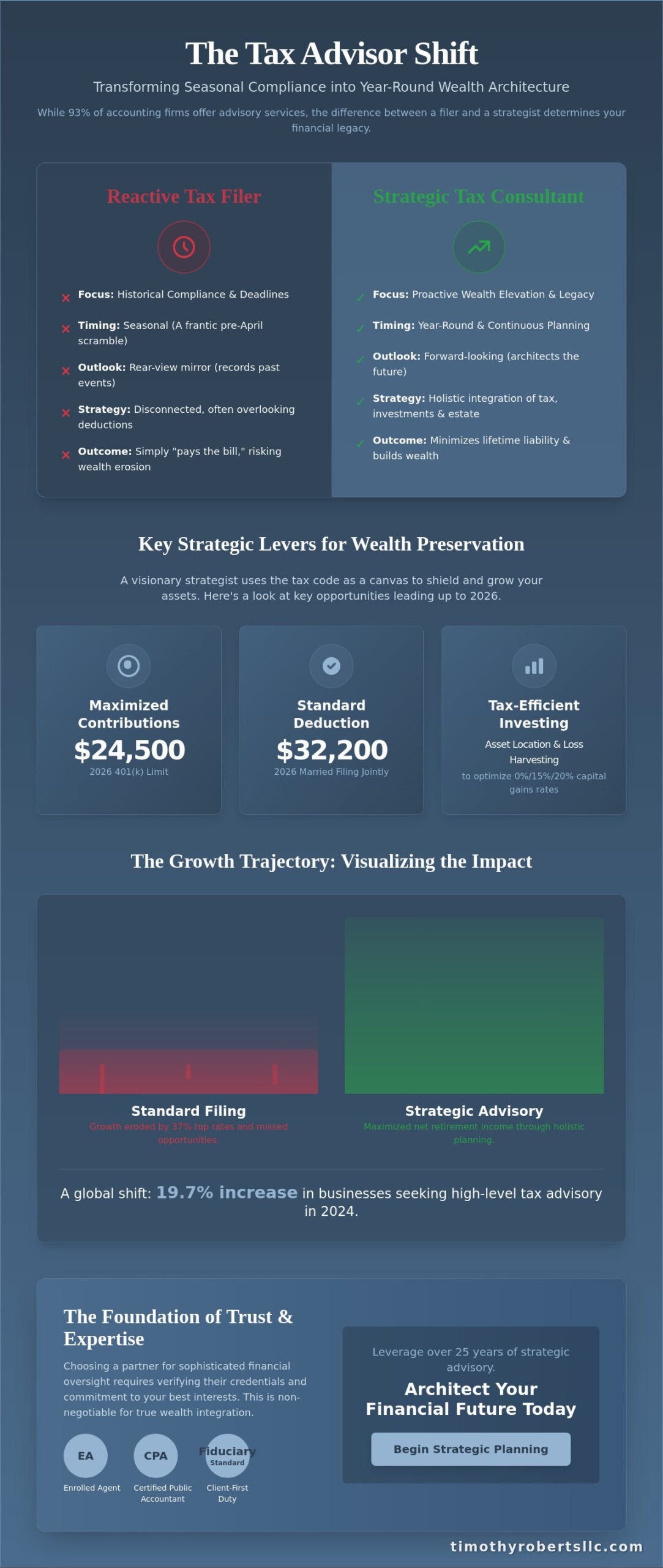
This article demonstrates how a sophisticated advisory partnership transforms tax compliance into a powerful pillar of wealth elevation and retirement security. We’ll examine how integrating the 2026 standard deduction of $32,200 for joint filers with maximized 401(k) contributions of $24,500 creates a holistic shield for your assets. Discover the path to minimizing your lifetime liability through strategic innovation and intellectual rigor.
Key Takeaways
- Shift your perspective from reactive compliance to proactive advisory by engaging a tax consultant who prioritizes long-term wealth elevation over seasonal filing.
- Discover how integrating tax-efficient asset location within your investment management strategy can significantly maximize your net retirement income.
- Understand the critical value of the fiduciary standard and elite credentials like EA and CPA when choosing a partner for sophisticated financial oversight.
- Apply a structured framework to assess your estate’s complexity and verify a potential partner’s history of successful wealth integration.
- Explore how a legacy of over 25 years in strategic advisory can transform your financial future through a bespoke blend of creative vision and business rigor.
Beyond Compliance: Defining the Strategic Role of a Tax Consultant
Most individuals view the tax season as a frantic race toward an April deadline. It’s often a reactive scramble to assemble receipts and meet the bare minimum of compliance requirements. However, a professional tax consultant operates on an entirely different plane of service. They don’t just record financial history; they architect your financial future. While common industry definitions focus on the ability to sign a return, a visionary strategist views the tax code as a sophisticated canvas for wealth preservation. This distinction is vital as over 2.3 million businesses worldwide sought tax advisory support in 2024, a 19.7% increase that signals a global shift toward high-level strategic partnership.
To better understand how this professional shift impacts your financial trajectory, watch this helpful overview of the consultant’s role:
The Shift from Tax Preparation to Tax Advisory
Standard filing is the floor, not the ceiling, of your financial health. If your only interaction with tax professionals happens in the weeks leading up to April 15, 2026, you’ve already missed the most significant opportunities for wealth elevation. Strategic advisory moves beyond the snapshot of a single fiscal year. It prioritizes multi-generational exposure and long-term security through intentional, year-round planning. Researching what is a Tax Advisor? reveals a professional landscape where experts use their credentials to innovate rather than just report. This bespoke partnership ensures that your wealth isn’t just managed; it’s protected from the quiet erosion caused by inefficient, reactive planning.
Identifying Strategic Interventions
Identifying high-impact interventions requires a holistic lens that bridges the personal and the professional. A tax consultant reviews the complex intersection of your income, investment portfolio, and estate goals long before the fiscal year ends. With the “One Big Beautiful Bill Act” stabilizing tax brackets through 2026, the focus shifts toward optimizing specific levers like the $24,500 401(k) contribution limit or the $32,200 standard deduction for married couples. They anticipate regulatory shifts to shield your assets from volatility and ensure your strategy remains resilient. Strategic tax consulting is a continuous wealth-optimization process that aligns every fiscal decision with your ultimate legacy and retirement security.
The Holistic Intersection: How Tax Strategy Elevates Wealth Management
True wealth elevation occurs at the intersection of investment growth and tax efficiency. While retail preparers chase immediate refunds, a strategic tax consultant views your portfolio through a holistic lens. They understand that asset-based management is incomplete without considering the friction of taxation. A sophisticated approach integrates several key components:
- Asset Location: Placing high-yield bonds in tax-deferred accounts while keeping tax-efficient equities in brokerage accounts to protect net returns.
- Tax-Loss Harvesting: Capturing losses during periods of volatility to offset gains and rebalance the portfolio without triggering unnecessary liabilities.
- Estate Coordination: Aligning tax strategies with estate planning to ensure a fluid legacy transfer for the next generation.
This deliberate positioning ensures your growth remains sustainable. Instead of viewing market volatility as a threat, it becomes an opportunity to capture losses that offset gains. For 2026, long-term capital gains rates of 0%, 15%, or 20% depend heavily on your taxable income levels. Coordinating these moves with your estate plan prevents your heirs from inheriting a tax burden that compromises your lifetime of accumulation.
Tax-Efficient Retirement Income Planning
The transition from accumulation to distribution requires a precise sequence of withdrawals. Balancing distributions from 401(k)s, Roth IRAs, and brokerage accounts is essential to maintain your lifestyle while staying in the lowest possible tax bracket. Strategic sequencing can prevent a sudden jump from the 12% bracket to the 22% bracket, which in 2026 occurs at income over $100,800 for joint filers. You can explore these strategies in depth through our guide on retirement income planning. This level of foresight transforms your retirement from a period of uncertainty into one of secure, optimized growth.
Portfolio Optimization and Capital Gains
Managing the tax implications of high-turnover investment strategies is a hallmark of premium advisory. Every trade has a tax consequence, and a fiduciary advisor ensures these actions align with your specific risk tolerance. Adhering to Professional Tax Advisory Standards, your consultant may also suggest charitable giving as a strategic mitigation tool. For instance, donating appreciated securities can eliminate capital gains tax while providing a deduction that lowers your overall liability. This intersection of philanthropy and fiscal rigor is where your wealth truly begins to work for your values. By engaging a dedicated tax consultant, you move from a reactive stance to a position of command over your financial future. Those who seek a bespoke wealth strategy often find that these integrated interventions provide the most significant long-term impact.
Fiduciary Standards and Credentials in Professional Tax Advisory
Trust is the silent architecture of any successful wealth strategy. When you engage a tax consultant, you aren’t just hiring a technician; you’re selecting a steward for your legacy. The risks of “ghost” preparers, individuals who refuse to sign the returns they prepare, are substantial. These actors lack accountability and often leave clients vulnerable to audits without professional support. In a market where 83% of financial leaders reported talent shortages in 2024, identifying a partner with verified, elite credentials is more critical than ever. True professional accountability ensures that your strategy is built on a foundation of integrity and high-level expertise.
Comparing Professional Designations
Elite designations like Enrolled Agents (EA) and Certified Public Accountants (CPA) represent the pinnacle of tax expertise. An EA is federally authorized by the U.S. Department of the Treasury, specializing specifically in taxation. CPAs are state-licensed and often manage broader financial reporting. Both share unlimited representation rights before the IRS, which means they can stand in your place during appeals or audits. These titles aren’t static trophies; they require rigorous continuing education. This commitment ensures your advisor remains fluent in the latest regulatory shifts and sophisticated planning techniques required for wealth preservation.
The Fiduciary Advantage
The true hallmark of a premium partnership is the fiduciary standard. This legal and ethical obligation requires your advisor to act solely in your best interests, prioritizing your financial health over their own incentives. While many preparers operate under a “suitability” standard, a fiduciary offers a higher level of transparency. This commitment fosters a partnership of trust where fee structures are clear and advice is untainted by hidden commissions. Choosing the right partner is a foundational step in your journey. You can learn more about the nuances of financial advisor selection to see how this standard applies to your broader wealth strategy. Bespoke guidance requires a visionary who understands your entire financial roadmap, transforming a simple transaction into a strategic intervention for lifelong growth.
A Framework for Selecting Your Strategic Tax Partner
Discernment is the first step toward wealth elevation. With approximately 67,000 tax consulting firms operating globally, the challenge isn’t merely finding a practitioner; it’s identifying a visionary strategist. You must begin by assessing the complexity of your current financial and estate structure. If your portfolio includes cross-border assets, private market investments, or intricate trust arrangements, a generalist won’t suffice. You require a tax consultant who views your estate as a cohesive ecosystem rather than a series of isolated line items. This selection process should be as rigorous as the financial strategies you intend to implement.
Verification of credentials is paramount, yet you must look beyond the letters behind a name to find a history of strategic wealth integration. While billing rates for tax services increased by 10.8% year-over-year in 2026, the value of an advisor isn’t found in their hourly cost but in their ability to minimize lifetime tax liability. Evaluate the firm’s communication rhythm. A high-end partner doesn’t wait for you to call; they provide a steady, logical flow of information that guides you from high-level vision to practical execution. This proactive planning style ensures that your fiduciary oversight remains a constant, year-round presence rather than a seasonal occurrence.
Questions to Ask During a Strategic Consultation
The initial dialogue serves as a blueprint for the future partnership. You should feel empowered to probe the depth of their expertise with specific inquiries:
- “How do you integrate tax planning into my investment management strategy to optimize net returns?”
- “What is your documented process for identifying year-round tax-saving opportunities before the fiscal year ends?”
- “How do you handle complex legacy and estate planning considerations to ensure a fluid transfer of wealth?”
Signs of a High-End Advisory Partnership
A sophisticated partnership is characterized by aspirational growth and intellectual curiosity. One primary indicator is proactive outreach regarding new tax legislation. For instance, an elite advisor would have already briefed you on the permanent provisions of the “One Big Beautiful Bill Act” and how those impact your 2026 strategy. They focus on “elevation,” treating your financial development as an upward journey. Furthermore, they demonstrate the ability to coordinate seamlessly with your other professional advisors, such as legal counsel or insurance specialists, to create a unified front. If you’re ready to transform your financial trajectory with a bespoke intervention, we invite you to begin your strategic assessment with our team today.
Elevating Your Financial Future with Timothy Roberts & Associates, LLC
Timothy Roberts & Associates, LLC represents the pinnacle of strategic wealth preservation. For over 25 years, our firm has served as a visionary partner for those who demand more than a seasonal transaction. We believe that a truly effective tax consultant must be both an expert craftsman and a reliable business advisor. Our philosophy pairs Timothy’s individual creative vision with the structured, rigorous capabilities of a dedicated LLC. This synthesis creates a human-led, results-driven identity that distinguishes us from larger, more anonymous agencies. It’s a boutique experience where personal attention and high-level expertise go hand in hand to protect your financial legacy. We treat wealth management as an upward journey, prioritizing depth over superficiality in every intervention.
Our Strategic Approach to Tax Advising
We view tax compliance not as a burden but as a sophisticated pillar of your broader financial architecture. Our tax advising services are designed to transform your fiscal obligations into strategic opportunities for growth. This involves continuous monitoring and precise rebalancing to optimize your position as regulatory landscapes shift. By moving away from aggressive sales tactics toward a narrative of shared success, we inspire trust through intentionality. We don’t offer off-the-shelf solutions. Instead, we provide bespoke interventions that reflect your unique risk tolerance and long-term retirement aspirations. Every strategy is meticulously balanced to provide the stability you need for long-term security.
Begin Your Journey Toward Financial Elevation
Elevation is a journey, not a destination. It requires a comprehensive financial roadmap that integrates expert tax guidance with your lifestyle goals. When you partner with us, you gain the calm confidence that comes from professional fiduciary oversight and intellectual curiosity. Our team takes the time to understand and solve complex problems rather than rushing to generic conclusions. This deliberate pacing reinforces the stability of your plan. It’s time to move toward a more intentional and optimized financial life. Taking the first step ensures your wealth is shielded and your future is secure. We invite you to experience a partnership where your success is our shared narrative. Engaging a strategic tax consultant is the cornerstone of a secure legacy.
Architecting Your Legacy Through Strategic Vision
True financial elevation requires moving beyond the seasonal rush of compliance toward a model of continuous, year-round optimization. We’ve explored how a dedicated tax consultant serves as a visionary strategist, effectively bridging the gap between your immediate tax obligations and your ultimate retirement security. By integrating bespoke planning with asset-based management, you protect your wealth from the quiet erosion of fiscal inefficiency and shifting regulatory landscapes. This holistic approach ensures that every investment decision and estate plan is anchored by a sophisticated understanding of tax impact.
With over 25 years of fiduciary wealth management experience, Timothy Roberts & Associates provides the intellectual rigor and personal attention necessary to navigate complex high-net-worth goals. We focus on the comprehensive integration of tax and retirement strategies to create a seamless upward journey for your assets. Our role is to transform the practicalities of execution into a narrative of shared success and aspirational growth. Discover how our strategic tax advisory can elevate your wealth preservation at Timothy Roberts & Associates, LLC. Your journey toward a secure and sophisticated legacy begins with a single, intentional choice to prioritize depth and strategic innovation.
Frequently Asked Questions
What is the primary difference between a tax preparer and a tax consultant?
A tax preparer focuses on the historical recording of past transactions, while a tax consultant provides forward-looking strategy and year-round intervention. While preparers ensure compliance with filing requirements, consultants architect future wealth by identifying opportunities before the fiscal year ends. This distinction is critical as billing rates for advisory services rose by 10.8% in 2026, reflecting the premium value of strategic planning over basic data entry.
How can a tax consultant help with my retirement income planning?
They optimize the specific sequence of your withdrawals to minimize tax friction across different account types. By balancing distributions from 401(k)s and brokerage accounts, they prevent you from unintentionally crossing into higher tax brackets, such as the 24% bracket for single filers earning over $105,700 in 2026. This holistic approach ensures your retirement income is sustainable and protected from the quiet erosion of inefficient withdrawal strategies.
Why should high-net-worth individuals seek a fiduciary tax advisor?
A fiduciary is legally and ethically bound to prioritize your financial interests above all other considerations. For high-net-worth individuals, this ensures that every recommendation is untainted by hidden commissions or conflicts of interest. In an environment where 83% of financial leaders report talent shortages, securing a fiduciary advisor guarantees that your complex estate receives the ethical transparency and intellectual rigor it deserves for long-term growth.
Can a tax consultant help reduce capital gains taxes on my investments?
Yes, they utilize sophisticated techniques like tax-loss harvesting and the charitable gifting of appreciated securities to offset liabilities. For 2026, long-term capital gains rates are tiered at 0%, 15%, or 20% based on your taxable income levels. A consultant manages your portfolio turnover to capitalize on these rates, potentially saving single filers significant amounts on gains exceeding $545,500 by timing realizations and utilizing available deductions effectively.
What credentials should I look for in a professional tax consultant?
You should prioritize professionals with Enrolled Agent (EA) or Certified Public Accountant (CPA) designations, as these individuals maintain unlimited representation rights before the IRS. These credentials signal a commitment to continuous education and a mastery of the tax code. It’s also beneficial to find a tax consultant who understands specific 2026 provisions, such as the 72.5 cents per mile business deduction, to ensure your strategy is built on current regulatory facts.
How often should I meet with my tax consultant for strategic planning?
You should engage in a strategic review at least quarterly to align your plan with market shifts and legislative changes. While standard filers interact with professionals once a year, a strategic partnership requires a steady communication rhythm. This allows for timely adjustments to quarterly estimated tax payments, which are due on June 15, September 15, and January 15, ensuring your wealth preservation strategy remains proactive and precise.
Does tax consulting include help with estate and legacy planning?
Strategic tax consulting is foundational to estate planning as it structures the fluid transfer of assets to the next generation. Consultants coordinate with legal counsel to implement gifting strategies and trusts that minimize the tax burden on your heirs. For 2026, this includes maximizing the $16,100 standard deduction for single filers and ensuring that your multi-generational legacy remains protected from unnecessary estate tax exposure.
Is the cost of a strategic tax consultant worth it for small business owners?
The investment typically yields significant returns through optimized entity structuring and the identification of overlooked business deductions. Small business owners can leverage the 2026 business mileage rate of 72.5 cents per mile and sophisticated 401(k) contribution strategies to lower their effective tax rate. This transforms compliance costs into a strategic pillar for business growth, providing the professional oversight necessary to elevate your personal and professional financial health.
