

May
The Strategic Bond Ladder Strategy for Retirement Income: A Fiduciary Perspective
Relying on the fluctuating yields of a standard bond fund to fuel your lifestyle isn’t a strategy; it’s a gamble with your peace of mind. While many investors settle for the convenience of funds, they often sacrifice the certainty that only a defined maturity can provide. You’ve likely felt the pressure as market volatility challenges your spending plans, or perhaps you’re wary of how the 4.38% yield on a 10-year Treasury note as of May 8, 2026, might be devalued by future inflation. It’s a common anxiety that stems from a lack of control over when and how your capital returns to you.
You deserve a more intentional approach to your wealth. By implementing a bespoke bond ladder strategy for retirement income, you can architect a predictable, tax-efficient cash flow that effectively mitigates interest rate risk. This article provides a sophisticated framework to help you optimize your portfolio against the 2026 tax brackets and modern regulatory standards. We’ll examine how to transform individual bonds into a strategic engine of growth, ensuring your financial legacy remains secure and your lifestyle remains elevated regardless of market shifts.
Key Takeaways
- Architect a reliable financial foundation by staggering individual maturities to replicate the consistency and predictability of a professional salary.
- Master the mechanics of a bespoke bond ladder strategy for retirement income to neutralize interest rate volatility and secure your annual cash flow requirements.
- Gain clarity on why individual securities provide a level of principal certainty and control that generic bond funds cannot match in a shifting interest rate environment.
- Elevate your portfolio performance through sophisticated tax-planning strategies, focusing on the strategic placement of municipal bonds within taxable accounts.
- Learn how a fiduciary perspective transforms standard fixed-income management into a holistic strategy tailored to your personal legacy and long-term vision.
The Strategic Architecture of a Bond Ladder for Retirement Income
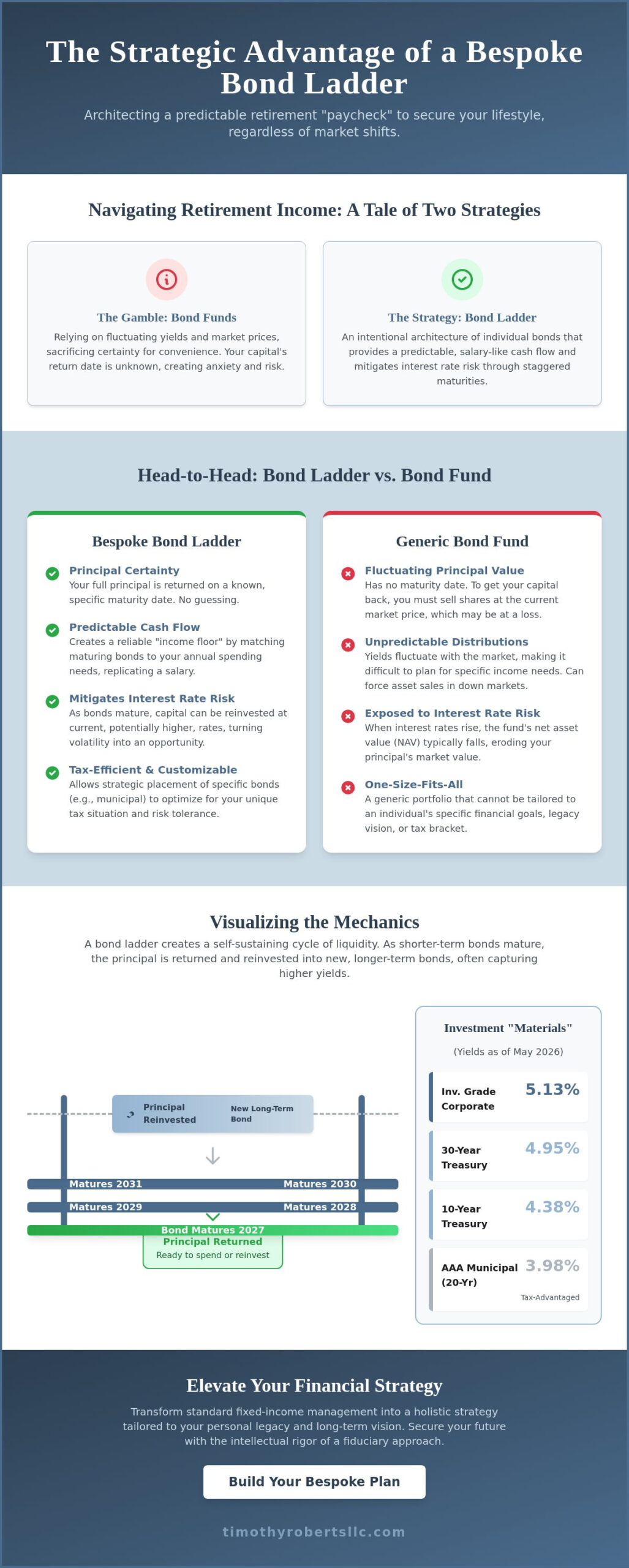
In the current economic climate of May 2026, where the 10-year Treasury note yields 4.38%, investors require a more precise instrument than generic bond funds. A sophisticated bond ladder investment technique transforms your portfolio from a pool of uncertain assets into a structured engine of wealth. By purchasing individual securities that mature at regular intervals, you create a self-sustaining cycle of liquidity. This approach replaces the ambiguity of market fluctuations with the clarity of a contractual “paycheck,” effectively mimicking your professional salary in a post-career environment.
To better understand how this structure provides stability, watch this helpful video:
Solving the Retirement Income Puzzle
The “sequence of returns” risk often haunts retirees, as a market downturn in the early years of distribution can permanently impair a portfolio’s longevity. A bespoke bond ladder strategy for retirement income addresses this by creating a structural “income floor.” By matching specific bond maturities to your annual spending needs, you ensure your essential expenses are covered by returning principal rather than forced asset sales during a market dip. A bond ladder is a strategic architecture of staggered fixed-income maturities designed to neutralize interest rate sensitivity while providing a predictable liquidity schedule.
Mitigating Interest Rate Volatility Through Structure
The relationship between bond prices and interest rates is inherently inverse; when rates rise, the market value of existing bonds typically falls. However, a laddered structure turns this volatility into an advantage. As shorter-term bonds mature, the principal is reinvested into the “long” end of the ladder, allowing you to capture higher yields, such as the 4.95% currently offered by 30-year Treasury bonds as of May 8, 2026. This process provides a significant psychological benefit. You aren’t forced to guess the direction of the Federal Reserve; you simply wait for your bonds to reach par value, knowing exactly when your capital will return to your pocket.
Adopting this strategy requires a visionary mindset that prioritizes control over convenience. Unlike generic bond funds that lack a fixed maturity date, individual bonds allow a fiduciary to optimize for your specific tax bracket and risk tolerance. Under modern standards like Regulation Best Interest, this level of customization isn’t just a luxury; it’s a strategic necessity for those who value professional stability and intellectual rigor in their financial planning.
Constructing Your Income Stream: The Mechanics of Rungs and Maturities
Building a resilient income stream requires more than a casual selection of securities; it demands a meticulous evaluation of “materials” that align with your personal lifestyle goals. As of May 8, 2026, the financial landscape offers a diverse palette for construction. You might choose U.S. Treasury notes for their sovereign backing, currently yielding 4.38% for 10-year durations, or opt for investment-grade corporate bonds which provided a more robust 5.13% yield as of May 5, 2026. For high-earning retirees, AAA-rated municipal bonds offer a tax-advantaged path with 20-year yields sitting near 3.98%. Understanding how a bond ladder works at a granular level allows you to customize the “rungs” to match your specific liquidity needs, whether you require monthly distributions or annual payouts.
A bespoke bond ladder strategy for retirement income thrives on the intentional spacing of these rungs. By staggering maturities, you ensure that capital is consistently returned to you, providing the freedom to either spend the principal or reinvest it based on the prevailing interest rate environment. This mechanical discipline eliminates the emotional fatigue of timing the market. Optimizing these mechanics is a hallmark of sophisticated wealth management, ensuring your portfolio remains a strategic asset rather than a source of administrative burden.
Selecting High-Quality Fixed-Income Instruments
Precision is paramount when selecting individual securities. We prioritize non-callable bonds to protect the integrity of the ladder’s timeline. If a bond is “called” or redeemed early by the issuer, it disrupts your planned cash flow and forces reinvestment at potentially lower rates. By focusing on high-quality, investment-grade instruments, we mitigate credit risk and maintain a focus on capital preservation. This careful curation balances the pursuit of yield with the necessity of safety, creating a portfolio that is both high-performing and inherently stable.
The Reinvestment Engine: Rolling the Ladder
The true power of this strategy lies in the reinvestment cycle, often called “rolling the ladder.” When the shortest rung matures, the principal is typically reinvested into a new bond at the longest end of the ladder. This process allows you to capture the higher yields often found in longer-dated securities, such as the 4.95% yield on 30-year Treasuries observed in early May 2026. If your income needs shift, the ladder can be adjusted by shortening the rungs or increasing the cash cushion to bridge any gaps. This dynamic flexibility ensures your income stream evolves alongside your retirement journey.
Strategic Comparisons: Why a Bespoke Ladder Often Outperforms Generic Funds
Many investors gravitate toward bond funds for their perceived simplicity, yet this convenience often masks a lack of structural control. A bond fund is a perpetual pool of securities without a final maturity date, meaning your principal is always subject to the market’s whims. In contrast, a bespoke bond ladder strategy for retirement income provides a definitive end date for every dollar invested. This distinction becomes critical during periods of rising rates, where a fund’s Net Asset Value (NAV) can decline even as its yield increases, potentially eroding your capital just as you need to withdraw it. By holding individual securities, you bypass the “NAV trap” and ensure that your principal returns to you at par value upon maturity.
Cost transparency remains another significant differentiator. Managed bond products often carry expense ratios and internal transaction costs that are opaque to the retail investor. When you own individual bonds, the yield you see is the yield you receive. This clarity extends to the comparison with annuities. While annuities offer a “guarantee,” they often come at the cost of high surrender fees and a loss of control over the underlying assets. A bond ladder maintains your liquidity, allowing you to pivot as your vision for retirement evolves. It’s a professional approach that values transparency and flexibility over the rigid structures of off-the-shelf products.
Individual Control vs. Pooled Risks
Holding a bond to maturity guarantees the return of its face value, assuming the issuer remains solvent. This certainty is the cornerstone of a strategic fixed-income portfolio. Bond funds are often forced to sell securities to meet shareholder redemptions or to maintain a specific duration target, effectively turning paper losses into realized ones. A bespoke ladder is a precision-engineered instrument that prioritizes your specific cash flow requirements over a fund manager’s arbitrary benchmark. It’s the difference between a one-size-fits-all approach and a tailored solution designed for your unique financial landscape.
Liquidity and Legacy: The Flexibility of the Ladder
Beyond immediate income, the ladder serves as a sophisticated tool for long-term wealth transfer. Unlike an annuity that may vanish upon the owner’s death, individual bonds are tangible assets that can be passed to heirs. This integration is vital for a holistic estate planning strategy. It allows for potential tax advantages and provides the liquidity needed for unforeseen medical expenses or philanthropic goals. By maintaining ownership of the underlying debt, you preserve the ability to optimize your legacy on your own terms, ensuring that your wealth continues to reflect your values long after the career phase has ended.
Optimization and Tax Efficiency: Elevating the Basic Strategy
A standard ladder provides structure, but a tax-optimized ladder provides resilience. For high-net-worth investors, the “tax drag” on interest income can quietly erode the very lifestyle they’ve worked to build. As of May 2026, single filers with incomes exceeding $201,776 find themselves in the 32% federal tax bracket, while those over $640,600 face a 37% rate. Without a sophisticated approach to asset location, a significant portion of your yields—such as the 5.13% currently offered by investment-grade corporate bonds—could be lost to the IRS. Implementing a bond ladder strategy for retirement income requires a holistic view of your entire financial landscape to ensure that every rung is placed in its most efficient environment.
Strategic coordination is the difference between a generic portfolio and a bespoke income engine. By aligning your ladder’s interest payments with your Social Security benefits and Required Minimum Distributions (RMDs), you can avoid the “tax torpedo” effect that often catches retirees off guard. This level of precision ensures that your income remains steady while your tax liability remains controlled. To see how these variables interact with your specific goals, we invite you to explore our approach to wealth management.
Tax-Aware Asset Location
Precision in asset location is paramount for maintaining net returns. Taxable corporate bonds are generally best suited for tax-deferred accounts like a traditional IRA or a 401(k), where interest can grow without immediate taxation. Conversely, for high-earning retirees in taxable brokerage accounts, municipal bonds become the preferred “material.” With 30-year AAA-rated municipal yields near 4.30% as of May 8, 2026, the tax-equivalent yield for those in the top bracket often outperforms taxable alternatives. Utilizing professional tax advising allows us to minimize the impact of the 3.8% Net Investment Income Tax (NIIT), which applies to married couples filing jointly with a modified adjusted gross income over $250,000.
Inflation-Proofing Your Income Floor
The greatest threat to a fixed-income stream is the slow devaluation of purchasing power. While a 4.38% yield on a 10-year Treasury note provides stability, it doesn’t account for the rising cost of living over a 30-year retirement. We solve this by incorporating Treasury Inflation-Protected Securities (TIPS) into specific rungs of the ladder. As of May 2026, Series I Savings Bonds carry a composite rate of 4.26%, providing a reliable benchmark for inflation protection. Integrating these inflation-adjusted instruments into a comprehensive retirement income plan ensures that your “income floor” rises alongside the economy, preserving your standard of living for decades to come.
The Fiduciary Approach: Tailoring Your Ladder to Your Bespoke Vision
Managing the nuances of a bond ladder strategy for retirement income is not merely a mathematical exercise; it is a strategic intervention. While the mechanics involve yield curves and maturity dates, the architecture must be led by a visionary strategist who understands the profound interplay between your wealth and your personal values. A fiduciary approach ensures that every selection is made with intellectual curiosity and business-minded rigor, prioritizing your best interest over the convenience of generic product sales. This level of personal attention transforms a collection of securities into a sophisticated blueprint for professional stability and aspirational growth.
The transition from wealth accumulation to strategic wealth distribution is perhaps the most significant pivot in an investor’s journey. It requires a move away from aggressive growth toward a narrative of partnership and shared success. Under the Regulation Best Interest standards reinforced in early 2026, a fiduciary advisor acts as both an expert craftsman and a reliable business advisor. We move beyond off-the-shelf solutions to innovate and optimize your portfolio, ensuring that your income stream remains as dynamic as the life you’ve built. This deliberate pacing reinforces the idea that we take the time to understand complex problems rather than rushing to generic conclusions.
Beyond the Math: Aligning Income with Legacy
A holistic strategy recognizes that your need for immediate cash flow shouldn’t exist in a vacuum. It is essential to protect your long-term investment portfolio management while ensuring your daily lifestyle remains elevated. By acting as a fee-only fiduciary, we provide objective oversight that mitigates the administrative complexity of managing individual bond maturities. This creates a “sleep-at-night” portfolio where the return of principal is a contractual certainty. It allows you to focus on your legacy and creative passions, knowing that the structural integrity of your wealth is being professionally monitored.
Taking the First Step Toward Strategic Elevation
The journey toward a refined income structure begins with a comprehensive financial audit. This process evaluates your current assets against the 2026 economic landscape, where 10-year Treasury yields sit at 4.38% and corporate spreads remain tight. Transitioning a growth-heavy portfolio into a structured income engine shouldn’t feel like a compromise; it should feel like an upward journey toward greater control. We invite you to a bespoke consultation to discuss your unique goals. Together, we can architect a strategic roadmap that secures your retirement lifestyle and optimizes your financial trajectory for the decades ahead.
Architecting Your Financial Legacy
Securing your lifestyle in a shifting economic landscape requires more than passive participation; it demands a structured, intentional framework. We’ve explored how individual maturities provide a level of principal certainty that generic bond funds cannot replicate, especially as the 10-year Treasury yield remains at 4.38% as of May 8, 2026. By integrating tax-efficient asset location and inflation-protected securities, you transform a simple portfolio into a resilient engine of wealth. This holistic approach ensures your income floor remains stable regardless of interest rate volatility or the 3.8% Net Investment Income Tax thresholds.
Your journey toward a more predictable future deserves the oversight of a visionary strategist. With over 25 years of fiduciary expertise, we provide the high-touch, bespoke planning necessary to coordinate complex tax and investment needs. Elevate your retirement strategy with a bespoke income plan from Timothy Roberts & Associates. By aligning a bond ladder strategy for retirement income with your unique vision, you gain both the financial results and the psychological freedom to enjoy your success. It’s time to move toward a retirement defined by clarity and confidence.
Frequently Asked Questions
Is a bond ladder better than a bond fund for retirement?
A bond ladder provides a level of maturity certainty that a bond fund cannot match. While funds offer ease of use, they lack a fixed maturity date, exposing your principal to perpetual price risk. A bespoke ladder ensures your capital returns at par value on specific dates. This control allows you to architect a predictable paycheck that isn’t at the mercy of a fund manager’s benchmark.
How many bonds do I need to build an effective ladder?
Constructing an effective ladder typically requires between 5 and 10 individual rungs spaced at annual intervals. This structure ensures you have consistent liquidity while spreading your reinvestment risk across different interest rate environments. For more granular needs, some investors choose quarterly rungs. The goal is to create a steady rhythm of returning principal that matches your specific lifestyle expenses without over-complicating the administrative oversight of the portfolio.
Can I build a bond ladder within my 401(k) or IRA?
You can implement a bond ladder strategy for retirement income within most self-directed IRAs or 401(k) brokerage windows. Using tax-advantaged accounts is a sophisticated move for holding corporate bonds, as it shields the interest from immediate taxation. This asset location strategy helps minimize the tax drag on your fixed-income returns, allowing your portfolio to grow more efficiently toward your long-term legacy and wealth management goals.
What happens to my bond ladder if interest rates fall significantly?
Falling interest rates will increase the market value of your existing rungs, but you’ll likely face lower yields when reinvesting maturing principal. This scenario highlights the importance of the ladder’s structure; you’ve already locked in higher rates on your longer-term rungs. While your future rolls might capture lower yields, your immediate income stream remains protected by the contractual coupons and par value of your current holdings.
Are bond ladders safe for investors worried about a recession?
High-quality bond ladders are considered premier defensive tools for those concerned about a potential economic recession. By utilizing U.S. Treasuries or AAA-rated municipals, you secure your income floor with instruments that have historically shown resilience during market stress. This structural safety provides the psychological freedom to stay invested in growth assets elsewhere in your portfolio, knowing your essential spending is backed by reliable, investment-grade rungs.
How often should I review or ‘roll’ my bond ladder rungs?
You should review your ladder’s performance annually or whenever a specific rung reaches its maturity date. This rolling process is the engine of the strategy, where you reinvest the returned principal into a new rung at the longest end of the ladder. As of May 8, 2026, you might look to capture the 4.95% yield on 30-year Treasuries to extend your income horizon. Consistent oversight ensures the strategy stays aligned.
What are the tax implications of the interest earned from a bond ladder?
Tax treatment varies by security type, with corporate bond interest taxed at your ordinary income rate, which could reach 37% for top earners in 2026. Municipal bonds offer a strategic alternative, as their interest is generally exempt from federal taxes. High-net-worth investors must also account for the 3.8% Net Investment Income Tax (NIIT) if their modified adjusted gross income exceeds $250,000 for married couples filing jointly.
Can I use CDs instead of bonds to build a ladder?
CDs are highly effective for building a short-term ladder, with 1-year CD rates reaching 4.10% APY in May 2026. They offer the security of FDIC insurance up to $250,000 per institution, making them an attractive material for the earliest rungs of your plan. However, they lack the potential for capital appreciation and the deep liquidity of the secondary bond market, which is why a holistic ladder often combines both instruments.
