

Sep
2026 Michigan Giving Guide: Maximize Impact & Tax Savings
In 2026, the traditional “checkbook philanthropy” model has officially become a liability for the high-net-worth donor. You’ve likely noticed that the One Big Beautiful Bill Act has fundamentally shifted the math of generosity, particularly with the introduction of the 0.5% AGI floor for itemized deductions. It’s unsettling to realize that your philanthropic intent, while pure, may no longer yield the same fiscal efficiency it did just a few years ago. This tension is especially palpable when considering the complexities of donor-advised funds and how they fit into a modern, high-level wealth strategy.
We’ll help you transform these legislative hurdles into a structured roadmap for aspirational growth. You’ll discover how to architect a giving plan that maximizes tax savings under the 35% deduction cap while effectively offsetting Required Minimum Distributions. We’ll examine the strategic “bunching” of contributions and the nuances of multi-generational wealth transfer. By the end of this guide, you’ll have the clarity needed to turn your charitable vision into a precise, tax-optimized legacy that thrives within the current regulatory environment.
Key Takeaways
- Navigate the complexities of the One Big Beautiful Bill Act, including the $15 million federal estate tax exemption, to ensure your wealth transfer remains efficient.
- Leverage donor-advised funds michigan as a sophisticated mechanism to aggregate charitable contributions, allowing you to exceed the 0.5% AGI floor for maximum tax benefit.
- Discover how to use Qualified Charitable Distributions (QCDs) as a strategic intervention to offset Required Minimum Distributions without increasing your taxable burden.
- Evaluate the structural advantages of Charitable Remainder Trusts and Lead Trusts for creating sustainable income streams while securing your family’s philanthropic legacy.
- Shift from reactive giving to a visionary fiduciary model that integrates tax planning strategies with your personal mission for long-term impact.
The 2026 Philanthropic Landscape: Navigating New Tax Thresholds
Philanthropy in 2026 has transitioned from a simple act of goodwill into a sophisticated exercise in fiduciary precision. The passage of the One Big Beautiful Bill Act redefined the boundaries of tax-efficient giving, requiring donors to look beyond the immediate impact of a single check. Understanding What is a Donor-Advised Fund? is no longer just for the ultra-wealthy. It’s a foundational step for anyone seeking to maintain their charitable footprint in a more restrictive tax environment.
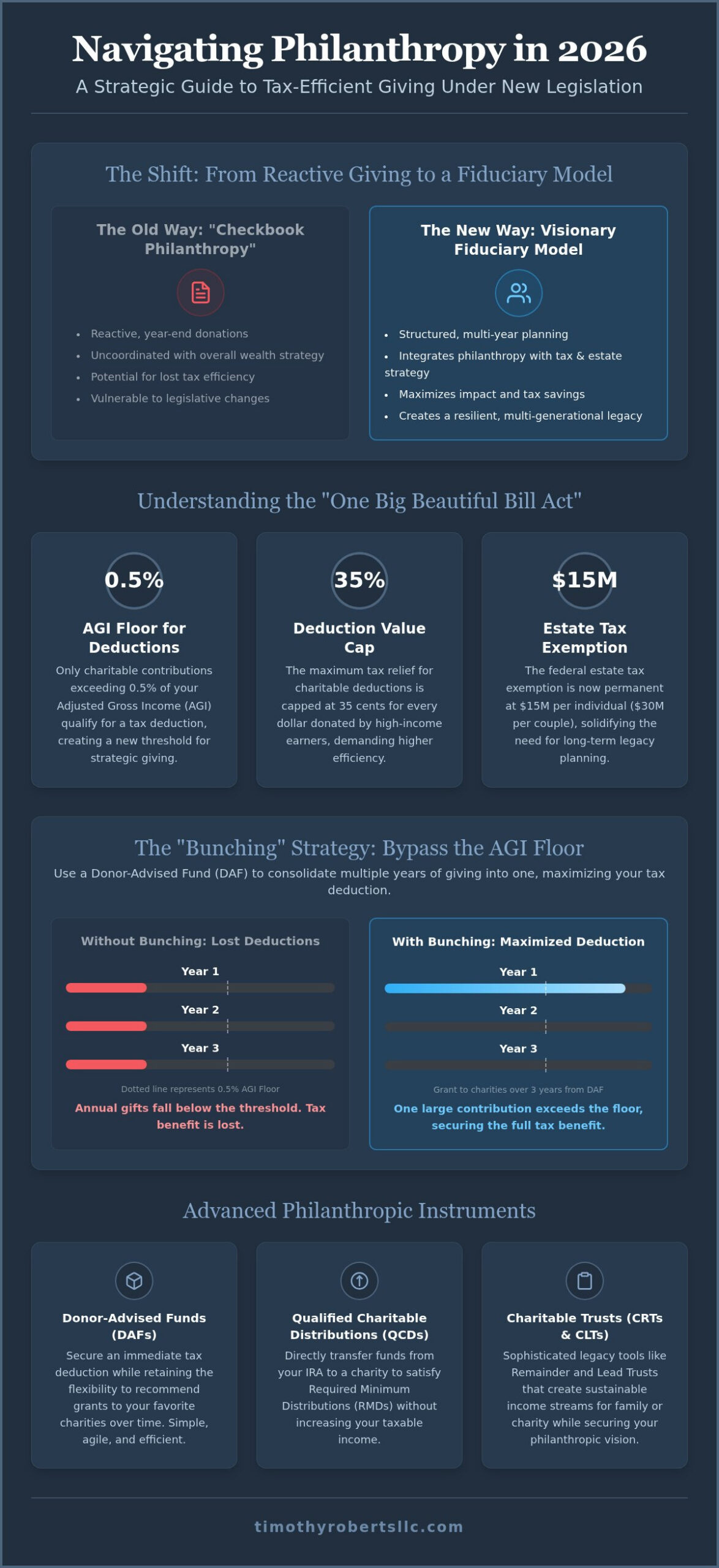
The days of reactive, year-end donations are fading. High-income earners now face a 35% cap on the tax benefit of their charitable deductions, meaning every dollar donated provides a maximum of 35 cents in relief. This shift demands a move toward structured fiduciary strategies that align personal values with the realities of the current code. It’s about architecting an evolution from checkbook philanthropy to a visionary legacy plan.
To better understand this concept, watch this helpful video:
The Impact of the One Big Beautiful Bill Act
This legislation has made the federal estate tax exemption of $15 million per individual, or $30 million for married couples, a permanent fixture. While this provides a generous ceiling, it also reshapes the necessity of estate planning for families who previously relied on sunsetting provisions. The act introduces new compliance requirements that render old, uncoordinated strategies obsolete. It’s a journey of upward progression, where your legacy is built through intentional, business-minded rigor rather than simple transactions. Moving away from reactive giving toward structured fiduciary strategies allows for a more resilient family office structure that survives generational shifts.
Bypassing the 0.5% AGI Floor
One of the most significant frictions in the 2026 code is the 0.5% Adjusted Gross Income (AGI) floor for itemized deductions. This threshold means that only charitable contributions exceeding 0.5% of your AGI are deductible. The AGI floor creates a tax liability for uncoordinated gifts by effectively stripping the tax benefit from the first few thousand dollars of your annual giving. To solve this, many are turning to donor-advised funds michigan to facilitate a strategy known as “bunching.” By consolidating several years of planned giving into a single high-contribution year, you can bypass the floor and maximize the impact of your deductions. This approach is particularly vital given the 35% cap on deduction values for top earners. It’s a carefully crafted intervention that ensures your generosity isn’t swallowed by administrative thresholds.
Strategic Giving Vehicles: DAFs vs. Private Foundations
The decision to utilize a Donor-Advised Fund or establish a private foundation is an architectural choice that defines the future of your family’s legacy. In the 2026 landscape, this choice is no longer just about preference; it’s about navigating a tax code that rewards agility and punishes administrative friction. While both vehicles serve the spirit of generosity, they operate with vastly different levels of business-minded rigor. Choosing the right path requires a synthesis of your personal creative vision with structured corporate capabilities.
The Agility of Donor-Advised Funds
Donor-advised funds have emerged as the premier instrument for donors who value immediate impact and administrative ease. One of the most compelling advantages is the ability to secure an immediate tax deduction while deferring the actual grant-making process. According to IRS regulations for donor-advised funds, the tax benefit is realized the moment assets are transferred into the fund. This is a critical tactical advantage when managing donor-advised funds michigan, as it allows you to time your contributions to years where your income is highest, thereby maximizing the deduction’s value under the 35% cap.
This vehicle also integrates seamlessly with high-end investment portfolio management. By donating appreciated non-cash assets, such as stock or private equity, you eliminate capital gains liabilities while receiving a deduction for the fair market value. It’s an elegant solution for tax-loss harvesting, allowing you to rebalance your holdings without the friction of a taxable event. For most strategic donors, the DAF is the ideal tool for “bunching” strategies, providing a clear path to exceed the 0.5% AGI floor and ensure every dollar of your gift remains tax-efficient.
Private Foundations for Legacy Control
Private foundations remain a relevant option for those who require absolute, bespoke control over their philanthropic endeavors. They allow for a level of customization that DAFs cannot match, including the ability to employ family members or run internal charitable programs. However, this control comes with a higher cost of entry and ongoing complexity. Foundations are subject to excise taxes on investment income and require extensive public disclosures that may not suit those who value privacy in their financial affairs.
The fiduciary oversight required to manage a private foundation is significant. In 2026, the compliance landscape is more rigorous than ever, demanding a sophisticated understanding of mandatory distribution rules and self-dealing prohibitions. For many families, the administrative burden of a foundation feels cluttered compared to the streamlined, professional flow of a DAF. Deciding which path fits your upward progression requires a deep dive into your long-term objectives. You might find that a bespoke wealth management plan provides the necessary clarity to choose the vehicle that best supports your vision for shared success.
Integrating Philanthropy into Retirement Income Planning
Effective philanthropy in the retirement phase requires a shift from asset accumulation to strategic distribution. While we previously explored the agility of donor-advised funds michigan, the most powerful tool for those over age 70.5 is often found within their traditional IRA. Integrating your charitable intent with retirement income planning allows you to fulfill your philanthropic vision while simultaneously lowering your effective tax bracket. It’s a synthesis of personal values and business-minded financial rigor.
Qualified Charitable Distributions (QCDs) Explained
The mechanism of a QCD is elegantly simple yet profoundly impactful. You direct your IRA custodian to send funds directly to a qualified 501(c)(3) organization, bypassing your personal bank account entirely. A QCD serves as a direct offset to taxable RMD income, effectively removing those funds from your tax return before they can inflate your Adjusted Gross Income. For the 2026 tax year, the annual limit for QCDs is $111,000 per taxpayer. Maximize this limit to satisfy your charitable goals while keeping your taxable income suppressed. It’s important to remember that while DAFs are versatile, they cannot currently receive QCDs, making this a distinct, parallel strategy in your wealth management toolkit.
The RMD Offset Strategy
The true value of a QCD becomes clear when compared to taking a standard deduction and writing a check. Because a QCD is an “above-the-line” exclusion, it preserves your AGI for other income-based calculations. This is a critical intervention for high-income retirees who wish to avoid surcharges on Medicare premiums or the phase-out of other tax credits. By reducing your AGI, you’re not just giving; you’re protecting your overall cash flow from the friction of higher tax brackets.
Coordinating these distributions with tax advising professionals ensures that every dollar moved from your IRA serves a dual purpose. It’s a journey of upward progression where your retirement assets are deployed with the same precision as a corporate treasury. This level of intentionality transforms a mandatory distribution into a powerful legacy instrument. It ensures that your philanthropic passion doesn’t inadvertently trigger unnecessary fiscal consequences.
Sophisticated Legacy Instruments: CRTs and Lead Trusts
While donor-advised funds michigan offer unmatched agility for annual giving, sophisticated legacy planning often requires more robust instruments to manage complex asset structures. Charitable Remainder Trusts (CRTs) and Charitable Lead Trusts (CLTs) represent the intersection of aesthetics and functionality in high-level wealth management. They’re not mere legal documents; they’re carefully crafted interventions designed to foster family evolution. These trusts allow you to synthesize your personal creative vision with business-minded rigor, ensuring that highly appreciated assets serve both your family and the causes you champion.
Charitable Remainder Trusts (CRTs)
A CRT provides a dual benefit that aligns with a narrative of aspirational growth. You contribute assets to the trust and receive a lifetime income stream, which can be particularly advantageous during your retirement years. The primary mechanism of this tool is the ability to sell highly appreciated assets, such as real estate or concentrated stock positions, within the trust without the immediate friction of capital gains taxes. This preserves the full value of the asset for reinvestment, allowing for a more significant income payout than if you had sold the asset personally.
Designing the income payout requires a strategic choice between a fixed annuity and unitrust options. A Charitable Remainder Annuity Trust (CRAT) provides a predictable, fixed dollar amount every year, offering professional stability for your cash flow. In contrast, a Charitable Remainder Unitrust (CRUT) pays a percentage of the trust’s value, which is revalued annually. This unitrust model allows your income to grow alongside the trust’s investments, reflecting a journey of upward progression. This structure turns a dormant, highly taxed asset into a steady, tax-efficient cash flow that supports your lifestyle while securing a future gift for your chosen charities.
Charitable Lead Trusts (CLTs)
Charitable Lead Trusts reverse the CRT structure by front-loading the philanthropic gift. The charity receives income from the trust for a specified term, after which the remaining assets pass to your heirs. In the 2026 tax environment, CLTs serve as a powerful tool for wealth transfer, especially as families navigate the permanent $15 million estate tax exemption. They allow you to move assets out of your taxable estate at a significantly reduced gift tax cost, as the value of the gift to your heirs is discounted by the value of the income stream provided to the charity.
Integrating a CLT into your comprehensive legacy planning roadmap demonstrates a commitment to community impact while protecting the long-term wealth of your family. It’s a visionary strategy that prioritizes the community first, creating a human-led identity for your family’s wealth. These sophisticated instruments require a visionary strategist to execute properly, ensuring every detail aligns with the current tax code. If you’re ready to architect a more intentional future, consider exploring bespoke estate and legacy planning to align your wealth with your values.
Designing a Bespoke Charitable Strategy: The Fiduciary Path
The transition from understanding individual tools to executing a comprehensive strategy requires a fiduciary-first mindset. It’s not enough to simply open donor-advised funds michigan; you must architect a plan that evolves alongside the complexities of the tax code. This process is a journey of upward progression, moving away from isolated transactions toward a narrative of shared success. By synthesizing your personal creative vision with structured corporate capabilities, you create a human-led, results-driven identity for your family’s wealth.
The Discovery and Implementation Process
The journey begins with a meticulous discovery phase. Before selecting a vehicle, it’s essential to identify the core values that drive your philanthropic intentions. This ensures that every intervention is bespoke rather than an off-the-shelf solution. Collaborating with a financial advisor and tax professional allows for the seamless execution of these complex strategies. It bridges the gap between your individual creative vision and the rigorous requirements of modern compliance.
Once the foundation is laid, the focus shifts to a rhythmic experience of review and rebalancing. A sophisticated strategy is never static. It requires continuous optimization to account for shifting AGI calculations and the nuances of the 2026 tax landscape. We treat this as a professional consultancy, where reviewing charitable grants is as intentional as managing a high-end investment portfolio. This steady, logical flow ensures that your giving remains efficient and impactful throughout every stage of your financial life.
Architecting Your Generational Contribution
True legacy is built when the next generation is invited into the philanthropic mission. This isn’t merely about wealth transfer; it’s about passing down a structured framework for decision-making. By involving heirs in the management of donor-advised funds michigan, you transform development into a journey of organizational evolution. It allows children and grandchildren to understand the intersection of aesthetics and functionality in financial stewardship. They learn that wealth is not just an asset, but a tool for tangible impact.
The final steps for implementing a sophisticated 2026 charitable plan involve a blend of creative passion and business-minded rigor. You must ensure that all trust documents, beneficiary designations, and fund agreements are aligned with the $15 million estate tax exemption. This level of personal attention and high-level expertise distinguishes a visionary strategist from a generic service provider. It secures your position as an expert craftsman of your family’s future, ensuring your contribution remains resilient against the friction of shifting regulations.
Architecting a Legacy of Intentional Impact
Philanthropy in 2026 is no longer a simple transaction; it’s a sophisticated exercise in fiduciary precision. We’ve explored how the One Big Beautiful Bill Act necessitates a shift from reactive check-writing to strategic “bunching” and the use of donor-advised funds michigan. By aligning your charitable vision with the current tax thresholds, you ensure that your generosity remains as efficient as it is impactful. It’s about moving from a cluttered, reactive approach toward a spacious and deliberate flow that mirrors your broader financial goals.
Success in this new landscape requires a partner who understands the intersection of personal vision and structured corporate capabilities. With over 25 years of experience, we provide the integrated tax preparation and compliance expertise necessary for high-end wealth and estate management. Our fiduciary-first advisory model is designed to guide you through this journey of upward progression. Elevate your philanthropic strategy with a bespoke fiduciary consultation. You have the power to transform a mandatory distribution into a visionary legacy that serves your family and your community for generations.
Frequently Asked Questions
Is the 0.5% AGI floor applicable to all charitable donations in 2026?
Yes, the 0.5% AGI floor introduced by the One Big Beautiful Bill Act applies to all taxpayers who choose to itemize their charitable contributions for the 2026 tax year. This means your first gifts effectively bear the burden of this threshold before any tax relief is realized. Strategic donors often utilize donor-advised funds michigan to aggregate several years of giving into a single year. This “bunching” method ensures your total contributions comfortably exceed the floor for maximum efficiency.
Can I use a Donor-Advised Fund to satisfy my Required Minimum Distribution (RMD)?
You cannot satisfy an RMD by directing a Qualified Charitable Distribution (QCD) into a Donor-Advised Fund under current IRS regulations. While DAFs are premier tools for administrative ease, they are specifically excluded from receiving tax-free transfers directly from an IRA. To offset your RMD income, you must direct those funds to a qualified 501(c)(3) organization. We recommend coordinating these distributions with a fiduciary advisor to maintain your overall wealth strategy and philanthropic impact.
How much can I donate via a Qualified Charitable Distribution (QCD) in 2026?
For the 2026 tax year, the annual limit for a Qualified Charitable Distribution is $111,000 per taxpayer. If you file a joint return, both you and your spouse may contribute up to this amount from your respective IRAs. This direct transfer allows you to exclude the distribution from your Adjusted Gross Income entirely. It’s a powerful intervention for those over age 70.5 who wish to support their community while managing their effective tax bracket and Medicare premiums.
What happens if the estate tax exemption sunsets after 2026?
The One Big Beautiful Bill Act established a permanent shift in the federal estate tax exemption to $15 million per individual. Because this change is positioned as a long-term fixture of the tax code, the anxiety surrounding a sudden sunset has diminished. However, a sophisticated legacy plan must still evolve with future legislative adjustments. Fiduciary oversight is essential to ensure your estate and legacy planning remains resilient against any subsequent shifts in federal law or individual financial circumstances.
Is a Charitable Remainder Trust better than a DAF for highly appreciated stock?
A Charitable Remainder Trust (CRT) is often superior for highly appreciated stock when the donor requires a lifetime income stream alongside their philanthropic gift. While donor-advised funds michigan provide immediate deductions and administrative simplicity, a CRT allows you to sell assets without immediate capital gains friction while reinvesting the full value. This choice depends on whether you prioritize immediate grant-making agility or a structured, unitrust-based income payout for your own long-term retirement security.
Can I still claim charitable deductions if I take the standard deduction?
Yes, taxpayers who take the standard deduction in 2026 can claim a limited charitable deduction for cash contributions. This deduction is capped at $1,000 for single filers and $2,000 for married couples filing jointly. It’s important to note that contributions to donor-advised funds and private foundations are not eligible for this specific benefit. Most high-net-worth donors find that bunching contributions into a DAF provides a much more significant tax advantage by allowing them to itemize.
How does the One Big Beautiful Bill Act affect private foundation payouts?
The One Big Beautiful Bill Act increases the fiduciary rigor required for private foundation compliance and payout calculations. While the standard 5% distribution requirement remains a baseline, the Act introduces stricter oversight regarding administrative expenses and self-dealing prohibitions. This shift makes the streamlined nature of a DAF more attractive for those seeking to avoid the cluttered regulatory environment of a foundation. Professional guidance is necessary to ensure your foundation’s activities align with these updated, more demanding federal standards.
What is the maximum tax deduction for DAF contributions in 2026?
The maximum tax benefit for charitable deductions is capped at 35% for high-income earners in the top federal bracket. For every dollar you contribute to a donor-advised fund, the actual reduction in your tax liability will not exceed 35 cents. Additionally, you must account for the 0.5% AGI floor that applies to all itemized deductions. Synthesizing these limits into a results-driven strategy requires a deep understanding of your total income and long-term philanthropic goals.
