

Apr
Retirement Bucket Strategy: A Strategic Framework for Sustainable Income in 2026
Market volatility during the initial 36 months of your retirement can dictate the success of your next thirty years more than any other single factor. This phenomenon, known as sequence of returns risk, remains the primary hurdle for those shifting from building wealth to spending it. You’ve likely spent decades focused on growth; yet, the mechanics of drawing a steady paycheck from a fluctuating portfolio often feel inherently fragile. It’s a complex transition that requires a departure from traditional accumulation mindsets.
By implementing a bespoke retirement bucket strategy, you can transform this uncertainty into a structured, resilient framework for long-term security. We’ll show you how to master time-segmented asset allocation to protect your lifestyle and elevate your financial legacy. This guide provides a strategic roadmap for 2026 to optimize your monthly income, mitigate tax liabilities, and ensure your portfolio thrives regardless of market cycles. You’ll gain the intellectual clarity needed to move from confusion to a state of calm, strategic confidence.
Key Takeaways
- Transition from a passive accumulation mindset to a sophisticated, structural framework designed for the complexities of modern decumulation.
- Master the architecture of a bespoke retirement bucket strategy to segment your assets effectively across cash, income, and growth horizons.
- Identify the optimal methodology for your lifestyle by evaluating the strategic differences between time-segmented and expense-category approaches.
- Secure your long-term vision through a disciplined refill strategy that mitigates market volatility while maintaining your desired standard of living.
- Elevate your results by integrating your withdrawal sequence with holistic tax and estate planning to ensure your financial security remains uncompromised.
Beyond the Withdrawal Rate: Why Your Retirement Strategy Needs Structural Elevation
Transitioning from the accumulation of wealth to the strategic distribution of assets requires more than a simple spreadsheet. It’s a fundamental shift in perspective. For decades, the focus was building a “number.” Now, the reality of decumulation takes center stage, requiring a more sophisticated lens. A Retirement planning framework must evolve beyond the static 4% rule, which originated from Bill Bengen’s 1994 study. In the projected market environment of 2026, where interest rates may stabilize at higher levels than the previous decade, a one-size-fits-all withdrawal rate lacks the nuance required for a bespoke lifestyle.
The retirement bucket strategy offers a time-segmented approach to asset management. Instead of viewing your portfolio as a monolithic block of capital, you divide it into distinct segments based on when you’ll need the liquidity. This isn’t just diversification; it’s structural optimization. By segmenting assets into short, medium, and long-term horizons, you create a buffer against the volatility that often plagues the early years of retirement. It transforms a generic investment account into a purpose-driven financial engine.
The Problem with Linear Thinking in a Volatile World
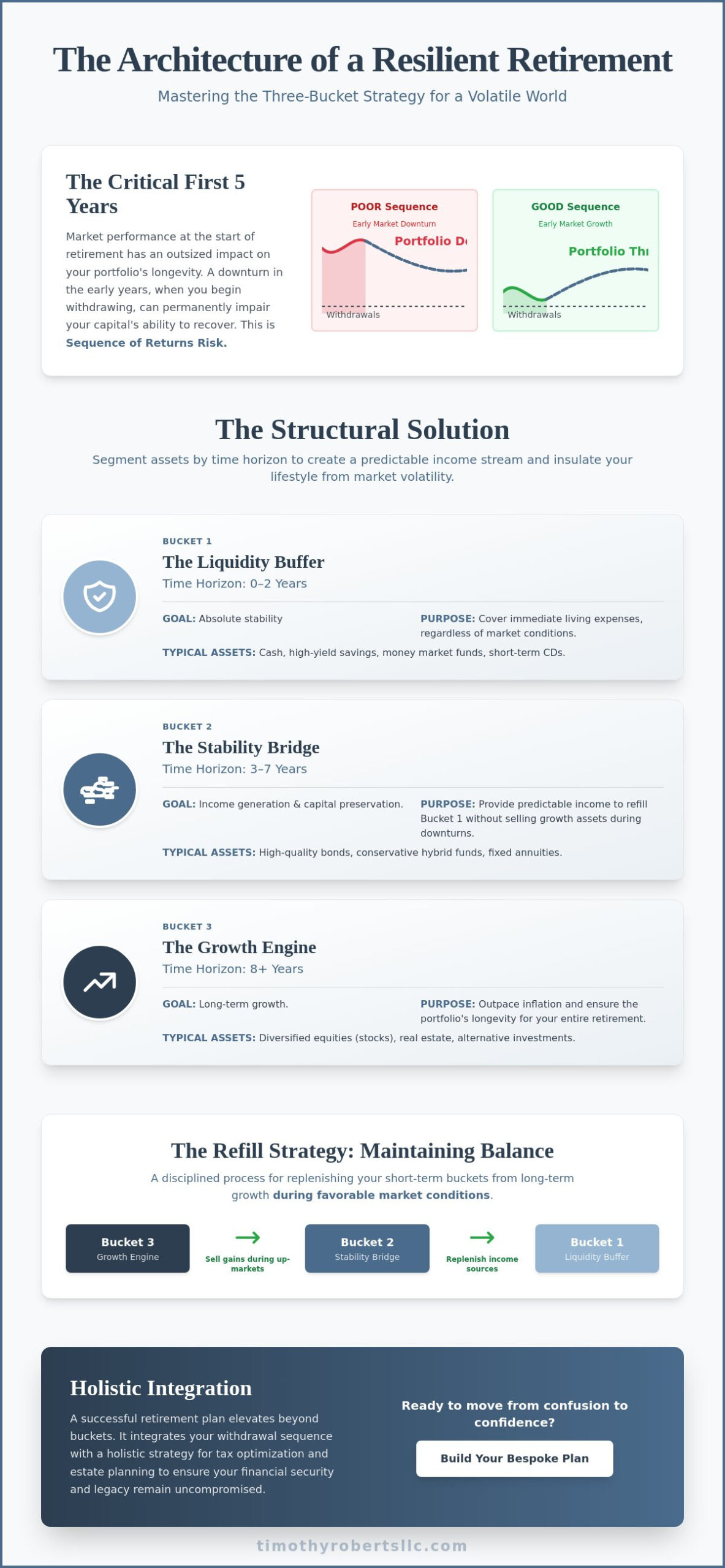
Linear projections often ignore the harsh reality of market timing. A 12% to 15% market correction in the first five years of retirement can permanently impair a portfolio’s ability to recover if withdrawals continue unabated. While a standard diversified portfolio manages risk through asset classes, a bucketed stream manages risk through time. This structure prevents the forced sale of equities during a downturn, allowing your growth assets the necessary years to recover. Sequence of returns risk is the specific phenomenon where the timing and order of investment returns significantly impact the longevity of a portfolio when withdrawals are being made.
The Psychological Dividend of Segmented Assets
Financial security is as much about emotional stability as it is about mathematical solvency. When you know your next three years of essential income are secured in liquid, low-volatility instruments, “ticker shock” loses its power. This framework allows you to separate non-negotiable “needs” from aspirational “wants,” creating a highly customized capital structure. You’re no longer just watching a brokerage balance fluctuate; you’re managing a series of dedicated financial missions. This shift from a single balance to a purpose-driven structure provides the calm confidence needed to enjoy your wealth rather than fearing its depletion.
The Architecture of Income: Designing a Bespoke Three-Bucket System
Designing a retirement plan requires more than simple asset allocation. It demands a structured hierarchy of capital that aligns with the timing of your life milestones. The retirement bucket strategy serves as this structural foundation, segmenting assets not by type, but by their temporal purpose. By organizing wealth into distinct tiers of liquidity, you transform a volatile portfolio into a predictable income stream. This approach moves away from the anxiety of daily market fluctuations toward a narrative of partnership between your current needs and your future legacy.
Customizing bucket sizes is not a one-size-fits-all exercise. It requires a deep dive into your specific risk tolerance and lifestyle goals. While a conservative investor might prefer a larger liquidity buffer, an individual with a high risk appetite might lean more heavily into growth assets. The objective is to create a holistic system where liquid assets provide a buffer against market corrections, while fixed-income instruments provide a bridge to long-term growth.
Bucket 1: The Liquidity Buffer (Years 0-2)
This initial tier serves as your immediate financial foundation. Its primary goal is to provide absolute stability and the psychological peace of mind needed to ignore short-term market noise. Asset selection focuses on cash equivalents, money markets, and high-yield savings accounts. To determine your “magic number” for this liquid reserve, calculate your total annual expenses and subtract any guaranteed income like Social Security or pensions. Multiplying this net figure by two ensures that a 15% market correction in year one won’t force you to liquidate assets at a loss.
Bucket 2: The Stability Bridge (Years 3-10)
This segment acts as a defensive corridor between immediate needs and long-term growth. It focuses on inflation-protected income and moderate capital preservation. Common assets include short-term bonds, certificates of deposit (CDs), and diversified income-producing assets. Implementing a bucket drawdown strategy allows this tier to replenish the liquidity buffer when cash runs low. This bridge prevents the premature sale of equities during a market dip, providing a 10-year runway for the market to recover before you touch your riskier investments.
Bucket 3: The Growth Engine (Years 11+)
The final tier is designed for long-term capital appreciation and legacy planning. It consists of domestic and international equities, real estate, and alternative investments that can withstand volatility in exchange for higher returns over a decade or more. A strategic investment portfolio management approach is vital here to ensure these assets are rebalanced without losing their growth potential. This bucket ensures your purchasing power isn’t eroded by inflation over a 30-year retirement horizon. If you’re ready to move beyond generic advice, consider how a bespoke financial assessment can clarify your specific bucket requirements.
Time vs. Purpose: Selecting the Right Bucketing Methodology for Your Lifestyle
Every successful retirement bucket strategy demands more than a generic allocation. It requires a philosophy that mirrors your daily reality. You must choose between organizing your wealth by the calendar or by the specific intent of each dollar. This decision determines how you’ll interact with your portfolio for the next three decades. It’s the difference between following a rigid schedule and orchestrating a fluid lifestyle.
The Timeframe Approach: Managing the Calendar
This methodology excels for retirees who value a clear, chronological countdown for their assets. It segments capital into immediate, intermediate, and long-term horizons, typically using five-year increments. In a 2026 market environment where inflation targets hover near 2.5% and bond yields remain sensitive to central bank shifts, strict time-segmentation provides a psychological safety net. It ensures cash is ready for withdrawal regardless of equity market volatility. While it offers clarity, the primary drawback is potential “cash drag” if interest rates pivot unexpectedly. You should evaluate and rebalance these time horizons every 18 to 24 months to maintain the integrity of your liquid reserves.
The Expense Approach: Managing the Lifestyle
The expense approach shifts the focus from “when” to “what.” It’s a superior choice for individuals with complex legacy goals or highly variable discretionary spending. We segment capital into three distinct tiers: Essential, Discretionary, and Legacy. The Essential bucket covers non-negotiables like property taxes and healthcare. The Discretionary bucket fuels your passions. This method integrates seamlessly with comprehensive retirement income planning, allowing you to prioritize lifestyle elevation over simple survival. It transforms your portfolio into a functional tool for personal fulfillment rather than just a collection of tickers.
True financial artistry often involves a bespoke hybrid model that merges these two philosophies. Consider these distinct archetypes:
- The Active Traveler: This individual might front-load their discretionary bucket during the first 120 months of retirement. They prioritize high-liquidity assets to fund global exploration while their health is at its peak.
- The Legacy-Focused Retiree: This person keeps their essential bucket lean. They direct a larger percentage of their 60/40 or 70/30 allocation toward a long-term growth bucket intended for heirs or charitable foundations, accepting higher volatility for greater generational impact.
Selecting your methodology isn’t a one-time transaction; it’s a strategic commitment. Whether you prioritize the steady rhythm of the calendar or the vibrant goals of your lifestyle, your retirement bucket strategy must be agile enough to adapt to the shifting economic landscape of 2026 and beyond.
The Refill Strategy: Maintaining Balance Amidst Market Volatility
A retirement bucket strategy thrives on movement. It is a living architecture rather than a static plan. The primary objective isn’t just to spend down assets; the goal is to orchestrate a perpetual cycle of replenishment that preserves the integrity of your long-term capital. By 2026, the anticipated sunsetting of the Tax Cuts and Jobs Act (TCJA) provisions will likely increase individual tax rates for approximately 70% of taxpayers. This shift makes the timing and location of your refills a matter of high-stakes fiscal strategy.
Refilling differs from simple rebalancing. While rebalancing focuses on maintaining a specific risk profile, refilling focuses on liquidity. You may choose the “Cash Flow” method, which directs organic dividends and interest payments from Bucket 3 directly into Bucket 1. Alternatively, the “Rebalance” method involves a more intentional harvest of capital gains during market peaks to reset the entire structure. Both require a bespoke approach to ensure you aren’t over-relying on cash when growth is necessary to combat 2026 inflation projections.
The Mechanics of the Refill
- Step 1: Evaluate the Growth Engine. We audit Bucket 3 to identify assets that have exceeded their target allocation by 5% or more. This allows us to capture growth without compromising the overall risk appetite.
- Step 2: Harvest gains strategically. During market highs, we move realized profits into the Stability Bridge (Bucket 2). This ensures that the assets supporting your mid-term needs are bought low and sold high.
- Step 3: Schedule the move. On a quarterly or semi-annual basis, we funnel matured bonds or high-yield instruments from Bucket 2 into Bucket 1. This creates a seamless stream of income that feels like a traditional paycheck.
Tactical Adjustments During Bear Markets
When the Growth Engine (Bucket 3) experiences a drawdown of 10% or more, the refill strategy must pivot. We pause all transfers from the growth bucket to avoid the cardinal sin of sequence of returns risk. Instead, we lean on the two to three years of cash stored in Bucket 1. This buffer allows your equities the necessary time to recover without being liquidated at depressed prices.
We also utilize a “Dry Powder” strategy. If cash reserves in Bucket 2 are sufficient, we may opportunistically move funds into Bucket 3 to acquire high-quality assets at a discount. In an extended downturn, we implement a defensive glide path that prioritizes the longevity of the stability bridge over aggressive growth targets. This disciplined response transforms market volatility from a threat into a manageable variable.
Elevate your financial trajectory by exploring our strategic wealth management services today.
Holistic Integration: Elevating Your Retirement Plan Beyond the Buckets
A retirement bucket strategy provides the structural integrity your portfolio needs to weather market volatility. However, even the most robust framework can falter without precise tax and estate integration. Your assets aren’t just numbers on a spreadsheet; they’re instruments of a larger legacy. To maximize their impact, you must align your cash flow needs with a sophisticated tax-efficient withdrawal sequence. This involves orchestrating a delicate balance between taxable accounts, tax-deferred IRAs, and tax-free Roth vehicles to keep your effective tax rate as low as possible.
Success requires moving beyond simple asset allocation to prioritize asset location. By integrating strategic tax advising, you can proactively minimize the IRS’s share of your wealth. This level of planning ensures that your buckets aren’t just full, but are also shielded from unnecessary erosion. It’s about looking at the 2026 tax landscape and making intentional moves today to protect your tomorrow. A well-executed plan transforms a simple income stream into a resilient wealth engine.
The Tax-Efficient Bucket
Asset location is the silent driver of long-term success. Placing high-growth equities in Roth accounts while keeping income-producing bonds in tax-deferred buckets can significantly increase your net spendable income. Managing Required Minimum Distributions (RMDs) is another critical factor. Under current SECURE 2.0 guidelines, RMDs start at age 73 or 75, which can trigger massive tax spikes if not managed within your retirement bucket strategy. Strategic gifting also plays a role. Using Qualified Charitable Distributions (QCDs) allows you to satisfy RMD requirements while elevating your legacy through tax-optimized philanthropy.
Fiduciary Oversight and Peace of Mind
Managing a multi-bucket system is a complex, ongoing process that demands more than a “set it and forget it” approach. It requires a partnership with a fiduciary advisor who views your wealth through a lens of intellectual curiosity and business-minded rigor. A bespoke retirement plan evolves as your life and the markets change. You deserve a strategist who can optimize your portfolio in real-time, ensuring every withdrawal is purposeful and every tax move is calculated. This collaborative process shifts the focus from simple survival to aspirational growth. To begin your journey toward a more refined financial future, consult with our strategic advisors to curate your retirement framework.
Securing Your Legacy Through Structural Elevation
Navigating the financial landscape of 2026 requires a shift from simple withdrawal math to a sophisticated architectural framework. A well executed retirement bucket strategy provides this elevation by segmenting your wealth into distinct time horizons. This methodology ensures your immediate liquidity is insulated from market turbulence while your long term growth assets remain positioned for maximum impact. By balancing a three bucket system with a disciplined refill strategy, you transform a standard portfolio into a resilient engine for sustainable income.
True financial security demands a holistic approach that reaches beyond basic investment management. Timothy Roberts & Associates brings over 25 years of fiduciary expertise to the table, specializing in bespoke wealth management for high net worth individuals. Our process integrates tax optimization, estate planning, and strategic investment oversight into a single, cohesive vision. It’s time to move past off the shelf solutions and embrace a plan designed for your specific lifestyle goals. Elevate your retirement strategy with a bespoke income plan from Timothy Roberts & Associates and step into your next chapter with absolute confidence.
Frequently Asked Questions
Is the bucket strategy better than the 4% rule for retirement income?
The retirement bucket strategy provides a more dynamic framework than the rigid 4 percent rule because it prioritizes cash flow psychology over a flat withdrawal rate. While the 4 percent rule, established by William Bengen in 1994, offers a simple baseline, it fails to account for sequence of returns risk during volatile cycles. This bespoke approach allows you to segment assets by time horizon, ensuring you aren’t forced to sell equities during a 20 percent market correction.
How many years of cash should I keep in my first bucket?
You should maintain 1 to 3 years of living expenses in your first bucket to ensure immediate liquidity. This cash reserve acts as a strategic buffer, shielding your long-term investments from short-term market fluctuations. By holding 2 years of expenses in high-yield accounts or money market funds, you create a psychological safety net. This structure allows you to navigate a typical 18 month bear market without liquidating devalued assets.
What are the biggest risks associated with a retirement bucket strategy?
The primary risks include the erosion of purchasing power due to inflation and the opportunity cost of holding too much cash. While a 3 year cash cushion provides security, it may underperform a balanced portfolio by 4 percent or more during bull markets. You must also manage the risk of bucket depletion if the 10 year return on your growth assets fails to meet projections. Strategic oversight ensures your allocation remains aligned with your goals.
How often should I rebalance or refill my retirement buckets?
You should evaluate and refill your buckets on an annual basis or when your equity allocation drifts by more than 5 percent from your target. This disciplined cadence prevents emotional decision making during periods of high volatility. Some investors prefer a tactical refill strategy, moving gains from the growth bucket to the cash bucket after a 10 percent market gain. This methodical process maintains the integrity of your holistic financial architecture.
Can I use a bucket strategy with a mix of Roth and Traditional IRAs?
You can and should integrate Roth and Traditional IRAs into your retirement bucket strategy to optimize tax efficiency. This multi-account approach allows you to draw from Traditional IRAs to fill your lower tax brackets while using Roth assets for larger, lump-sum purchases. By coordinating withdrawals across these 2 account types, you can potentially reduce your lifetime tax liability by 15 percent or more. It’s a sophisticated way to elevate your net spendable income.
Does the bucket strategy protect against high inflation?
The strategy protects against inflation only if your third bucket contains assets like equities or TIPS that historically outpace the Consumer Price Index. Since the 12 month inflation rate hit 9.1 percent in June 2022, investors have recognized that cash alone is a losing proposition. Your long-term bucket must target a 7 percent annual return to preserve your purchasing power over a 30 year retirement horizon. A static cash position won’t suffice.
How does the bucket strategy impact estate and legacy planning?
This framework enhances estate planning by clearly separating your lifestyle assets from your legacy assets. By the time you reach age 85, your growth bucket often transforms into a dedicated vehicle for your heirs. This segmentation allows you to gift assets with a high cost basis while you’re still living, potentially reducing future estate taxes. It creates a transparent roadmap for the 2 or 3 generations that follow your lead.
Is a bucket strategy too complex for a DIY investor to manage?
Managing this strategy requires a higher level of discipline than a simple 60/40 portfolio, but it’s accessible for the diligent DIY investor. You must track 3 distinct time horizons and execute rebalancing trades at least once every 12 months. While 45 percent of retirees prefer professional guidance to manage these complexities, modern software makes the execution more intuitive. It’s about shifting your mindset from simple accumulation to sophisticated, strategic distribution.
