

Apr
The Best Age to Claim Social Security: A Strategic Guide to Elevating Your Retirement Income
What if your Social Security benefit was a bespoke asset rather than a simple government check? While many view this income as a static entitlement, the reality is that your choice acts as a strategic lever for your entire financial architecture. Identifying the best age to claim social security is a critical inflection point that requires more than a cursory glance at a chart. It demands a holistic approach to wealth preservation.
You likely feel the pressure of getting this right, particularly as the Social Security Board of Trustees 2024 report signals potential reserve depletion by 2035. You’ve worked decades to build your portfolio; the fear of eroding that progress through inefficient tax planning or poor timing is a valid concern. This article provides a clear decision-making framework to transform your benefits into a sophisticated, tax-optimized pillar of your long-term wealth. We’ll explore how to coordinate spousal benefits and minimize tax liabilities to ensure your retirement income remains sustainable for 30 years or more.
Key Takeaways
- Understand how the mechanics of Full Retirement Age act as the cornerstone of your strategy, helping you avoid the compounding reductions of early filing.
- Reframe your benefit as a sophisticated longevity hedge rather than a simple break-even calculation to protect your portfolio against the risk of outliving your assets.
- Address solvency concerns with a strategic lens, focusing on how spousal coordination can maximize your household’s total lifetime wealth.
- Determine the best age to claim social security by navigating the “Tax Torpedo” and managing provisional income levels to keep more of what you’ve earned.
- Transition from generic advice to a bespoke retirement income plan that transforms your Social Security benefit into an optimized pillar of financial stability.
Understanding Full Retirement Age (FRA) and the Mechanics of Your Benefit
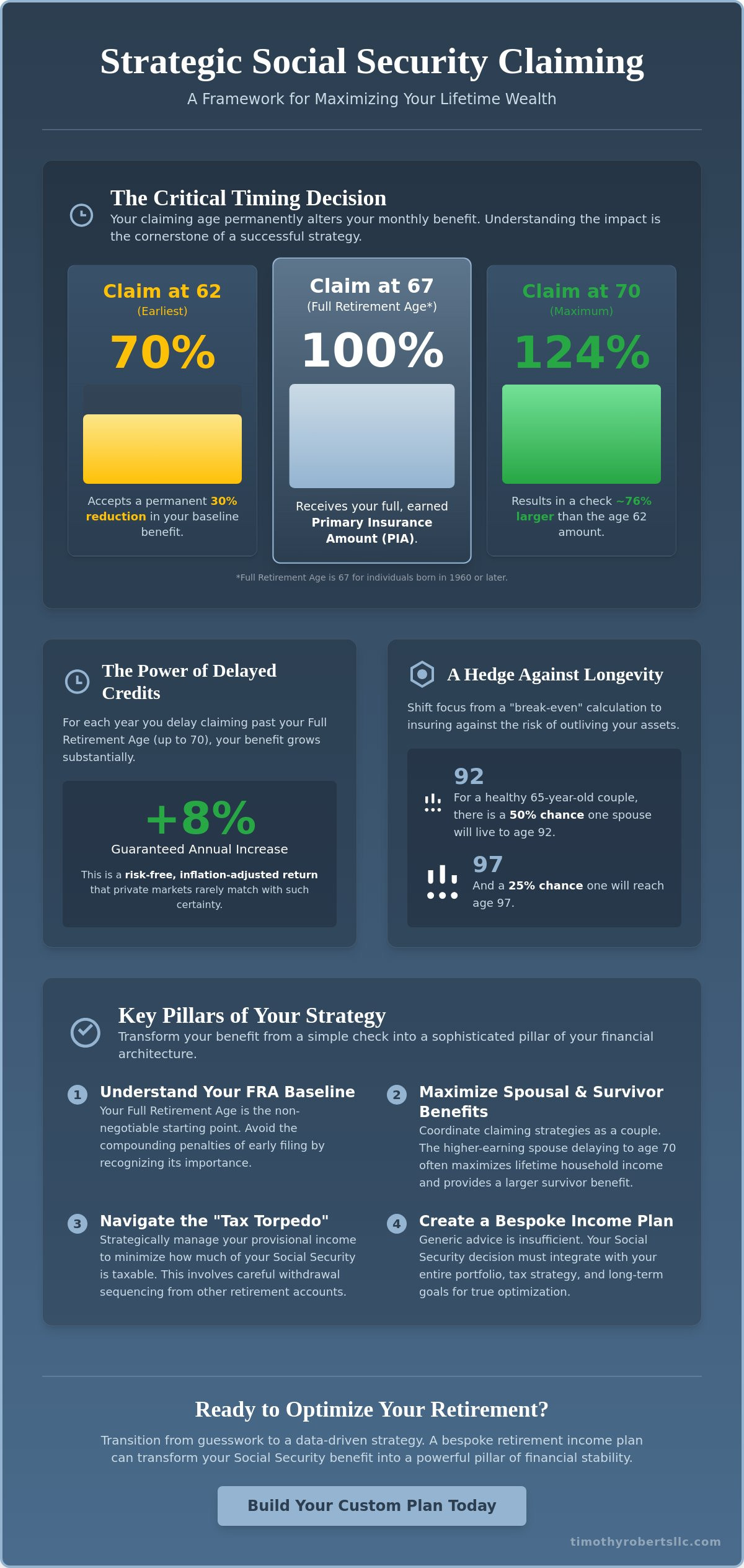
Retirement planning isn’t a series of guesses; it’s a strategic exercise in asset optimization. At the heart of this financial architecture lies the Full Retirement Age (FRA). This specific chronological marker, determined by the year you were born, serves as the baseline for every calculation within the Social Security (United States) system. For individuals born in 1960 or later, the FRA is currently 67. Claiming benefits before this milestone triggers a permanent reduction of 6% to 7% for every year you’re early. If you choose to start at 62, the earliest possible age, your monthly check is slashed by up to 30%.
Conversely, patience yields a sophisticated return. For every year you delay beyond your FRA up to age 70, you earn “Delayed Retirement Credits” worth 8% annually. This isn’t just a simple bonus. It’s a guaranteed, inflation-adjusted return that private markets rarely match with such certainty. Determining the best age to claim social security requires viewing these credits as a core component of a high-performing income strategy. This 8% increase represents a bespoke financial advantage, functioning as a risk-free, cost-of-living-adjusted yield that remains unattainable in traditional brokerage accounts.
The 62 vs. 67 vs. 70 Comparison
The financial delta between claiming early and waiting is profound. A beneficiary claiming at 62 accepts a permanent discount, receiving only 70% of their intended benefit. Waiting until the “sweet spot” of 67 ensures you receive 100% of your earned amount. However, those who optimize their strategy until age 70 receive 124% of their baseline amount. This creates a monthly check roughly 76% larger than the age 62 alternative, providing a powerful, long-term hedge against longevity risk.
Calculating Your Primary Insurance Amount (PIA)
The Social Security Administration (SSA) arrives at your benefit by averaging your 35 highest-earning years, adjusted for inflation. To audit these figures, you should access your annual statement via the “my Social Security” portal. This document serves as a vital blueprint for your future cash flow. PIA is the monthly benefit amount you receive if you start benefits at your full retirement age. Understanding this figure is the first step toward deciding the best age to claim social security for your bespoke lifestyle needs. It allows for a holistic view of how your career trajectory translates into a predictable, monthly revenue stream.
The Longevity Hedge: Moving Beyond the Break-Even Analysis
Traditional retirement planning often fixates on the “break-even” point. This calculation suggests you must survive past age 78 or 80 to justify waiting for a higher payout. It’s a flawed metric. It treats your benefits as a gamble rather than a strategic asset. For high-net-worth individuals, the objective isn’t just to “win” a math equation; it’s about mitigating longevity risk. This is the very real danger of outliving your liquid capital. By reframing Social Security as a bespoke insurance policy against a long life, the decision-making process shifts from short-term gain to long-term security.
View Social Security as a fixed-income component within a diversified portfolio. It provides a COLA-adjusted floor that private annuities struggle to replicate. A sophisticated strategy involves “spending down” taxable assets, such as traditional IRAs or 401(k)s, to bridge the gap between retirement and age 70. This allows your Social Security benefit to compound, effectively transforming a volatile tax liability into a guaranteed, inflation-protected income stream. Consulting the official Social Security Administration guide clarifies how your birth year dictates these pivotal benefit adjustments.
Life Expectancy and Probability
Actuarial data from the Society of Actuaries reveals a 50% probability that at least one member of a healthy 65-year-old couple will live to age 92. There’s a 25% chance one will reach age 97. These aren’t outliers; they’re statistical realities. The “healthiest” spouse, or the one with the higher earnings history, should almost always delay until age 70. This maximizes the survivor benefit, ensuring the remaining partner isn’t left with a diminished lifestyle. Use the Social Security Life Expectancy Calculator to ground your personal analysis in hard data rather than guesswork.
The Opportunity Cost of Early Claiming
The “invest it myself” argument often fails when adjusted for risk. To beat the guaranteed 8% annual increase offered between full retirement age and age 70, a market-based portfolio would need to perform with incredible consistency. You won’t find a bond ladder or a CD that offers an 8% real return backed by the federal government. Furthermore, the impact of the Cost of Living Adjustment (COLA) is amplified on a larger base. A 3% COLA on a $4,000 monthly benefit adds $120 to your check, while the same 3% on a $2,800 benefit only adds $84. Over twenty years, this gap creates a massive disparity in purchasing power. For those seeking to elevate their wealth strategy, delaying becomes the best age to claim social security to ensure the highest possible inflation-adjusted floor.
Navigating the Solvency Myth and Spousal Strategies
Headlines often broadcast the 2033 or 2035 trust fund depletion as the end of Social Security. This narrative creates unnecessary anxiety for those planning a high-level retirement. It’s vital to view these dates with strategic clarity. Even if the trust fund reserves are exhausted, ongoing payroll tax revenue is projected to cover roughly 77% to 80% of scheduled benefits. The system isn’t disappearing; it’s evolving. A holistic retirement plan accounts for this potential adjustment while focusing on the variables we can influence today. We don’t build a legacy on fear; we build it on calculated, informed decisions.
Spousal and Survivor Benefit Optimization
True wealth management requires a bespoke approach to spousal benefits. A lower-earning spouse can often claim up to 50% of the higher-earner’s benefit at Full Retirement Age. This coordination allows the primary earner to delay until age 70, maximizing the household’s long-term floor. This delay is particularly critical for survivor benefits. When the higher-earning spouse waits, they effectively lock in a higher monthly income for the surviving partner. This strategic decision acts as a form of longevity insurance, ensuring the survivor isn’t left with a diminished lifestyle. For individuals who were married for at least 10 years and are currently single, divorced spouse benefits offer a similar path to elevate their income based on an ex-spouse’s record.
The Earnings Test: Claiming While Still Working
Many professionals choose to continue their careers while beginning their Social Security journey. However, claiming before your Full Retirement Age (FRA) while earning a high income triggers the retirement earnings test. In 2024, the SSA deducts $1 for every $2 earned above the $22,320 threshold. It’s a common misconception that these funds are gone forever. The SSA credits these withheld benefits back to you once you reach FRA, which increases your monthly check for the rest of your life. Reviewing a Consumer Financial Protection Bureau guide on Social Security can help clarify the best age to claim social security based on your specific employment status. Timing your retirement date to align with your filing date ensures you don’t inadvertently trigger these temporary reductions. This level of precision is what distinguishes a standard retirement from a strategically optimized one.
- 2024 Earnings Limit: $22,320 for those under FRA.
- Benefit Recovery: Benefits withheld due to earnings are added back to your monthly amount at FRA.
- Survivor Impact: The highest earner’s benefit amount sets the floor for the survivor’s future income.
Tax-Efficient Withdrawal Sequencing and the Tax Torpedo
The transition into retirement requires more than a simple shift in lifestyle; it demands a sophisticated recalibration of your tax strategy. The IRS uses a specific metric known as Provisional Income to determine how much of your benefit is subject to federal income tax. This formula combines your adjusted gross income, tax-exempt interest, and 50% of your Social Security benefits. If this sum exceeds $34,000 for individuals or $44,000 for joint filers, up to 85% of your benefits may be taxed at your ordinary income rate. This threshold catches many high-net-worth individuals off guard, turning a perceived safety net into a complex tax liability.
A multi-year tax plan is the only way to mitigate this burden effectively. Without a strategic roadmap, you risk falling victim to the Tax Torpedo. This is a sharp spike in marginal tax rates caused by the interaction of Social Security benefits and Required Minimum Distributions (RMDs). Deciding on the best age to claim social security isn’t just about the gross check amount. It’s about the net income that remains after the IRS takes its share. By timing your claim alongside other income sources, you protect your wealth from unnecessary erosion and ensure your portfolio remains resilient.
Coordinating with IRAs and 401(k)s
Strategic sequencing often involves utilizing traditional IRAs and 401(k)s between the ages of 60 and 72. This bridge period allows you to facilitate a delay in Social Security, maximizing your eventual monthly benefit through delayed retirement credits. Roth conversions are another bespoke tool used during these years to lower future provisional income. By paying taxes now at a potentially lower rate, you insulate your future self from higher tax brackets. Professional tax advising is essential during this window to ensure these conversions don’t inadvertently push you into a higher bracket today while trying to save for tomorrow.
The Role of Asset Location
The type of account you choose for your monthly distributions determines the longevity of your portfolio. Taxable, tax-deferred, and tax-free accounts all interact differently with Social Security rules. The Tax Torpedo is the phenomenon where every dollar of additional income causes $0.85 of Social Security to become taxable. To avoid this, a holistic approach is required. You must balance current liquidity with the preservation of tax-advantaged assets to keep your total provisional income below the critical thresholds. This level of planning ensures that your withdrawal strategy supports your lifestyle without compromising your legacy or your long-term purchasing power. Finding the best age to claim social security requires looking at your entire balance sheet as a single, integrated system.
Elevating Your Strategy with Bespoke Retirement Income Planning
Determining the best age to claim social security isn’t a matter of following a universal rule or a government table. It’s a deeply personal decision that balances your immediate cash flow needs against your long-term longevity risk. At Timothy Roberts & Associates, we view this choice as the foundation of your broader financial architecture. We act as your fiduciary partner. This means our advice is always centered on your best interest, integrating your investments, tax liabilities, and legacy goals into one cohesive vision. We help you move from the anxiety of “what if” to the calm confidence of a well-executed plan. Our team doesn’t offer off-the-shelf solutions. We craft bespoke roadmaps that respect the complexity of your financial life.
The Timothy Roberts & Associates Approach
Our methodology treats Social Security as more than just a monthly check. We integrate this benefit into a comprehensive retirement income plan that optimizes every available dollar. By viewing Social Security as a “bond-like” asset, our portfolio management strategies can take a more nuanced approach to risk and growth. We prioritize long-term financial stability and intentional wealth elevation. This holistic perspective ensures that your Social Security strategy doesn’t exist in a vacuum. Instead, it works in tandem with your private investments to create a robust shield against market volatility. We look at the intersection of aesthetics and functionality in your portfolio, ensuring your lifestyle remains as premium as your career achievements.
Next Steps: Your Personalized Analysis
Your journey toward a secure future begins with precise data. Before our meeting, we recommend gathering your latest Social Security Administration (SSA) statements and your tax returns from the last two years. This information allows us to run sophisticated simulations tailored specifically to your unique life circumstances. Finding the best age to claim social security requires looking at the math and the mission of your retirement. When you meet with a professional advisor, use this checklist to guide the conversation:
- How does the timing of my claim affect my spouse’s potential survivor benefits?
- What specific tax brackets will my Social Security income push me into when combined with Required Minimum Distributions (RMDs)?
- If we delay benefits to age 70, which specific assets should we liquidate first to maintain our current lifestyle?
- How does this decision impact the total legacy I leave to the next generation?
Professional planning replaces guesswork with certainty. It’s time to transform your retirement vision into a tangible reality through disciplined, strategic oversight. Schedule a consultation to elevate your retirement strategy.
Elevating Your Retirement Legacy
Determining the best age to claim social security isn’t a simple calculation; it’s a strategic pillar of your broader financial architecture. While many rush to claim at age 62, those who wait until age 70 capitalize on delayed retirement credits that increase monthly payments by 8% per year. This decision impacts more than just your monthly check. It influences spousal survival benefits and the tax efficiency of your entire portfolio. Since the Social Security Administration’s 2023 Trustees Report projects that trust fund reserves may be depleted by 2034, navigating these nuances requires a sophisticated, forward-looking perspective rather than a reactive one.
True wealth management transcends basic break-even charts. It demands an integrated view of tax-efficient withdrawals and multi-generational legacy goals. At Timothy Roberts & Associates, our fiduciary advisors bring over 25 years of experience to this complex landscape. We specialize in bespoke wealth management and tax-integrated strategies designed to optimize every facet of your financial life. Elevate your retirement strategy with a bespoke income plan from Timothy Roberts & Associates.
You’ve worked hard to build your assets. Now it’s time to ensure they work just as hard for you and your family for decades to come.
Frequently Asked Questions
Is 62 really the worst age to claim Social Security?
Claiming at age 62 isn’t objectively the worst choice, but it does result in a permanent 30% reduction in your monthly benefit compared to waiting until full retirement age. This early filing can significantly diminish your lifetime wealth if you live into your 80s or 90s. Determining the best age to claim social security requires a bespoke analysis of your health, longevity, and current cash flow needs to ensure your strategy is optimized.
Can I change my mind after I start receiving Social Security benefits?
You can change your mind within 12 months of your initial claim through a process called a withdrawal of benefits. This option requires you to repay every dollar you’ve received, including any money withheld for taxes or Medicare premiums. It’s a strategic reset that allows you to wait and claim a higher amount later. You’re limited to one such withdrawal in your lifetime, making it a high stakes decision for your retirement timeline.
How do I calculate the tax on my Social Security benefits?
Taxation on your benefits is calculated using your combined income, which is the sum of your adjusted gross income, nontaxable interest, and 50% of your Social Security. If this total exceeds $34,000 for individuals or $44,000 for joint filers, you’ll pay taxes on up to 85% of your benefits. These income thresholds were established in 1984. Proper planning can help you transform your withdrawal strategy to minimize this tax impact.
Will my Social Security benefits be reduced if I have a pension?
Your benefits are only reduced if your pension comes from a job where you didn’t pay Social Security taxes, such as specific government or international roles. The Windfall Elimination Provision can reduce your monthly payment by up to $587 in 2024. Most private sector pensions don’t trigger this reduction. We recommend a holistic review of your employment history to identify if these specific rules apply to your unique financial situation.
What happens to my Social Security if I continue to work part-time?
If you’re under full retirement age, the Social Security Administration withholds $1 for every $2 you earn above the 2024 limit of $22,320. This isn’t a permanent loss; the agency recalculates your benefit at full retirement age to credit you for those withheld months. Once you reach your full retirement age, you can earn unlimited income without any reduction. This allows you to elevate your total earnings while still receiving your full monthly check.
How does the 8% annual increase work after I reach full retirement age?
You earn delayed retirement credits of 8% for every full year you postpone claiming past your full retirement age until you reach 70. This increase is applied at a rate of 0.66% for each month you delay. For an individual with a full retirement age of 67, waiting until 70 results in a 24% permanent boost to their base benefit. This is a powerful, guaranteed way to innovate your long term income floor.
Should my spouse and I both wait until 70 to claim?
A coordinated strategy often involves the higher earner waiting until 70 to maximize the survivor benefit for the remaining spouse. This ensures the surviving partner inherits the largest possible monthly payment. Finding the best age to claim social security for a couple requires looking at the age gap and health of both individuals. It’s a sophisticated balancing act designed to protect the household’s standard of living for the duration of both lives.
What is the maximum Social Security benefit I can receive in 2026?
The Social Security Administration hasn’t released the official 2026 maximum benefit yet, but the 2024 maximum for those claiming at age 70 is $4,873 per month. This figure increases annually based on the Cost of Living Adjustment and changes to the taxable earnings base. To reach this peak, you need 35 years of earnings at or above the taxable maximum, which is $168,600 for 2024. High earners should focus on these benchmarks to elevate their retirement income.
