

Apr
Social Security Maximization Strategies: A Strategic Guide for Wealth Elevation in 2026
What if your retirement income’s most stable pillar is actually its most under-optimized asset? Most high-net-worth individuals understand that the 2026 tax sunset creates a complex environment for wealth preservation, yet many overlook how precise social security maximization strategies can fundamentally alter their financial trajectory. It’s a common realization that the difference between a standard claim and a strategic one can impact your lifetime wealth by hundreds of thousands of dollars. You’ve spent decades building your portfolio; you shouldn’t let a lack of coordination trigger a tax torpedo that consumes up to 85% of your benefits.
We’re here to shift the narrative from simple collection to sophisticated optimization. This guide provides a bespoke framework to transform your benefits into a high-performance component of a holistic wealth plan. We’ll examine how to navigate the 2026 claiming rules, coordinate spousal benefits for a protected legacy, and align your timing with your broader tax strategy to ensure maximum inflation-adjusted income.
Key Takeaways
- Navigate the evolving 2026 legislative landscape to transform your benefits from a standard entitlement into a high-performance asset for lifetime wealth elevation.
- Master the “Age 70 Pivot” and the “Bridge Strategy” to optimize early retirement cash flow while allowing your guaranteed credits to reach their maximum potential.
- Coordinate household benefits through sophisticated social security maximization strategies that prioritize long-term survivor protection and total portfolio longevity.
- Identify the specific provisional income thresholds that trigger the “Tax Torpedo” and learn how to shield your benefits from unnecessary fiscal erosion.
- Discover why a bespoke, holistic approach is essential for integrating Social Security into a comprehensive plan that aligns with your unique estate and legacy goals.
The Architecture of Social Security Maximization in 2026
Social security maximization strategies represent the intentional orchestration of timing to capture the highest possible cumulative lifetime value. For the sophisticated investor, this benefit isn’t a passive government handout. It’s a foundational, inflation-adjusted, bond-like asset that provides a unique hedge against market volatility. Understanding the underlying Social Security program is the first step toward transforming a standard retirement income stream into a bespoke financial engine. By treating these payments as a strategic component of a broader portfolio, you can optimize your cash flow while minimizing longevity risk.
High-net-worth planners typically reject the “Early Claim” mindset that characterizes the average retiree. While nearly 30% of recipients still claim at age 62, high-level strategy favors the “Strategic Delay” philosophy. This approach views Social Security as a deferred annuity with a guaranteed internal rate of return that no private market instrument can reliably match. In the 2026 fiscal environment, where traditional fixed-income yields may fluctuate, the certainty of government-backed, cost-of-living-adjusted income becomes even more valuable for wealth preservation.
To better understand how these variables interact to increase your monthly checks, watch this detailed breakdown:
Understanding Your Full Retirement Age (FRA)
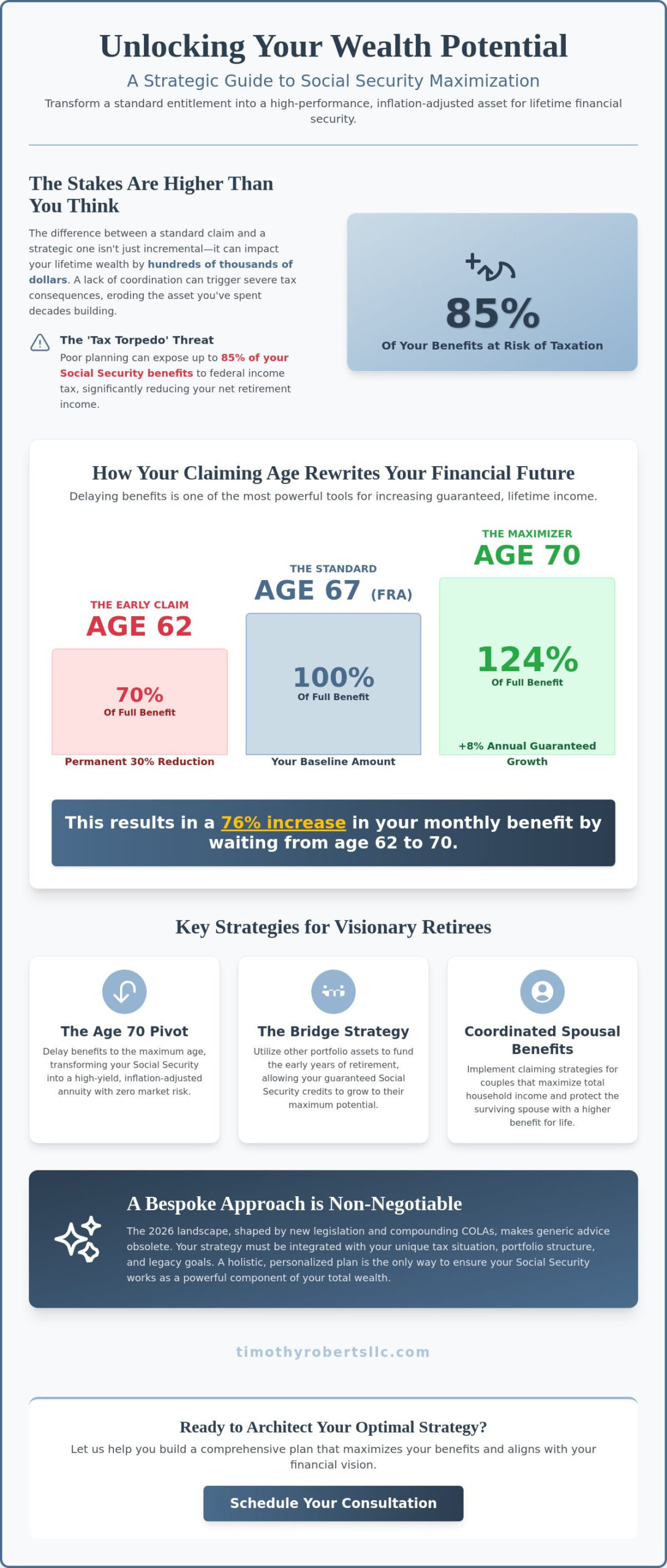
For most individuals reaching retirement eligibility in 2026, age 67 serves as the critical pivot point. This is your Full Retirement Age (FRA). Claiming at 62 results in a permanent reduction of up to 30% in monthly benefits, a mathematical penalty that compounds over decades. Conversely, waiting past age 67 allows you to earn “Delayed Retirement Credits.” These credits provide a guaranteed 8% annual increase for every year you wait until age 70. This total 24% boost creates a significantly higher floor for your entire wealth elevation strategy, ensuring that your base benefit is maximized before inflation adjustments are even applied.
The 2026 Regulatory Environment
The 2026 landscape is defined by the ripple effects of the Social Security Fairness Act of 2025. This legislation fundamentally changed the math for public service workers and high-earners by modifying the Windfall Elimination Provision (WEP). Furthermore, recent cost-of-living adjustments (COLAs) from the mid-2020s now compound more aggressively on higher base benefits. Standard advice from 2021 is now obsolete for sophisticated planners. Modern social security maximization strategies must account for these legislative shifts and the way 2026 tax brackets interact with provisional income. Success in this environment requires a holistic view that bridges the gap between personal creative vision and structured financial capabilities.
Strategic Claiming Techniques for the Visionary Retiree
Social security maximization strategies represent more than a bureaucratic filing; they serve as a sophisticated hedge against longevity risk. For the visionary retiree, the decision of when to claim benefits is a pivot point that defines the stability of a multi-decade financial architecture. The most potent tool in this arsenal is the “Age 70 Pivot.” By delaying benefits to the maximum age, you transform a standard entitlement into a high-yield, inflation-adjusted annuity that provides a level of security private markets rarely match.
The Mathematical Power of Delaying to 70
The math behind delaying is precise and compelling. If you choose to claim at age 62, your monthly benefit is reduced by as much as 30% compared to your full retirement age. Conversely, waiting until age 70 triggers delayed retirement credits of 8% per year. This creates a 76% increase in the monthly check amount compared to the age 62 baseline. This 8% annual growth is a guaranteed return, backed by the federal government, and adjusted for inflation. It’s an asset class that carries zero market risk. Many high-earners hesitate, fearing they’ll “lose” money if they pass away early. However, a holistic view prioritizes the risk of living to 95 over the risk of dying at 75. The larger benefit acts as a permanent floor for your lifestyle, ensuring that your standard of living remains elevated regardless of how long your retirement lasts.
Portfolio-First Sequencing
Executing a delay requires a tactical “Bridge Strategy.” Instead of tapping Social Security early, you utilize investment portfolio management to fund your initial retirement years. By drawing from taxable brokerage accounts or traditional IRAs between ages 62 and 70, you allow your Social Security credits to compound undisturbed. This sequencing is vital for managing sequence-of-returns risk. If the equity markets experience a downturn during your early retirement, your increased Social Security benefit at age 70 provides a larger “risk-off” bucket. This reduces the pressure on your remaining portfolio to generate high returns later in life. It’s a bespoke approach that treats Social Security as the foundation of your fixed-income allocation.
For those who have already claimed benefits but regret the decision, the “Claim, Suspend, and Restart” maneuver offers a strategic course correction. Once you reach full retirement age, you can suspend your payments. This allows your benefit to earn those 8% annual credits until age 70, effectively boosting your future floor. This is particularly crucial when evaluating claiming strategies for married couples, as the higher earner’s benefit often determines the survivor benefit for a spouse. Most break-even analyses suggest that if you live past age 80, the decision to delay yields a higher cumulative lifetime payout. When you view your wealth through a lens of long-term elevation, the choice to wait becomes the most logical path to prosperity. To explore how these maneuvers fit into your broader financial picture, consider how a strategic partnership can refine your retirement trajectory.
Coordinating Benefits for Couples and Survivors
Effective social security maximization strategies require a pivot from individual gain to household wealth optimization. Viewing benefits through a solitary lens often results in a 15% to 25% reduction in total lifetime value for a couple. A sophisticated approach treats these benefits as a joint asset, where the timing of one spouse directly influences the long term security of the other. The goal is to create a bespoke income floor that sustains the household through various longevity scenarios. This shift in perspective transforms a simple government check into a robust tool for financial stability.
The primary lever in this coordination is the higher earner rule. When the spouse with the larger work history delays claiming until age 70, they aren’t just increasing their own monthly check. They’re establishing a permanent high water mark for the survivor benefit. This strategic delay serves as a hedge against inflation and longevity risk, ensuring the surviving spouse isn’t left with a diminished income stream. Understanding these calculations is easier when referencing the Social Security Administration’s guide to retirement benefits, which outlines the foundational mechanics of benefit computation and the impact of timing on your primary insurance amount.
The Survivor Benefit Multiplier
A survivor inherits 100% of the deceased spouse’s monthly benefit if it’s higher than their own retirement amount. This makes delaying the primary earner’s claim a critical component of legacy planning. Many couples make the mistake of claiming both benefits at age 62 to maximize immediate cash flow. This tactic often results in a permanent loss of hundreds of thousands of dollars in cumulative wealth over a 30 year retirement. By 2026, the gap between early filing and age 70 filing will be even more pronounced as cost of living adjustments compound on a larger base.
Divorced and Spousal Claiming Nuances
Divorced individuals can often unlock significant value by claiming on an ex-spouse’s record. To qualify, the marriage must have lasted at least 10 years, and the claimant must remain unmarried. It’s a common misconception that this reduces the ex-spouse’s benefit; it has zero impact on their payments or their current spouse’s record. This allows for complex sequencing where a survivor might claim a reduced widow’s benefit at age 60 while letting their own retirement benefit grow until age 70. These social security maximization strategies ensure that no capital is left on the table during the transition into a high end retirement lifestyle. Precision in these choices defines the difference between a standard retirement and one characterized by true financial elevation.
Mitigating the ‘Tax Torpedo’ and Provisional Income
Many high-net-worth retirees fear their benefits will be entirely eroded by taxes. This isn’t just a psychological hurdle; it’s a mathematical reality for those who fail to plan. Effective social security maximization strategies must account for the “Tax Torpedo,” a phenomenon where additional income triggers a cascade of taxation on your benefits. This creates a scenario where every dollar of extra income can sometimes cost $1.85 in taxable impact, effectively punishing you for your success.
When your provisional income exceeds certain thresholds, the IRS taxes up to 85% of your Social Security payments. For married couples filing jointly, this threshold sits at a modest $44,000. For individuals, it’s just $34,000. Crossing these lines can lead to a marginal tax rate as high as 40.7% on modest income increases. This happens because every dollar earned pulls more of your benefit into the taxable category until you hit the 85% cap.
Calculating Your Tax Exposure
Provisional income is the metric the IRS uses to determine benefit taxation. You calculate it by taking your Adjusted Gross Income, adding any tax-exempt interest, and then adding 50% of your Social Security benefits. Many investors mistakenly believe municipal bond interest is tax-free, yet it’s fully included in the provisional income formula. This oversight can inadvertently push you into the 85% taxation bracket, turning a low-yield bond into a high-cost liability.
Tax-Efficient Withdrawal Sequencing
Precision in your withdrawal order is essential for wealth preservation. Expert tax advising helps coordinate Required Minimum Distributions (RMDs) from traditional IRAs to ensure they don’t spike your provisional income at the wrong time. Utilizing Qualified Charitable Distributions (QCDs) allows you to satisfy RMD requirements by sending funds directly to a 501(c)(3) organization. This technique keeps that income off your tax return entirely, shielding your Social Security from the torpedo effect.
Strategic Roth conversions performed prior to claiming benefits can also lower your future tax liability. By paying taxes now at a known rate, you reduce the size of the accounts that trigger future RMDs. Integrating non-provisional income sources like cash-value life insurance or Roth IRA distributions is a hallmark of bespoke social security maximization strategies. These tools provide liquidity without increasing your taxable footprint, allowing for a more holistic approach to retirement cash flow.
Bespoke Maximization: The Timothy Roberts LLC Approach
Generic online calculators often treat your financial life as a series of isolated data points. They lack the nuance to account for the sunsetting of the Tax Cuts and Jobs Act provisions in 2026 or the specific complexities of your estate goals. These digital tools provide a baseline, but they don’t offer a strategy. At Timothy Roberts LLC, we move beyond the algorithm to deliver a personalized roadmap that treats your benefits as one component of a larger, sophisticated engine. We believe that a standardized software report is no substitute for a fiduciary perspective.
True success isn’t found in a vacuum. It requires an understanding of how your filing date impacts your spouse, your tax bracket, and your portfolio’s longevity. We focus on the intersection of aesthetics and functionality in financial planning, ensuring your income stream is as resilient as it is robust. This is the difference between a guess and a calculated financial intervention designed for long-term stability. By choosing a tailored approach, you ensure that your social security maximization strategies are aligned with your broader vision for wealth elevation.
The Holistic Wealth Elevation Framework
Effective social security maximization strategies require a perspective that extends across multiple decades. We don’t simply look at the filing age; we examine how those benefits interact with your investment oversight and tax liabilities. Our framework models “what-if” scenarios, such as a 20% market downturn during your first three years of retirement or a lifespan reaching age 95. We integrate your benefits into a comprehensive retirement income plan to ensure every dollar serves a purpose. This approach transforms a government benefit into a strategic asset for wealth preservation and legacy building.
Your Strategic Consultation
A calculated financial intervention begins with absolute clarity. During a strategy session, we dive deep into your current financial architecture to identify untapped opportunities. To make the most of this time, you’ll need to provide your Social Security Statement, your most recent tax return, and your full investment portfolio. We’ll use this data to move your retirement journey from a series of guesses to an intentional, polished plan. This isn’t just about numbers; it’s about the confidence that comes from a structured, high-level strategy.
The peace of mind that comes from a professional roadmap is invaluable. You’ll leave with a clear understanding of how to thrive in a multi-decade retirement, backed by rigorous analysis and a fiduciary commitment. Elevate your retirement journey today. Let’s build a future that reflects your ambition and your legacy through precise, data-driven planning. Your wealth deserves more than a generic solution, it deserves an intervention that is as unique as your goals.
Secure Your Wealth Legacy for 2026 and Beyond
Navigating the complexities of 2026 requires more than a casual glance at a benefits statement. It demands a rigorous understanding of how provisional income affects your bottom line and how coordinated claiming protects a surviving spouse. You’ve explored the architecture of high-level social security maximization strategies, from timing your filing to avoid the tax torpedo to aligning benefits with a broader portfolio. These aren’t just administrative choices. They’re the foundation of your financial independence.
Timothy Roberts LLC brings over 25 years of fiduciary experience to this delicate process. We specialize in crafting bespoke tax-efficient retirement roadmaps that go beyond simple spreadsheets. Our focus remains on sophisticated multi-generational legacy planning, ensuring your wealth serves your family for decades. It’s time to move past generic advice and embrace a plan designed for your specific vision. Elevate your retirement strategy with a bespoke Social Security maximization plan. Your future deserves the clarity of a professional, well-timed strategy.
Frequently Asked Questions
What is the best age to claim Social Security for a high-net-worth individual?
Age 70 is the optimal milestone for high-net-worth individuals to lock in the maximum monthly payout. This strategy leverages the 8% annual delayed retirement credit provided by the Social Security Administration. It creates a robust, inflation-protected floor for your broader portfolio. Waiting until 70 ensures your bespoke wealth plan captures the highest possible guaranteed income stream for life.
How does the Social Security Fairness Act of 2025 affect my 2026 claiming strategy?
The Social Security Fairness Act of 2025 eliminates the Windfall Elimination Provision and the Government Pension Offset. This legislative shift benefits 2.8 million retirees who previously saw reduced checks due to public service pensions. In 2026, your social security maximization strategies should account for this full restoration of benefits. It allows for a more holistic approach to retirement income without previous penalties.
Can I change my mind and restart my Social Security benefits if I claimed early?
You can stop your benefits and restart them if you file a withdrawal within 12 months of your initial claim. This requires filing Form SSA-521 and repaying every dollar received to the Social Security Administration. It’s a one-time opportunity to reset your strategy. After 12 months, you’ll need to wait until you reach full retirement age to suspend payments and earn delayed credits.
How much of my Social Security benefit will be lost to taxes in 2026?
In 2026, up to 85% of your benefits will be subject to federal income tax if your provisional income exceeds $44,000 for married couples. The IRS uses a specific formula where half of your Social Security plus other income determines the tax liability. For high-earning households, this is a near-certainty. Strategic tax planning is essential to mitigate the impact of these thresholds on your total net worth.
Is it better to take Social Security early and invest it in the stock market?
Taking benefits at 62 to invest in equities is rarely a winning strategy compared to the guaranteed 8% annual increase from delaying. While the S&P 500 has a long-term average return of 10%, it lacks the risk-free nature of Social Security credits. Delaying provides a bespoke hedge against market volatility. Most sophisticated investors find that social security maximization strategies prioritize the certainty of the government-backed 8% return.
How do spousal benefits work if my husband or wife never worked outside the home?
A spouse who never worked is eligible for up to 50% of the primary earner’s benefit at full retirement age. This claim doesn’t reduce the primary worker’s monthly payment. The non-working spouse must be at least 62 to qualify for this secondary stream of income. It’s a vital component of a holistic family wealth plan that ensures both partners are supported through their sunset years.
Will my Social Security benefit be reduced if I continue to work part-time?
Your benefits will be reduced if you’re under full retirement age and earn more than the 2026 limit, projected to be $23,500. The Social Security Administration withholds $1 for every $2 earned above this threshold. Once you reach full retirement age, these earnings limits vanish entirely. Any withheld funds are eventually recalculated into your monthly benefit, so the money isn’t lost; it’s simply deferred.
What happens to my Social Security benefits if I move or retire abroad?
You can receive your Social Security payments in most foreign countries if you’re a U.S. citizen. The Social Security Administration currently sends payments to retirees in 200 different nations. Some countries, like Cuba and North Korea, are excluded due to Treasury Department restrictions. You must report your change of address to the local U.S. embassy to ensure your international banking details remain current and secure.
