

May
Questions to Ask a Potential Financial Advisor: A Strategic Vetting Guide for 2026
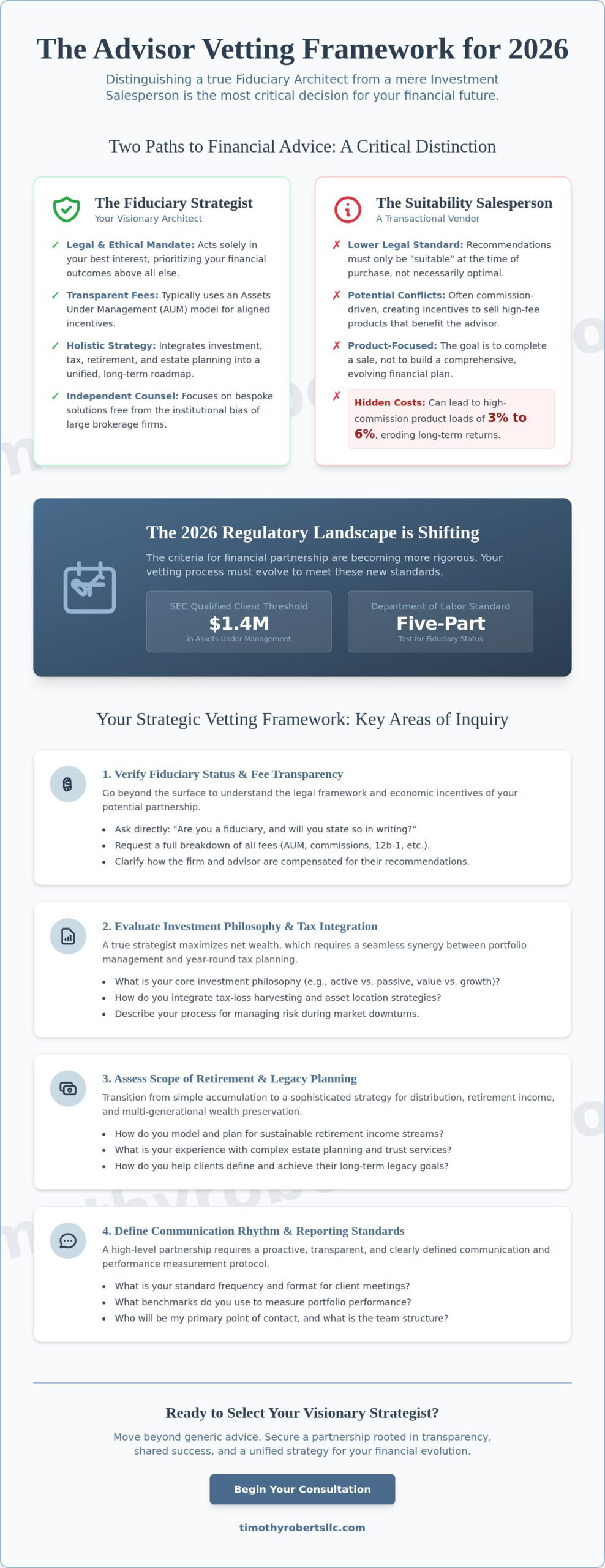
The most expensive mistake in your wealth journey isn’t a market downturn. It is a partnership built on a fundamental misunderstanding of intent. As 2026 introduces more rigorous SEC thresholds and a return to the five-part fiduciary test, the standard vetting process has become obsolete. You are not merely hiring a vendor to execute trades. You are selecting a visionary strategist to architect your financial evolution. Mastering the specific questions to ask a potential financial advisor is the only way to distinguish a true fiduciary from a simple investment salesperson.
You’ve likely felt the exhaustion that comes from generic advice and the lingering fear of hidden fee structures. It’s a valid concern, especially when tax laws and estate regulations grow more complex by the day. We’ll help you move past the surface-level pitch to secure a relationship rooted in transparency and shared success. This guide provides a high-level framework for your interviews. We will explore how to verify fiduciary status and build a unified strategy for retirement income, tax planning, and investment management.
Key Takeaways
- Identify the specific questions to ask a potential financial advisor that reveal whether they are a true fiduciary or merely a product salesperson.
- Explore the essential synergy between investment portfolio management and year-round tax planning strategies to maximize your net wealth evolution.
- Decode the complex 2026 regulatory landscape to distinguish between a standard “suitability” advisor and a deeply committed fiduciary partner.
- Transition your focus from simple wealth accumulation to a sophisticated distribution strategy designed for retirement income and long-term legacy preservation.
- Define a clear communication rhythm and performance reporting standard that fosters a proactive, high-level partnership for your organizational growth.
The Strategic Importance of Vetting Your Financial Partner
The 2026 fiscal environment is not a place for passive observation. With shifting tax brackets and the new SEC qualified client threshold of $1.4 million in assets under management, the stakes have never been higher. You aren’t just looking for a portfolio manager. You’re looking for a partner in organizational evolution. This requires a shift in mindset. Instead of a casual interview, approach this as a high-level consultancy audit. Knowing the right questions to ask a potential financial advisor transforms a standard meeting into a strategic intervention.
Understanding what is a financial advisor involves looking beyond the title to the underlying structure of the firm. A mere broker operates on a transactional basis, often driven by commissions. A visionary strategist integrates your personal creative vision with structured corporate capabilities. Misalignment here isn’t just a minor inconvenience. It’s a fundamental threat to multi-generational wealth that can erode your legacy over decades.
To better understand this concept, watch this helpful video:
The Evolution of the Advisor-Client Relationship
The relationship has evolved far beyond simple stock picking. Modern wealth stewardship requires an intersection of aesthetics and functionality. It’s about how your assets serve your life’s work. While some firms prioritize comfort or rapport, elite partnerships prioritize competence and character. You need an advisor who understands that your financial roadmap is a living document, not an off-the-shelf solution. This shift moves away from aggressive sales tactics toward a narrative of partnership and shared success.
Defining Your Objectives Before the Interview
Before the first meeting, define your primary driver. Are you focused on aggressive growth, capital preservation, or sustainable retirement income? This clarity allows you to create a shortlist based on specialized interventions. Seek a partner with intellectual curiosity. They should value depth over superficiality, ensuring your estate planning and legacy preservation are handled with the same rigor as your daily investments. Refining your list of questions to ask a potential financial advisor ensures you find a craftsman, not just a consultant.
Decoding Fiduciary Duty and Fee Transparency
In a landscape where the Department of Labor has reverted to a rigorous five-part test to determine fiduciary status as of April 2026, understanding the legal framework of your partnership is paramount. Transparency is not merely a courtesy; it’s a strategic requirement. High-net-worth individuals often find that a standard “suitability” model fails to protect their interests during complex market shifts. To secure your wealth evolution, you must look beyond the pitch to the underlying incentives. Refined Forbes’ 10 Questions for Financial Advisors offer a foundational starting point, but true vetting requires a deeper dive into how an advisor’s compensation dictates their counsel.
The Fiduciary Standard vs. Suitability
The fiduciary standard is a legal and ethical mandate to act solely in the client’s interest. This distinction is critical because the alternative, the suitability standard, only requires that a recommendation be “suitable” for your situation at the time of purchase. This lower bar often permits the sale of high-commission products that may carry significant 3% to 6% loads, potentially undermining your long-term performance. In contrast, a fiduciary must prioritize your outcomes above their own firm’s profit. Large-scale brokerage firms often struggle with institutional bias, whereas an independent fiduciary partner focuses on bespoke interventions that align with your specific objectives.
Demystifying the Cost of Expertise
Understanding fee structures is the first step toward genuine transparency. While 96% of registered investment advisory firms utilize an Assets Under Management (AUM) model, typically around 1.0% for portfolios up to $1 million, it’s not the only path. This model aligns your advisor’s growth directly with your portfolio’s success. Alternatively, fixed-fee planning, with a 2026 median of $4,500 annually, provides a predictable cost for project-based strategic work. When preparing your list of questions to ask a potential financial advisor, insist on a full disclosure of “soft dollar” compensation or 12b-1 fees. These hidden costs can silently erode your returns if not identified early in the engagement.
Securing a written fiduciary oath is a non-negotiable step in this process. It transforms a verbal promise into a professional commitment. If you’re seeking a partner who prioritizes this level of clarity, exploring a structured approach to wealth management can provide the stability your portfolio requires. This level of rigor ensures that every tactical move is made with your legacy in mind, rather than a sales quota.
Evaluating Investment Philosophy and Tax-Efficient Integration
Investment management exists at the intersection of aesthetics and functionality. It’s not enough for a portfolio to grow; it must be architected to withstand the friction of taxation and market volatility. In the current 2026 environment, where single filers earning over $640,600 face a 37% marginal tax bracket, a “tax-blind” investment approach is a significant strategic failure. When considering the right questions to ask a potential financial advisor, you must pivot the conversation toward how they mitigate capital gains and utilize year-round tax-loss harvesting. This level of rigor ensures that your growth isn’t quietly eroded by avoidable liabilities.
The Strategic Intersection of Taxes and Wealth
True wealth stewardship requires that your advisor coordinate directly with sophisticated tax advising. This synergy ensures that every trade is evaluated for its net-of-tax impact rather than just its gross performance. Inquire whether their strategy is “Tax-Aware” or “Tax-Blind.” A tax-aware approach uses professional investment portfolio management to proactively minimize liabilities. They should treat tax planning as a continuous intervention rather than a year-end checklist, especially as 2026 tax brackets demand more precise income management.
Vetting the Investment Framework
Beyond taxes, you must interrogate the advisor’s stance on active versus passive management and their specific diversification methodology. A disciplined partner doesn’t chase trends. They rely on a rigorous framework to manage risk tolerance and portfolio volatility. Ask specific questions to ask a potential financial advisor regarding their asset allocation during high-volatility periods. In 2026, with a standard deduction of $32,200 for married couples filing jointly, the margin for error in tax-efficient distribution has narrowed.
A visionary advisor will explain their disciplined rebalancing schedule and how they protect your capital during “Black Swan” events or sudden market corrections. Their mechanism for rebalancing should be steady and logical, guiding the portfolio through volatility without emotional reaction. This isn’t about predicting the future; it’s about building a resilient structure that values depth over superficial market noise. This professional stability distinguishes a visionary strategist from a generic consultant who simply reacts to the news cycle.
Assessing the Scope of Retirement and Estate Planning
Growth is only half the journey. The transition from the accumulation phase to the distribution phase represents one of the most significant tactical shifts an investor will ever face. While many advisors focus on the climb, few are equipped to architect the descent. A visionary strategist understands that retirement is not a destination but a period of organizational evolution. One of the most vital questions to ask a potential financial advisor is whether they specialize in turning a portfolio into a sustainable paycheck. This shift requires a deep understanding of tax-efficient withdrawal sequencing and risk management that extends far beyond the equity markets.
Mastering the Retirement Income Phase
Effective wealth stewardship involves more than just hitting a target number. It requires comprehensive retirement income planning that accounts for the “Sequence of Returns” risk. This risk occurs when market downturns happen early in your retirement, potentially depleting your capital faster than anticipated. Your advisor should provide a clear roadmap for Social Security optimization and pension integration. They must ensure your withdrawal rates are sustainable against the 2026 inflationary backdrop. It’s about creating a steady, logical flow of income that preserves your lifestyle without compromising your principal.
Legacy and Estate Coordination
A will is a document; a legacy is a strategy. High-level estate planning and legacy preservation involves coordinating with your legal counsel to ensure every asset is titled correctly and every trust is funded. An expert advisor helps you organize the “financial junk drawer” that often accumulates over decades. They facilitate family governance and charitable giving strategies that reflect your personal creative vision. This level of customized intervention ensures that your multi-generational wealth transfer is seamless and intentional. When refining your questions to ask a potential financial advisor, inquire about their experience with complex trust structures and risk management analysis. They should act as the central hub for your professional advisors, ensuring your legacy remains intact across generations.
Protecting your future requires a partner who looks at the total picture of your wealth. If you’re ready to move beyond generic savings and toward a sophisticated income strategy, consider how a bespoke approach to retirement income planning can secure your evolution.
Finalizing the Selection: From Inquiry to Implementation
The final stage of vetting is not merely about verifying credentials. It’s about confirming a cultural and strategic fit that will sustain your wealth evolution for decades. You’ve analyzed fiduciary standards and interrogated tax-efficient integration. Now, the focus shifts to the functional reality of the partnership. A high-end advisory relationship is a professional consultancy, and its success depends on a shared vision of upward progression. The last questions to ask a potential financial advisor should target the clarity of their reporting and the proactive nature of their outreach. You aren’t just looking for a service provider; you’re engaging a visionary strategist who acts as a reliable business partner.
Setting the Cadence of Partnership
Define the communication rhythm early to avoid the frustration of reactive service. A sophisticated firm provides calm confidence through regular, structured touchpoints rather than just calling during market volatility. Inquire about their “bench strength.” You should know if you’re working with a single individual or a team of experts who provide specialized interventions in wealth management. This team-based approach ensures that your strategy remains stable even if a primary contact is unavailable. Formal reviews should be steady and logical, guiding you from high-level vision down to the practicalities of execution.
The Implementation Roadmap
The transition from “Interviewing” to “Engaging” should feel seamless and intentional. The first 90 days of a high-end relationship are the most intensive. Industry data from the 2023 Kitces Report indicates that advisors typically dedicate an average of 36 hours to a client in the first year of a relationship, dropping to 21 hours in subsequent years. This initial surge of activity is necessary to organize your “financial junk drawer” and align your investment portfolio management with your long-term goals. Your advisor should lead this onboarding process with professional stability, handling the complexities of account transfers and tax cost-basis verification without burdening you with the minutiae.
Transitioning from a legacy advisor to a new strategic partner can feel daunting, but it’s a necessary step for your continued growth. If your current counsel offers only generic, uninspired advice, it’s time to seek a partner who values depth over superficiality. Frame the move as a strategic choice for your future rather than a critique of the past. By finalizing your selection with a clear implementation roadmap, you ensure that your retirement income planning and legacy goals are in the hands of a true craftsman. This deliberate approach reinforces the idea that your wealth is a journey of development, not a simple transaction.
Architecting Your Financial Future
Your wealth is more than a balance sheet. It’s the manifestation of your life’s work and creative vision. Selecting a partner to steward this legacy requires more than a cursory glance at credentials. It demands a rigorous interrogation of intent and capability. By mastering the strategic questions to ask a potential financial advisor, you’ve moved from a position of uncertainty to one of calm confidence. You now understand that a true partnership thrives on the intersection of tax-efficient investment management and a sophisticated distribution strategy.
Our firm has dedicated over 25 years to fiduciary excellence, acting as a visionary strategist for high-net-worth individuals. We synthesize integrated tax and wealth management capabilities with a specialized focus on Retirement Income Planning to ensure your upward progression remains steady. We don’t offer off-the-shelf solutions. We provide carefully crafted interventions designed for your specific evolution. Request a Strategic Consultation with our Fiduciary Team to begin this new chapter. Take the next step in your journey with a partner who values depth over superficiality. Your future deserves the rigor of an expert craftsman.
Frequently Asked Questions
What is the difference between a fee-only and a fee-based financial advisor?
Fee-only advisors receive compensation exclusively from their clients, while fee-based advisors collect both client fees and commissions from financial product sales. This distinction is a fundamental part of the questions to ask a potential financial advisor because it highlights potential conflicts of interest. Fee-only structures prioritize transparency, ensuring the advice remains focused on your wealth evolution rather than meeting product sales quotas.
Why is fiduciary duty the most important factor when choosing an advisor?
Fiduciary duty is the only standard that legally and ethically mandates an advisor to act solely in your best interest at all times. Unlike the lower “suitability” standard, a fiduciary must prioritize your outcomes over their own firm’s profit. As of the April 2026 regulatory updates, this distinction has become even more critical for individuals navigating complex tax laws and estate preservation requirements.
Can a financial advisor also help with my business and personal tax preparation?
Many high-end firms offer integrated tax advising and tax planning strategies as a core component of their wealth management services. While these firms provide the strategic framework for tax mitigation and liability reduction, you should verify if they perform the actual filing or coordinate with your external CPA. This synergy ensures your investment decisions and tax liabilities are managed as a single, unified roadmap.
How much should I expect to pay for a comprehensive financial plan in 2026?
Industry pricing for comprehensive financial planning varies depending on the complexity of your assets and the depth of the strategic interventions required. Some firms utilize a flat-fee model for project-based work, while others integrate planning costs into an overall assets under management fee. You should request a transparent, written breakdown of all costs during your initial discovery phase to ensure long-term alignment.
What certifications should I look for in a potential financial advisor?
The Certified Financial Planner (CFP) designation remains the industry gold standard for comprehensive expertise and ethical conduct. In 2026, this certification requires a bachelor’s degree, rigorous exam passage, and 6,000 hours of professional experience. Look for advisors who also demonstrate a commitment to ongoing intellectual curiosity through advanced training in retirement income planning and estate coordination.
How do I know if an advisor specializes in retirement income planning specifically?
Specialized advisors focus on the distribution phase of wealth, emphasizing how to turn assets into a sustainable paycheck. They will proactively discuss “Sequence of Returns” risk and withdrawal rate sustainability during market cycles rather than just focusing on asset accumulation. If their primary pitch is only about portfolio growth without a plan for generating income, they likely lack this specific specialization.
What happens to my assets if the advisory firm closes or is acquired?
Your assets are typically held at independent, third-party custodians rather than by the advisory firm itself. This structure provides a layer of professional stability and protection for your portfolio. If a firm closes or is acquired, your accounts remain secure at the custodian, and the transition to a new strategic partner is primarily an administrative process rather than a risk to your principal.
Should I ask a potential advisor for references from existing clients?
While asking for references is a traditional step, privacy regulations and SEC compliance often prevent advisors from sharing specific client contact information. A more effective vetting method is to review the firm’s Form ADV and check their history through the Investment Adviser Public Disclosure (IAPD) website. This provides an objective, regulatory view of their professional standing and any past disciplinary actions.
