

Oct
Financial Planning to Reduce Anxiety About the Future
A financial plan can’t tell you exactly what the future holds, but it can make your next decision clearer. If you’re unsure whether your savings will support your goals, struggling to organize competing priorities, or unsettled by changes in the markets, your health, work, or family, financial planning to reduce anxiety about the future starts with clarifying what you can influence, not predicting what you can’t.
It’s understandable to want certainty before making important financial choices. But confidence doesn’t have to depend on guaranteed outcomes. A practical plan can bring your current finances into focus, help you set priorities, and identify manageable steps, even as circumstances change.
This article explores how to build that foundation: review where you stand, connect decisions that may otherwise feel fragmented, and identify next steps for retirement income, investing, taxes, and protecting your legacy. You’ll see how a plan can evolve with your life, replacing an overwhelming list of unknowns with clearer priorities and a steadier path forward.
Key Takeaways
- Financial planning to reduce anxiety about the future is about clarifying choices, not predicting or controlling every outcome.
- See how cash flow, savings, debt, investments, insurance, taxes, and future income fit into one financial picture.
- Use goals, timelines, and risk tolerance to decide which priorities deserve attention first.
- Build your plan gradually by gathering records, clarifying goals, prioritizing decisions, modeling possibilities, and reviewing as life changes.
- Coordinating retirement income, investment, tax, risk, and estate priorities can help you take more deliberate next steps.
How financial planning can make an uncertain future feel more manageable
Questions about whether savings will support retirement, how to prepare for family needs, or what might happen if work or health changes can be difficult to sort through all at once. Financial planning is an ongoing process of aligning your resources, goals, risks, and decisions as life changes. It gives separate concerns a structure, helping you distinguish what needs attention now from what can be revisited later.
A plan has limits. It can’t predict market movements, prevent every setback, or guarantee a particular outcome. Its value is in preparing you to make informed choices as circumstances evolve. This comprehensive financial planning overview describes the broad areas planning can encompass, but applying them starts with your own priorities and financial picture.
What can a financial plan help you control?
You can’t control every event, but you can decide how to prepare. Saving regularly, reviewing insurance coverage, tracking spending, and checking whether your investments still fit your goals are actions within your influence. Bringing income, expenses, assets, and obligations together can reveal which decision deserves attention first.
For example, someone balancing retirement saving with support for a family member could begin by listing monthly income, essential expenses, and current savings contributions. Seeing those amounts together makes it easier to compare priorities and identify whether an adjustment is manageable. The right choice differs by household, but making trade-offs visible helps decisions reflect individual needs rather than competing worries.
Why a plan is a process, not a prediction
A plan is a working framework, not a fixed script. A change in income, a new family responsibility, or a shift in retirement timing may call for a fresh look at goals and priorities. Revisiting the plan helps you respond deliberately instead of assuming earlier decisions must remain right forever.
Projections rely on assumptions about factors such as future income, spending, and investment performance. They can help you explore possibilities, but they aren’t promises. Financial planning to reduce anxiety about the future means using assumptions as tools for discussion and adjustment, not as guarantees of what will happen.
General financial worry may involve uncertainty that no financial plan can resolve. A plan can help organize the parts connected to financial choices, such as savings, obligations, and future income. The aim isn’t to produce a perfect forecast or eliminate every concern. It’s to build clarity through manageable steps, then adapt as your circumstances change.
The financial planning elements that create a clearer picture
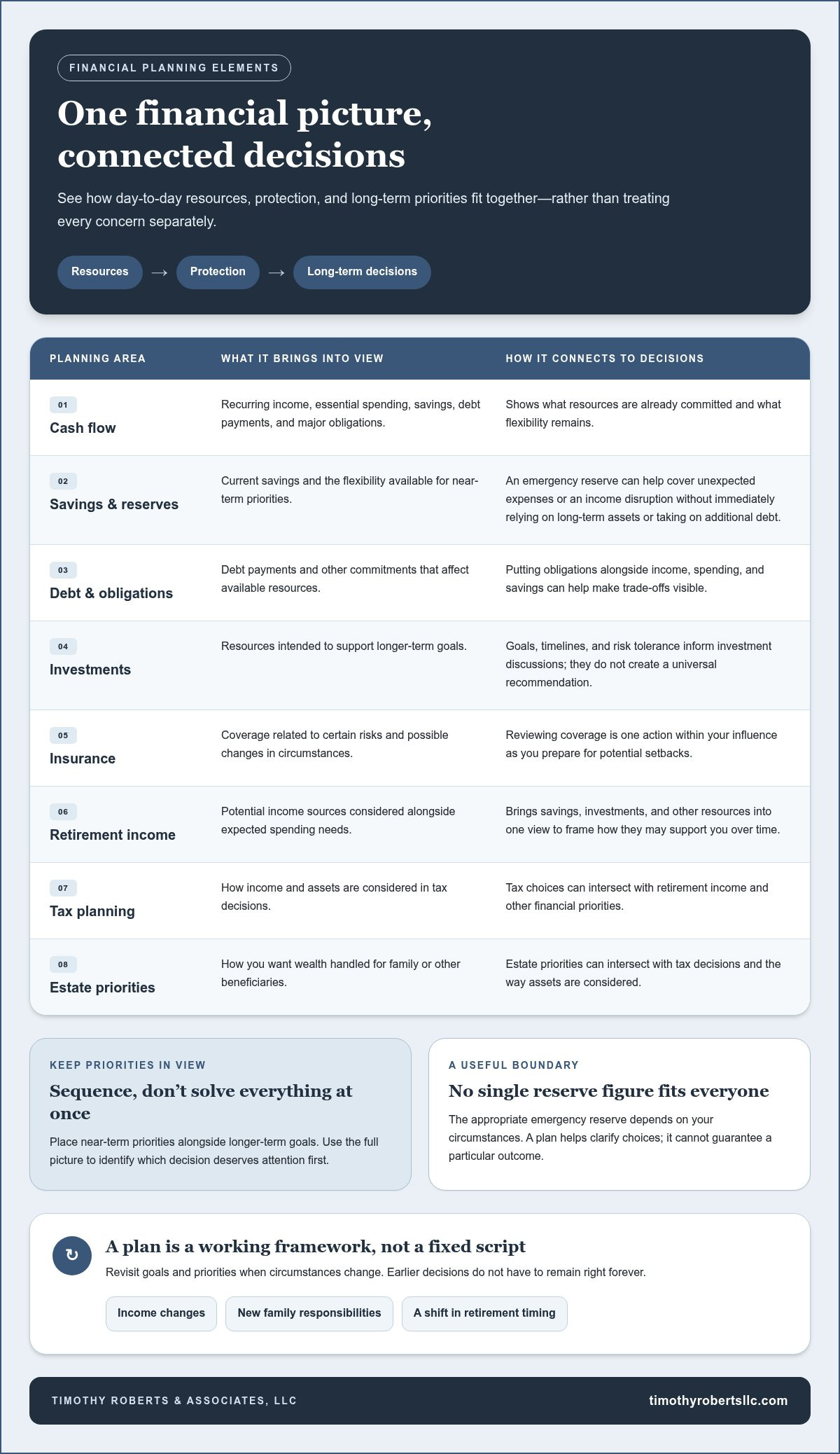
A useful plan brings financial areas into view together rather than treating each decision separately. Cash flow shows what comes in and goes out; savings and emergency reserves provide flexibility; debt and obligations affect available resources; investments support longer-term goals; insurance addresses certain risks; and tax, estate, and future income planning connect today’s choices with later needs.
Financial planning elements work together to align day-to-day resources, protection, and long-term decisions with your goals and capacity for risk. Coordinating them can reveal trade-offs that are easy to miss when you look at one account or concern at a time.
Start with cash flow, reserves, and near-term priorities
Begin with a straightforward inventory: recurring income, essential spending, savings, debt payments, and major obligations. The aim isn’t to judge every choice. It’s to understand what resources are already committed and what flexibility remains.
An emergency reserve can help cover unexpected expenses or a disruption in income without immediately relying on long-term assets or taking on additional debt. The appropriate amount depends on your circumstances, so there’s no single figure that fits everyone. Next, name near-term priorities, such as managing a major expense or strengthening savings. Putting these alongside longer-term goals makes it easier to sequence decisions instead of trying to address everything at once.
Connect long-term goals with risk, tax, and income planning
Goals and timelines help shape investment discussions. A goal that is years away may involve different considerations than an upcoming expense, while risk tolerance helps clarify how much uncertainty you’re prepared to accept. These factors inform a tailored conversation, not a universal investment recommendation.
Retirement income planning brings potential income sources and expected spending needs into one view. It can help frame questions about how investments, savings, and other resources may support you over time. Tax decisions can influence how income and assets are considered, while estate priorities may affect how you want wealth handled for family or other beneficiaries. These areas can intersect, and the right approach depends on your circumstances. Qualified financial and tax guidance can help coordinate the decisions.
For financial planning to reduce anxiety about the future, the goal is to understand how each piece relates to the others. A change to income, for example, may affect savings priorities, retirement timing, or the need to revisit risk management. Coordinated financial planning can bring those questions into focus. Explore comprehensive financial planning as one way to connect your priorities and decisions.
Does financial planning really reduce anxiety when the future is uncertain?
A financial plan can’t remove uncertainty, prevent every setback, or promise that a goal will unfold exactly as expected. Markets change. Health and family needs shift. Plans can also be affected by events no one anticipated. If “reduce anxiety” sounds like a promise of complete peace of mind, it’s important to set a more realistic expectation.
The value of financial planning to reduce anxiety about the future is more practical: it can help clarify which choices are available, define what matters most, and establish a process for responding when circumstances change. That structure may make financial decisions feel more manageable, but it doesn’t guarantee how you’ll feel or what outcomes you’ll experience.
What a financial plan can, and cannot, do
A plan can help you compare scenarios without claiming to predict which one will happen. For instance, you might consider how a retirement timeline could change if income, spending, or investment values differ from current assumptions. Comparing possibilities can surface questions to address now, such as whether priorities need adjusting or a decision should be revisited.
Scenarios are tools for preparation, not forecasts. Investment values can fluctuate, tax rules may change, and health needs or family circumstances can evolve. A projection built on today’s assumptions may need updating as those inputs change. Review your plan when a meaningful event affects your finances or goals, such as a change in employment, a major family transition, or a decision to retire. The purpose is to reassess, not treat an earlier estimate as a promise.
This distinction matters: planning offers a framework for choice, not control over every outcome. It can help you identify what you know, what remains uncertain, and which decisions are still within your influence.
When financial worries may need support beyond a plan
Organizing financial information can help with financial questions, but it isn’t a substitute for mental health care. Feeling concerned about savings or future expenses is not, on its own, a diagnosis. If distress persists, feels difficult to manage, or interferes with daily life, consider speaking with a qualified mental health professional.
Different kinds of support address different needs. Financial planning can organize resources and decisions; mental health support can help with emotional distress. Seeking help for either is a considered step, not a sign that you’ve failed to plan. The aim isn’t to eliminate every unknown, but to have an appropriate way to address the practical and personal parts of uncertainty.
How to build a financial plan, one manageable step at a time
You don’t need to solve every financial question at once. A measured process can turn broad concerns into specific decisions, then give you a way to revisit them as life changes. A useful sequence is simple: gather, clarify, prioritize, model, and review.
Gather information and define what matters most
Start with a working snapshot of your finances. Collect the information you have. Estimates can help you begin, and you can refine them later.
- Gather: List income, recurring expenses, savings and investment accounts, debts, insurance coverage, and relevant tax or estate-planning documents.
- Clarify: Turn general concerns into questions. For example, “Will I have enough?” might become “What income might I need in retirement?” or “How do I want to approach future education costs?”
- Prioritize: Separate essential goals from preferences, then give each a realistic time horizon. A near-term need and a long-term aspiration may call for different next steps.
This simple worksheet can organize your starting point:
- Goals: What do I want to fund or prepare for?
- Current resources: What income, savings, investments, and coverage do I have?
- Concerns: Which uncertainties or obligations need attention?
- Next actions: What is one practical step, and when will I take it?
Choose actions, test scenarios, and schedule reviews
Choose a small number of actions to begin. Make each one specific: organize account details, review a recurring expense, or gather information about a goal. Write down when you’ll do each one. A scheduled time is easier to act on than a vague intention to “get finances in order.”
Next, compare reasonable scenarios. For example, consider how a goal might be affected if income or expenses change. Record the assumptions and trade-offs behind each possibility. The purpose is to explore choices, not predict which outcome will occur. Then choose a review rhythm that fits your circumstances and revisit the plan after a major life or financial change.
These steps make financial planning to reduce anxiety about the future a practical process rather than a search for a perfect forecast. If you’d like personalized support connecting your goals, resources, and decisions, explore comprehensive financial planning.
How comprehensive financial planning can support your next steps
Professional guidance may be useful when financial decisions begin to overlap. Planning for retirement income, for example, can raise questions about investment withdrawals, tax considerations, insurance needs, and the legacy you hope to leave. Considering these priorities together can help you see how one decision may affect another, rather than treating each concern as a separate task.
At Timothy Roberts & Associates, LLC, fiduciary advisors develop personalized strategies around clients’ goals and risk tolerance. This guidance can support a more coordinated view of your financial picture, but it doesn’t promise certainty, investment performance, or a particular result. Its purpose is to help you understand your options and make decisions suited to your circumstances.
What to expect from a coordinated planning relationship
A planning relationship begins with understanding your goals and organizing relevant financial information. From there, recommendations can be developed around your priorities, then revisited as circumstances or goals change. The process is collaborative: you bring your questions and context, while planning helps connect them to practical decisions.
Those connections matter. Investment portfolio management relates to how you pursue longer-term goals, while tax advising considers tax-related decisions and estate planning considers your legacy priorities. Retirement income planning brings potential income sources and future spending needs into the conversation. Together, these perspectives can create a more integrated framework than considering each area in isolation.
Timothy Roberts & Associates, LLC brings more than 25 years of experience to financial planning and related areas, including retirement income, investments, tax advising, and estate planning. Recommendations depend on each person’s goals, risk tolerance, and financial circumstances.
Turn the first step into a practical next move
Before seeking guidance, write down your three most important financial questions. They might concern whether your savings align with a goal, how to think about future income, or which family priorities need attention. Then prepare an organized snapshot of your goals, accounts, income, and concerns. It doesn’t need to be perfect; a clear starting point is enough to make a conversation more focused.
Financial planning to reduce anxiety about the future isn’t about handing every decision to someone else. It’s about gaining a clearer view of your choices and having a thoughtful process for working through them. Personalized guidance can help connect those choices to your circumstances.
Take a clearer next step toward your financial goals
A practical financial plan won’t predict the future, but it can help you organize what matters, understand your choices, and adapt as life changes. Start by clarifying your priorities and taking one manageable step. Coordinating retirement income, investments, taxes, and estate considerations can also help you see how separate decisions fit into a broader financial picture.
For financial planning to reduce anxiety about the future, focus on building clarity rather than seeking guarantees. Timothy Roberts & Associates, LLC brings more than 25 years of experience to financial planning. Its fiduciary advisors develop personalized strategies around each client’s goals and risk tolerance, connecting planning areas through a thoughtful, collaborative approach.
To discuss how financial planning can support your priorities, connect with Timothy Roberts & Associates, LLC and take a considered next step that fits your life.
Frequently Asked Questions
Can financial planning reduce anxiety about the future?
Financial planning can make financial decisions feel more manageable, though it can’t remove uncertainty or guarantee peace of mind. It helps organize goals, resources, and risks so you can identify priorities and decide what to address next. For example, reviewing savings alongside expected retirement income may clarify which questions need attention. Financial planning to reduce anxiety about the future is about creating a process for informed choices, not predicting exactly what will happen.
How do I start financial planning if I feel overwhelmed?
Start with one simple financial snapshot rather than trying to solve everything at once. List your income, regular expenses, savings, investments, debts, and insurance coverage. Then write down your three most important financial questions, such as whether you’re saving toward a near-term goal or how to prepare for retirement income needs. Choose one practical next action and a time to take it. You can fill gaps in your records as you go.
What should a financial plan include?
A financial plan typically considers cash flow, savings and emergency reserves, debt, investments, insurance, taxes, and future income. It should also connect those elements to your goals, time horizons, and comfort with financial risk. Retirement income, estate priorities, and tax decisions may influence one another, so reviewing them together can reveal important trade-offs. The right scope depends on your circumstances; a useful plan reflects your actual priorities rather than a generic checklist.
How often should I review my financial plan?
Review your plan regularly and revisit it sooner when a meaningful change affects your goals or finances. A change in employment, family responsibilities, health needs, or retirement timing may alter your priorities or assumptions. During a review, compare your current circumstances with the plan, note what has changed, and decide whether any next steps need adjusting. Projections are based on assumptions, so they’re worth reconsidering as circumstances evolve.
Can financial planning help me prepare for retirement?
Yes. Retirement planning can help you consider the income you may need, the resources available to support it, and how your goals and spending priorities fit together. Retirement income planning is one part of a broader financial picture that may also include investment management, taxes, risk considerations, and estate priorities. Because future needs and investment values can change, a plan can help you revisit assumptions and adapt your decisions over time.
Does a financial plan guarantee that I will reach my goals?
No. A financial plan cannot guarantee that you’ll reach every goal or prevent setbacks. Investment values, income, expenses, tax rules, and personal circumstances can change. A plan can help you understand the assumptions behind projections, compare possible scenarios, and make adjustments when needed. Treat it as a working guide for decisions, not a promise about future results. That distinction allows you to plan thoughtfully while recognizing what remains outside your control.
When should I consider working with a financial advisor?
Consider working with a financial advisor when several decisions feel connected or difficult to coordinate, such as retirement income, investments, taxes, insurance, and estate priorities. A fiduciary advisor can develop personalized strategies around your goals and risk tolerance. Timothy Roberts & Associates, LLC provides financial planning and related services, with more than 25 years of experience. Professional guidance can help you organize questions and consider next steps, without promising a particular financial outcome.
