

Oct
Retirement Planner: How to Find the Right Fit for Your Financial Goals
If you are exploring ways to turn years of savings into a cohesive retirement strategy, you are likely comparing different approaches to financial planning. The challenge is often not choosing a single investment, but bringing income, taxes, risk, and legacy decisions together so they support the life you want.
A retirement planner can help organize those decisions into a plan. Beyond investment selection, retirement planning may involve shaping an income strategy, assessing risk, considering tax implications, and aligning financial choices with longer-term goals. A useful plan reflects your circumstances and can be revisited as they change.
This article explains what retirement planning can include, what questions to ask about a planner’s process, and how to understand the working relationship. Timothy Roberts & Associates, LLC provides retirement income planning alongside investment management, tax advising, estate and legacy planning, and risk analysis. Its fiduciary advisors tailor strategies to clients’ goals and risk tolerance, bringing related financial decisions into one planning conversation.
Key Takeaways
- Retirement planning goes beyond investment management. It connects financial decisions to the retirement you want.
- Income sources, portfolio choices, taxes, and risk can work together in a strategy shaped around your circumstances.
- Compare a planner’s scope, fiduciary relationship, compensation, communication, and review process to assess the fit.
- Prepare for a planning conversation by clarifying your priorities and gathering key financial details. Approximate figures can be a useful starting point.
- Coordinating retirement income, investment, tax, estate, and risk planning can help keep your strategy aligned as your needs change.
What Does a Retirement Planner Actually Help You Plan?
A retirement planner helps coordinate financial decisions around your goals for life after work. The role is broader than selecting investments: it considers the income you may need, the resources available, and how different choices fit together. Investment management focuses on managing portfolio assets within an agreed approach. Some professionals provide both services, but they serve different purposes.
Planning should reflect your desired lifestyle, financial accounts, comfort with investment risk, tax considerations, and legacy priorities. These factors shape the questions your plan needs to address. A thoughtful planning process can help clarify choices, but it cannot guarantee investment performance, tax outcomes, or a particular level of retirement income.
For a broad introduction to retirement goals and considerations, see this overview of comprehensive retirement planning.
For a visual introduction to turning retirement goals into a plan, watch this video:
How retirement planning reaches beyond your investment portfolio
Income needs, retirement accounts, taxes, investment risk, and legacy goals can affect one another. For example, someone nearing retirement may be considering how to manage portfolio volatility while drawing income from several accounts. The timing and order of decisions can affect the broader plan, so it helps to consider them together rather than as isolated moves. Specific withdrawal rules depend on account type and individual circumstances.
When professional retirement guidance may be useful
Planning support can be useful when you’re approaching retirement, adjusting to a change in income, or coordinating accounts accumulated through different jobs. The complexity of your financial picture and the decisions ahead matter more than a particular age or savings threshold. You might want help setting an overall direction, ongoing coordination, or both. The right arrangement depends on the guidance you need.
This guide covers the areas a planner may coordinate, how to assess a planning process, what information to prepare, and how to consider next steps. Use it to identify the questions that matter to you, rather than assuming every plan or professional relationship should look the same.
How a Retirement Planner Connects Income, Investments, and Taxes
A retirement strategy is a set of connected decisions, not a collection of separate account choices. Your goals help define the income you’ll need; those income needs inform portfolio discussions; and the accounts and income sources involved may raise tax considerations. Risk tolerance, family changes, and legacy priorities can also affect how the pieces fit together.
Coordination matters because a decision in one part of a retirement plan can change the questions that need attention elsewhere. A useful plan reflects your circumstances and priorities instead of relying on a universal withdrawal rule or investment formula. For a broader look at services a financial advisor provides, Forbes outlines areas that may be relevant to a planning relationship.
Coordinating retirement income with investment decisions
Expected spending helps frame conversations about income sources and portfolio strategy. Someone who values flexibility may weigh different considerations from someone focused on predictable expenses or supporting family members. Time horizon, comfort with investment risk, and changing priorities also matter. The goal is to consider how portfolio decisions relate to the income plan, not to assume one allocation or withdrawal rate will suit everyone.
Retirement income planning can give these questions a more deliberate framework. Explore the firm’s retirement income planning overview for more about this part of the planning process.
Bringing tax and legacy considerations into the plan
Different accounts and income sources may have different tax implications. Tax-aware planning can help clarify trade-offs, although the relevant considerations depend on your financial picture and no particular tax result is guaranteed. Read about the firm’s tax advising approach for related context.
Legacy priorities can also influence retirement decisions. If preserving assets for family matters to you, for example, include that goal alongside spending needs and income planning. Coordinating retirement income, investments, tax considerations, and estate and legacy priorities can help keep decisions aligned as your circumstances evolve.
How to Evaluate a Retirement Planner’s Process and Fit
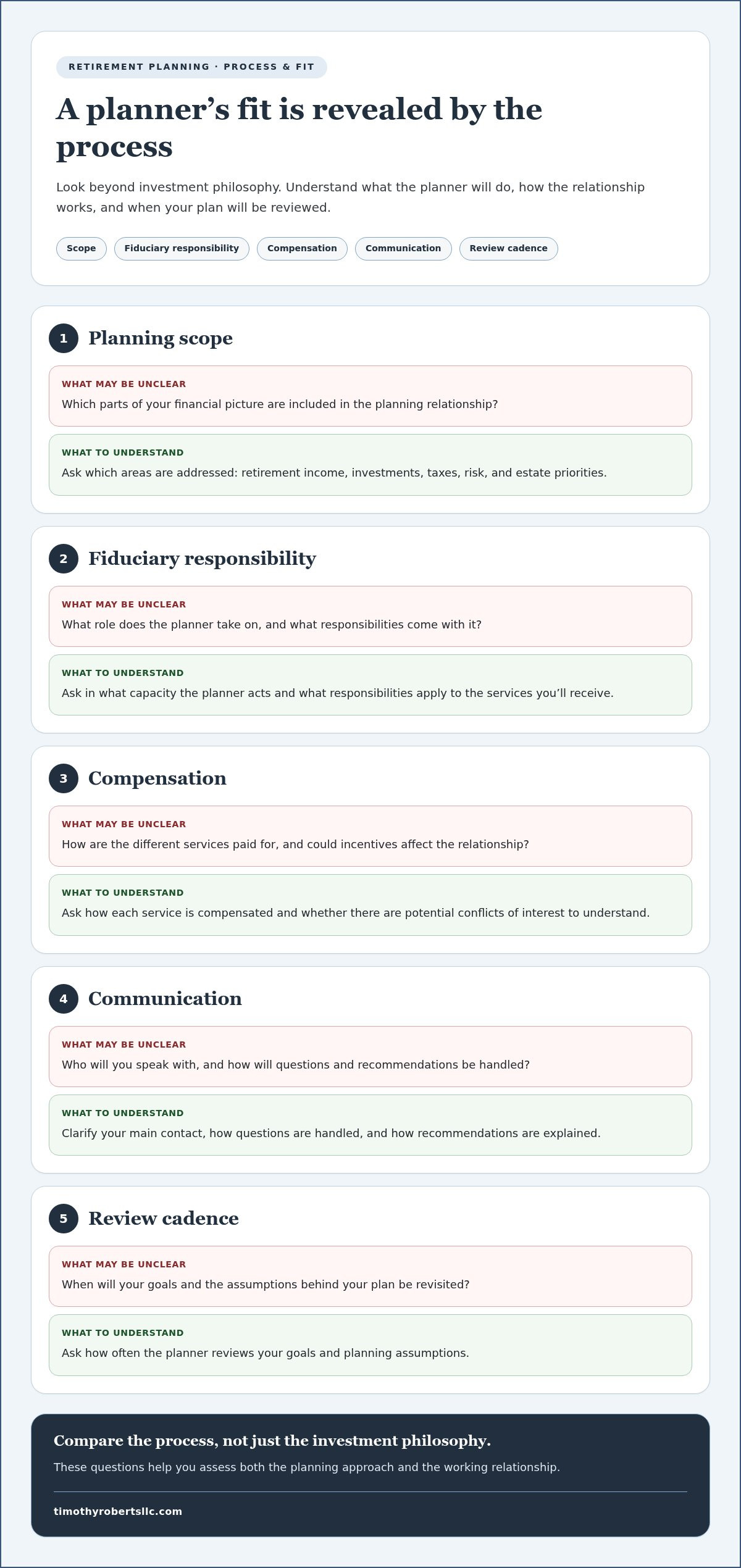
Look beyond investment philosophy when comparing a planning relationship. Understand what the planner will do, how responsibilities and compensation are explained, how communication works, and when the plan will be reviewed. These questions help you assess the process as well as your initial impression.
| What to evaluate | What to understand |
|---|---|
| Planning scope | Which areas are addressed, such as retirement income, investments, taxes, risk, and estate priorities? |
| Fiduciary responsibility | In what capacity does the planner act, and what responsibilities apply to the services you’ll receive? |
| Compensation | How is each service paid for, and are there potential conflicts of interest to understand? |
| Communication | Who is your main contact, how are questions handled, and how are recommendations explained? |
| Review cadence | How often are goals and planning assumptions revisited, and what may prompt an interim review? |
Understanding fiduciary responsibility and compensation
In plain language, a fiduciary relationship centers the client’s interests in the advice being provided. Specific responsibilities can depend on the services and capacity involved, so clarify what applies to your relationship. Timothy Roberts & Associates’ advisors are fiduciaries, and the firm tailors strategies to each client’s goals and risk tolerance. Fiduciary status supports a considered process, but it does not guarantee investment or tax results. To review available information about investment advisers, use the SEC’s Investment Adviser Public Disclosure database.
Compensation depends on the service. An asset-based investment-management fee is calculated in relation to the assets managed. A fixed-fee financial planning arrangement covers an agreed planning service for a set fee. Tax-preparation fees relate to preparing a tax return, a service distinct from tax advising or tax planning. Ask what each fee covers and how it is calculated. No single structure suits every need.
Assessing communication, scope, and ongoing reviews
Ask how your goals are documented, how recommendations relate to them, and how often priorities are revisited. Clear responsibilities and communication expectations help you understand what the planner will do and what information or decisions they’ll need from you. A coordinated scope can bring investment management, tax advising, and estate and legacy planning into the same conversation.
Timothy Roberts & Associates brings retirement income planning together with investment, tax, estate, and risk considerations. Explore the firm’s planning approach to learn how these areas can be addressed as part of a personalized strategy.
What to Prepare Before Working With a Retirement Planner
You can start a planning conversation before every statement is in order. A clear picture of your priorities and finances gives the planner useful context, and approximate figures can help if records are incomplete. Preparing a few details makes it easier to focus on your goals, upcoming decisions, and what information may be needed next.
Gathering a clear picture of your financial life
Collect the information you have, but don’t let missing paperwork delay you. A simple list or estimate can help outline:
- Income sources, such as employment income, pensions, or other expected retirement income
- Retirement accounts and investments, including accounts from current or former employers
- Debts and major recurring expenses
- Existing tax, investment, estate, insurance, or risk-management considerations
You don’t need to solve these matters in advance. The goal is to make the pieces visible so they can be discussed in context. Protect sensitive information when handling or sharing documents. Avoid sending account numbers or other confidential details through unsecured channels, and use a document-sharing method agreed upon with the planner.
Turning retirement priorities into useful planning questions
Before meeting, consider what you want retirement to make possible. Note your preferred timing, lifestyle priorities, concerns, and important family commitments. Separating essential goals from preferences that could change can help identify where flexibility matters.
Ask questions that help you understand how the planning relationship works, not just what recommendations might result. For example:
- What areas will the planning process cover, and how will my goals be documented?
- How is compensation structured for each service?
- How will we communicate, and who will be my point of contact?
- How often will we review the plan and revisit priorities?
Bring questions about the decisions that feel most pressing, such as coordinating accounts or making sense of changing expenses. You can also raise topics you want to discuss even if you don’t know the right terminology. The conversation can help organize those questions and identify useful next information.
Preparation doesn’t need to be perfect. Start with what you know, label estimates clearly, and note where details are missing. Timothy Roberts & Associates brings retirement income planning together with investment management, tax advising, estate and legacy planning, and risk analysis. Explore a retirement planning conversation to consider how a coordinated approach can support your goals.
A Personalized Retirement Planning Relationship for Your Next Chapter
Once you’ve defined what you want from a planner, consider how the advice will fit together over time. Timothy Roberts & Associates, LLC provides retirement income planning alongside investment management, tax advising, estate and legacy planning, and risk analysis. This coordinated scope can connect decisions that might otherwise be considered separately, while keeping your goals and risk tolerance central to the discussion.
How coordinated planning can reflect your goals
The firm’s fiduciary advisors tailor strategies to each client’s goals and risk tolerance. The planning conversation can begin with what matters to you, then consider how income needs relate to investment decisions, tax considerations, and legacy priorities. The relevant questions depend on your accounts, timing, preferences, and broader financial picture.
Timothy Roberts & Associates has more than 25 years of experience and was founded in 1998. Experience provides context, but fit still depends on whether the process is clear and responsive to your needs. Consider whether the planner explains the scope of the work, how compensation is structured, and how your priorities may be revisited as circumstances change.
A considered next step toward retirement clarity
You don’t need to arrive with a perfect plan. Bring the priorities you’ve identified, the questions you want answered, and the financial details you have available. An initial discussion can help clarify which planning areas matter most, how responsibilities are defined, and what the ongoing process involves. Understanding these points can help you decide whether the relationship fits the guidance you’re seeking.
Retirement planning evolves as needs and decisions change. A thoughtful relationship should make those decisions easier to understand without promising a particular investment return, income level, or tax outcome. If you’re ready to explore how coordinated guidance could relate to your goals, Explore retirement planning with Timothy Roberts & Associates.
Build a Retirement Strategy Around What Matters to You
Choosing a retirement planner is about more than portfolio management. Look for a process that connects income needs with investment decisions, tax considerations, and legacy priorities. Understanding the planning scope, compensation, communication, and review process can help you decide whether a relationship fits your goals.
If you searched for “retirement planner plymouth,” use the same practical criteria to assess the guidance you need: consider whether it is coordinated and tailored to your circumstances. Timothy Roberts & Associates provides retirement income planning alongside investment management, tax advising, and estate and legacy planning. Its fiduciary advisors tailor strategies to client goals and risk tolerance, drawing on more than 25 years of experience.
Your next step can be a conversation grounded in your priorities and questions. Explore retirement planning with Timothy Roberts & Associates and consider how coordinated guidance could support your next chapter. A thoughtful plan can give you a clearer framework for decisions as retirement needs evolve.
Frequently Asked Questions
What does a retirement planner do?
A retirement planner helps organize financial decisions around your retirement goals. This may include estimating income needs, reviewing retirement accounts and other resources, considering investment risk, and coordinating tax and legacy priorities. The planner connects these areas into a strategy suited to your circumstances. Planning can provide structure for decisions, but it cannot guarantee investment performance, tax outcomes, or a particular level of retirement income.
When should I work with a retirement planner?
Consider working with a retirement planner when you’re approaching retirement, changing your work or income plans, or coordinating accounts from different stages of your career. You don’t need to meet a specific age or savings threshold to benefit from clearer guidance. The right time depends on the decisions you’re facing, the complexity of your financial picture, and whether professional support would help you make choices with greater confidence.
How is a retirement planner different from an investment manager?
A retirement planner helps set direction across your retirement goals, income needs, accounts, and related financial decisions. An investment manager focuses on managing portfolio assets within an agreed approach. Some professionals provide both services, but they aren’t identical. Clarify whether the work includes a broader financial plan, ongoing portfolio management, or both, and how those responsibilities fit together.
What should I ask a retirement planner before working together?
Ask what the planning process covers, how your goals are documented, and how often the plan is reviewed. Clarify the planner’s role, fiduciary capacity, compensation structure, and any potential conflicts relevant to the services provided. It’s also useful to understand who you’ll communicate with and how recommendations are explained. These questions help you assess whether the scope and working relationship match your needs.
How much does a retirement planner cost?
Costs depend on the service and fee arrangement, so ask for a clear explanation before agreeing to work together. Investment management may use an asset-based fee, while financial planning may have a fixed-fee structure. Tax preparation is a separate service and may be billed separately from tax advising or tax planning. Find out what each fee covers, how it’s calculated, and whether ongoing reviews are included.
Is a fiduciary retirement planner required to act in my best interest?
A fiduciary generally has an obligation to put a client’s interests first when providing advice in a fiduciary capacity. The specific responsibility can depend on the services and role involved, so ask what applies to your relationship and review the relevant disclosures or agreements. Fiduciary status can inform how advice is provided, but it doesn’t guarantee investment results, tax savings, or any particular financial outcome.
Can a retirement planner help with taxes and estate planning?
Yes. A retirement planner may coordinate tax and estate considerations with income and investment decisions, depending on the services included in the planning relationship. Timothy Roberts & Associates provides tax advising and estate and legacy planning alongside retirement income planning and investment management. This connected perspective can bring your goals into the discussion, though tax results aren’t guaranteed and legal documents should be addressed through appropriate legal services.
