

Oct
Wealth Preservation Planning: A Strategic Guide for 2026
What if the greatest risk to your wealth isn’t one market downturn, tax change, or unexpected expense, but decisions made without considering how they affect one another? Protecting what you’ve built calls for more than a set of separate financial choices. It calls for a coordinated strategy. For people searching for comprehensive wealth preservation planning, the same starting point applies: connect financial decisions to the goals and needs they’re meant to support.
It’s natural to want confidence that your investments can support your future, that taxes and rising costs won’t derail your priorities, and that your legacy plans reflect what matters to you. Wealth preservation planning brings those concerns into one thoughtful conversation. This guide explains how investment portfolio management, retirement income planning, tax strategies, risk analysis, and estate and legacy planning can work together to support long-term goals.
You’ll also learn how to clarify financial risks, organize planning priorities, and consider retirement income and legacy goals as parts of the same evolving plan. Timothy Roberts & Associates, LLC develops personalized strategies shaped around clients’ goals and risk tolerance, with fiduciary oversight and a long-term perspective.
Key Takeaways
- Wealth preservation is about sustaining your financial choices and supporting future goals, not simply accumulating more assets.
- Investment, retirement income, tax, and legacy decisions can influence one another, so coordination matters.
- Compare financial strategies by purpose, liquidity, risk, tax considerations, and time horizon rather than expecting guarantees.
- Use a practical planning sequence to organize household finances, retirement needs, accounts, risks, and family priorities.
- Fiduciary-led guidance can connect retirement, investment, estate, risk, and tax planning with your goals and risk tolerance.
What Wealth Preservation Planning Means, and What It Is Designed to Protect
Wealth preservation planning organizes financial decisions to help sustain the resources and choices that matter over time. It isn’t simply about accumulating more assets. It considers how finances can support future needs, adapt to uncertainty, and reflect personal or family priorities. The key is to look beyond a single account or investment and consider how retirement income, taxes, risk, and legacy intentions relate to one another. A broad overview of wealth management principles likewise shows how these areas can connect within a wider financial approach.
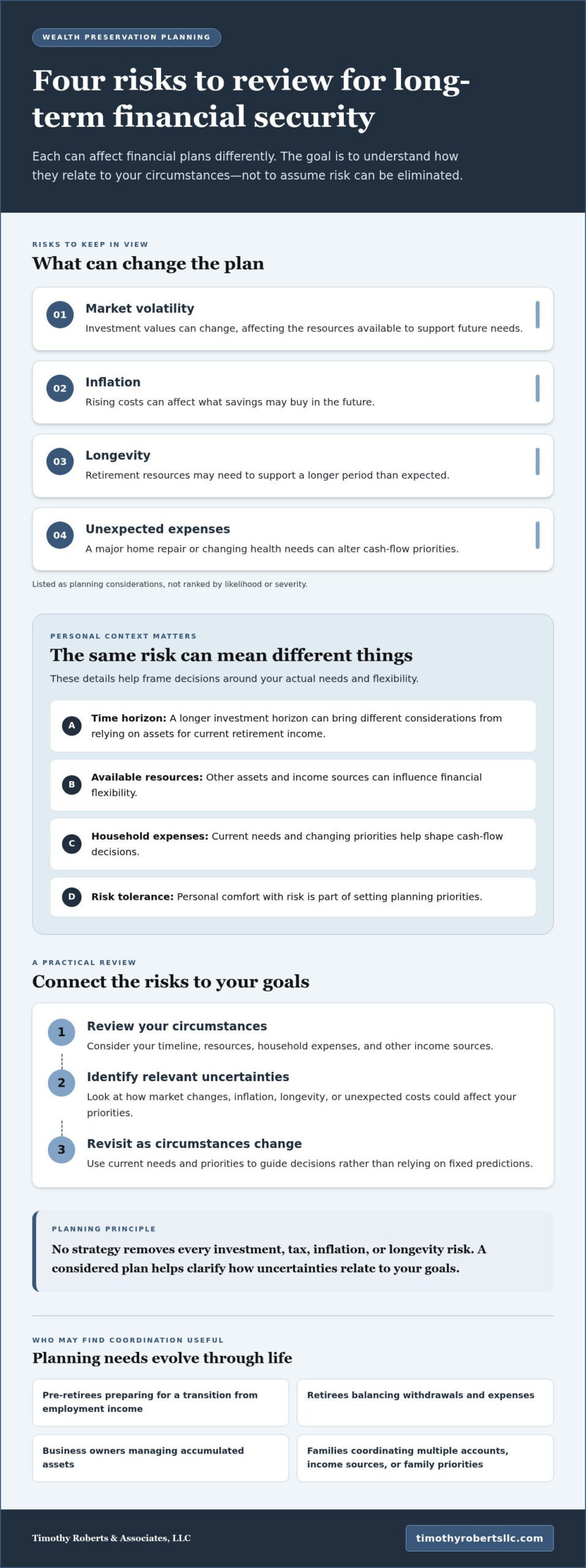
A coordinated wealth plan connects decisions across your financial life; a single investment decision addresses only one part of it. That distinction helps bring potential trade-offs into view. A choice that supports access to funds may differ from one intended to serve a longer-term goal. Priorities depend on your assets, obligations, timeline, and risk tolerance. No strategy removes every investment, tax, inflation, or longevity risk, but a considered plan can help you understand how those uncertainties relate to your goals. Personal circumstances should shape the questions and priorities, rather than a one-size-fits-all formula.
Which risks can affect long-term financial security?
Market volatility can change investment values, while inflation can affect what savings may buy in the future. Longevity is another consideration: retirement resources may need to support a longer period than expected. Unexpected expenses, such as a major home repair or changing health needs, can also alter cash-flow priorities.
These factors affect people differently. Someone with a longer investment horizon may have different considerations from a retiree relying on assets for current income. Available resources, household expenses, and other income sources also influence flexibility. Reviewing these details can help frame decisions without relying on fixed predictions or assuming risk can be eliminated.
Who may benefit from a coordinated preservation strategy?
Pre-retirees preparing for a transition from employment income, retirees balancing withdrawals and expenses, business owners, and families managing accumulated assets may all benefit from considering their financial choices together. Coordination can be especially useful when finances involve multiple accounts, income sources, or family priorities.
Planning can begin before a major transition or unexpected event. Someone approaching retirement, for example, may review income needs and investment risk while considering the choices ahead. A family might clarify how current priorities relate to future legacy intentions. The goal isn’t to pursue every possible strategy, but to make deliberate choices suited to current circumstances and the future they’re meant to support.
How Investment, Retirement, Tax, and Legacy Decisions Work Together
Financial choices rarely operate in isolation. Investments can shape the assets available to support retirement income; withdrawals may affect taxable income; and account ownership or beneficiary designations can influence how assets are ultimately passed on. Each decision may serve a different purpose, but considering them together can help reveal where priorities align and where trade-offs deserve attention.
Coordination isn’t about pursuing every possible strategy. It’s about testing choices against the same goals. A decision that offers greater liquidity, for example, may support near-term spending needs, while another may serve longer-term objectives. Consider investment portfolio management alongside retirement income needs, tax planning, and estate intentions so portfolio decisions fit the broader plan rather than stand alone.
Aligning portfolio decisions with retirement income needs
An investor’s time horizon, expected income needs, and other resources inform discussions about portfolio risk. Diversification may help spread investments across different holdings, while periodic review can help assess whether the portfolio still reflects changing goals and circumstances. Neither approach guarantees a particular outcome. Considering retirement income planning alongside investment choices can help clarify how assets may be used and which trade-offs deserve attention. For example, compare the timing of expected withdrawals with the time horizon for assets intended for later goals.
Connecting tax planning with estate and legacy goals
Tax-aware planning considers how financial decisions may interact with tax obligations, without assuming a specific reduction. Beneficiary designations and estate intentions also merit periodic review, especially after changes in family circumstances or financial accounts. A coordinated review can consider tax advising, retirement accounts, and estate and legacy goals together, helping ensure decisions reflect current priorities rather than outdated assumptions.
Consider a hypothetical couple nearing retirement. One spouse expects to continue working for several years, while the other is preparing to draw income from savings. They also want to support a family member and pass assets to their children. Their plan might weigh how much income to take, which accounts to draw from, how the investment mix relates to their time horizon, and whether beneficiary designations still match their intentions. The right sequence depends on their circumstances; no single decision guarantees a financial result.
A useful review asks how one change affects the rest. Would a different withdrawal approach alter the household’s tax picture? Does a portfolio adjustment fit the income timeline? Do estate intentions still align with account designations? Working through these questions can make competing priorities easier to see and support deliberate decisions.
Timothy Roberts & Associates, LLC brings investment, retirement income, tax, risk, and estate considerations into personalized planning shaped around client goals and risk tolerance. Learn more about coordinated financial planning and how these planning areas can fit together.
How to Evaluate Wealth Preservation Strategies Without Chasing Guarantees
Preserving wealth doesn’t mean avoiding every market risk or keeping all assets in cash. Cash can offer ready access for near-term needs, but relying on it alone may not fit longer-term objectives. The aim is to understand what a strategy is designed to address, what trade-offs it involves, and how it fits your circumstances. Evaluate any approach by asking what purpose it serves, when you may need the funds, what risks it carries, and how it relates to your other financial decisions. No approach guarantees protection from losses, inflation, taxes, or changing needs.
Risk management should reflect both your goals and the time you have to pursue them, not a promise that uncertainty can be removed. Compare broad strategy categories by their purpose, access to funds, risks, tax considerations, and intended time horizon. Their role and suitability depend on your full financial picture.
- Accessible reserves: These can support near-term expenses and provide liquidity, meaning how readily you can access funds. Their purchasing power may be affected by inflation, and they aren’t designed to address every long-term objective.
- Investment portfolio management: Portfolio decisions can be considered in relation to longer-term goals and risk tolerance. Values may fluctuate, and diversification or periodic review can’t guarantee returns or prevent losses.
- Risk management and insurance analysis: This can help assess how certain unexpected financial exposures may affect a household. Coverage involves terms and limitations, and it can’t address every possible expense or disruption.
- Tax and estate planning: These areas can help organize financial decisions around tax timing, account structure, and asset-transfer intentions. Outcomes depend on individual circumstances and applicable rules; planning doesn’t guarantee tax savings or a particular legacy result.
How do liquidity, risk, and time horizon affect a strategy?
Liquidity describes how easily an asset can be accessed or used. Funds set aside for an upcoming expense may call for different considerations from resources intended for goals years away. Selling an investment to meet an immediate need can involve trade-offs, particularly if its value has changed.
Risk tolerance is how comfortable you feel with uncertainty or a possible decline. Risk capacity is your financial ability to absorb a loss without disrupting essential goals. You might feel comfortable with fluctuations but have limited capacity if you rely on assets for current income. Considering both helps make risk discussions more practical.
What can tax and estate planning contribute?
Tax planning considers how the timing and structure of financial decisions may affect tax obligations under current rules. Estate coordination can help keep asset-transfer intentions and beneficiary records aligned as accounts, relationships, and priorities change. A review may surface details that need attention.
Financial planning and tax advising address financial considerations, while legal advice and document drafting are distinct. Keeping that distinction in mind helps separate financial planning questions from legal questions about documents or their interpretation.
A Practical Sequence for Building and Reviewing a Wealth Preservation Plan
A useful plan turns broad intentions into a series of connected decisions. Start with the outcomes you want, establish a clear picture of your finances, then assess how income, accounts, risk, and family priorities fit together. The process should be specific enough to guide decisions and flexible enough to revisit as circumstances change.
- Define goals and priorities. Identify what your resources need to support, such as retirement income, family commitments, or a future legacy. Distinguish essential needs from goals that may be adjusted if your circumstances change.
- Map household finances. Gather income sources, major expenses, debts, and anticipated commitments. Include current retirement income needs and note when different sources of income may begin or change.
- Inventory accounts and planning records. List account types, approximate balances, ownership, and beneficiary records. Gather existing estate-planning documents so your financial picture can be considered alongside your stated intentions.
- Assess risks and trade-offs. Consider how market fluctuations, inflation, unexpected costs, and changes in income could affect your plans. Compare those possibilities with your time horizon, resources, and comfort with risk.
- Set priorities and review. Identify decisions that need attention first, unanswered questions, and steps that can wait. Set a review rhythm that suits your financial complexity, then revisit the plan when important circumstances shift.
What information should you gather before reviewing your plan?
Bring together a practical snapshot: employment or business income, retirement and investment accounts, major recurring expenses, debts, and expected commitments such as education or a planned move. Add current beneficiary records and existing estate-planning documents. A simple list of uncertainties can be just as useful as the records themselves. Note which decisions feel urgent, what information is missing, and which family priorities should guide the discussion.
When should a wealth plan be revisited?
Revisit the plan after a retirement transition, inheritance, business change, marriage, separation, birth, or other meaningful family shift. A significant market change may also prompt a review of whether assumptions and priorities still fit, rather than an automatic reaction. Review frequency should reflect the plan’s complexity and your circumstances; there’s no single schedule that suits everyone. Regular check-ins can help keep decisions connected as life evolves.
A sound planning sequence moves from goals to facts, from facts to coordinated decisions, and from decisions to thoughtful review. This framework can help organize a personalized financial plan. Learn more about personalized financial planning and how it can bring your priorities into focus.
How Timothy Roberts & Associates Connects Wealth Preservation With Long-Term Goals
Wealth preservation becomes more considered when the decisions shaping it are viewed together. Timothy Roberts & Associates, LLC brings retirement income planning, investment portfolio management, estate and legacy planning, risk analysis, and tax advising into a broader financial planning perspective. The firm’s advisors are fiduciaries, and recommendations are tailored to each client’s goals and risk tolerance. That approach can help clarify how current choices relate to the future a client wants to build, without promising a particular investment result.
With more than 25 years of experience, the firm works with clients on financial plans shaped by their individual circumstances. Experience provides context, not certainty: markets and personal needs can change, and investment outcomes aren’t guaranteed. The value of a coordinated relationship lies in examining the connections between decisions, understanding their trade-offs, and revisiting priorities as life evolves.
What a coordinated planning relationship can address
A planning relationship can bring retirement income needs, investment oversight, risk considerations, tax planning, and legacy priorities into a shared discussion. For example, a shift in expected retirement timing may prompt a review of income needs and portfolio considerations, while a family change may lead to questions about beneficiary records or legacy intentions. Ongoing review can help keep decisions aligned as circumstances evolve. Financial guidance doesn’t replace legal counsel or the role of tax authorities.
How to take the next step with confidence
Before a planning conversation, identify the goals that matter most and the questions that feel unresolved. You might be considering how to structure retirement income, whether your current approach reflects your comfort with risk, or how financial decisions relate to family priorities. A first conversation can establish which topics deserve attention and where further analysis may be useful. You don’t need every answer in advance; a clear sense of what matters is a constructive place to begin.
From there, planning can develop around your specific objectives, resources, and risk tolerance. The process is a partnership, not a promise of performance: decisions are considered in context, and recommendations are personalized rather than treated as a universal formula.
Learn more about personalized planning with Timothy Roberts & Associates, LLC. A measured discussion can help identify the questions to address and the planning considerations that best support your long-term goals.
Give Your Next Financial Decision a Clearer Direction
A strong next step doesn’t require solving every question at once. Choose one decision that feels especially important, such as how to prepare for a coming transition or whether your current priorities still fit your financial picture. Use it as a starting point for a broader conversation about the future you want your resources to support.
A useful wealth preservation strategy is grounded in personal goals, not promises of certainty. A thoughtful planning conversation can help bring the key questions into focus and identify where coordinated guidance may be valuable.
Explore a personalized wealth planning conversation with Timothy Roberts & Associates, LLC. A considered beginning can help you move forward with greater clarity and confidence.
Frequently Asked Questions
What does wealth preservation planning include?
Wealth preservation planning can include decisions about how assets support income, family priorities, and future needs. The details depend on your circumstances. For example, someone who has recently sold a business may need to consider how the proceeds fit with retirement plans, existing accounts, and intended gifts to family. A coordinated review can help identify where those choices intersect and which questions deserve attention first.
Can wealth preservation planning help protect assets from market volatility?
It can help you prepare for market fluctuations, but it can’t prevent them or guarantee that your assets will retain a particular value. A plan may consider whether your investments reflect your goals, when you expect to use different assets, and how you’d respond to a decline. Having a response framework in advance can help you avoid making rushed decisions based solely on short-term market movement.
Is wealth preservation planning only for high-net-worth households?
No. Planning can be useful whenever someone wants to coordinate financial decisions, regardless of whether they consider themselves wealthy. A household with retirement accounts, a mortgage, and education costs may need to balance competing priorities just as a household with substantial investments might. The scale and complexity of the plan should reflect the person’s finances, responsibilities, and goals, rather than an assumed asset threshold.
How does wealth preservation planning differ from investment management?
Investment management focuses on overseeing a portfolio in relation to objectives and risk considerations. Wealth preservation planning takes a broader view, placing portfolio decisions alongside retirement income, taxes, risk analysis, and legacy intentions. For instance, a portfolio change may need to be considered alongside a planned withdrawal or a shift in family priorities. Investment management can be one component of a broader financial plan.
When should I review my wealth preservation plan?
Review it when a change could affect your assumptions, such as leaving a job, receiving an inheritance, selling a business, or taking on a new family responsibility. You may also revisit it if your retirement date or spending expectations shift. The key is to assess the plan against current circumstances, rather than wait for a crisis or follow a universal calendar.
Does wealth preservation planning include tax and estate planning?
It can include financial coordination around tax considerations and estate intentions. For example, a review might compare account records with current beneficiary designations or consider how a planned withdrawal fits into the household’s broader tax picture. The appropriate questions depend on individual circumstances and current rules. Financial planning can address these financial considerations, while legal questions about documents or their interpretation are distinct matters.
Can a financial advisor guarantee that my wealth will be preserved?
No advisor can guarantee that wealth will be preserved. Investment values can fluctuate, expenses can change, and tax rules or personal circumstances may evolve. A financial advisor can help assess risks, align recommendations with your objectives and risk tolerance, and revisit the plan as conditions change. The aim is informed decision-making and preparation, not certainty about investment performance or future financial outcomes.
