

Oct
Year-End Retirement Income Optimization Strategies for 2026
What if a decision that appears tax-efficient this year changes your retirement income picture elsewhere? That’s why year-end retirement income optimization strategies 2026 should begin with coordination, not a single transaction. A withdrawal, Roth conversion, or portfolio adjustment can affect more than one part of your financial plan.
If you’re unsure which decisions matter before December 31, or you’re receiving conflicting advice about distributions and taxes, the answer depends on your income needs, account mix, tax picture, and longer-term goals. A checklist alone can’t capture those connections.
This article outlines the year-end decisions worth reviewing, including retirement account withdrawals, required distributions, Roth conversions, portfolio positioning, and potential effects on Social Security and Medicare. You’ll learn how to weigh those choices together, identify which items deserve attention before 2026 closes, and shape a personalized action list for the year ahead.
Key Takeaways
- Use year-end retirement income optimization strategies 2026 to prioritize decisions around your household’s income needs, account mix, and tax picture.
- Review withdrawals, required distributions, and Roth conversions together, since each choice may affect other parts of your financial plan.
- Compare potential year-end moves by timing, tax exposure, flexibility, and portfolio impact before deciding what merits attention.
- Gather income estimates, account balances, planned withdrawals, tax documents, and expected expenses to make your year-end review more focused.
- Turn the review into documented decisions and next-year priorities tailored to your goals and risk tolerance.
Why Year-End Retirement Income Planning Matters in 2026
December 31 can feel like a hard stop. You may be weighing a required distribution, a possible Roth conversion, year-end spending, or a portfolio adjustment, while wondering which decisions truly need action now. The goal isn’t to make every move before the calendar turns. It’s to identify time-sensitive choices and assess them in the context of your broader retirement income plan.
Year-end retirement income optimization is a coordinated, circumstance-specific review of income, accounts, taxes, and spending to support informed decisions for the year ahead. That wider perspective matters because a withdrawal can influence taxable income, while income changes may also affect the taxation of Social Security benefits or Medicare premiums. For a broad overview of the elements involved, see this guide to retirement planning.
A separate example of using retirement assets to pursue income is explored in this video:
Which year-end decisions deserve attention first?
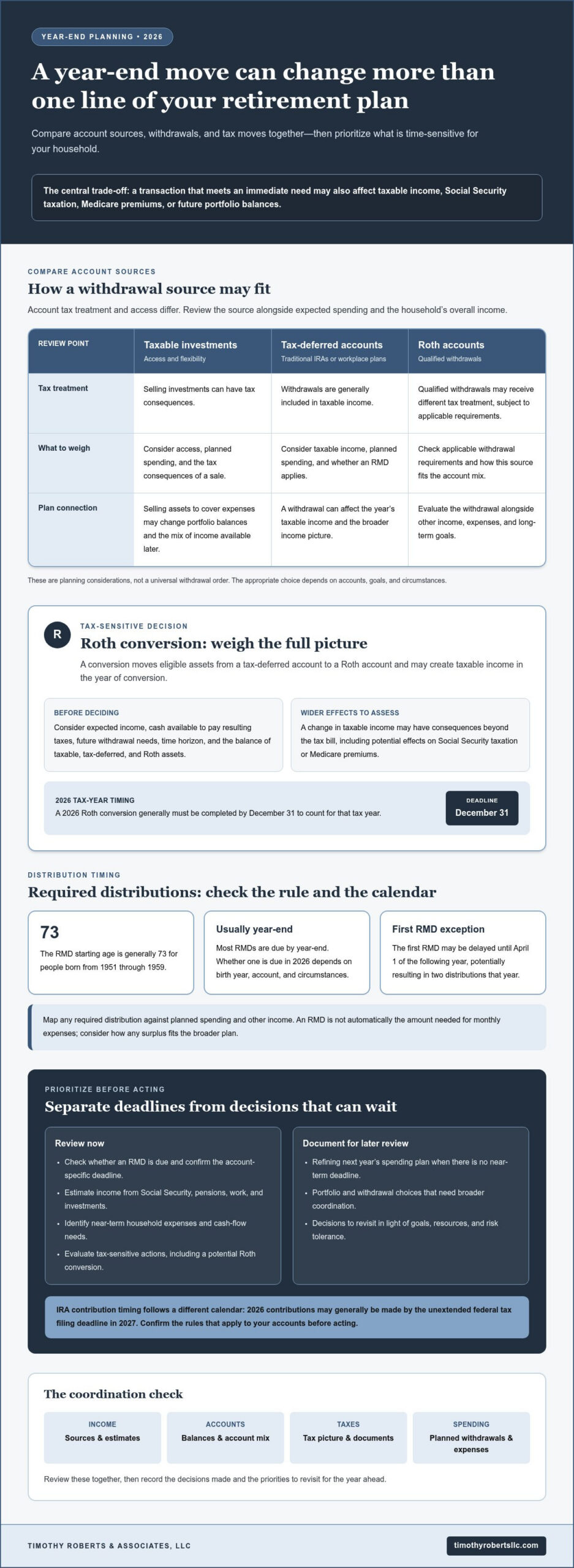
Start with decisions that have a clear deadline or address an immediate cash-flow need. Check whether you have a required minimum distribution (RMD), estimate income from Social Security, pensions, work, and investments, and identify expenses the household expects to cover soon. The RMD starting age is generally 73 for people born from 1951 through 1959. Whether an RMD is due in 2026 depends on your birth year, account, and circumstances. Most RMDs are due by year-end, but the first RMD may be delayed until April 1 of the following year, potentially resulting in two distributions that year.
Next, flag tax-sensitive actions. A 2026 Roth conversion generally must be completed by December 31 to count for that tax year. The deadline for 2026 IRA contributions follows a different calendar: contributions may generally be made by the unextended federal tax filing deadline in 2027. Confirm the rules and deadlines that apply to your accounts before acting. Items without a near-term deadline, such as refining next year’s spending plan, can be documented for a later review rather than rushed.
Why a single financial decision can affect the wider plan
A withdrawal may provide needed cash, but its tax treatment depends on the account and the household’s overall income. A conversion can shift assets into a Roth account while increasing taxable income for the year. That change may have consequences beyond the tax bill, including potential effects on Social Security taxation or Medicare premiums. Evaluate the projected result rather than assuming how the transaction will affect your overall plan.
Review investment choices alongside spending needs and tax considerations. Selling assets to fund expenses, for example, may change portfolio balances and the mix of income available later. There’s no universal withdrawal order or conversion amount that suits every household. A coordinated review helps distinguish decisions that need attention now from choices that can wait, based on your goals, resources, and risk tolerance.
Coordinate 2026 Withdrawals, Tax Moves, and Retirement Income
Retirement accounts can serve different purposes in an income plan. Taxable investments may offer access and flexibility, though sales can have tax consequences. Withdrawals from tax-deferred accounts, such as traditional IRAs or workplace plans, are generally included in taxable income. Qualified Roth withdrawals may receive different tax treatment, subject to applicable requirements. Reviewing the account mix alongside expected spending can help clarify which source may fit a particular need.
Evaluate a tax-sensitive transaction against the full income plan, not just its apparent benefit in isolation. A withdrawal or conversion can affect the year’s taxable income and may have wider implications for other financial considerations. The U.S. Department of Labor retirement resources provide background on retirement plans and savings. Personal decisions still depend on your accounts, goals, and circumstances.
Review required distributions and withdrawal timing
Required minimum distributions (RMDs) are amounts that certain account owners must withdraw from eligible retirement accounts under applicable rules. The RMD starting age is generally 73 for people born between 1951 and 1959. Whether a distribution is due in 2026 depends on your birth year and circumstances, as well as which accounts you hold. The first RMD may generally be delayed until April 1 of the following year, but doing so can mean taking two distributions in that year. Account type, beneficiary status, and other circumstances can affect the analysis.
Map any required distribution against planned spending and other income. For example, someone expecting pension income and a large one-time expense may need a different withdrawal schedule from someone relying primarily on portfolio withdrawals. Confirm the applicable deadline and account-specific rules for 2026 before acting. An RMD is not automatically the same as the amount needed for monthly expenses, so consider how any surplus will fit into the broader plan.
Evaluate Roth conversions and portfolio tax decisions
A Roth conversion moves eligible assets from a tax-deferred account to a Roth account and may create taxable income in the year of conversion. The decision calls for more than a comparison of current and future tax rates. Consider expected income, cash available to pay any resulting tax, future withdrawal needs, time horizon, and the balance of taxable, tax-deferred, and Roth assets. A conversion can support one household’s long-range plan and be unsuitable for another.
Tax-loss harvesting is another potential portfolio review, not an automatic year-end move. It involves evaluating whether investments held in taxable accounts with losses may be sold to help manage realized gains or losses. The result depends on holdings, transactions, applicable tax rules, and how the portfolio will be reinvested. Review those details before making changes rather than selling solely because an asset has declined.
These interconnected choices are part of personalized retirement income planning. The year-end retirement income optimization strategies 2026 that make sense for you depend on how withdrawals, taxes, investments, and future income fit together.
Compare Year-End Strategies Against Your Retirement Income Picture
Measure a year-end choice against more than its immediate tax effect. Consider when action is needed, how much income the household requires, what tax exposure a move may create, how much flexibility it preserves, and what it means for the portfolio. These factors help distinguish a potentially useful strategy from one that looks attractive in isolation.
The comparison below is a starting point, not a recommendation. Dates, account provisions, and tax treatment can vary by situation, so verify the rules that apply before implementing a transaction.
| Strategy to review | When it may merit attention | What to weigh or verify |
|---|---|---|
| Required distribution | An account owner may be subject to an RMD or need a distribution to meet spending needs. | Applicable age, account rules, amount, deadline, and any exception. |
| Roth conversion | There may be room in the household’s tax plan to consider shifting eligible assets. | Current and projected income, tax impact, funds available to pay tax, and future flexibility. |
| Portfolio adjustment | Withdrawals, spending needs, or investment changes may call for a review of holdings. | Taxable gains or losses, portfolio balance, timing, and applicable tax rules. |
How retirement stage changes the year-end review
Someone nearing retirement may still have employment income and contributions while planning how pensions, Social Security, and investments could support future spending. The review may focus on transition timing and the account mix available for withdrawals. A retiree already drawing from several accounts may instead need to coordinate recurring expenses, benefit income, and distributions. Priorities depend on the household’s income sources and timeline.
For example, a person with steady pension income and a planned large expense may assess withdrawals differently from someone whose income varies with work or portfolio distributions. Neither situation points automatically to a conversion, a particular withdrawal source, or a portfolio sale. A personalized retirement income planning approach compares available choices against the household’s cash-flow needs and long-term objectives.
How to weigh current tax impact against future flexibility
A transaction that reduces this year’s tax bill isn’t automatically beneficial overall. A decision may shift taxable income between years, affect the balance among account types, or limit access to assets for future expenses. Evaluate the immediate effect alongside expected income needs, portfolio implications, and the value of preserving options.
Medicare premiums can also be affected by income-related rules, so a conversion or other income event may warrant a review of applicable thresholds and timing. Don’t assume a specific premium result without checking current rules. A coordinated tax planning for retirement income review can put the potential tax effect in context with income and account decisions. That’s the practical purpose of year-end retirement income optimization strategies 2026: compare trade-offs before choosing a move.
Use This 2026 Year-End Retirement Income Checklist
A useful review starts with a clear record of where income comes from, what’s held in each account, and what the household expects to spend. This sequence makes year-end retirement income optimization strategies 2026 more manageable by separating urgent transactions from decisions that can be revisited later.
Gather the documents and projections for a useful review
Collect current account statements, income records, distribution notices, and tax estimates before deciding what to change. Add expected expenses and major household changes, such as a planned move, a change in work, or a significant one-time cost. A current investment portfolio management strategy can also help clarify how withdrawals or investment changes fit the household’s needs.
Turn the review into a prioritized action list
Use the records to build a short list, then assign each item a timing category. For every potential action, note the reason, expected effect, relevant deadline, and person responsible for completing or reviewing it. This creates a decision record, not just a list of tasks.
- Assemble the records. Gather balances for taxable, tax-deferred, and Roth accounts; income estimates from work, pensions, and Social Security; distribution notices; prior-year and current tax documents; and any available tax projections.
- Map cash needs. Estimate regular spending, planned withdrawals, and upcoming one-time expenses. Note expected changes in income or household circumstances that could affect the amount or timing of withdrawals.
- Identify items with a 2026 cutoff. Mark transactions that generally need to be completed by December 31 to count for 2026, including Roth conversions and employee 401(k) contributions. Review any required minimum distribution deadlines and account-specific requirements. Deadlines and exceptions may differ.
- Separate filing deadlines. A 2026 IRA contribution generally has a different deadline from a transaction that must occur by year-end. The contribution deadline is the unextended federal tax filing deadline in 2027. Confirm the applicable date and eligibility rules for your circumstances.
- Sort remaining decisions. Place each item under complete by year-end, monitor, or revisit in the new year. Portfolio adjustments or longer-range spending refinements may belong in a later review if they don’t have a near-term deadline.
- Document the decision. Record what you chose, why, the expected effect, the date completed or next review date, and who is responsible for follow-through. Keep supporting statements and tax records together.
Before taking an irreversible action, verify the 2026 tax and account rules that apply to you. The implications of a conversion, withdrawal, or investment sale can depend on your full financial picture. A personalized financial planning review can help assess those considerations in context.
For a coordinated review of retirement income, investments, and tax considerations, explore personalized retirement income planning with Timothy Roberts & Associates, LLC.
Build a Coordinated Retirement Income Plan for the Year Ahead
A year-end review is most useful when it leads to a plan you can carry forward. Rather than treating withdrawals, investments, taxes, and spending as separate tasks, consider how each decision supports the household’s goals and what trade-offs it introduces. Timothy Roberts & Associates, LLC’s fiduciary advisors can help connect those moving parts while taking your resources and risk tolerance into account.
What an integrated year-end planning review can address
A coordinated review can compare expected withdrawals with portfolio positioning and spending needs, then consider how tax-sensitive decisions fit into the larger income strategy. For example, a change in planned withdrawals may affect which accounts are used and how much of the portfolio remains invested. Tax planning can inform that review, but no particular transaction guarantees a specific tax result.
The conversation should start with your priorities, not a predetermined list of moves. What income do you expect? Which expenses or goals take precedence? How much flexibility do you want to preserve? From there, an advisor can help assess options in light of your circumstances and identify which decisions merit action, monitoring, or further analysis.
Planning should also adapt as life changes. A shift in employment, household spending, investment conditions, or personal goals may prompt a review of income assumptions and priorities. The timing and scope of reviews can be tailored to the household rather than tied to a one-size-fits-all calendar.
How to carry year-end decisions into 2027
Close the review by documenting what you decided, what you deferred, relevant deadlines, and questions that still need answers. A concise plan can record expected income sources, withdrawal priorities, upcoming expenses, and the reasoning behind tax or investment choices. This creates a useful reference point for the next review and helps keep decisions aligned as circumstances evolve.
For each deferred item, note what would prompt another look. That might be a change in income, a new expense, or updated tax information. Keep supporting records with the plan so future decisions build on the same information instead of starting from scratch.
Timothy Roberts & Associates, LLC brings over 25 years of experience in financial planning and wealth management. Its fiduciary advisors develop personalized strategies around each client’s goals and risk tolerance, bringing retirement income planning, investment management, and tax advising into a coordinated discussion. The aim is to identify the decisions that best fit your household and clarify next steps.
The year-end retirement income optimization strategies 2026 you choose should provide a thoughtful bridge from this year’s decisions to next year’s priorities. If you’re ready to explore a personalized plan, start a retirement income planning conversation.
Carry Your Decisions Into the Year Ahead
The value of year-end retirement income optimization strategies 2026 isn’t measured by how many transactions you complete. It comes from knowing why a decision fits, what it changes, and when it should be revisited. Treat your year-end notes as a living guide for 2027, ready to evolve as household priorities and financial circumstances do.
You don’t have to resolve every question at once. A thoughtful next step is to identify the decision that matters most to your household, gather the information it depends on, and weigh the trade-offs before acting. A personalized planning conversation can help turn that priority into a practical direction for the year ahead.
Timothy Roberts & Associates, LLC brings over 25 years of financial planning and wealth management experience. Its fiduciary advisors develop strategies around each client’s goals and risk tolerance, coordinating retirement income planning with investment management and tax advising.
Explore personalized retirement income planning and take a considered next step toward a plan shaped around your priorities. Your path forward can be deliberate, coordinated, and distinctly your own.
Frequently Asked Questions
What retirement income decisions should I review before the end of 2026?
Review decisions that could affect cash flow or require action within the calendar year, including planned account withdrawals, any required distributions, potential Roth conversions, and investment sales. Estimate income from work, pensions, Social Security, and accounts, then compare it with expected spending. The year-end retirement income optimization strategies 2026 that deserve attention first depend on your account types, timing, and household needs. Also review whether tax withholding or estimated payments may need adjustment.
Do I need to take a required minimum distribution before December 31, 2026?
Possibly, depending on your birth year, account, and circumstances. The RMD starting age is generally 73 for people born from 1951 through 1959, but whether a distribution is due in 2026 depends on the details of your situation. Most required distributions are due by December 31, though the first RMD may generally be delayed until April 1 of the following year. That delay can mean taking two distributions in that following year. Review account-specific rules and exceptions to determine your deadline and required amount.
Can a Roth conversion lower my retirement taxes in 2026?
A Roth conversion generally adds the converted amount to taxable income for the year, so it doesn’t typically lower your current-year taxable income. Its potential value depends on how today’s tax cost compares with future circumstances, along with your ability to pay any resulting tax from available funds. For example, someone expecting lower income this year might evaluate a partial conversion, but the outcome depends on the full tax picture and future needs.
Is December 31 the deadline for every retirement tax strategy?
No. Some actions tied to the 2026 tax year, including Roth conversions and employee 401(k) contributions, generally must be completed by December 31, 2026. The deadline for a 2026 IRA contribution generally falls on the unextended federal tax filing deadline in 2027. Deadlines can depend on the account and transaction, so distinguish calendar-year cutoffs from filing deadlines and verify the applicable rules before scheduling a move.
How do retirement account withdrawals affect taxable income?
Tax treatment depends on the account and the type of withdrawal. Distributions from traditional tax-deferred accounts are generally included in taxable income, while qualified Roth withdrawals may receive different treatment if applicable requirements are met. In a taxable investment account, selling an asset can produce a reportable gain or loss. Before withdrawing, consider how the amount may combine with wages, pension income, or other taxable sources in the same year.
Should I sell investments at a loss before the end of 2026?
Not automatically. Selling an investment at a loss may be worth reviewing in relation to realized gains, portfolio objectives, and the role that holding plays in your plan. But a tax benefit, if available, shouldn’t be the only reason to sell: the transaction can change your investment mix and future exposure. Review the specific holdings, related transactions, and current tax rules before acting, and consider whether the investment still supports your goals.
How can Social Security affect my retirement income plan?
Social Security can shape how much income you need from savings and when you draw from other accounts. Benefits may also be taxable depending on your overall income, so a withdrawal or conversion can affect the household’s tax picture. For 2026, Social Security benefits include a 2.8% cost-of-living adjustment. Use your own benefit estimate alongside pension, employment, and investment income, and review current tax and Medicare rules before making changes.
