

Oct
Private Retirement Planning: Build a More Confident Retirement Strategy
Your savings may be growing, yet the path from those savings to reliable retirement income can still feel unclear. People searching for private retirement planning often want more than an account projection. They want to understand how today’s decisions can support the life they hope to lead in retirement.
That uncertainty is understandable. Income choices, investments, taxes, risk, and legacy priorities can affect one another, but they’re often considered separately. A plan that doesn’t connect them may leave important questions unanswered, even when you’ve saved diligently.
This article explains how personalized retirement planning from Timothy Roberts & Associates, LLC can bring those priorities into a coordinated strategy. You’ll learn how to inventory income sources, identify potential gaps, and consider how investment management, tax planning, estate goals, and risk fit together. You’ll also find questions to help you compare planning approaches and prepare for a useful review.
Key Takeaways
- Private retirement planning coordinates income needs, investments, taxes, risk, and long-term priorities rather than focusing on a single account projection.
- Learn a practical sequence for assessing retirement income sources, identifying potential gaps, and connecting financial decisions without relying on a universal withdrawal order.
- Compare self-directed planning, occasional advice, and an ongoing advisory relationship by coordination, implementation support, review cadence, and fee structure.
- Prepare for a planning review by gathering account statements, benefit estimates, spending details, insurance information, and existing estate records.
- For those exploring private retirement planning northern michigan, fiduciary guidance can connect retirement income, investment management, tax advising, estate coordination, and risk analysis.
What Private Retirement Planning Coordinates, and Why It Matters
Retirement readiness isn’t measured by an investment balance alone. A more useful question is how your savings, income sources, taxes, and priorities fit together over time. For households exploring private retirement planning northern michigan, that means looking beyond a projection to understand how financial decisions relate to the retirement they want.
Private retirement planning is personalized guidance that coordinates your financial resources, future income needs, priorities, and related decisions into a strategy designed around your circumstances. It differs from investment management alone, which focuses on a portfolio, and from a do-it-yourself projection, which may not account for how one choice affects another. The broader subject of understanding retirement planning includes financial goals and investment considerations. Personalized guidance places those elements in the context of an individual household.
A short video offers another perspective on preparing for retirement decisions:
Which decisions can a private retirement plan bring together?
A coordinated plan may consider retirement income, investment portfolios, tax considerations, estate and legacy priorities, and risk management. These areas are connected, but not every household needs the same level of attention in each one. The right balance depends on a household’s resources, goals, and comfort with uncertainty.
Illustrative example: Imagine a couple deciding whether one spouse should reduce work hours. That change could affect when and how much income they draw from investments, their household tax picture, and how much they hope to preserve for family or charitable goals. Reviewing the choices together can reveal trade-offs that a portfolio review or single projection might miss. This example illustrates the connections, not a prediction or recommendation.
When might personalized planning become valuable?
Planning can help as retirement approaches, when work patterns change, or when accounts from different employers need to be viewed as part of one household picture. It may also be useful when priorities shift, such as balancing current spending with a desire to support loved ones later. The trigger isn’t a particular account balance. It’s whether your decisions feel connected and understandable.
Some people prefer managing decisions independently; others value a structured review or ongoing guidance. Wanting a clearer framework isn’t a sign of financial failure. It’s a practical response to choices that can influence one another. A planning conversation can help identify which questions matter now, which can wait, and how decisions relate to the retirement you’re working toward.
How Private Retirement Planning Connects Income, Investments, and Taxes
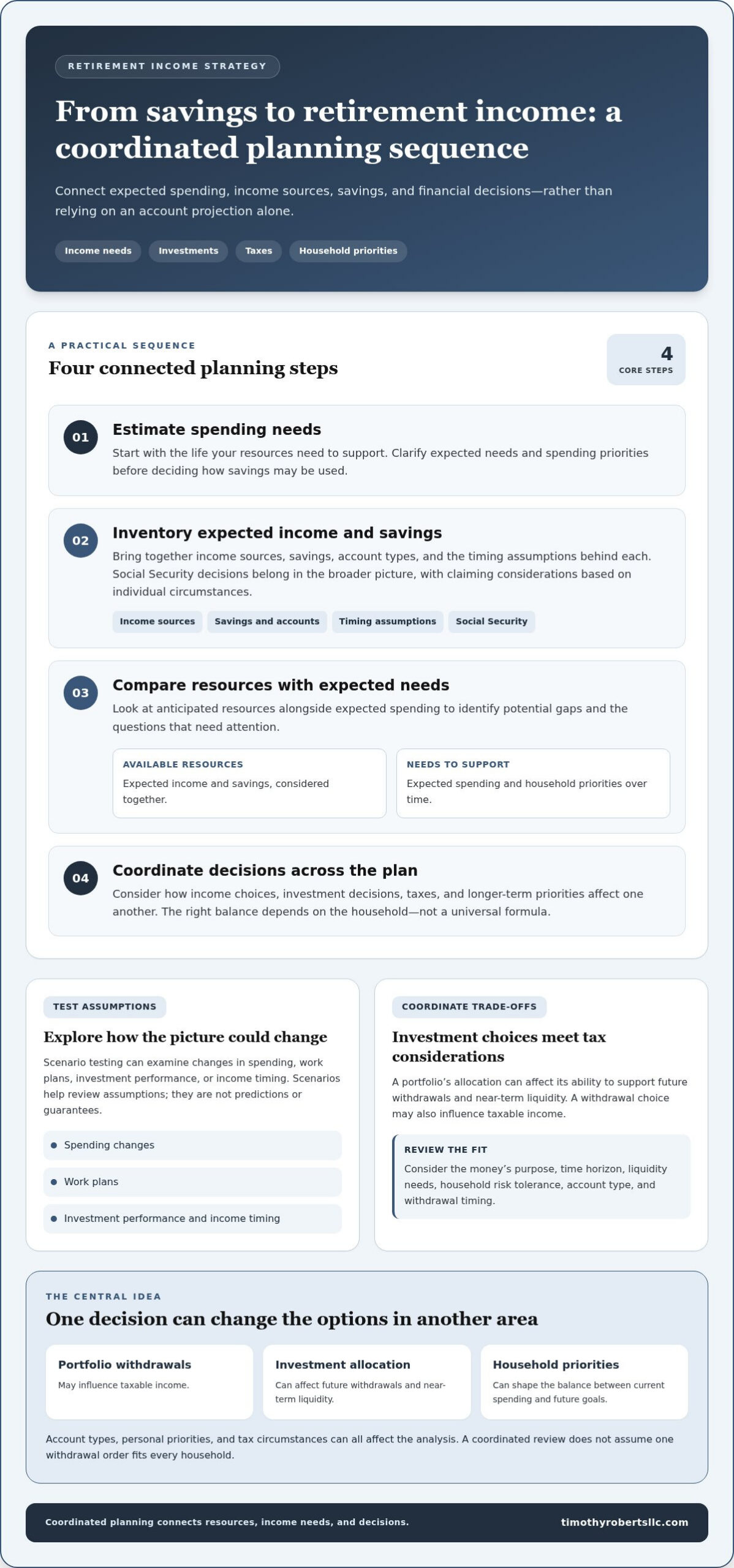
A useful retirement strategy starts with the life your resources need to support. A practical sequence is to estimate spending needs, identify expected income and savings, assess potential gaps, and then coordinate decisions that may affect how resources are used. For people considering private retirement planning northern michigan, the goal is to understand how the moving parts relate, not to assume one formula suits every household.
Income, investments, and taxes should be considered together because a decision about one can change the options available in the others. For example, choosing when to draw from a portfolio may influence taxable income, while a portfolio’s allocation can affect its ability to support future withdrawals and near-term liquidity needs.
How does a retirement plan translate resources into income?
Start with an inventory of expected income sources, savings and account types, spending priorities, and the timing assumptions behind each. The Department of Labor retirement resources offer background on retirement plans and savings. Social Security decisions also belong in the broader picture, although the relevant claiming considerations depend on individual circumstances.
Next, compare anticipated resources with expected needs. Scenario testing can show how the picture changes if spending, work plans, investment performance, or income timing differs from expectations. These scenarios help examine assumptions; they aren’t predictions or guarantees. Retirement income planning can help frame the questions and clarify how decisions fit together.
Why coordinate investment and tax considerations?
Dependable income sources and portfolio withdrawals play different roles. A plan can identify which income is expected and when, then consider how savings may help cover remaining needs. It shouldn’t assume a universal withdrawal order. Account types, personal priorities, and tax circumstances can all affect the analysis.
Investment allocation should reflect the purpose of the money, time horizon, liquidity needs, and household tolerance for risk. Funds needed in the near term may call for different considerations than assets intended for longer-term goals. A portfolio review can assess whether the allocation still fits as retirement approaches, spending changes, or priorities evolve.
Taxes belong in that review. The account an individual draws from and the timing of a withdrawal can affect tax treatment, so evaluate those decisions using current rules and the household’s full financial picture. A coordinated review can also connect income choices with estate and legacy priorities, rather than treating those goals as an afterthought.
To prepare, organize income estimates, account information, spending expectations, and questions about taxes or risk. A personalized retirement income planning review can help connect those details to your goals.
Private Retirement Planning vs. Managing the Plan on Your Own
Choosing how to plan is a question of scope and responsibility, not a test of whether you can manage money. A self-directed approach may suit someone comfortable coordinating accounts and reviewing decisions independently. Episodic advice can address a specific question, while an ongoing advisory relationship may bring planning and portfolio oversight into a continuing process. None guarantees better investment results. The value depends on whether the service addresses needs you actually have.
For people weighing private retirement planning northern michigan, compare the work involved and what each approach leaves in your hands. The table offers a general framework. Services and fee arrangements depend on the engagement.
| Approach | Coordination | Implementation support | Review cadence | Fee structure |
|---|---|---|---|---|
| Self-directed | You coordinate accounts and decisions. | You handle decisions and follow-through. | Set by you. | May include investment or account expenses. |
| Episodic advice | Focuses on a defined question or planning need. | Support depends on the engagement’s scope. | Typically tied to the agreed work. | May be fixed for a planning engagement. |
| Ongoing advisory relationship | Can connect planning priorities with portfolio oversight. | Responsibilities are defined by the relationship. | Established as part of the ongoing service. | May be asset-based, fixed-fee, or otherwise structured. |
What should you evaluate in a private planning relationship?
Look for a process that reflects your goals, risk tolerance, income needs, and changing circumstances. Clarify what the advisor will do and what remains your responsibility. Timothy Roberts & Associates, LLC advisors are fiduciaries. The firm offers ongoing investment management charged as a percentage of assets managed, as well as fixed-fee planning engagements for defined work. Its financial planning overview provides more context about the firm’s advisory approach.
How can you assess the value of ongoing guidance?
Professional advice has a cost, so assess its relevance rather than assuming more service is automatically better. Compare the stated scope, planning deliverables, monitoring responsibilities, review process, and fee structure. Asset-based arrangements calculate fees as a percentage of assets managed; fixed-fee planning engagements charge for defined planning work. Understand what each arrangement covers and whether it fits your priorities.
Ongoing guidance may suit you if you want regular portfolio oversight alongside planning as circumstances shift. A focused engagement may fit a defined planning question. The firm’s financial planning services include both fixed-fee planning and investment management.
Five Steps to Prepare for a Private Retirement Planning Review
A focused review starts with an organized picture of where you stand and what you want your plan to answer. You don’t need to resolve every uncertainty beforehand. Preparing this information can reveal missing details, clarify priorities, and help make planning time more productive.
- 1. Gather your financial records. Collect recent account statements, benefit estimates, and details about other expected income sources. Include account balances, debts, recurring expenses, relevant tax returns, insurance policies, and existing estate-planning records. If a document isn’t readily available, note what’s missing rather than delaying the entire review.
- 2. Map income and spending. List current and expected income sources alongside regular expenses. Separate essential costs, such as housing and utilities, from flexible spending and goals you may adjust. This can show which needs are firm and where you have choices.
- 3. Identify decisions on the horizon. Note likely changes in work, retirement timing, major purchases, family support, or other priorities. Include questions about how a decision might affect income needs or savings. A short list helps keep the review centered on what matters most.
- 4. Write down your concerns and assumptions. Record what you’re unsure about, such as how long savings may need to support you or whether your investment mix reflects your comfort with risk. Flag assumptions that may need testing rather than treating estimates as fixed outcomes.
- 5. Protect your records. Keep sensitive financial documents in a secure location and use a protected method when sharing them. Gather what’s relevant, but avoid sending personal information through channels that aren’t designed to safeguard it.
Which retirement scenarios are worth discussing?
Consider how the plan might look with different retirement dates, spending patterns, or market conditions, and after an unexpected change in health, work, or family circumstances. Scenarios help examine how assumptions affect decisions; they don’t predict the future. Ask what information informs each scenario and which variables matter most to your plan.
Discuss how the plan will be monitored, too. Clarify what events should prompt a review, such as a major change in income, spending, or priorities, and how assumptions will be updated. Preparation brings useful detail to the conversation, but it doesn’t replace individualized analysis or a review of current tax rules. For readers exploring private retirement planning northern michigan, the aim is to arrive with a clearer starting point, not a finished strategy.
To organize your questions and consider the next step, explore retirement planning with Timothy Roberts & Associates.
How Timothy Roberts & Associates Approaches Private Retirement Planning
A useful retirement strategy connects financial decisions to the life you want them to support. Timothy Roberts & Associates brings retirement income planning together with investment portfolio management, tax advising, estate and legacy planning, and risk analysis. This approach considers how those areas relate to your circumstances instead of treating each as an isolated task.
The firm’s advisors are fiduciaries. Their guidance is shaped around your objectives and risk tolerance, with recommendations informed by your financial picture and priorities. The questions driving the work matter: what income you may need, how you want investments positioned, which risks you want to address, and what legacy considerations belong in the plan. No single strategy or outcome fits every household.
How can planning bring related financial priorities into one view?
Retirement income planning provides a framework for examining how portfolio decisions, tax considerations, estate priorities, and risk management may interact. For example, a desired level of retirement income informs how a portfolio may need to support withdrawals. Tax considerations can influence how different resources fit into that picture, while legacy goals can shape the importance of preserving assets. Risk analysis adds another lens by helping identify financial exposures that could affect the broader strategy.
Not every client needs the same mix of planning or investment services. The appropriate focus depends on individual circumstances, objectives, and tolerance for investment risk. Estate and legacy planning can incorporate those priorities into the financial plan, while legal document preparation remains separate from that planning role. Coordinating the relevant areas creates a more coherent basis for considering trade-offs, not a promise that uncertainty can be removed.
For someone researching private retirement planning northern michigan, personalized advice should start with goals and constraints, then connect relevant planning areas in a way that can be revisited as life changes. Investment portfolio management may be part of an ongoing advisory relationship, while financial planning can also be structured as a fixed-fee engagement. The right structure depends on the scope of guidance you’re seeking.
What is a practical next step toward a retirement plan?
Begin with one clear question. You might want to understand whether expected income aligns with your retirement timing, whether your investment approach reflects your comfort with risk, or which financial priorities need coordination. Gather relevant account information and a concise outline of your goals, concerns, and expected changes. That gives a planning discussion a useful starting point without requiring you to arrive with every answer.
A personalized planning conversation can clarify which decisions deserve attention and how they relate to your objectives. To explore that next step, explore private retirement planning with Timothy Roberts & Associates.
Take the Next Step Toward a Retirement Strategy That Fits
Your next planning step doesn’t need to answer every retirement question at once. Start with the decision that feels most important, then use it to shape a focused conversation about your priorities and where you want greater clarity. A specific question can turn a broad concern into a practical path forward.
For those considering private retirement planning northern michigan, a tailored approach can bring personal goals into the planning process. Timothy Roberts & Associates has more than 25 years of experience helping clients consider their financial priorities. The firm’s planning and wealth management services can connect retirement income, investments, tax considerations, estate and legacy goals, and risk analysis.
When you’re ready, explore private retirement planning with Timothy Roberts & Associates and start with the retirement question that matters most to you.
Frequently Asked Questions
Is private retirement planning worth it if I already manage my own investments?
It can be, particularly if you’re unsure how investment decisions connect with income needs, taxes, or family priorities. If you’re searching for private retirement planning northern michigan, focus on the specific decisions where professional guidance could help rather than assuming you need someone to manage every account. Compare the proposed scope, responsibilities, fees, and review process with your needs. If your situation is straightforward and you’re confident maintaining it, self-management may remain a reasonable fit.
When should I begin private retirement planning?
Begin when a retirement choice could shape other decisions, such as setting a target date, reducing work hours, or coordinating savings from different jobs. You don’t need to wait until retirement is close. Earlier planning gives you more time to examine assumptions and consider alternatives. If retirement is approaching, prioritize decisions with near-term consequences. Revisit the plan when your goals, income, or circumstances change rather than treating it as a fixed forecast.
Can private retirement planning include tax and estate considerations?
Yes. Financial planning can account for tax and estate priorities alongside retirement income and investments. For example, you might review whether beneficiary designations across accounts reflect your current intentions or identify tax questions related to planned withdrawals. Financial and tax planning can help frame these issues, while legal document preparation is a separate function. Tax rules can change, so verify current requirements before acting on a strategy or making account decisions.
How often should a retirement plan be reviewed?
Review it when a meaningful change could make an assumption outdated, such as a new source of income, a change in household spending, or a shift in retirement timing. Keep a short list of review triggers, then revisit it during planned check-ins in your advisory relationship. This helps distinguish a decision that needs timely attention from a routine update. The appropriate review rhythm depends on your circumstances and the scope of guidance you receive.
What happens if my retirement plans or financial circumstances change?
Update the information behind the plan, then examine which decisions the change affects. Moving from full-time to part-time work, for instance, could alter income expectations and the timing of portfolio use. Record what changed, when it changed, and any choice that can’t be postponed. Scenario analysis can help compare possible adjustments, but it can’t predict market conditions or ensure a specific result. Use the review to reset priorities, not to chase certainty.
Should my spouse or partner be part of retirement planning?
Usually, involving both partners is useful when retirement decisions or finances are shared. Each person can describe preferred timing, spending priorities, family commitments, and concerns about uncertainty. Differences are informative: one partner may value flexibility, while the other prioritizes predictable routines. Discuss which decisions need agreement and which resources or goals belong to each person. That conversation helps the plan reflect both perspectives instead of relying on assumptions about what the other person wants.
