

Oct
How to Create a Financial Plan for Early Retirement at 55
The Rule of 25 is a starting point, not a complete early-retirement plan. If you’re learning how to create a financial plan for early retirement at 55, estimate expenses and use 25 times that amount as an initial savings target, then map how you’ll fund the years before retirement accounts and Social Security become more accessible. Retiring at 55 and living to 90 means planning for 35 years of income.
That target can make the goal feel clear, but it doesn’t show whether your money will be available when you need it or how healthcare and taxes may shape your spending. A strong plan connects the savings target to a practical income bridge. You’ll learn how withdrawal rules, healthcare costs before Medicare, Social Security timing, taxes, and portfolio withdrawals fit together, and why a strategy that works at 65 may need a different structure at 55.
Key Takeaways
- Use the Rule of 25 as an initial savings benchmark, then test how your spending needs and withdrawal rate hold up across a longer retirement.
- Include the healthcare coverage gap in your income plan: according to the Centers for Medicare & Medicaid Services, Medicare eligibility begins at age 65.
- Compare Social Security claiming options before setting your income schedule; according to the Social Security Administration, age 62 is the earliest you can claim retirement benefits.
- Understand how the Rule of 55 may affect access to a workplace plan: according to the Internal Revenue Service, penalty-free withdrawals may be possible in or after the year you turn 55 if you leave your company and the plan permits them.
- Build an income bridge around the accounts you can access, taxes, healthcare costs, and the rules for any 72(t) payments.
What’s the 59½ rule for early retirement savings withdrawals?
To budget for a 35- to 40-year retirement beginning at 55, estimate expenses, subtract dependable income, then test how your portfolio could cover the gap. The Rule of 25 offers a starting target: save 25 times annual expenses, associated with an initial withdrawal of 4%. A 35-year retirement may call for a more cautious 3% to 3.5% withdrawal rate.
Build liquidity into the plan for unexpected expenses, not just routine bills. Keep a separate cash reserve for urgent repairs, health costs, or a temporary income shortfall; for healthcare costs after leaving an employer, one planning recommendation is 13 to 24 months of expenses in cash. This reserve can help avoid selling investments during a market decline.
To see how early-retirement funding strategies fit together, watch this video:
Translate the target into a household estimate. At $80,000 in annual expenses, a 3.5% withdrawal rate points to roughly $2.3 million. At 4%, about $2 million provides $80,000 in annual spending; at 3%, the comparable portfolio is about $2.7 million. These examples are starting models, not substitutes for projecting taxes, inflation, investment returns, and changing expenses.
List housing, food, transportation, insurance, healthcare, travel, and taxes separately. Then divide expenses into essential and discretionary spending, and include one-time costs. Use a share of pre-retirement income as a cross-check, but base your retirement income target on your expected expenses. Include contributions you expect to make before retirement and income sources that may start later.
Estimate Social Security using your earnings history, since benefits reflect a worker’s highest 35 years of earnings. Compare that future income with your projected withdrawals, rather than treating it as available immediately at 55. A year with little or no earnings may affect the calculation if it replaces a higher-earning year.
The 59½ threshold affects access, not just the total nest egg. Qualified Roth IRA earnings can be tax-free after age 59½ when the account’s five-year aging requirement and an age or other qualifying condition are met. Contributions generally have different withdrawal treatment than investment earnings. For traditional tax-deferred accounts, estimate ordinary income taxes on withdrawals and include any state income tax.
Treat Roth conversions as a tax-planning decision. Moving money from a traditional account to a Roth IRA can create taxable income in the conversion year, while qualified future withdrawals may receive different tax treatment. Compare the tax impact with your expected income and withdrawal schedule. Review the projections each year, especially before taking large distributions or changing contributions; consulting experienced accounting professionals such as Davis & Co LLP can provide valuable perspective when evaluating complex tax planning and distribution scenarios.
Medical expenses and health insurance premiums
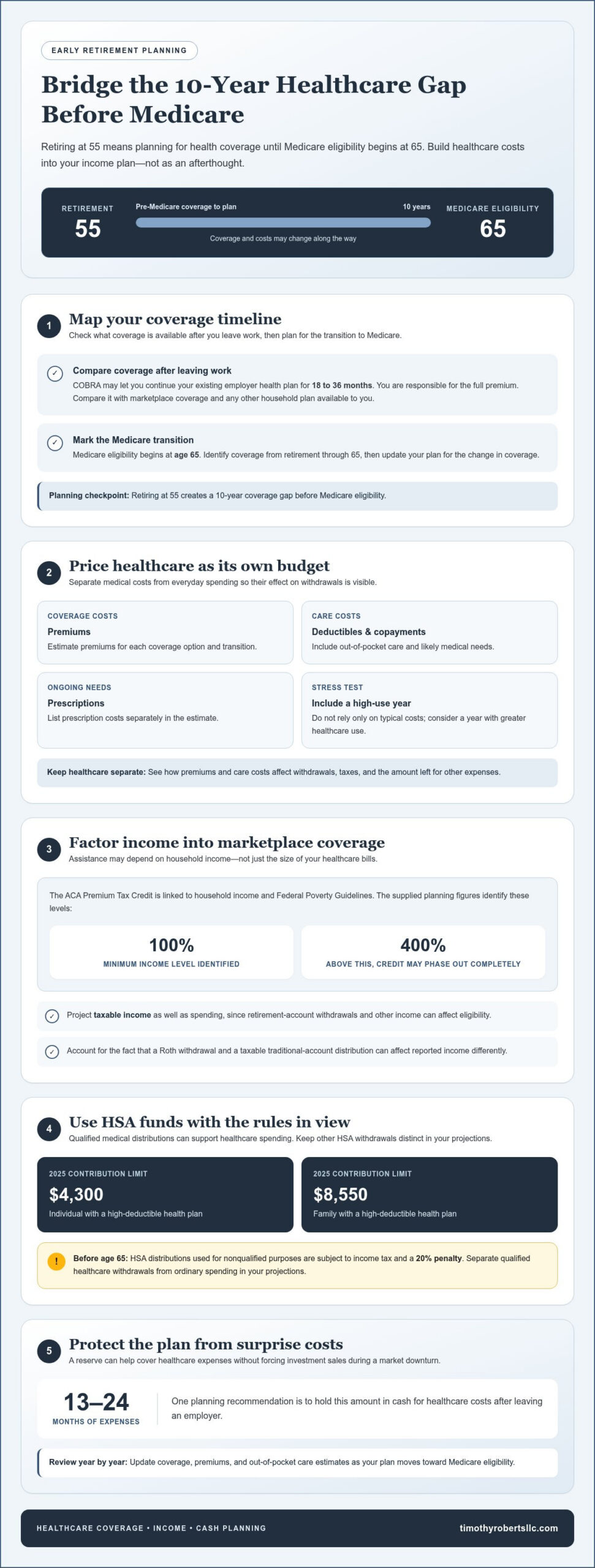
To estimate retirement expenses and healthcare costs before Medicare, separate routine living costs from premiums, deductibles, prescriptions, and out-of-pocket care. Medicare eligibility begins at age 65, according to the Centers for Medicare & Medicaid Services. Retiring at 55 therefore creates a 10-year coverage gap to include in the plan.
Start with the coverage available after leaving work. COBRA may let you continue an existing employer health plan for 18 to 36 months, but you’re responsible for the full premium. Compare that temporary option with marketplace coverage and any other household plan available to you.
Estimate healthcare costs by listing premiums, deductibles, copayments, prescriptions, and likely care separately. Include a high-use year, not just typical costs. Then consider how expenses could change as coverage shifts, such as from an employer plan to marketplace insurance and later to Medicare. Keep healthcare costs separate from other expenses so you can see their effect on withdrawals and taxes.
Marketplace assistance can change the net premium. The ACA Premium Tax Credit is linked to household income and Federal Poverty Guidelines: the supplied planning figures identify 100% as the minimum income level and 400% as a level above which the credit may be phased out completely. Project taxable income as well as spending, because retirement-account withdrawals and other income can affect eligibility. A Roth withdrawal and a taxable traditional-account distribution can have different effects on reported income.
Health savings accounts can add another layer. For 2025, the contribution limit is $4,300 for an individual with a high-deductible health plan and $8,550 for a family. Qualified medical distributions can support healthcare spending; before age 65, HSA distributions used for nonqualified purposes are subject to income tax and a 20% penalty. Separate qualified healthcare withdrawals from ordinary spending in your projections.
Use a year-by-year timeline: identify coverage from retirement through age 65, estimate premiums and out-of-pocket care, then update the plan when Medicare eligibility begins. A cash reserve can help cover premiums and medical bills without forcing investment sales during a downturn. One planning recommendation is to hold 13 to 24 months of expenses in cash for healthcare costs after leaving an employer.
Coordinating premiums, income, and withdrawals is part of retirement income planning. A clear projection can show how healthcare costs affect the amount available for other expenses and which income sources to draw on during the pre-Medicare years.
Social Security claiming age
Social Security can become a later income layer, not the funding source for retiring at 55. Age 62 is the earliest age at which a person can claim Social Security retirement benefits, according to the Social Security Administration. Build the years before claiming into your plan with portfolio withdrawals, pension income, or other available resources.
Your claiming age affects the monthly benefit. Full retirement age is between 66 and 67, depending on birth year. Claiming before full retirement age may reduce benefits permanently, with an approximate reduction of 25% to 30% for early claims. Delaying past full retirement age increases benefits by 8% per year until age 70. Compare the trade-off between income sooner and a larger later benefit.
Social Security retirement benefits are based on lifetime earnings, including a worker’s highest 35 years of earnings. Review the earnings record used to estimate your benefit and consider how additional work could affect it. If your record includes years with lower earnings, later earnings may replace them in the calculation. This estimate helps you avoid treating a projected benefit as a fixed amount independent of your work history.
To bridge the gap before Social Security, map income sources by year. For example, a person retiring at 55 could plan for portfolio withdrawals first, then layer in Social Security when claiming begins. Keep the bridge distinct from long-term retirement income: withdrawals taken early reduce assets that might otherwise support later years. Include taxes and investment performance when comparing different withdrawal schedules.
Coordinate pensions, Social Security, and investments as one income system. A pension may cover essential expenses, leaving investments to fund discretionary spending or unexpected costs. Without a pension, your portfolio may need to support more of the early-retirement years. Compare the timing and reliability of each income source, and identify which assets can cover spending before retirement accounts become more accessible.
Work income can matter even after Social Security benefits begin. Earnings from work may affect the amount of Social Security retirement benefits paid before full retirement age. After full retirement age, work and earnings do not affect benefits. Include expected employment income in the same calendar-year projection as benefits and investment withdrawals to account for both cash flow and possible withholding.
Compare three claiming paths: at the earliest eligible age, at full retirement age, and at age 70. For each, estimate annual income alongside pension payments and planned withdrawals. A later claim can require a larger bridge from investments, while an earlier claim provides income sooner with a lower monthly benefit. The right comparison is the effect on the whole plan, not the benefit in isolation.
Taxes and penalties on early 401(k) and IRA withdrawals
Early access can create both income taxes and penalties, so distinguish account rules before planning withdrawals. The Rule of 55 and 72(t) substantially equal periodic payments are separate ways some retirees may access funds before age 59½ without the usual early-withdrawal penalty.
Rule of 55 Employer-Plan Withdrawals
The Rule of 55 may allow penalty-free withdrawals from a workplace plan after separation from the employer. According to the Internal Revenue Service, this may apply in or after the year you turn 55, if you’ve left the company and its plan permits these withdrawals. It matters because the exception concerns the employer plan you just left, not an IRA or a previous employer’s plan.
The Rule of 55 removes the 10% early-withdrawal penalty, not income taxes. Traditional 401(k) distributions generally remain taxable as ordinary income, so include each withdrawal in your tax estimate. Before moving funds, compare the employer plan’s withdrawal provisions with your expected spending needs. A rollover to an IRA can change access options because the Rule of 55 doesn’t apply to IRAs.
72(T) Substantially Equal Periodic Payments
Section 72(t) allows a series of substantially equal periodic payments from retirement savings under specific rules. The payments must continue for five years or until you reach age 59½, whichever is longer. This can create an income stream before the usual age threshold, but it restricts your ability to change or stop the schedule.
Changing or stopping a 72(t) payment schedule can trigger a retroactive 10% early-withdrawal penalty. Treat the payment amount and duration as a coordinated commitment, not a flexible annual withdrawal. Model the cash flow alongside taxes and other income before relying on it to fund early retirement.
Generally, distributions from pretax IRA or 401(k) savings before age 59½ are subject to ordinary income tax and a 10% penalty unless an exception applies, according to the Internal Revenue Service. State income tax may also apply. A withdrawal’s net value can therefore differ from its gross amount, so estimate the tax impact before setting a spending budget.
Some exceptions are specific to the account and circumstance. Roth IRA rules allow penalty exceptions for disability and distributions to a beneficiary or estate after the account owner’s death. A terminal illness may qualify for an early-withdrawal penalty exception when a physician certifies that death can reasonably be expected within 84 months. These exceptions don’t make every distribution tax-free.
Hardship withdrawals require careful consideration. They are limited to the amount needed to meet an immediate and heavy financial need, and they remain subject to federal and state income taxes even when an early-withdrawal penalty does not apply. Before choosing a withdrawal method, compare the tax cost, penalty rules, and effect on future retirement income.
Early retirement income bridging strategies
An income bridge connects the year you stop working with the later years when Social Security or other income begins. A useful way to approach how to create a financial plan for early retirement at 55 is to map which accounts can fund each stage, the tax treatment of withdrawals, and the flexibility available if markets fall.
To manage sequence-of-returns risk, avoid depending on forced sales of growth investments during a market decline. Match near-term spending with accessible cash and other lower-volatility assets, while maintaining a diversified investment allocation suited to your longer retirement horizon and risk tolerance. Review the balance as spending needs, income, and market conditions change.
Create a year-by-year withdrawal plan. Start with dependable income, such as pension payments, and calculate the gap between income and expenses. Identify accessible savings to cover that gap, accounting for taxable distributions and income taxes. A taxable investment account may bridge the gap without an early withdrawal from a retirement account, although sales can still affect taxes. Coordinate withdrawals with expected income from other sources; for business owners planning an early transition, resources from specialized advisory firms like tax accountants perth can offer valuable insight on optimizing distributions and personal profitability.
Workplace plans may offer access under the Rule of 55 when the conditions described in the previous section are met. Another option is a series of substantially equal periodic payments under Section 72(t). Those payments must continue for five years or until age 59½, whichever is longer. Changing or stopping the schedule can trigger a retroactive 10% early-withdrawal penalty, so it requires a sustained cash-flow commitment.
A 401(k) loan can appear to bridge a short-term gap, but it creates repayment obligations. The maximum is generally the lesser of $50,000 or 50% of your vested account balance. Repayments generally must be made in substantially equal payments at least quarterly. A missed repayment can change the tax treatment, while borrowing also reduces the funds remaining invested in the plan.
Keep bridge income separate from long-term retirement income in your forecast. For each year, list the account used, gross withdrawal, estimated income tax, and remaining balance. Revisit the schedule when employment income, Social Security timing, or spending changes. For healthcare, remember that HSA distributions used for nonqualified purposes before age 65 face income tax and a 20% penalty.
If you’re deciding how to create a financial plan for early retirement at 55, connect the bridge to both near-term access and future income needs. A disciplined strategy pairs accessible assets with a portfolio built for withdrawals and longer-term growth. Plan your retirement income strategy around account access, tax treatment, and a sustainable investment mix.
Timothy Roberts & Associates: Retirement Income Planning
Timothy Roberts & Associates can help turn your early-retirement estimates into a coordinated income strategy. Its Retirement Income Planning can bring withdrawal timing, Social Security, taxes, and spending needs into one plan, while Investment Portfolio Management aligns the portfolio with your income horizon and risk considerations.
This planning can be useful as you approach retirement, particularly when deciding which accounts to draw from, how to bridge the years before benefits begin, or whether to adjust your investment mix. Estate & Legacy Planning and Risk Management & Insurance Analysis can also help connect broader financial priorities with retirement income.
To discuss your retirement planning, contact Timothy Roberts & Associates.
Make Your Next Retirement Decision With Clarity
Understanding how to create a financial plan for early retirement at 55 means treating it as an evolving decision framework, not a one-time calculation. As your priorities or circumstances change, revisit the assumptions behind your income, spending, and investment decisions. That gives you a clearer basis for adjusting course while keeping your long-term goals in view.
Timothy Roberts & Associates, LLC offers Retirement Income Planning to help shape an income strategy, alongside Investment Portfolio Management and Estate & Legacy Planning. These services can help connect your retirement choices with your wider financial priorities.
If you’re ready to discuss your next steps, contact Timothy Roberts & Associates, LLC. A thoughtful plan can give your next chapter a more deliberate start.
Frequently Asked Questions
What about the rule of 25?
The Rule of 25 estimates a portfolio target by multiplying annual expenses by 25. It’s associated with an initial withdrawal of 4%, giving you a quick way to compare savings with spending needs. For example, annual expenses are the key input, not salary alone. Treat the result as a planning benchmark, then account for other income, taxes, healthcare, and how long your retirement may last.
How Can I Access My 401(k) at 55?
You can use the Rule of 55 for eligible withdrawals from a workplace plan after separating from that employer, if the plan permits them. The Internal Revenue Service says the separation must occur in or after the calendar year you turn 55. For example, leaving a job before that year may not meet the age condition. This exception applies to the qualifying employer plan, not an IRA.
Is Retiring at 55 Realistic?
Retiring at 55 can be feasible when savings and other income can support your expected spending over a long horizon. A person retiring at 55 and living to 90 must plan for 35 years of retirement. Test the plan against essential expenses, healthcare coverage, accessible assets, taxes, and market declines. If the numbers depend on optimistic returns or very low spending, revise the assumptions before setting a retirement date.
Retirement at 55: Is It Possible, and What Does It Actually Cost?
Yes, it’s possible, but the cost depends on your household expenses, healthcare, taxes, and income sources. One hypothetical early-retirement household estimated monthly living and medical-insurance expenses of about $7,000. Use your own budget rather than adopting that example: separate recurring bills from irregular costs, then account for the years before Medicare eligibility. The portfolio need also depends on how much spending pensions or other income can cover.
What if I need to withdraw from a 401(k)s or IRAs before age 59½?
Before age 59½, pretax 401(k) and IRA withdrawals are generally subject to ordinary income tax and a 10% penalty unless an exception applies. First identify the account type and the reason for withdrawal. The Rule of 55 concerns eligible employer-plan withdrawals, while Section 72(t) uses scheduled payments. A hardship withdrawal can remain taxable even when a penalty exception applies, so estimate the net amount available.
How much retirement savings do I need to retire at 55 in the U.S.?
There’s no single savings total that fits every U.S. household; the target depends primarily on annual expenses and dependable income. As one benchmark, $80,000 in annual expenses corresponds to roughly $2.3 million at a 3.5% withdrawal rate. A pension or later Social Security income can change how much the portfolio must provide. Build separate estimates for the years before and after those income sources begin.
What withdrawal rate is safe for retiring at 55, and how does it compare with the 4% rule?
A 3% to 3.5% withdrawal-rate range is one planning reference for a 35-year retirement; the Rule of 25 is associated with an initial 4% withdrawal. For $80,000 in annual spending, the examples put the portfolio target at about $2.7 million at 3%, versus about $2 million at 4%. Compare these starting points with your time horizon, expenses, taxes, and income sources.
How to access 401(k) and IRA money before age 59½ without penalties?
Potential routes include eligible Rule of 55 withdrawals from a qualifying workplace plan and substantially equal periodic payments under Section 72(t). For a Roth IRA, contributions have separate withdrawal treatment, while qualified earnings require the five-year aging requirement plus an age or other qualifying condition. These routes have distinct rules and tax effects. Identify the account and withdrawal purpose before relying on funds for planned spending.
