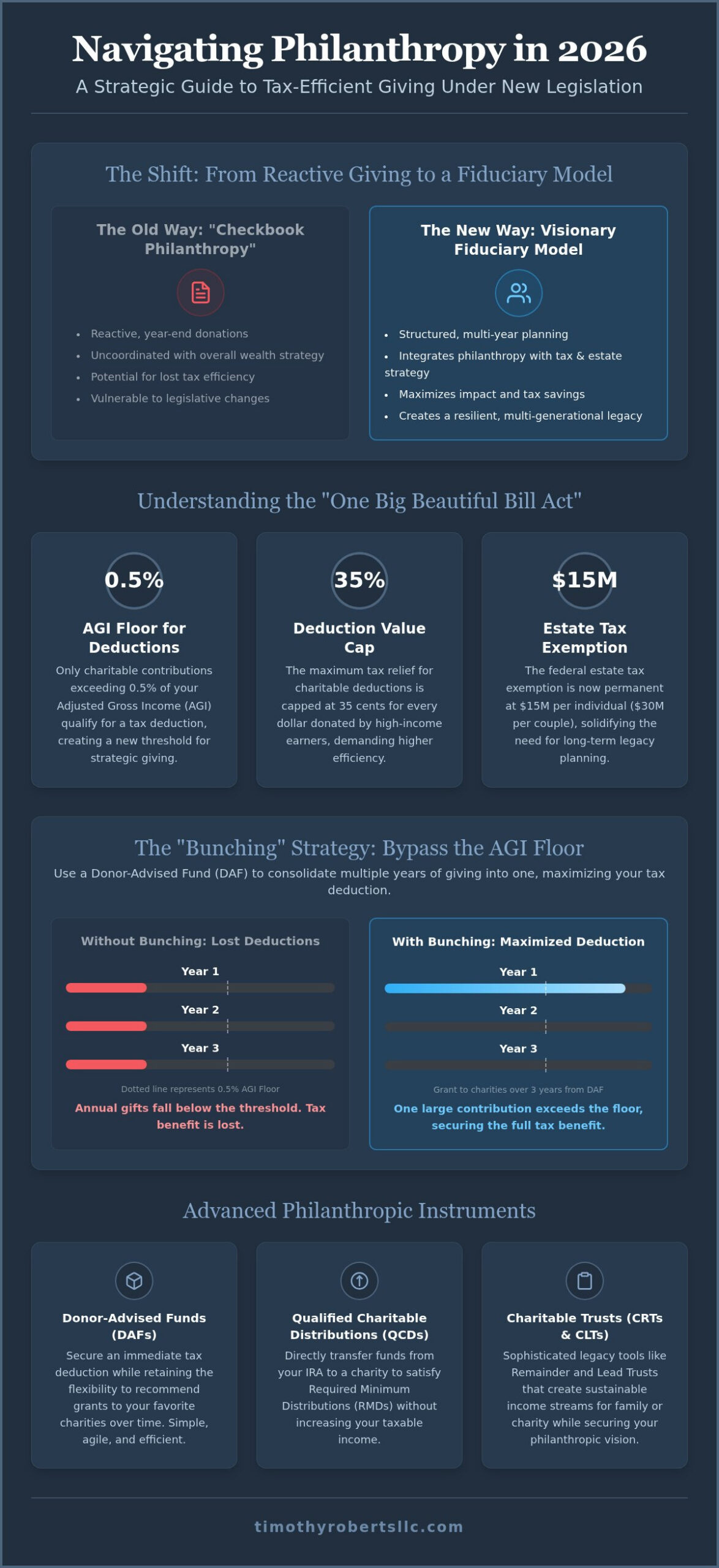
For people searching for effective charitable giving strategies, the central question is how to support causes they care about without disrupting retirement or family plans.
The right approach depends on the assets you want to give, the timing, and the legacy you have in mind. This guide compares direct gifts, donor-advised funds, gifts of appreciated assets, charitable trusts, private foundations, and qualified charitable distributions, and outlines questions to discuss with financial, tax, and legal professionals.
Timothy Roberts & Associates, LLC brings charitable intentions into fiduciary financial, retirement, investment, and estate planning. Its fee-only approach has no commissions, and its philosophy is “Your Interest is Our Only Interest.” Financial planning can help clarify trade-offs, but it does not promise tax outcomes or replace tax or legal advice.
The information in this material is not intended as tax or legal advice. Please consult legal or tax professionals for specific information regarding your individual situation. This site is published for residents of the United States only. Not all of the products and services referenced on this site may be available in every state and through every advisor listed. Securities offered through Cetera Financial Specialists LLC (doing insurance business in CA as CFGFS Insurance Agency), member FINRA/SIPC. Advisory services offered through Cetera Investment Advisers LLC. Cetera entities are under separate ownership from any other named entity.
Key Takeaways
- Start with the causes and legacy you want to support, then consider how giving fits alongside retirement income, family priorities, and available resources.
- Compare direct gifts, donor-advised funds, charitable trusts, and private foundations by timing, flexibility, administration, and the involvement you want.
- Consider charitable giving alongside broader financial, retirement, investment, and estate planning priorities.
- Use a practical checklist to define your purpose, review liquidity, compare approaches, coordinate professionals, and document your intentions.
- Timothy Roberts & Associates is fee-only and fiduciary. Its advisors are legally bound to act in clients’ best interests, guided by “Your Interest is Our Only Interest.” Tax and legal questions should be addressed with qualified professionals.
Charitable Giving Strategies: Start With Your Purpose and Financial Picture
Giving generously and protecting the priorities that support your household can fit within the same plan. Start by defining what you hope your generosity will accomplish, what resources you can commit, when you want a gift to take effect, and how involved you want to be. These answers help narrow the options before you compare specific giving structures.
A charitable giving strategy is a planned approach to directing assets toward causes or organizations in a way that reflects your purpose, financial capacity, timing, and preferred level of involvement. It might mean a recurring gift, a contribution of an asset, or a legacy intention. Understanding Charitable Giving offers general context on common forms and motivations, but the right approach depends on your circumstances.
What makes a charitable giving strategy different from a one-time donation?
A spontaneous donation responds to a present need or opportunity. A strategy considers the longer term: who receives support, when it is given, which asset is used, and how the gift fits family and financial priorities. Planning does not make every gift more suitable or advantageous. It gives you a chance to consider the choices before committing. For some households, a direct gift is the clearest expression of generosity. For others, coordinating gifts over time may better reflect their intentions.
Which goals should shape a giving plan?
Begin with the mission, then set practical boundaries. Clarifying both can help you compare approaches without assuming one structure suits every donor. Consider questions such as:
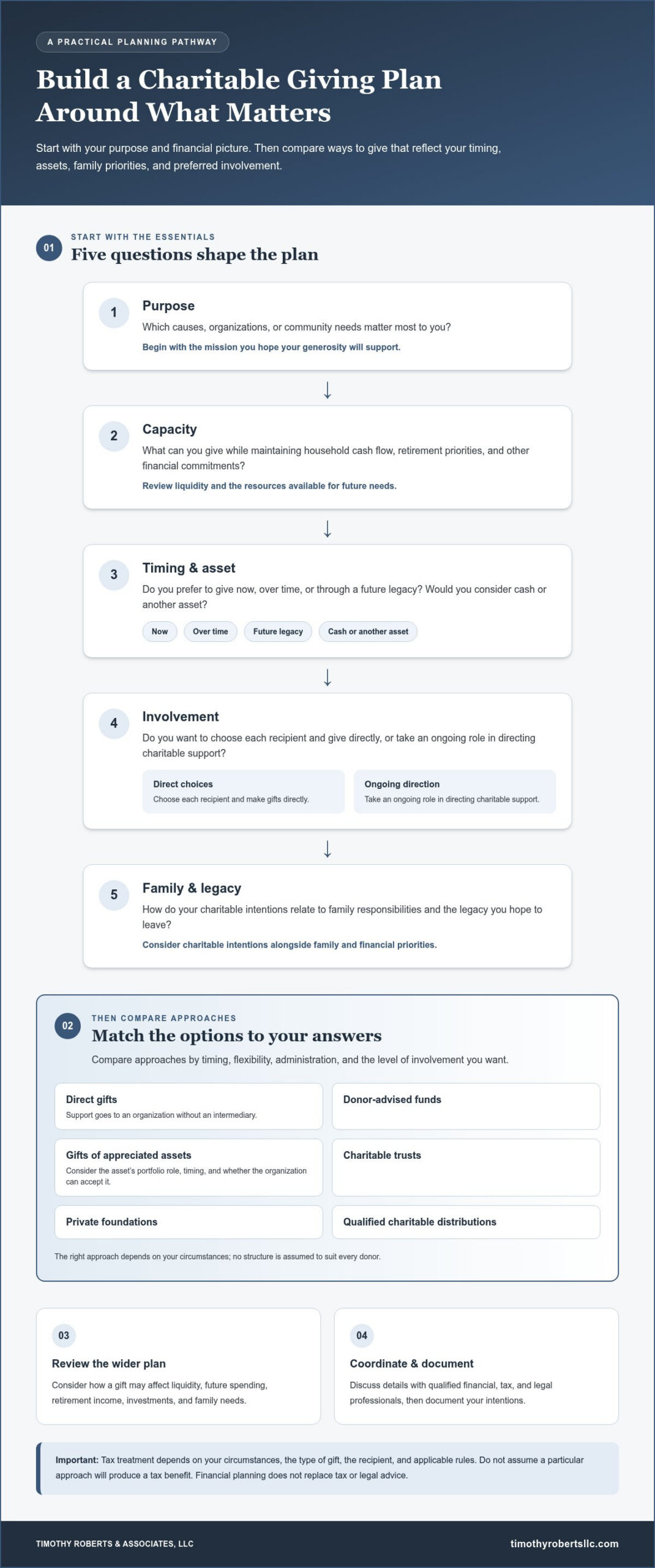
- Purpose: Which causes, organizations, or community needs matter most to you?
- Capacity: What can you give while maintaining household cash flow, retirement priorities, and other financial commitments?
- Timing and asset: Do you prefer to give now, over time, or through a future legacy? Would you consider cash or another asset?
- Involvement: Do you want to choose each recipient and make gifts directly, or take an ongoing role in directing charitable support?
- Family: How do your charitable intentions relate to family responsibilities and the legacy you hope to leave?
These questions distinguish charitable intent from financial capacity. Both matter, but they are not interchangeable: a deeply held cause does not determine what a household can comfortably give, and available assets alone do not define the impact a donor wants to make. A thoughtful plan makes room for both.
Possible tax treatment depends on your circumstances, the type of gift, the recipient, and applicable rules. Do not assume a particular approach will produce a tax benefit. Discuss the details with qualified tax and legal professionals. Financial planning can help place charitable intentions alongside retirement, investment, and estate priorities, so generosity is considered within your broader financial picture.
How Charitable Gifts Can Fit Into Retirement, Investment, and Legacy Plans
A charitable gift can affect more than an account balance. It may change the liquidity available for future needs, the investments available to support retirement, and how you plan to provide for family or charitable causes over time. Reviewing these connections before choosing a giving structure can help you weigh generosity alongside financial priorities.
How can charitable giving interact with retirement planning?
Consider a hypothetical retiree who wants to make a substantial gift while also drawing from investments to support living expenses. The decision involves more than charitable intent: the timing and source of the gift may affect which assets remain available for future spending. Reviewing the gift alongside retirement income planning can help clarify that trade-off without assuming a particular outcome. Family needs, income sources, and the role of investments all belong in the discussion.
What should donors understand about assets and possible tax treatment?
Cash and appreciated securities are different asset categories, and a gift involving one may raise different planning questions from a gift involving the other. Before transferring an asset, consider its role in your portfolio, the timing of the contribution, and whether the recipient organization can accept it. Rules can change, and eligibility depends on individual facts. The IRS provides general information about charitable organizations and contributions in its IRS Guidelines for Charitable Contributions. A tax professional can help assess how current rules apply to your situation.
Tax treatment varies by asset, giving structure, and individual circumstances. A direct gift sends support to an organization without an intermediary. A donor-advised fund generally separates the contribution to the fund from recommendations about later grants to charities. A charitable trust is a legal arrangement with defined terms for managing assets and directing benefits. These options differ in control, administration, timing, and intended beneficiaries. They are not interchangeable, and added complexity does not necessarily make an option a better fit.
Estate intentions matter, too. A gift made during your lifetime may affect assets available for family needs; a legacy gift may express charitable priorities through your estate plan. Coordinate these intentions with investment and retirement decisions, and consult qualified legal and tax professionals about documents, eligibility, and tax treatment. Timothy Roberts & Associates provides fiduciary, fee-only financial planning to help clients consider these priorities together. Fiduciary financial planning can bring the broader trade-offs into focus.
Compare Charitable Giving Strategies by Flexibility, Timing, and Involvement
The right approach depends on how you want to give, when you want support to reach a cause, and how much ongoing administration you are prepared to take on. This comparison is a starting point for evaluating charitable giving strategies ann arbor, not a recommendation. Details depend on your circumstances and the governing terms of each arrangement.
| Approach | Control and timing | Assets and administration | Potential beneficiaries |
|---|---|---|---|
| Direct gift | You choose the organization and make a gift directly. Support reaches the recipient when the gift is made. | Often straightforward, though the recipient’s ability to accept a particular asset matters. | The organization or cause you select. |
| Donor-advised fund | You contribute to a charitable account and may recommend grants over time, subject to the sponsoring organization’s rules. Contributions do not mean retaining unrestricted ownership or control. | May let a donor separate the timing of a contribution from later grant recommendations. Account terms and eligible assets vary. | Eligible charitable organizations selected under the fund’s governing rules. |
| Charitable trust | Terms set out how assets are managed and when charitable or other beneficiaries receive distributions. | Requires a legal structure and ongoing administration. The trust’s terms shape how it operates. | May include charitable organizations and, depending on the trust, other beneficiaries. |
| Private foundation | Donors or designated decision-makers may guide grantmaking under the foundation’s governance. | A distinct charitable structure with formal governance and administrative responsibilities. | Organizations or causes supported through its grantmaking. |
How do direct gifts and donor-advised funds differ?
A direct gift suits donors who know which organization they want to support now. A donor-advised fund can provide a way to recommend grants on a later schedule, while the sponsoring organization’s rules govern how those recommendations are handled. The practical distinction is timing and administration, not unrestricted control over charitable assets.
When might donors explore charitable trusts or foundations?
A charitable remainder trust generally directs payments to noncharitable beneficiaries for a defined period or lifetime, with remaining assets designated for charity. A charitable lead trust generally directs payments to charity first, with remaining assets passing to other beneficiaries under its terms. Private foundations involve a separate governance and administration framework. Each structure deserves careful review, particularly when family, legacy, and asset-management goals intersect.
Use the comparison to identify questions, not to select a structure based on its label alone. Consider who should benefit, when, which assets are involved, and how much oversight you want. Eligibility, legal structure, and tax treatment require individualized review by qualified legal and tax professionals. Timothy Roberts & Associates’ fiduciary financial planning can help place charitable intentions alongside broader financial priorities. Explore fiduciary financial planning as part of that wider conversation.
Build a Charitable Giving Plan With a Practical Decision Checklist
A clear process can turn charitable intentions into decisions that account for household needs, family priorities, and the legacy you hope to create. Use this checklist to organize your thinking before comparing approaches and to make conversations with financial, tax, and legal professionals more focused.
- Define your purpose. Identify the causes and organizations you want to support, whether you prefer gifts during your lifetime or through your estate, and how involved you want to be in directing contributions.
- Review your resources. Consider cash flow, assets you may want to give, upcoming expenses, retirement income needs, family responsibilities, and the liquidity you want to preserve. This is a high-level review, not a prediction of future outcomes.
- Compare structures. Weigh direct gifts, donor-advised funds, trusts, and foundations based on timing, administration, asset considerations, and your desired level of involvement. The most elaborate option is not automatically the best fit.
- Coordinate professionals. A fiduciary financial planner can help assess financial trade-offs within the scope of financial planning. Bring legal questions to a qualified legal professional and tax questions to a qualified tax professional.
- Document intentions. Keep a record of the organizations, assets, timing, and decisions you are considering. Review relevant estate documents with your legal professional so your charitable intentions and written plans can be considered together.
What information should donors gather before comparing options?
Prepare a concise snapshot of your charitable priorities, intended recipients, potential asset types, and preferred timing. Add a high-level view of household cash flow, retirement plans, family needs, and existing estate documents. Note open questions, such as whether an organization can accept a particular asset or what records may be needed. Documentation requirements and applicable rules vary, so review current IRS guidance and discuss your circumstances with tax and legal professionals.
For decisions involving future gifts or beneficiaries, estate and legacy planning can help frame how charitable intentions relate to family and other estate priorities. Discuss potential tax implications with a qualified tax professional. Tax planning considerations can help identify questions to raise without assuming a specific outcome.
How should donors coordinate financial and professional guidance?
Financial planning can help evaluate how a proposed gift fits with liquidity, retirement income, investments, and broader goals. Legal professionals address legal structures and documents; tax professionals assess tax treatment and reporting based on current rules and individual facts. One role does not replace another. Timothy Roberts & Associates is fee-only and fiduciary, guided by “Your Interest is Our Only Interest.” Discuss charitable goals within your financial plan.
Coordinate Charitable Giving With Fiduciary Financial Planning
Charitable intentions belong in the broader financial picture. A fiduciary planning conversation can consider how giving relates to retirement priorities, investment decisions, household needs, and the legacy you hope to shape. This can clarify trade-offs and questions to explore without promising a particular financial, charitable, or tax outcome.
What does fiduciary, fee-only planning mean for charitable decisions?
A fiduciary advisor is legally bound to act in the client’s best interest. Fee-only planning means the firm receives no commissions. Together, these describe how the advisor is compensated and whose interests guide the planning relationship. They do not guarantee that a particular giving structure will be suitable or produce a specific result. Evaluate charitable giving strategies ann arbor within the full context of your goals and resources, rather than relying on a label alone.
How can a planning conversation help clarify next steps?
A focused discussion can bring separate priorities into the same frame: the causes you want to support, your retirement plans, investment holdings, and how charitable intentions may relate to estate planning. It can help identify financial trade-offs and organize questions for follow-up. Legal questions about documents or structures belong with a qualified legal professional; a qualified tax professional should review tax eligibility, treatment, and reporting.
Timothy Roberts & Associates, LLC provides fee-only financial planning and fiduciary guidance. Its philosophy, “Your Interest is Our Only Interest,” reflects a commitment to considering decisions in the client’s best interest. Financial planning can help you assess how generosity fits with the rest of your financial life, while legal and tax determinations remain within the appropriate professional roles.
Explore fiduciary financial planning to consider charitable intentions alongside your broader financial priorities.
Shape Your Next Step With Purpose
Your charitable intentions can evolve as your financial life changes. Treat your plan as something to revisit when priorities shift, rather than a decision that must remain fixed. A useful next step is to bring your giving goals into a broader conversation about what matters to you and how you want your resources to support those priorities.
Timothy Roberts & Associates offers fee-only financial planning with no commissions. Its fiduciary advisors are legally bound to act in clients’ best interests and bring more than 30 years of financial-management experience to that work. Guided by “Your Interest is Our Only Interest,” the firm can help you consider charitable goals alongside financial priorities without promising a particular outcome. Explore fiduciary financial planning as you consider your next step.
With clear priorities and the right professional perspectives, charitable giving strategies ann arbor can become a considered expression of your values and a meaningful part of your financial journey.
Frequently Asked Questions
Can charitable giving strategies support both a cause and a long-term financial plan?
Yes. Charitable goals can be considered alongside retirement, liquidity, investment, and family priorities, though no approach guarantees a particular charitable impact or financial result. For example, a household planning recurring gifts can review how they fit expected withdrawals and other commitments. The question behind charitable giving strategies ann arbor readers explore is how generosity fits their own financial picture. Suitable structures and tax treatment depend on individual circumstances, current rules, and professional review.
What is the difference between a donor-advised fund and a private foundation?
Both can support charitable giving, but they differ in structure, governance, administration, and donor involvement. A donor-advised fund is administered through a sponsoring organization, with grant recommendations made under its rules. A private foundation is a separate charitable structure with its own governance and administrative responsibilities. Neither option is automatically right for every donor. Legal and tax implications depend on individual facts, so consult qualified professionals before deciding.
Are charitable contributions always tax-deductible?
No. A charitable contribution is not automatically deductible in every situation. Eligibility and treatment can depend on the recipient’s status, the asset given, the donor’s circumstances, applicable rules, and whether required records are kept. Do not assume a gift qualifies for a deduction or that a particular amount will be deductible. A qualified tax professional can review your circumstances and current IRS requirements, including documentation relevant to the contribution you are considering.
How can appreciated investments be considered for charitable giving?
Some donors discuss gifts of appreciated investments with financial, tax, and legal professionals before making a transfer. Considerations can differ from those for a cash gift and depend on the asset, recipient, holding circumstances, and current rules. Review how a transfer could affect your portfolio and other financial priorities. Do not assume it will create capital-gains or income-tax savings. Professional guidance can help you understand possible implications before taking action.
What happens if my charitable priorities change after I make a gift?
Your options depend on how the gift was structured and on the governing documents or fund policies. Some transfers may be irrevocable, and some arrangements may limit changes to the recipient or purpose. Do not assume you can redirect a contribution later. Before giving, review the terms, including who can recommend or approve future distributions and what flexibility exists. Qualified professionals can help you understand those terms before you commit assets.
How do I coordinate charitable giving with retirement and estate planning?
Start by clarifying the causes you want to support, then consider retirement needs, family priorities, assets, and timing together. For instance, compare a proposed gift with planned withdrawals and other future commitments before deciding how to proceed. A fiduciary financial planner can help assess financial trade-offs, while legal and tax professionals address their respective areas. The plan should reflect your circumstances, not a standard formula or assumed outcome.
Do I need a financial, tax, or legal professional to plan a charitable gift?
Professional input can be valuable when a gift involves investments, a trust, retirement assets, or estate documents. A financial planner can help assess effects on the broader plan; qualified tax and legal professionals address tax treatment and legal structure. Financial planning does not replace those opinions. The information in this material is not intended as tax or legal advice. Please consult legal or tax professionals for specific information regarding your individual situation. For fiduciary financial planning that considers charitable goals alongside your broader priorities, connect with Timothy Roberts & Associates.