

Oct
Overcoming fear of running out of money in retirement
In the United States, 46% of retirees say spending their retirement savings creates anxiety. A clear spending plan, cash reserves for near-term needs, and realistic preparation for healthcare costs can make overcoming fear of running out of money more manageable.
That worry is understandable: retirement savings must last an uncertain number of years, and market changes or unexpected expenses can make routine decisions feel significant. The goal isn’t to predict every cost or avoid spending. It’s to understand what your resources can support and how your plan can adapt.
This article explains how retirement income and withdrawals fit into a spending plan, how cash reserves may help during market downturns, and how healthcare costs and personal concerns can shape your sense of security. You’ll also learn how flexible spending choices and clear priorities can help you approach retirement with greater confidence.
Key Takeaways
- Build a retirement spending plan around income, essential costs, and flexible choices so you can adjust without treating every change as failure.
- Consider how a longer retirement could affect your savings, and account for healthcare and long-term care needs in your financial picture.
- Set aside cash for near-term expenses to help reduce pressure to sell investments during a market downturn.
- Identify the values behind your concerns about safety, independence, and leaving a legacy to make financial decisions feel more purposeful.
- Retirement income planning can bring spending, investments, risk management, and legacy goals into a more coordinated strategy.
Creating a retirement spending plan
A retirement spending plan turns savings and income into clear choices about what you can spend, save, or adjust. It can make overcoming fear of running out of money more manageable by replacing guesswork with a practical view of your resources and priorities.
To see how planning can change your perspective, watch this video:
Shifting From Accumulation to Sustainable Spending
Sustainable retirement spending means using savings and income to support your life without treating every withdrawal as a mistake. During your working years, contributing to accounts may be the priority. In retirement, you balance regular expenses with goals such as travel. A written plan shows which resources cover essentials and which support discretionary choices, making spending decisions clearer and easier to revisit.
Projected and Observed Retirement Spending
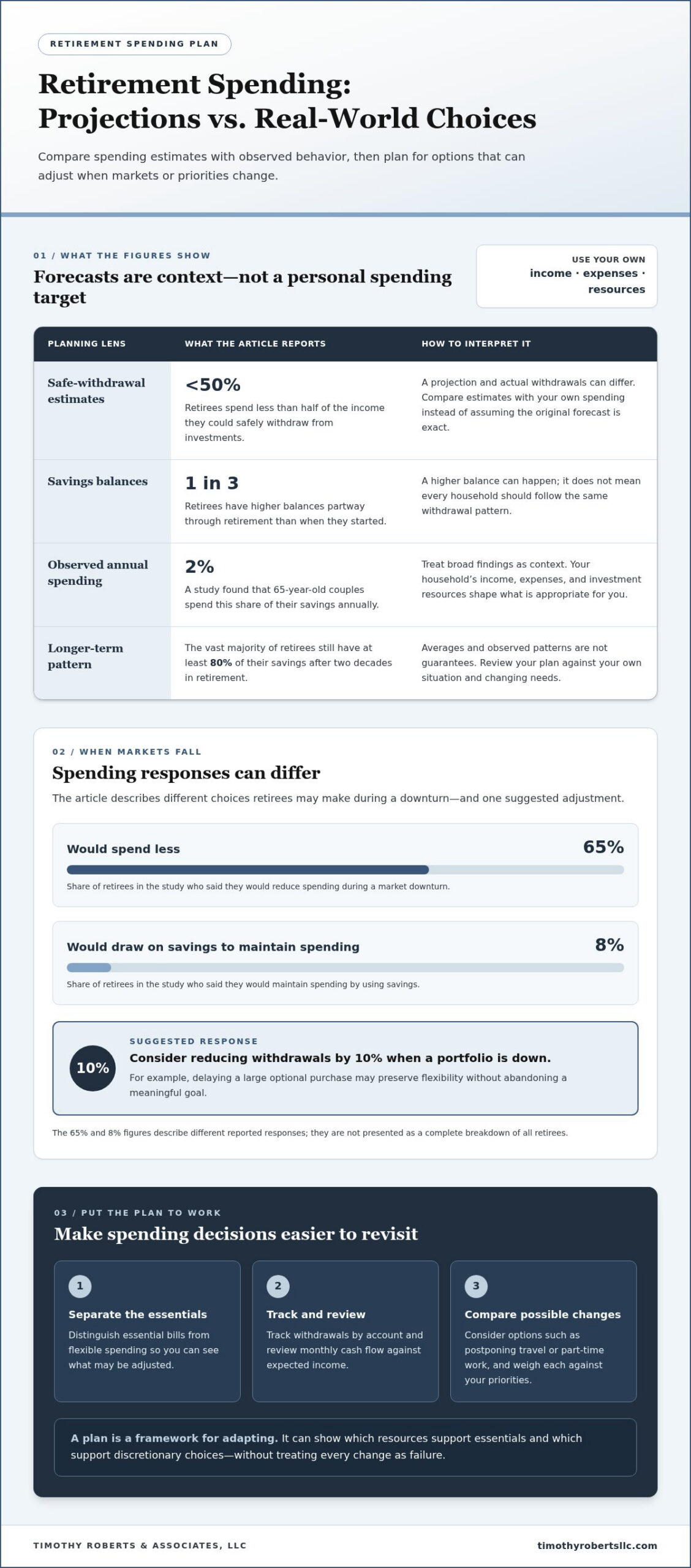
Spending projections estimate how savings may perform under assumptions, while observed behavior shows what retirees actually withdraw. These can differ: retirees spend less than 50% of the income they could safely withdraw from investments, and one-third have higher balances partway through retirement than when they started. A study found 65-year-old couples spend 2% of their savings annually. Comparing estimates with actual spending can help refine a plan instead of assuming the initial projection is exact.
Flexible Spending During Market Downturns
Flexible spending means adjusting optional withdrawals when investments fall, while protecting essential costs where possible. A study found 65% of retirees would spend less during a market downturn, while 8% would maintain spending by drawing on savings. One suggested response is reducing withdrawals by 10% when a portfolio is down. For example, delaying a large optional purchase can preserve flexibility without abandoning a meaningful goal; the plan should describe adjustments, not label a downturn as failure.
Budgeting and Recurring Money Worries
Budgeting methods that can reduce anxiety include separating essential bills from flexible spending, tracking withdrawals by account, and reviewing your plan regularly. A monthly cash-flow review can show whether spending matches expected income and where an adjustment may help.
If you’re concerned about a shortfall, list possible expense reductions, such as postponing travel, and potential income options, such as part-time work. Compare each change with your priorities before adjusting investments or withdrawing more from savings.
Speak with a financial professional when uncertainty about income, withdrawals, or bills makes your plan difficult to manage. Consider a therapist if recurring worry disrupts daily life or leads you to avoid financial tasks. The Centers for Disease Control and Prevention says therapy can help people develop coping skills and find solutions.
To manage recurring worries, schedule a brief weekly review of bills and accounts, then write down the next action for each concern. If a bill feels difficult to face, open it during that planned review and handle one task at a time.
Acknowledging and understanding retirees’ concerns
Fear of financial insecurity can reflect genuine uncertainty about longevity, expenses, and income. Understanding what drives the worry can help you distinguish financial pressures from assumptions that may not fit your circumstances.
Changing Expenses and Financial Insecurity
Retirement expenses can shift with age, so a fixed spending estimate may not reflect every stage of life. Spending remains relatively constant or rises slightly through retirees’ 60s and 70s, then levels off. Discretionary needs at 65 may differ from those at 85, while healthcare or care needs can change the picture. Recognizing these shifts helps you plan for experiences now while considering later needs.
Fear also reflects uncertainty about how long savings must last. According to the U.S. Department of Labor, 10 percent of men and women will live almost 11 years past their gender’s life expectancy, making it expensive to self-insure against longevity. That possibility helps explain why retirement concerns can persist even when current expenses feel manageable.
Savings and Withdrawal Rates
Withdrawal rates show how much retirees draw from savings relative to their balances, offering context for concerns about losing money. Married couples aged 65 and older withdraw an average of 2.1% annually from retirement savings. The vast majority of retirees still have at least 80% of their savings after two decades in retirement. These findings describe broad patterns, not a personal spending target.
Use your own income, planned expenses, and investment resources to put figures in context. For example, a household with steady pension income may rely on savings differently from one that draws more heavily on investments. A clear picture of your resources can make withdrawal decisions easier to understand.
Reframing Retirement Plan Outcomes
A retirement plan is a framework for adapting, not a pass-or-fail promise that every forecast will unfold exactly as expected. A survey found 51% of U.S. retirees fear running out of money, while Janus Henderson’s 2025 survey found 73% of affluent investors worried about generating enough retirement income. These concerns deserve attention, but worry alone doesn’t establish that a plan is failing.
Review your plan by asking practical questions: Are essential expenses covered? Has income changed? Which discretionary choices could shift if circumstances change? Expenses may naturally ease during retirement, so consider different stages of retirement rather than assuming spending will remain the same throughout.
Debt and Essential Expenses
A realistic debt payoff plan protects essential expenses first, then directs available cash toward debt without relying on optimistic assumptions. List housing, utilities, food, insurance, and minimum debt payments, then compare them with reliable income. Identify flexible spending you could reduce and choose a repayment amount that won’t leave routine bills unpaid.
In the United States, free or low-cost financial counseling may be available through nonprofit credit counseling and community-based financial counseling services. These services can help people review budgets and debt repayment options, while organizations like Consolidate My Payday Loans assist individuals struggling with high-interest short-term obligations by combining multiple balances into a single payment. Seek guidance focused on your actual income and obligations.
If anxiety makes it harder to assess your retirement income, a structured retirement strategy can bring expenses, savings, and priorities into one clear picture.
Addressing healthcare and long-term care costs
Healthcare and long-term care expenses can affect how much retirement income remains for everyday living. Planning for them means considering routine care, unexpected needs, and the resources available to meet each expense.
Separate Routine Healthcare From Long-Term Care
Start by distinguishing recurring healthcare expenses from extended support with daily activities. For example, list regular appointments, prescriptions, and insurance premiums separately from potential in-home assistance or residential care. This helps show which costs belong in your regular retirement budget and which require a contingency plan.
An unexpected long-term care expense can reach seven figures. That doesn’t mean every retiree will face costs at that level. It illustrates why a plan should consider care needs alongside other retirement priorities. Think about how paying for assistance could affect savings, income, housing choices, and support from family.
Build Healthcare Into the Financial Picture
Use a written estimate of current healthcare spending as a starting point, then identify which costs could change. For example, compare this year’s premiums and prescriptions with expected income and essential expenses, or consult retirement health planning resources such as medicarementors.com to evaluate coverage choices. Keep healthcare costs separate from general living expenses so changes don’t disappear inside a broad monthly total.
Next, consider how different care scenarios could affect your available resources. A plan might compare paying for support from income, using savings, or adjusting discretionary spending. The goal isn’t to predict exactly when or what kind of care you may need. It’s to understand the trade-offs each approach could create for travel, housing, and financial independence.
Evaluate Long-Term Care Insurance
Long-term care insurance is one possible way to transfer some eligible care expenses to an insurer, subject to the policy’s terms. Review which care settings and services are covered, when benefits can begin, how long they last, and which costs remain yours. These details determine how the policy fits your overall finances.
Compare the premium commitment with the value of keeping more savings available for other goals. For instance, a household could weigh paying premiums over time against setting aside assets for future care. Consider how each choice affects income, reserves, and your ability to manage other expenses. Insurance isn’t automatically the right fit for everyone.
Make the Plan Usable
Write down the assumptions behind your care plan, including who might provide support and which resources could fund it. Review those assumptions after a major change in health, income, or family circumstances. A clear record can replace vague concerns about the future with specific decisions you can revisit.
Responsible preparation also leaves room for choice. If projected care costs compete with essential expenses, identify which discretionary plans you could adjust first. A financial plan connecting healthcare, income, and savings can help you understand the trade-offs before a care need arises.
Cash reserves and sequence-of-returns risk
Sequence-of-returns risk describes how investment gains and losses can affect retirement savings when withdrawals are taking place. A cash reserve may help cover near-term needs, reducing pressure to sell investments after a decline and giving your plan room to respond.
Why the Order of Returns Matters
Investment results arrive in a particular order, and that order matters when you’re withdrawing money. If your portfolio falls while you’re taking income, selling investments to cover expenses can leave fewer assets available for a recovery. For example, using cash for a planned bill may help you avoid selling an investment at a temporarily lower value. This doesn’t remove market risk, but it can make withdrawals more deliberate.
The concern isn’t simply whether markets rise or fall over time. It’s whether a decline coincides with withdrawals and how much income your portfolio needs to provide. A retirement plan that identifies which assets fund near-term spending can make this risk easier to understand, rather than treating every market drop as a reason to change your entire strategy.
Give Near-Term Cash a Defined Role
A cash reserve is a planned source for upcoming expenses, not a sign of weakness or a substitute for an investment strategy. One recommendation is to keep cash or cash equivalents equal to six to 12 months of portfolio withdrawals outside the market. Separately, planning for confidence about the next 12–18 months of expenses can help clarify which near-term needs the reserve is meant to cover.
These time frames describe related but distinct planning approaches: one is based on portfolio withdrawals, the other on expenses. For example, list upcoming bills and compare them with expected income and planned withdrawals. This makes it easier to see what the reserve covers and which funds remain invested for longer-term goals.
Plan for Adjustments, Not Panic
Cash works best when its purpose is defined before markets become stressful. Decide which expenses the reserve can cover, how it will be replenished, and when you’ll review the amount. A written plan can also describe temporary spending changes. One recommendation is to reduce retirement withdrawals by 10% when a portfolio is down, helping turn a worrying moment into a considered adjustment.
Not every expense should be treated alike. Separate essential costs from discretionary plans, such as optional travel, then decide what could shift if investments decline. This preserves a sense of choice without assuming every purchase must stop or every market move requires action.
Review the Reserve Alongside the Plan
At a regular review, compare the reserve with current expenses, expected income, and planned portfolio withdrawals. If a major expense changes, reconsider what the cash is meant to cover before adjusting investments. This keeps the reserve connected to actual needs instead of an arbitrary balance.
Finally, treat the reserve as one part of a broader retirement strategy. Cash can support near-term spending while investments serve longer-term needs. Clarifying the role of each resource can lower stress and build confidence in how your plan works.
Emotional triggers related to safety, independence, and legacy
Fear of running out of money can stem from uncertainty about security, independence, and supporting loved ones. If worry repeatedly disrupts spending decisions or leads you to avoid reviewing accounts, treat that pattern as a signal to examine, not a diagnosis.
Financial concerns often have an emotional dimension because money represents more than a balance. It can represent control over daily choices, the ability to manage unexpected needs, or the desire to leave something meaningful behind. Market headlines can intensify these concerns, even when your personal circumstances haven’t changed.
A study cited in the research found that losing money can feel roughly twice as painful as gaining the same amount feels pleasurable. A purchase may be affordable yet still feel risky if spending has come to symbolize losing control.
Try identifying the concern behind your reaction. Ask whether a purchase threatens an essential expense, affects your independence, or conflicts with a legacy goal. For example, someone hesitating to pay for a family trip may be balancing enjoyment today against leaving savings to children. Naming both priorities makes the decision clearer than labeling it simply responsible or irresponsible.
A Financial Purpose Statement can connect financial decisions with personal values and aspirations. Write a few sentences about what you want money to support, such as living independently, sharing experiences with family, or preserving assets for loved ones. Refer to the statement when headlines or a market decline make every spending choice feel urgent. It gives decisions a reference point beyond the latest source of stress.
Review the statement alongside your plan when your circumstances or priorities change. A goal that mattered decades ago may no longer carry the same weight, while a new family responsibility may matter more. This doesn’t mean abandoning the past. It means recognizing that the life your savings supported, and the life you want next, can evolve.
If recurring worries occupy your attention many times a week, write down when they arise and what causes them. Note whether the trigger is a bill, a market headline, or a conversation about inheritance. Compare the concern with your financial records, and discuss persistent distress with a qualified mental health professional. A measured pause can help prevent an emotional trigger from driving an impulsive financial decision.
For support aligning financial decisions with personal values and legacy priorities, explore a more purposeful financial plan.
Timothy Roberts & Associates: Retirement Income Planning
Timothy Roberts & Associates can help connect your retirement income, investments, and legacy priorities through Retirement Income Planning. This may be a useful next step if you’re unsure how withdrawals, market changes, or future needs fit together.
Investment Portfolio Management and Risk Management & Insurance Analysis can complement that planning by aligning investment decisions and risk considerations with your financial picture. Estate & Legacy Planning can bring your intentions for loved ones into the broader strategy. The aim is a coordinated view of your resources and priorities, not a promise that every uncertainty will disappear.
If you’re ready to discuss how retirement income planning could support your goals, contact Timothy Roberts & Associates.
Shape Your Next Chapter With Greater Intention
Retirement planning isn’t a one-time decision. It’s an evolving framework for making choices as your priorities, resources, and circumstances change. A useful next step is to identify what greater financial confidence would help you do, then bring that goal into your planning conversations. This shifts attention from trying to control every uncertainty to making thoughtful decisions with the information available.
For support putting that direction into practice, Timothy Roberts & Associates, LLC offers Retirement Income Planning, Investment Portfolio Management, and Estate & Legacy Planning. These services can help connect income decisions, investment strategy, and the legacy you hope to create through a plan shaped around your goals.
Overcoming fear of running out of money can begin with a single, considered conversation about what matters most in your next chapter. Contact Timothy Roberts & Associates, LLC to discuss your retirement planning goals. Your future can be approached with clarity, purpose, and room for the life you want to live.
Frequently Asked Questions
How can I calculate how much money I need for an emergency fund?
Estimate your emergency fund by totaling essential expenses and deciding how much time you may need to manage a disruption. Include housing, utilities, food, insurance, and minimum debt payments, then consider income reliability, health needs, and likely unexpected costs. Keep this reserve separate from money set aside for planned purchases. Revisit the estimate after a change in household income or essential expenses so it reflects your current circumstances.
How can I create a financial plan for irregular income or unexpected expenses?
Build an irregular-income plan around your dependable baseline, not your best earning period. List essential bills first, then assign variable income to upcoming expenses, savings, and flexible goals as it arrives. For example, a freelancer can set aside part of a strong payment for a future tax bill or a slow month. Track irregular expenses, such as home repairs, separately so you can anticipate them rather than treat them as routine monthly costs.
