

Nov
How to Manage Deferred Compensation Plans for Executives
A larger deferral isn’t automatically a stronger retirement strategy. Understanding how to manage deferred compensation plans for executives starts with knowing that these plans let executives postpone part of their earnings for a later payout, often under a nonqualified arrangement subject to Internal Revenue Code Section 409A. The plan’s terms shape what can be deferred and when it can be paid.
It’s reasonable to view deferred compensation as a way to save beyond a regular retirement plan, but the election and payout choices also affect future income and tax planning. This guide explains how these plans work, how they coordinate with plans such as a 401(k), and what to consider when setting deferral elections, choosing payout structures, or facing a withdrawal decision. With the mechanics clear, you can assess how deferred compensation fits into a broader retirement and investment strategy.
Key Takeaways
- Understand how nonqualified deferred compensation can complement a 401(k) and where the plans differ.
- Recognize why deferral elections and payout choices need to be coordinated with your anticipated income needs.
- See how employment termination and a change of control can affect access to deferred compensation.
- Connect retirement income planning and investment decisions to the role deferred compensation plays in your broader financial strategy.
How does deferred compensation interact with other retirement plans?
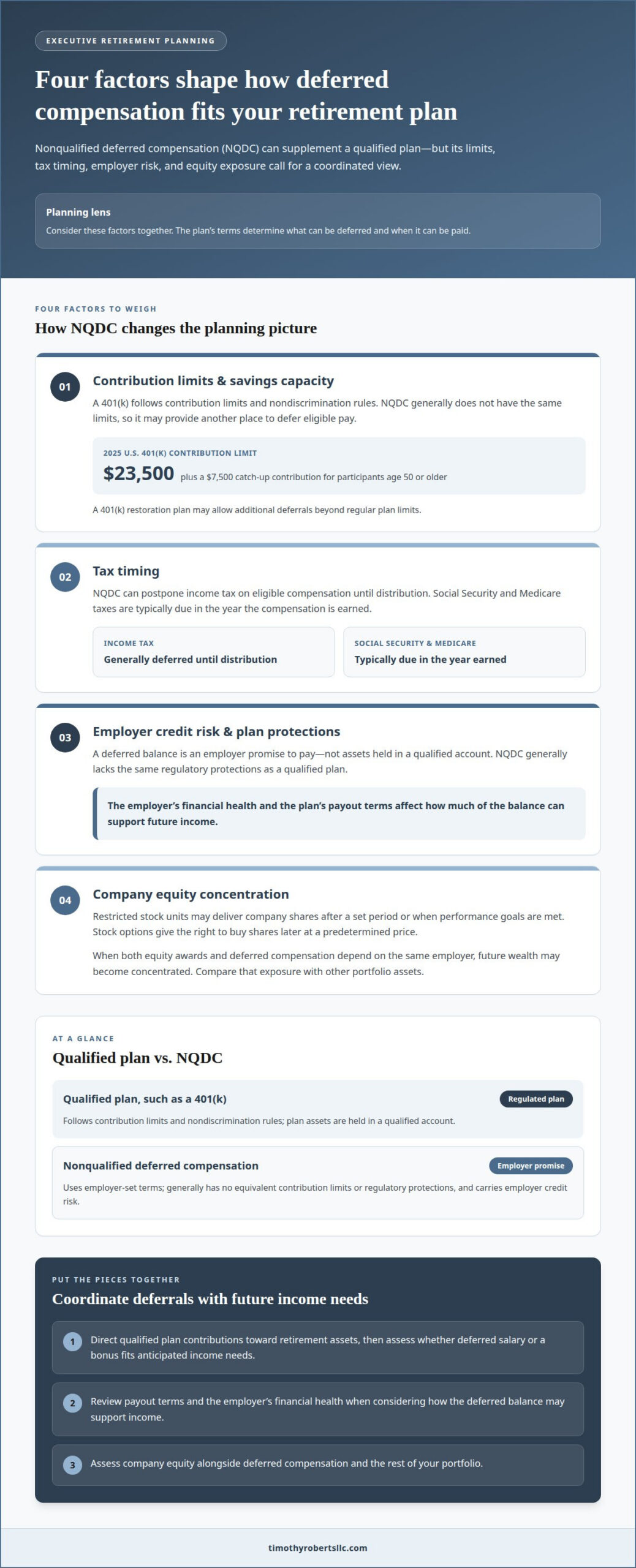
An executive’s deferred compensation can supplement, but not replace, a qualified retirement plan. To understand how to manage deferred compensation plans for executives, weigh contribution limits, tax timing, employer credit risk, and company equity together.
NQDC and Qualified Plan Differences
A nonqualified deferred compensation (NQDC) plan lets an executive defer eligible pay under employer-set terms. A qualified plan, such as a 401(k), follows contribution limits and nondiscrimination rules. NQDC plans generally lack the same limits and regulatory protections, so this distinction affects savings capacity and risk. Deferred balances represent an employer promise to pay, rather than assets held in a qualified account.
Supplemental Savings and Deferral Limits
NQDC can supplement retirement savings by postponing income tax on eligible compensation until distribution. Social Security and Medicare taxes are typically due in the year compensation is earned. According to the Internal Revenue Service, the 2025 U.S. 401(k) contribution limit is $23,500. The Internal Revenue Service also states that in 2025, U.S. 401(k) participants age 50 or older can make catch-up contributions of $7,500. These limits help frame qualified savings before additional deferrals.
Coordinate the plans within one retirement-income strategy. An executive might direct qualified plan contributions toward retirement assets, then assess whether deferred salary or a bonus fits future income needs. The NQDC plan’s payout terms and the employer’s financial health also shape how much of its balance can support that income. A 401(k) restoration plan may allow additional deferrals beyond regular plan limits.
Equity compensation adds another consideration. Restricted stock units may deliver company shares after a set period or when performance goals are met. Stock options give the right to buy shares later at a predetermined price. When both equity awards and deferred compensation depend on the same employer, your future wealth may become concentrated. Before setting savings priorities, compare that exposure with your other portfolio assets.
Distribution elections and payout structures
Section 409A governs nonqualified deferred compensation plan design, payout timing, and tax implications. It makes election timing consequential: executives choose from the distribution options their employer provides, and later changes face restrictions.
Deferral Election Timing
A deferral election sets how much eligible compensation is postponed and when it will be distributed. Executives generally make elections before the compensation year begins, and many plans allow an annual election for the following year, often in November or December. Some plans allow employees 30 days to enroll when first offered. These deadlines matter because the election is generally binding for that year.
Election Deadlines and Changes
Distribution elections specify the timing and form of future payouts. If a plan permits preretirement distributions, participants state the intended timing on the enrollment form. The U.S. Department of the Treasury describes Section 409A as requiring a change at least 12 months before the scheduled distribution date. The U.S. Department of the Treasury also describes the change as requiring a delay of at least 5 additional years from the original date. A change in circumstances may not allow an immediate revision.
Payout Structures and Duration
Plans may offer a lump sum, installments, or payment at retirement, separation, or a specified date. A participant might elect a lump sum at retirement or installments over several years, depending on plan options. Some plans let participants schedule distributions in 5, 10, or 20 years. These choices shape when deferred income arrives and how it fits with other expected income.
Allocation decisions also affect the account’s growth pattern. Plan credits may follow investment benchmarks or selected allocations, so the selected approach influences the balance used for future payouts. Review election timing, payout form, and allocation together; changing one may alter the intended retirement income sequence. For broader legacy considerations, Estate & Legacy Planning can connect future distributions with wider financial priorities.
What are the withdrawal rules for deferred comp?
Evaluate plan charges against its investment benchmarks and allocation choices, then assess how those options shape potential returns. Federal tax rules, including Section 409A, govern payout timing; state income-tax treatment and the plan’s terms also affect the result.
Termination and Change-of-Control Provisions
Termination and change-of-control provisions set out when deferred compensation becomes payable after employment ends or ownership changes. The plan terms determine whether separation triggers payment or the balance remains scheduled for a later date. The employer remains obligated to pay according to those terms after you change jobs, but the balance generally cannot be transferred to an IRA or another tax-advantaged account.
In a change of control, the agreement’s trigger language and payment timing matter. An executive may face an additional 20% excise tax when nonqualified deferred compensation becomes payable because of a change in control and is subject to IRC Section 280G. Review the relevant provisions alongside any merger or acquisition terms.
State and Federal Rules
Federal tax rules shape plan design, distribution timing, and tax consequences, while state income-tax treatment can affect the net payout. Section 409A applies to U.S. nonqualified deferred compensation plans. Unlike qualified retirement plans, these arrangements generally do not carry the same regulatory protections. Many are structured as non-ERISA top-hat plans for a select management group.
Deferred compensation also carries employer credit risk. It is generally an unsecured promise, often held among the employer’s general assets and potentially exposed to corporate creditors. A rabbi trust may hold assets for payment, but those assets remain subject to the company’s creditors. Weigh this risk against the savings advantage and the employer’s financial health.
Investment credits can add another layer of concentration. If your account tracks company stock or a benchmark tied to your employer, consider how that exposure combines with your salary, equity awards, and other investments. Review plan charges, available benchmarks, and allocation choices together. A credited return is not the same as separately owned investment assets. These factors help clarify how deferred compensation fits into both incentive pay and retirement savings.
How nonqualified deferred compensation plans work
A nonqualified deferred compensation (NQDC) plan lets selected executives defer eligible compensation under terms set by the employer. The plan determines what you can defer, how earnings are credited, and when distributions become taxable.
Plan Mechanics
Employers may offer NQDC plans to selected management or highly compensated employees. Depending on the plan rules, participants may defer salary, bonuses, long-term incentive cash, or restricted stock units. The plan records deferred amounts and may credit earnings using investment benchmarks or selected allocations. Unlike qualified retirement plans, these arrangements are typically unfunded liabilities. The account represents a promise to pay, not a separately owned retirement asset.
Federal and state income taxes are generally postponed until distribution, subject to the plan terms and applicable tax rules. Social Security and Medicare taxes are typically due in the year compensation is earned, even if payment is deferred.
Funding and Accounting
Employers must plan for future NQDC payments because balances are generally unfunded liabilities. With a pay-as-you-go approach, the company pays benefits from future cash flow rather than setting assets aside in advance. Accounting tracks deferred compensation and credited earnings, while the employer plans for the timing and amount of eventual payouts.
A rabbi trust may hold assets connected to deferred compensation, but those assets remain subject to company creditors. Funding decisions affect the employer’s ability to meet scheduled benefits and the executive’s exposure to employer credit risk. Keep this distinction in view when considering the plan’s financial design.
Plan Design and Administration
Design begins by defining eligibility, compensation types, deferral choices, and distribution terms. Employers then establish how account credits will be calculated, such as through selected investment benchmarks. Administration must track elections, balances, vesting where applicable, and payout events in line with plan terms and Section 409A rules.
Employers should also plan for future cash needs and review how the arrangement operates over time. Clear records connect each participant’s election to deferred salary or bonus, credited earnings, and scheduled distributions. Coordinating those future payments with a broader retirement income plan can help executives assess how deferred compensation fits their long-term income strategy.
Timothy Roberts & Associates: Retirement Plans 401k, 403b, Roth IRA, IRA, SEP IRA
Timothy Roberts & Associates can help you connect deferred compensation decisions with your broader retirement and investment strategy. This can be useful when weighing future plan payouts alongside qualified retirement savings, investment exposure, and the income you expect to need in retirement.
Through Retirement Income Planning and Investment Portfolio Management, the firm helps shape a coordinated view of income sources and investment assets. Retirement Plans 401k, 403b, Roth IRA, IRA, SEP IRA can also form part of that picture. Estate & Legacy Planning can help incorporate long-term wealth priorities as you consider how deferred compensation fits your plans.
For a considered approach to your retirement strategy, contact Timothy Roberts & Associates.
Shape Your Next Retirement Decision With Intention
A thoughtful approach to deferred compensation starts with a broader question: how should future income support the life and priorities you’re building toward? Use the plan as a prompt to revisit your financial direction, rather than treating each election as an isolated decision. Consider how retirement income, investment choices, and long-term family priorities work together.
Timothy Roberts & Associates, LLC offers Retirement Income Planning, Investment Portfolio Management, and Estate & Legacy Planning to help bring those priorities into one considered strategy. These services can connect deferred compensation decisions with your wider financial picture, including how you expect to use income in retirement and preserve wealth for the future.
When you’re ready to explore how these pieces fit your goals, start a conversation with Timothy Roberts & Associates, LLC. A clear next step can help turn a complex benefit into a more intentional part of your financial future.
Frequently Asked Questions
What Is an Executive Deferred Compensation Plan?
An executive deferred compensation plan lets eligible executives postpone receiving part of their compensation until a future date or event. The deferred amount may come from salary, a bonus, or another eligible incentive. For example, an executive could defer a bonus to supplement retirement income later. The employer’s plan terms determine eligible participants, compensation, account credits, and payment conditions.
Can I lose my deferred compensation if my company goes bankrupt?
Yes. Nonqualified deferred compensation is generally an unsecured promise from the employer, so financial distress can put payment at risk. The deferred balance may remain among the company’s general assets and be exposed to corporate creditors. A rabbi trust does not remove that exposure because its assets remain subject to company creditors. Consider employer credit risk alongside the potential value of deferring compensation.
What types of executive deferred compensation plans are available in the U.S.?
Common arrangements include salary or bonus deferral plans, supplemental executive retirement plans (SERPs), and 401(k) restoration plans. A SERP can provide benefits beyond a regular pension or 401(k), while a restoration plan can address savings above regular plan limits. Some employers also use phantom stock, restricted stock units, or stock options as separate forms of executive incentive compensation.
How do nonqualified deferred compensation plans differ from qualified retirement plans?
Nonqualified plans are employer-designed arrangements for selected executives, while qualified plans such as 401(k) plans follow contribution limits and nondiscrimination rules. For instance, an executive may participate in both a 401(k) and an NQDC plan, but the NQDC balance does not gain the same regulatory protections. It also generally cannot be rolled into an IRA after a job change.
What payment elections and distribution schedules can executives choose?
Plan options may include a lump-sum payment, installments, or a distribution tied to retirement, separation, or a specified date. The employer sets the available choices, and you elect among them under the plan’s deadlines. For example, if you expect income from other sources early in retirement, you might schedule deferred payments for a later period, if the plan permits.
What are the tax consequences for executives and employers?
Executives generally recognize ordinary income when distributions are paid; Social Security and Medicare taxes are typically due in the year compensation is earned. Employers track payment obligations and plan future cash flow. A Section 409A violation can trigger immediate taxation of vested amounts, a 20% penalty, and interest. The information in this material is not intended as tax or legal advice. Please consult legal or tax professionals for specific information regarding your individual situation.
