

Nov
What law firm partners can expect from wealth management
A partner’s wealth plan works best when firm finances and personal decisions are coordinated. An adviser can work alongside the firm’s finance team and accountant to plan quarterly estimated tax payments, while a fiduciary adviser is required to act in the client’s best interest. According to the Internal Revenue Service, a partnership doesn’t pay income tax; each partner reports their share of its income or loss on a personal tax return.
That coordination matters when partner distributions, tax obligations, and personal goals intersect. A thoughtful approach to wealth management for law firm partners can bring those moving parts into one strategy instead of treating retirement, investments, and taxes as separate decisions. This article explains how advisers can coordinate with your firm and accountant, what fiduciary advice means, and how tax-aware retirement planning can support a broader wealth strategy.
Key Takeaways
- Align your adviser, firm finance team, and accountant so partner distributions and personal financial decisions are considered together.
- Understand how fiduciary advice centers recommendations on your interests, goals, and tolerance for investment risk.
- Review available retirement plan contributions and how they may fit into a tax-aware savings strategy.
- Consider partnership interests, cash-flow variability, insurance, and estate priorities as connected parts of your long-term wealth plan.
1. Can you coordinate with my firm’s finance team and my accountant?
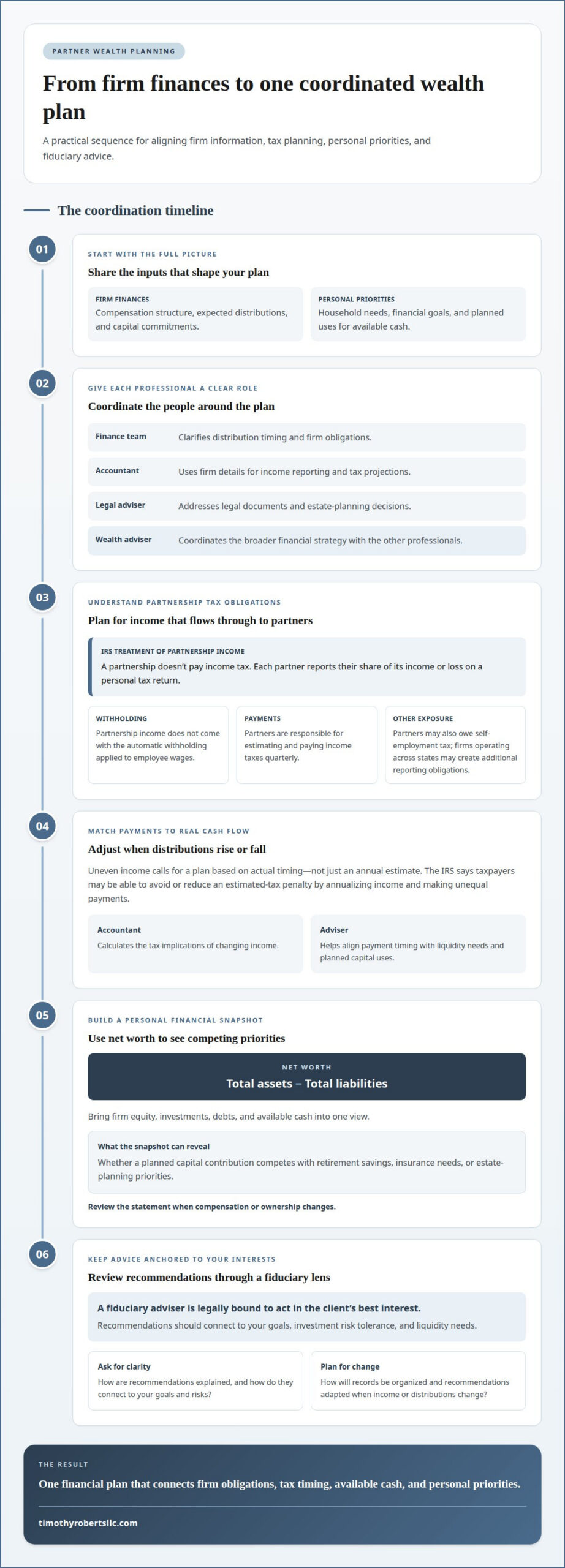
Yes. A wealth adviser can coordinate with your firm’s finance team, accountant, and legal adviser around one financial plan. Start by sharing your compensation structure, expected distributions, capital commitments, and personal priorities. The finance team can clarify timing and firm obligations. Your accountant can use those details for income reporting and tax projections. Your legal adviser can address legal documents and estate-planning decisions.
Tax coordination matters because partnership income doesn’t come with the automatic withholding applied to employee wages. According to the Internal Revenue Service, a partnership doesn’t pay income tax; each partner reports their share of its income or loss on a personal tax return. Partners are responsible for estimating and paying income taxes quarterly, and may also owe self-employment tax. A firm operating across states may create reporting obligations beyond a partner’s home state.
Uneven income calls for a plan based on actual timing, not just an annual estimate. If distributions rise or fall during the year, the Internal Revenue Service says taxpayers may be able to avoid or reduce an estimated-tax penalty by annualizing income and making unequal payments. Your accountant can calculate the tax implications; an adviser can help align payment timing with liquidity needs and planned capital uses.
Coordination also clarifies your personal financial picture. A net-worth statement starts with total assets minus total liabilities, bringing firm equity, investments, debts, and available cash into one view. It can reveal whether a planned capital contribution competes with retirement savings, insurance needs, or estate-planning priorities. Review the statement when your compensation or ownership changes.
Choose a fiduciary adviser who explains recommendations, investment risks, and how the financial plan connects to your goals. A fiduciary adviser is legally bound to act in the client’s best interest. Ask how the adviser will coordinate with your accountant, organize relevant records, and adapt recommendations when income or firm distributions change. Clear roles make the relationship useful: the adviser coordinates the broader strategy, while your accountant and legal adviser handle their respective professional work.
2. Fiduciary financial advice
A fiduciary adviser must put the client’s best interest first. For attorneys, that standard matters when recommendations involve firm equity, private investments, debt, and personal financial planning. Ask the adviser to explain how each recommendation fits your goals, risk tolerance, liquidity needs, and career stage. Clear reasoning helps you assess whether the advice suits your situation rather than a generic model.
What financial challenges are unique to law firm partners? Partner income can fluctuate with draws, bonuses, or firm performance, while capital contributions and partnership interests add financial commitments. Some firms also restrict trading in certain public securities when partners may have access to nonpublic company information. An adviser should account for those limits when shaping an investment strategy.
A partnership buy-in deserves its own funding plan. Map the contribution schedule against household cash flow, existing debt, liquid assets, and retirement savings. Firm capital contributions may be spread over several years or require debt financing. Compare how each option affects available cash and long-term goals instead of treating the buy-in as an isolated transaction.
How can law firm partners manage student loans, mortgages, and other debt? List each balance, payment, interest rate, and repayment term, then weigh debt reduction against liquidity needs and retirement contributions. For example, if you expect an uneven distribution, model whether a larger payment would leave enough cash for upcoming obligations. Revisit the plan when income, debt terms, or partnership commitments change.
Fiduciary advice should connect these decisions in one financial plan. Request a written explanation of the assumptions behind recommendations, how they account for firm restrictions, and what changes would prompt a review. That creates a practical basis for decisions across private equity exposure, debt, and household priorities. A coordinated financial planning approach can help organize those trade-offs around your goals.
3. Tax deferral through retirement plan contributions
Start by identifying the retirement accounts available through your firm and your role in each plan. Law firms may offer qualified defined benefit or defined contribution plans, alongside nonqualified deferred compensation options. Each structure affects how retirement contributions fit with current income, investment choices, and future cash flow. Compare plan terms before deciding how much savings to commit.
How much should law firm partners save for retirement and other financial goals? Set a target by weighing expected retirement income, current savings, firm contributions, debt, liquidity, and goals such as education or estate planning. Review the target as earnings, partnership responsibilities, and household needs change.
Defined benefit plans can allow high-income lawyers to defer hundreds of thousands of dollars annually. A cash balance plan combines pension-style benefits with tax-deferred growth, so evaluate its contribution requirements alongside your other retirement accounts. New law firm partners may have only four to eight weeks to decide whether to participate in a cash balance pension plan. Put that decision on your calendar as soon as the firm presents the plan.
Solo practitioners and small-firm partners can consider Solo 401(k) and SEP IRA accounts as tax-efficient retirement savings options. Compare these choices with your firm plan, including contribution structure, investment portfolio, and how much accessible cash you need. A higher contribution may support retirement goals, but shouldn’t crowd out near-term obligations or other priorities.
Lawyers may need to plan retirement across firm plans and personal savings. Bring all accounts into one view, then connect contribution decisions to expected retirement income and the timing of future expenses. Review the plan when your earnings pattern changes, you become a partner, or firm plan terms shift. This keeps tax deferral within a broader strategy instead of treating contributions as a standalone decision.
4. Wealth strategy for law firm partners and executives
Build a wealth strategy around your full balance sheet, not just investment accounts. Include partnership equity, retirement assets, real estate, debts, and capital commitments. A financial adviser can map how firm ownership, distributions, and succession planning affect personal liquidity and long-term goals. Effective wealth management for law firm partners also accounts for changes in ownership or compensation over time.
How should law firm partners manage irregular income, draws, and bonuses? Build a cash-flow plan around distribution timing, essential expenses, capital needs, and tax payments. Some partners receive draws semiannually; a July draw may need to cover July through December expenses, including estimated taxes. K-1 forms don’t include automatic tax withholding like W-2 forms, so set aside funds for tax payments.
What investment strategies suit law firm partners with high income and concentrated firm equity? Assess partnership ownership alongside your other assets, then weigh private investment opportunities against your portfolio, liquidity needs, risk profile, and long-term goals. This helps show whether firm equity already creates significant concentration before you add further exposure. For wealth management for law firm partners, evaluate each opportunity as part of the overall portfolio, not in isolation.
How do wealth management fees and services compare for law firm partners? Fees depend on the scope of advice, assets involved, and planning needs, and are provided after a quote request. Compare the service scope, including investment oversight, retirement planning, tax coordination, and insurance analysis, rather than price alone.
Bring insurance and liabilities into the same review. Check life, disability, umbrella liability, and health coverage for gaps, then note whether fixed-rate liabilities could become floating-rate liabilities in 3, 5, or 10 years. This connects protection and debt exposure to portfolio decisions. Explore investment portfolio management as part of a coordinated strategy for your assets, firm equity, and liquidity needs.
Timothy Roberts & Associates: Retirement Income Planning
Timothy Roberts & Associates can help law firm partners connect retirement decisions with investments, protection, and legacy priorities. Turn to the firm when you’re weighing retirement income needs, reviewing a portfolio, or aligning personal goals with a changing partnership role.
Retirement Income Planning can help organize how savings and investments may support future income needs. Investment Portfolio Management addresses how investments fit your objectives and risk tolerance. Estate & Legacy Planning and Risk Management & Insurance Analysis can also help you consider how your plans address family priorities and financial risks.
These services can be useful during career transitions, when partnership income changes, or as retirement approaches. Start by discussing which planning priorities matter most and how they connect. Contact Timothy Roberts & Associates to talk through your goals.
Shape the Next Chapter With Intention
A durable plan is not a document you finish once. It’s a decision framework that can evolve as your role, priorities, and family circumstances change. For wealth management for law firm partners, identify which decisions need attention now, which depend on future firm developments, and how you’ll revisit each one.
Before meeting with an adviser, write down your most important goals and the choices currently competing for your time or capital. Note what could change your priorities, such as a shift in partnership responsibilities, a planned career transition, or a new family need. This gives the conversation a clear starting point and helps keep recommendations connected to the life you want to build.
Timothy Roberts & Associates, LLC can help you turn those priorities into a considered financial strategy. Contact Timothy Roberts & Associates, LLC to begin a conversation about the next stage of your financial plan.
Frequently Asked Questions
Can you coordinate with my firm’s finance team and my accountant?
Yes. An adviser can coordinate planning assumptions with your accountant and firm finance team, including expected distributions, capital commitments, and retirement contributions. Agree on a shared process for updating projections when compensation or firm obligations change. A fiduciary adviser is legally bound to act in the client’s best interest, so recommendations should reflect your goals and circumstances.
What about estate planning?
Estate planning connects your financial priorities with how assets may be managed and transferred. Timothy Roberts & Associates offers Estate & Legacy Planning and follows the principle, “Your Interest is Our Only Interest.” A financial adviser can help organize estate-related goals and identify matters requiring legal document preparation. The information in this material is not intended as tax or legal advice. Please consult legal or tax professionals for specific information regarding your individual situation.
What alternative investments can I access, and what are the minimums?
Access and minimums depend on the specific investment and its terms; no single minimum applies across all alternative investments. Assess each opportunity’s liquidity, risk, portfolio fit, and capital commitment before making a decision. This site is published for residents of the United States only. Not all of the products and services referenced on this site may be available in every state and through every advisor listed.
Where are my assets held?
Account statements and online account records identify the institution holding each account and the account owner. Your financial adviser and the institution holding your assets have distinct roles, so review account documents to understand both. Securities offered through Cetera Financial Specialists LLC. Advisory services offered through Cetera Investment Advisers LLC. Cetera entities are under separate ownership from any other named entity.
What retirement plans are available to law firm partners, including 401(k), cash balance, and defined benefit plans?
Available options can include a firm-sponsored 401(k), a defined benefit plan, or a cash balance plan, which is a type of defined benefit plan. Solo practitioners and small-firm partners may also consider Solo 401(k) or SEP IRA accounts. Compare plan structure, contribution requirements, investment choices, and how each option fits your personal savings strategy.
How are law firm partner distributions and retirement contributions taxed in the United States?
According to the Internal Revenue Service, a partnership doesn’t pay income tax; each partner reports their share of its income or loss on a personal tax return. Distributions and retirement contributions can have different tax treatment depending on the partnership and plan structure. Coordinate reporting and contribution decisions with your tax professional. The information in this material is not intended as tax or legal advice. Please consult legal or tax professionals for specific information regarding your individual situation.
