

Nov
How to Talk to Aging Parents About Money and Planning
The most useful first money conversation may be about an everyday bill, not an inheritance. Knowing how to talk to aging parents about their finances starts with listening, asking what kind of help they’d welcome, and discussing who they trust to support them. A parent generally needs to authorize access to their assets while they’re alive, so clarify what they’re comfortable sharing before trying to step in.
It’s natural to worry that raising money matters will feel intrusive or suggest you doubt your parent’s independence. Keep the conversation collaborative: focus on honoring their wishes and making everyday finances easier to manage. This guide covers trusted financial contacts, future decision-making, important estate documents, and practical ways to help with routine money tasks. Start with one manageable topic, then build a clearer plan together.
Key Takeaways
- Agree on who can be contacted about financial accounts and what information they may access.
- Discuss future decision-making before a health crisis, including how care needs could affect financial plans.
- Clarify the roles of a will, durable power of attorney, and health care proxy in carrying out a parent’s wishes.
- Make everyday financial support practical by reviewing recurring bills, account activity, and the help your parent wants.
1. Adding trusted contacts to financial accounts
Begin by asking your parent whom they trust to help organize account information. A trusted contact may help a financial institution reach someone if concerns arise, but that role alone does not grant access to assets. While your parent is alive, someone generally needs their authorization to access those assets. Discuss the difference between being a contact, a joint owner, and someone authorized to act on their behalf.
Create an inventory together before deciding who needs access. Record each bank, brokerage, retirement, insurance, and loan account, including the institution and account owner. Note property, recurring bills, and where important documents are stored. For example, specify whether a checking account is individually or jointly owned. Keep the inventory somewhere secure that your parent chooses, and agree on who may see it.
Account ownership can affect what happens after a parent dies. A Montana joint checking account with right of survivorship gives the adult child, as a joint owner, equal access and transfers the balance to that owner when the parent dies. This example shows why it is important to discuss account titles carefully.
Plan for digital access separately. List online banking, investment, and bill-payment accounts, then ask your parent how they want access handled. Knowing a password does not necessarily authorize someone to manage an account. Discuss the institution’s procedures and record where access instructions are kept. Update the inventory when accounts change and remove outdated details. A calm conversation can clarify how to provide financial support without taking control away from your parent.
2. Planning ahead for incapacity and financial decision-making
About 70% of Americans who are 65 today are likely to need some type of long-term care in the future, according to the Administration for Community Living. That possibility makes it useful to discuss care preferences and financial decision-making before a health crisis. Ask your parent who they trust to help manage bills, income, and care arrangements if they can’t handle those tasks themselves.
Turn the conversation into a practical plan. Discuss what support your parent would welcome, who could provide it, and how decisions should reflect their wishes. Consider caregiving time as well as financial contributions so family members understand what they can realistically offer. A parent who can make financial decisions has the right to decline help from an adult child. Respecting that choice keeps the discussion focused on their independence.
Long-term care planning involves considering the kind of support your parent may want and how available resources could help pay for it. This figure is a planning reference, not a personal estimate. Care needs, setting, and financial resources all affect the plan. Include possible care costs alongside regular expenses and income.
The cost of elder-law services depends on the documents and issues involved. Financial planning costs depend on the scope of analysis and the services selected.
Discuss potential income sources such as Social Security, Veterans’ payments, and public-benefit income. A representative payee may receive and disburse payments for a parent who cannot manage them. Include the person who would handle payments in the plan, and discuss how the funds should support your parent’s expenses.
Write down care preferences, income sources, and each family member’s support role. Revisit the decisions as circumstances change. A clear plan helps everyone understand your parent’s priorities and reduces uncertainty about who will handle financial tasks if those circumstances shift.
3. Wills, durable power of attorney, and health care proxies
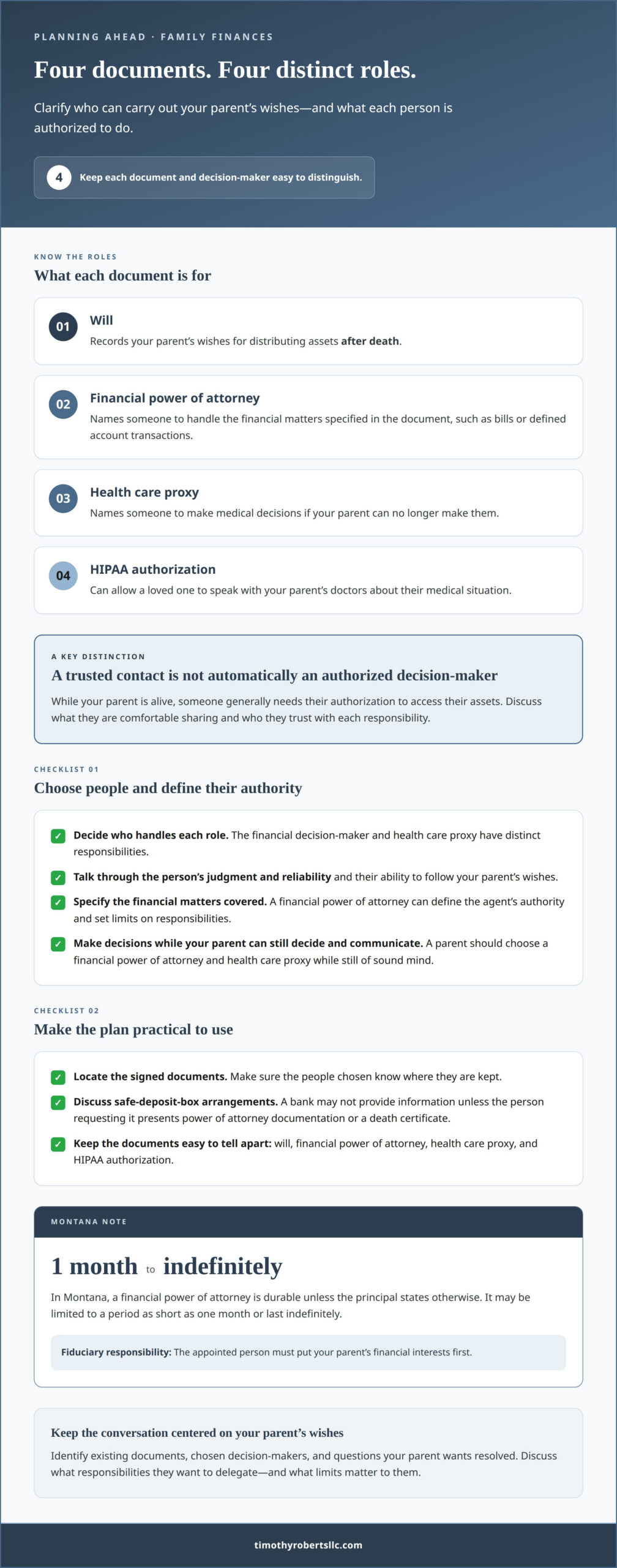
Discuss these documents while your parent can still make and communicate decisions. A will records their wishes for distributing assets after death. A financial power of attorney names someone to handle the financial matters specified in the document. A health care proxy names someone to make medical decisions if your parent can no longer make them. These roles are distinct, so clarify whom your parent trusts with each responsibility.
A financial power of attorney can authorize a trusted person to handle specific financial matters. For example, your parent might authorize someone to manage bills or complete defined account transactions. The appointed person has a fiduciary responsibility to put your parent’s financial interests first. In Montana, a financial power of attorney is durable unless the principal states otherwise. It can be limited to a period as short as one month or last indefinitely.
Ask your parent which responsibilities they want to delegate and what limits matter to them. The document can specify which financial matters it covers, defining the agent’s authority. A parent should choose a financial power of attorney and health care proxy while still of sound mind. Discuss the person’s judgment, reliability, and ability to follow your parent’s wishes. Make sure the people chosen know where the signed documents are kept.
Practical details can matter during a family emergency. A bank may not provide safe-deposit-box information unless the person requesting it presents power of attorney documentation or a death certificate. Discuss the box’s location and access arrangements in advance. A signed HIPAA authorization can also allow a loved one to speak with your parent’s doctors about their medical situation.
Use the conversation to identify existing documents, chosen decision-makers, and questions your parent wants resolved. Keep the will, financial power of attorney, health care proxy, and HIPAA authorization easy to distinguish. Estate & Legacy Planning can help connect financial decisions with your parent’s broader legacy goals, while legal documents set out formal appointments and instructions.
4. Helping parents manage everyday finances
Begin with routine tasks, not a judgment about your parent’s capabilities. Ask them to walk you through paying a bill, reviewing a bank statement, or recognizing an unfamiliar charge. Notice whether they can explain the steps and identify when something needs attention. One missed payment or confusing transaction does not establish a pattern; look for repeated difficulties with everyday tasks.
With your parent’s permission, review recent statements together. Look for duplicate payments, unfamiliar withdrawals, recurring subscriptions, and bills that remain unpaid. Another family found a $500 checkbook error that took a week to address with the bank. These examples show why small discrepancies deserve a calm, timely review.
How can I assess whether an older parent can manage their finances? Observe how they handle familiar tasks, such as paying bills, tracking income, and responding to unusual charges. Discuss repeated errors directly, then ask what support they would welcome.
Scams can disrupt those routines. The author’s mother received more than 100 scam texts per day, including a false message claiming a $15,000 IRS check was ready. Teach a simple pause: don’t click unexpected links or share account details in response to a message. Instead, discuss how your parent can independently reach the organization through a familiar, trusted channel. Agree on who they’ll call before acting on urgent payment requests.
How can families protect aging parents from financial scams and exploitation? Agree on a trusted person to consult about unexpected requests, and review suspicious messages together before responding. Keep your parent involved so safeguards support their judgment rather than quietly taking control.
Keep assistance specific: schedule a regular statement review, organize bill due dates, or help your parent contact a bank about an error. For a coordinated view of income, expenses, and financial priorities, explore financial planning support.
Timothy Roberts & Associates
Timothy Roberts & Associates, LLC helps families connect a parent’s financial decisions with their broader goals. When questions involve retirement income, investments, legacy priorities, or financial risks, a coordinated financial plan can clarify how those elements fit together. The focus is on understanding your parent’s priorities and shaping a strategy around their circumstances, with family conversations grounded in practical decisions.
Consider financial planning when account management, future care, and long-term priorities feel difficult to bring into one conversation. Retirement Income Planning, Investment Portfolio Management, Estate & Legacy Planning, and Risk Management & Insurance Analysis can each address a different part of the financial picture. These services support planning, while legal documents and decision-making authority remain separate matters.
For a thoughtful next step, contact Timothy Roberts & Associates, LLC to discuss your family’s financial planning questions.
Make the Next Conversation a Shared Decision
Learning how to talk to aging parents about their finances is less about finding perfect words and more about making room for their priorities. Let your parent set the pace, decide what feels comfortable to share, and choose one next step together. A small agreement, such as reviewing a financial goal in your next conversation, can give you both a constructive way forward.
If your family would benefit from a broader financial perspective, Timothy Roberts & Associates, LLC offers Retirement Income Planning, Investment Portfolio Management, and Estate & Legacy Planning. These services can help connect your parent’s financial goals with a considered plan for the years ahead.
Contact Timothy Roberts & Associates, LLC to discuss your family’s planning needs. Continue the conversation with patience and respect, and let your parent’s wishes guide each next step.
Frequently Asked Questions
How do I start a conversation with aging parents about money?
Start with a specific, low-pressure reason, such as organizing bill payments or planning for an upcoming expense. You might say, “I’d like to understand how you prefer to handle bills so I can support your choices if you need help.” When thinking about how to talk to aging parents about their finances, lead with their priorities, listen without interrupting, and ask permission before discussing private details.
When should families discuss finances with aging parents?
Start while your parent can comfortably explain their preferences and make decisions, rather than waiting for an urgent change. A quiet moment after reviewing household plans may feel more natural than raising the topic during a medical emergency. If your parent isn’t ready to discuss everything, agree on one subject to revisit later, such as recurring bills or whom to inform in an emergency.
What financial documents should aging parents organize?
Gather recent tax returns, bank and investment statements, insurance policies, pension or benefit records, property paperwork, and current estate documents. Include financial institutions’ contact details and a record of recurring income and payments. Keep the materials somewhere secure that your parent chooses, and make clear who may access them. A concise index can help family members find relevant records without searching through every file.
What is a financial power of attorney, and how do you set one up?
A financial power of attorney gives a chosen person authority to handle the financial matters specified in the document. Your parent should decide whom to appoint and what authority to grant while they can make that choice. The document’s scope and requirements depend on applicable state rules. A qualified legal professional can prepare or explain the document; financial planning can help coordinate it with broader goals.
How should families discuss long-term care costs and payment options?
Ask what care settings your parent would prefer, then compare possible expenses with income, savings, insurance, and other available resources. Separate routine household spending from potential care expenses so the family can see how each affects the plan. Discuss who will gather information and how often to revisit assumptions. Avoid treating one estimate as a fixed answer, since care needs and funding sources can change.
What should I do if an aging parent refuses to discuss finances?
Respect the refusal and avoid turning one conversation into a confrontation. Ask what feels uncomfortable, then offer a narrower topic, such as whom to call if a bill looks suspicious. Your parent may be more willing to share selected instructions than account details. If they continue to decline, keep communication open and focus on practical support they welcome, while respecting their right to make their own decisions.
