
Nov
How to Create a Values-Based Estate Plan for Your Family
What if an inheritance could carry your family’s values forward, not just its wealth? Learning how to create a values-based estate plan for your family means aligning financial decisions with the principles you want future generations to understand and live by.
That takes more than deciding who receives what. A thoughtful plan can use trusts to shape how assets are distributed, family conversations to make your intentions clear, charitable giving to reflect shared commitments, and 529 plans to support education. Each choice should work with the others, creating a legacy that feels considered rather than assembled from separate decisions.
This guide covers practical steps, from defining your priorities and preparing beneficiaries to considering education funding and charitable gifts. You’ll also learn how to account for different family needs and how open communication can help loved ones understand the purpose behind your plan. The aim is a clear framework for preserving both what you leave and what you hope it represents.
Key Takeaways
- Shape trust provisions around the choices and priorities you want an inheritance to support.
- Plan family conversations that explain your intentions and give beneficiaries context for future decisions.
- Connect charitable giving and education funding, including 529 plans, to the legacy you want to build.
- Balance fairness with individual circumstances by considering each family member’s needs and the assets available.
How an estate-planning professional uses trust provisions to encourage values-aligned choices
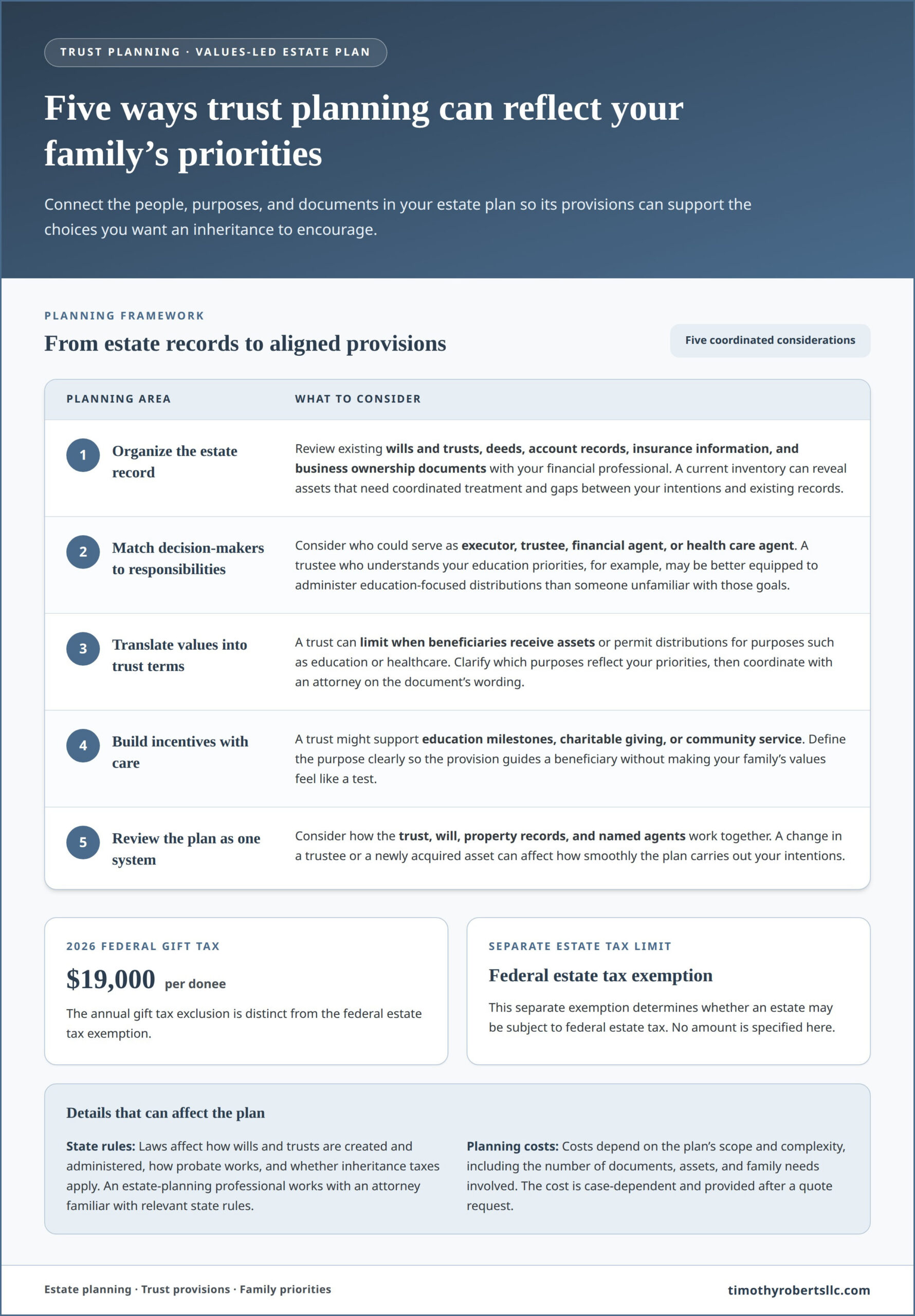
For 2026, the federal gift tax annual exclusion is $19,000 per donee, according to the Internal Revenue Service. That gift-tax exclusion is distinct from the federal estate tax exemption, which determines whether an estate may be subject to federal estate tax.
State laws affect how wills and trusts are created and administered, how probate works, and whether inheritance taxes apply. An estate-planning professional works with an attorney familiar with the relevant rules to shape the plan around your family’s circumstances, with legal practices such as szlaw.ca helping clients properly align documentation with local requirements.
Estate-planning costs depend on the plan’s scope and complexity, including the number of documents, assets, and family needs involved. The cost depends on the case and is provided after a quote request.
- Organize the estate record. Review existing wills and trusts, deeds, account records, insurance information, and business ownership documents with your financial professional. A current inventory can reveal assets that need coordinated treatment and gaps between your intentions and existing records.
- Match decision-makers to their responsibilities. Consider who could serve as executor, trustee, financial agent, or health care agent. For example, a trustee who understands your education priorities may be better equipped to administer education-focused distributions than someone unfamiliar with those goals.
- Translate values into trust terms. A trust can limit when beneficiaries receive assets or permit distributions for purposes such as education or healthcare. The professional can help clarify which purposes reflect your priorities, then coordinate with an attorney on the document’s wording.
- Build incentives with care. A trust might support education milestones, charitable giving, or community service. Define the purpose clearly so the provision guides a beneficiary without making your family’s values feel like a test.
- Review the plan as one system. Ask the professional to consider how the trust, will, property records, and named agents work together. A change in a trustee or a newly acquired asset can affect how smoothly the plan carries out your intentions.
The federal gift tax annual exclusion for 2026 is $19,000 per donee. The federal estate tax exemption is a separate limit that determines whether an estate may be subject to federal estate tax.
Planning family conversations about estate-planning intentions with professional guidance
- Address the risks of informal or outdated documents. DIY documents can leave beneficiaries uncertain when instructions conflict, important details are missing, or circumstances have changed. A professional can review how the documents fit together and identify decisions that need clearer explanation.
- Set a purpose for the conversation. Ask the professional to help frame what relatives need to understand, such as why education matters or how you hope an inheritance will support future generations. A focused agenda keeps the discussion centered on your intentions rather than speculation about individual shares.
- Choose the right people and setting. Consider which beneficiaries should hear the plan together and which conversations are better held privately. For example, a family business succession may call for a separate discussion with relatives involved in the business, followed by a broader explanation for others.
- Explain the values behind the decisions. A legacy letter can connect financial choices with personal priorities and hopes for the family. A recorded message can add warmth and context, while a professional helps keep the explanation consistent with the estate plan. Discuss any irrevocable provisions carefully, so relatives understand their purpose and significance.
- Plan for questions and future updates. Ask the professional to help identify which changes in family circumstances could prompt a review, such as a marriage, a new child, or a change in a beneficiary’s needs. Keep a clear record of the current documents and explain where authorized decision-makers can find them.
- Make the conversation ongoing. Revisit the family’s shared priorities when circumstances shift, rather than expecting one meeting to answer every future question. For guidance connecting family intentions with a coordinated plan, explore professional estate and legacy planning.
How an estate-planning professional helps incorporate charitable giving into an estate plan
- Define the charitable purpose. Begin by clarifying what you hope a gift will accomplish. You might support a religious organization, medical research, education, or another cause important to your family. Naming the purpose distinguishes a lasting commitment from a general intention to give and gives beneficiaries context for the decision.
- Identify suitable giving methods. A bequest can direct property to a named charity through an estate plan. Other approaches may include a foundation, donor-advised fund, or charitable remainder trust. Consider how each option fits your assets, family priorities, and desired level of involvement, then coordinate with an attorney on legal documents.
- Choose what property to give. Review your estate inventory to identify assets that could support your chosen purpose. You might intend to give a specific piece of property or a portion of your estate to charity. Clear instructions distinguish charitable gifts from what remains for family beneficiaries and reduce uncertainty about your intentions.
- Coordinate charitable gifts with family provisions. Consider how a proposed gift fits alongside inheritances, trusts, and other planned distributions. A family that values medical research, for instance, could include a charitable bequest while preserving separate provisions for children’s needs. The aim is to have each part of the plan reflect your priorities.
- Document and communicate the decision. Coordinate with the appropriate professionals to ensure your charitable intention is reflected in relevant estate documents. A legacy letter can explain why a particular organization or cause matters to you, helping beneficiaries understand the gift’s purpose rather than viewing it as an unexplained reduction in their inheritance.
How can an estate-planning professional help distribute assets fairly while accounting for different family needs?
- Define what fairness means for your family. An estate-planning professional helps distinguish equal shares from distributions tailored to different circumstances. For example, parents may want each child to receive comparable support while accounting for caregiving, education, or participation in a family business. Clarifying those priorities gives the plan a consistent decision-making principle.
- Map each beneficiary’s circumstances. Consider each beneficiary’s financial responsibilities, existing support, and role in family assets. A child who works in a family business may have different needs from a sibling who has built a separate career. Make those differences visible before deciding how assets should be allocated.
- Consider the form of each inheritance. A $500,000 inheritance might be distributed outright, in stages, or through provisions for particular purposes. The professional can help explore how each approach fits the beneficiary’s circumstances and your intentions. This makes the structure, not only the amount, part of a deliberate plan.
- Balance family and business interests. In a family with three children, one may continue the business while the others receive comparable value through different assets or income streams. A professional can help assess the available assets and clarify the reasoning behind that arrangement. Documenting the rationale can give relatives meaningful context for a decision that looks unequal at first glance.
- Explain the plan and revisit its assumptions. Ask the professional to connect each distribution to the priorities you identified, then help communicate that reasoning to beneficiaries. If a child’s needs or the family’s assets change, review whether the plan still reflects your intentions. A written explanation can help distinguish thoughtful differences from arbitrary treatment.
For guidance aligning family circumstances with your legacy goals, connect with an estate-planning professional.
Timothy Roberts & Associates: Estate & Legacy Planning
Timothy Roberts & Associates can help connect your legacy priorities with the financial decisions that support them. Consider the firm when you want beneficiary plans, charitable giving, or education funding considered alongside your broader financial picture.
Through Estate & Trust Planning, the firm helps shape a strategy around your family’s goals and circumstances. Retirement Planning and Wealth & Investment Management can also inform how future income and investment assets fit into your plans. This integrated perspective can bring your values and financial choices into closer alignment.
Contact Timothy Roberts & Associates to discuss your estate and legacy planning goals.
Shape the legacy your family will carry forward
Understanding how to create a values-based estate plan for your family is a starting point. The next step is turning your priorities into a clear strategy that can adapt as your family and financial circumstances evolve. Consider what you want future generations to understand about the choices behind your plan, not only what they may inherit. That perspective can keep your intentions meaningful as details change.
A thoughtful planning conversation can connect your long-term goals with decisions that feel coherent and personal. You don’t need every answer before beginning. Bring your most important questions, the priorities you want to preserve, and the concerns you want addressed. Then work toward a plan that reflects your financial picture and the legacy you hope to leave.
Begin a planning conversation with Timothy Roberts & Associates, LLC and take a considered next step toward the future you envision for your family.
Frequently Asked Questions
What is a values-based estate plan?
A values-based estate plan aligns the transfer and management of your assets with principles you want your family to carry forward. Learning how to create a values-based estate plan for your family starts with identifying what matters, such as education, stewardship, or generosity. Those priorities can inform beneficiary choices, trust purposes, and explanations for relatives, making your intentions easier to understand.
How can an estate-planning professional help identify family values and priorities for an estate plan?
A financial planning conversation can clarify the principles behind your decisions and connect them to your broader financial picture. For example, a family that values independence may want to discuss how beneficiaries will be prepared to manage inherited assets. Timothy Roberts & Associates, LLC’s fiduciary advisors are legally bound to act in your best interest. The firm’s guiding phrase is “Your Interest is Our Only Interest.”
What documents can an estate-planning professional help include in a U.S. estate plan?
An estate plan may involve a will, trust documents, property records, financial account information, and instructions for decision-makers, including end-of-life preferences. For veterans and their families, outlining arrangements with specialized providers like Harris Funeral Directors can help ensure that military honors and burial benefits are documented alongside financial assets. The relevant documents depend on your assets, family structure, and wishes. A financial professional can help coordinate planning around these records, while an attorney can address legal drafting. The information in this material is not intended as tax or legal advice. Please consult legal or tax professionals for specific information regarding your individual situation.
How can an estate-planning professional help choose an executor, trustee, and guardians for minor children?
A professional can help you assess each role separately: an executor handles estate administration, a trustee manages trust assets, and a guardian may care for minor children. Consider each person’s judgment, reliability, and willingness to take on the responsibility. Discuss the candidates with an attorney, who can address how appointments should be documented. Securities offered through Cetera Financial Specialists LLC (doing insurance business in CA as CFGFS Insurance Agency), member FINRA/SIPC. Advisory services offered through Cetera Investment Advisers LLC. Cetera entities are under separate ownership from any other named entity.
How can an estate-planning professional help include charitable giving and family legacy goals in an estate plan?
A financial professional can help connect a charitable intention with your broader financial goals and consider how it fits alongside family provisions. For example, you might want a gift to support a religious organization that has shaped your family’s life. A legacy statement can explain why the cause matters and give beneficiaries context. An attorney can advise on documenting charitable gifts and how the chosen approach applies to your circumstances.
How can an estate-planning professional help plan a conversation about an estate plan with family?
A professional can help you set a clear purpose for the discussion and decide which details are appropriate to share with each relative. You might begin by explaining the principles guiding your decisions, then leave time for questions about how those intentions affect the family. If a sensitive issue involves one beneficiary, a private conversation may be more constructive than raising it in a group meeting.
