

Nov
How to Invest a Seven-Figure Inheritance With Confidence
A seven-figure inheritance shouldn’t automatically go straight into the market. How to invest a seven-figure inheritance depends on what you receive, when you’ll need the money, and how much risk fits your goals. In the United States, an inheritance isn’t automatically taxable income to the beneficiary in its full amount; tax treatment depends on the type of asset. When federal estate tax applies, the estate pays it, not the beneficiary.
It’s understandable to want tax clarity before making investment decisions. A thoughtful plan considers each asset’s tax treatment, sets a suitable pace for investing, and builds a portfolio around your timeline and risk tolerance. The steps ahead explain what to consider with inherited cash, securities, retirement accounts, and property, and how an allocation can support both near-term needs and long-term priorities.
Key Takeaways
- Distinguish how inherited cash, investments, retirement accounts, and property may be taxed before deciding what to do with each asset.
- Use professional guidance to weigh estate-tax considerations and coordinate inheritance decisions with your broader financial goals.
- Give yourself time to clarify priorities and near-term cash needs before committing the inheritance to an investment plan.
- Shape a portfolio around when you expect to use the money and the level of market risk you can accept.
Do I Need a Financial Advisor for an Inheritance?
A financial advisor can help coordinate investment choices with tax exposure, family priorities, and future income needs. For a person who dies in 2026, the federal estate-tax exemption is $15 million, according to the Internal Revenue Service.
-
Choose a Fiduciary Financial Advisor
Consider fiduciary advice when an inheritance involves several asset types, a major withdrawal decision, or competing family goals. When choosing a fiduciary financial advisor, review how the advisor is paid, what services are included, and whether the advisor acts as a fiduciary when providing advice. Compare the scope and structure of fees, not just the quoted amount, and ask how recommendations reflect your interests.
-
Coordinate Financial, Tax, and Legal Advice
Involve financial, tax, and legal professionals before decisions that affect ownership, taxes, or estate plans. A financial advisor can model how investing or withdrawing assets may affect your goals; a tax professional can assess tax treatment; and a legal professional can address estate documents and legal questions. Sharing consistent information helps keep one decision from undermining another.
- Reassess risk and goals. Ask your advisor to revisit your risk tolerance after the inheritance changes your financial position. A portfolio designed before the inheritance may no longer fit if you expect to fund education, retire earlier, or preserve assets for family. Set priorities by time horizon: money for a near-term goal calls for different investment considerations than assets intended for long-term growth.
- Set boundaries for family support. If you plan to help children financially, define the purpose, such as education costs or help with a first home. Work with your advisor to fit that commitment into your retirement and spending plan before promising a specific amount. This keeps generosity aligned with long-term goals instead of leading to a series of unplanned withdrawals.
Different rules for inherited cash, securities, retirement accounts, and property
Classify each inherited asset before deciding whether to hold, sell, or reinvest it. Account type, tax basis, and distribution schedule can shape how inherited wealth fits into your retirement plan.
-
Have a Professional Review the Rules for Inherited Assets
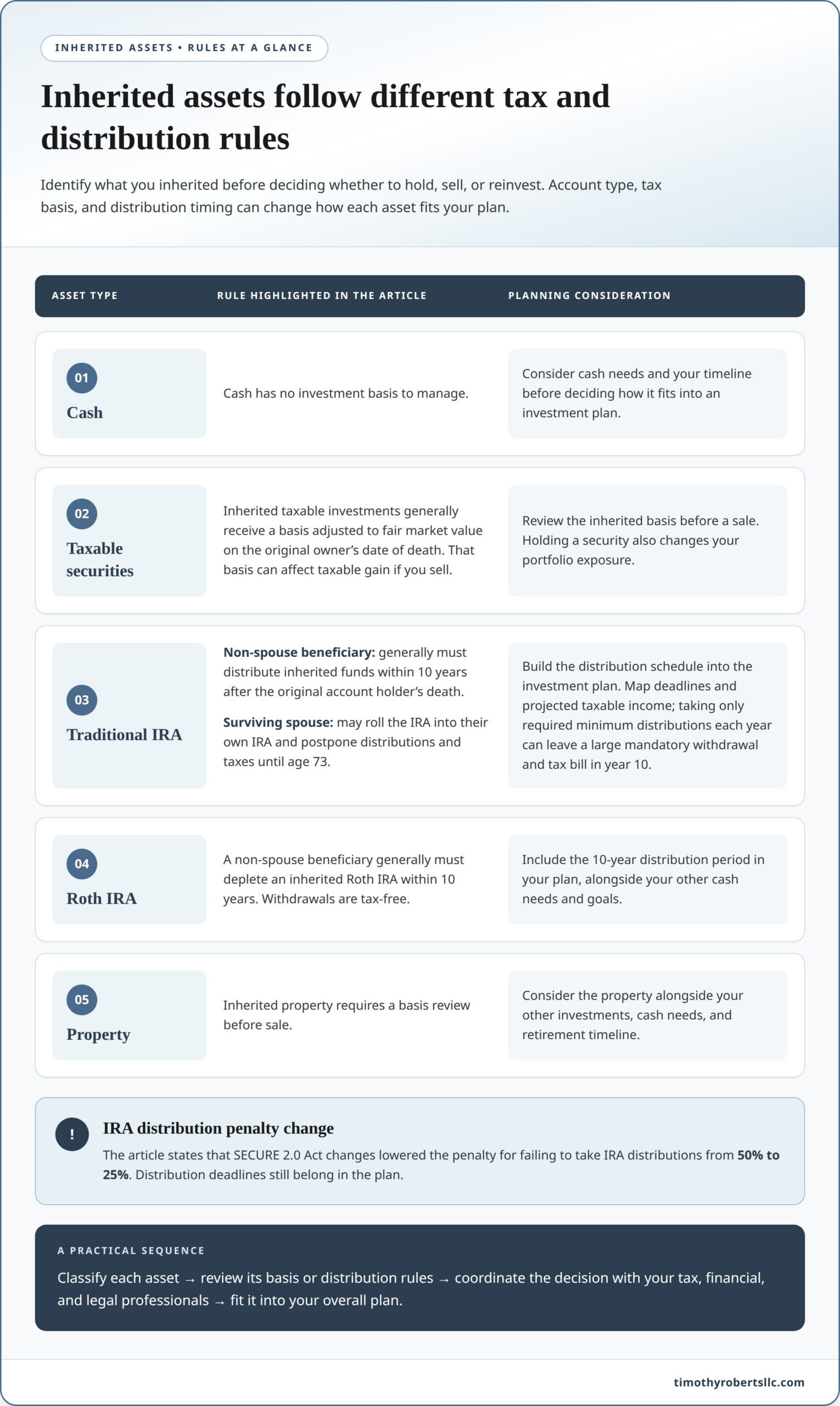
Have a financial professional review each asset separately, including cash, securities, retirement accounts, and property. Inherited taxable investments generally receive a basis adjusted to fair market value on the original owner’s date of death, which can affect taxable gain if you sell. Cash has no investment basis to manage, while inherited property also requires a basis review before sale—and for those navigating significant real estate holdings, property investment advisory and management firms like MaddisonV Properties can provide specialized guidance. Don’t treat every asset as one cash balance.
-
Get Guidance on Using Tax-Sheltered Accounts
Ask how your existing tax-sheltered accounts fit the inheritance and your broader retirement strategy. Their contribution and withdrawal rules differ from the rules for inherited assets, so keep the two decisions distinct. A non-spouse beneficiary generally must distribute inherited traditional IRA funds within 10 years after the original account holder’s death, according to the Internal Revenue Service. A surviving spouse may roll a traditional IRA into their own IRA and postpone distributions and taxes until age 73, according to the Internal Revenue Service.
A non-spouse beneficiary who inherits a Roth IRA generally must deplete it within 10 years, and withdrawals are tax-free, according to the Internal Revenue Service. The Internal Revenue Service also states that SECURE 2.0 Act changes lowered the penalty for failing to take IRA distributions from 50% to 25%. Build the distribution schedule into the investment plan.
- Map distributions to your situation. Ask the advisor to identify deadlines, projected taxable income, and the effect of withdrawals on your other goals. Taking only a required minimum distribution from an inherited IRA each year can leave a large mandatory withdrawal and tax bill in year 10. A planned schedule can help spread taxable distributions across the applicable period.
- Coordinate assets with your overall plan. Have the advisor consider inherited property and securities alongside your own investments, cash needs, and retirement timeline. For example, selling a security may create a taxable gain based on its inherited basis, while holding it changes your portfolio exposure. Estate and legacy planning can help connect these decisions to the wealth you intend to preserve.
How Can a Financial Advisor Help You Decide When to Invest a Seven-Figure Inheritance?
Preserve account records and keep inherited assets secure while a financial advisor reviews the estate, tax exposure, and upcoming needs. An advisor can help assess unsolicited investment pitches, unclear custody arrangements, and pressure to transfer capital before you understand the risks.
-
Take Time Before Making Decisions
Ask a financial advisor to structure the first decisions around facts, not urgency. During the first 30 days, preserve records and organize asset information before setting an investment strategy. Then use the following 30 to 60 days to define goals and an allocation that reflects income needs, tax exposure, and future plans.
A 60-to-90-day pause can provide a useful baseline, while some plans keep funds in a money market or CD account for six months to a year as a professional team is assembled. The right pace depends on required distributions, liquidity needs, and the complexity of the estate. A deliberate review can prevent rushed choices without leaving every asset unplanned.
-
Protect the Inheritance While You Decide
Have the advisor identify where inherited cash is held and whether account protection fits the balance. The Federal Deposit Insurance Corporation covers up to $250,000 for each FDIC-insured account, so a seven-figure cash inheritance may require careful deposit planning. Keep transaction records and avoid moving assets based on unsolicited messages or promises of unusually high returns.
Before approving a transfer, ask the advisor to review the investment’s risks, costs, liquidity, and custody. Don’t let sales pressure replace a written plan or push you into concentrated positions you don’t understand. The advisor can document the reasoning for each decision and flag tax consequences before assets are sold or withdrawn.
- Evaluate the mortgage alongside investment needs. Ask your advisor to compare the mortgage interest rate with potential investment returns, while accounting for taxes, cash reserves, and your comfort with debt. Paying it off can reduce required expenses; investing instead keeps capital available but exposes it to market movement. The choice should support your income plan, not follow a blanket rule.
How a Financial Advisor Builds a Portfolio Around Your Timeline and Risk Tolerance
A sound portfolio connects each investment to a purpose, time horizon, and capacity for risk. A tailored plan clarifies how to invest a seven-figure inheritance while keeping near-term needs and long-term goals in view.
- Match assets to your timeline. Ask your advisor to distinguish money for near-term spending from capital intended for longer-term goals. Funds reserved for a planned home purchase should play a different role from wealth intended for retirement. This helps align liquidity needs with each investment’s potential volatility.
- Assess risk tolerance and capacity. Discuss how you might respond to a market decline, then compare that comfort level with your ability to absorb losses. Someone relying on portfolio withdrawals for income may need a different allocation from someone with other income sources. Risk preference alone doesn’t determine a suitable strategy.
- Consider the cost of holding cash. From 1979 to July 2025, cash outperformed stocks in 23% of rolling one-year periods, 16% of rolling five-year periods, 7% of rolling 10-year periods, and 0% of rolling 20-year periods. These historical comparisons illustrate why investment timelines matter, without predicting future performance.
- Choose a diversified allocation. Ask your advisor to explain how each part of the portfolio supports a goal, balances risk, and fits anticipated withdrawals. Investments can serve different roles rather than relying on one concentrated position; for instance, some high-net-worth individuals diversify into prime international real estate with firms like SANSAV Properties LLC alongside traditional market holdings. If you’re considering how to invest a seven-figure inheritance, make the allocation reflect your priorities, not simply the size of your assets.
- Set a review process. Establish when your advisor will revisit the allocation, such as after a major life change or a shift in a goal’s timeline. Dollar-cost averaging doesn’t guarantee a profit or prevent a loss, and alternative investments are speculative and involve a high degree of risk. Keep these limitations in view when evaluating strategies.
Develop an inheritance portfolio strategy around your timeline, financial priorities, and risk tolerance.
Timothy Roberts & Associates, LLC: Investment Portfolio Management
Timothy Roberts & Associates, LLC provides fiduciary Investment Portfolio Management to help align an inheritance with your goals, timeline, and risk tolerance. Professional portfolio management can be useful when inherited assets, tax considerations, and future income needs must work together in a coherent plan.
Your investment strategy can account for anticipated withdrawals, retirement income, and the role you want the inheritance to play in your wider financial picture. Estate & Legacy Planning can connect investment decisions with the wealth you hope to preserve for family. Risk Management & Insurance Analysis can also bring market risk, insurance needs, and changing priorities into the planning process.
To discuss your inheritance and investment priorities, contact Timothy Roberts & Associates, LLC.
Let Your Inheritance Support the Future You Choose
Start by deciding what you want this inheritance to make possible. A disciplined approach to how to invest a seven-figure inheritance begins with your priorities, whether that means greater flexibility, retirement income, or a lasting legacy. Let those priorities guide the portfolio rather than letting the size of the inheritance dictate the plan.
Connect investment choices to the life you’re building. Timothy Roberts & Associates, LLC offers Investment Portfolio Management, Retirement Income Planning, and Estate & Legacy Planning to bring your priorities into a coordinated strategy. With a clear direction, each decision can serve a purpose, and the plan can evolve as your goals change.
Take the next step at a pace that feels considered and aligned with your intentions. Begin a planning conversation with Timothy Roberts & Associates, LLC and shape an investment strategy around the future you want to create.
Frequently Asked Questions
Do I Have to Pay Taxes on Money I Inherit?
Not necessarily. Receiving cash or property from an estate doesn’t automatically mean you owe federal income tax on its full value. Withdrawals from inherited traditional IRAs are generally taxed as ordinary income, while life insurance death benefits are generally income-tax-free. Income earned after inheritance may be treated differently. Identify each asset’s source and any income it generates before estimating your tax exposure.
How Can a Financial Advisor Build Your Portfolio?
A financial advisor can build an allocation by matching investments to spending needs, time horizon, and tolerance for market swings. For example, if you expect to use part of the inheritance for education while investing the rest for retirement, the portfolio can assign each purpose a different role. The advisor can also assess how existing savings and other assets affect concentration across your holdings.
Should a Financial Advisor Help You Decide Whether to Keep or Sell Your Relative’s Investments?
Yes. An advisor can assess how each investment fits your portfolio, goals, and tax situation. For example, inherited shares may leave you heavily exposed to one company, even if selling could create a taxable gain. Consider the holding’s expected income, liquidity, and role in diversification before deciding. Keeping every investment just because it came from family may not support your broader plan.
How Much Inheritance Tax or Estate Tax Might I Owe in the United States?
Your personal tax exposure depends on the estate, asset type, and applicable state rules. For a person who dies in 2026, the federal estate-tax exemption is $15 million, according to the Internal Revenue Service. Federal estate tax is paid by the estate, not the beneficiary. The information in this material is not intended as tax or legal advice. Please consult legal or tax professionals for specific information regarding your individual situation.
How Do Federal and State Inheritance and Estate Taxes Differ?
Federal estate tax and state-level estate or inheritance taxes are separate questions. The estate pays federal estate tax, while state rules may create different obligations depending on the state and circumstances. An estate’s federal tax position doesn’t establish whether state taxes apply. Review estate filings and personal tax obligations as separate parts of the overall assessment.
Can a Financial Advisor Help You Decide Whether to Pay Off Debt or Build an Emergency Fund Before Investing an Inheritance?
Yes. An advisor can weigh debt interest, cash-flow needs, and investment risk to help set priorities. A credit card charging 20% interest is one example of high-interest debt to consider. An emergency reserve can also help cover near-term expenses without forcing investment sales during a market decline. The right sequence depends on your obligations, liquidity needs, and financial goals.
