

May
Building a Dividend Income Portfolio: A Strategic Approach to Wealth Elevation
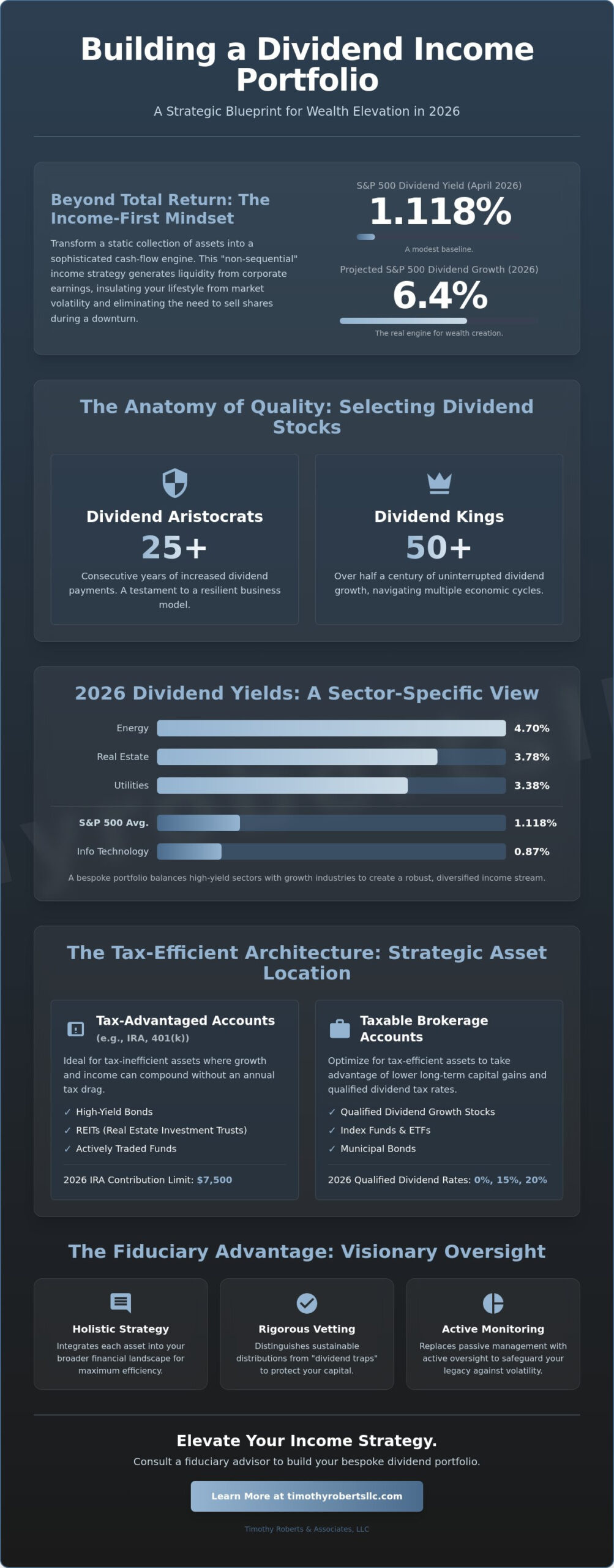
A robust portfolio is not merely a collection of tickers; it’s a carefully engineered architecture designed to withstand the shifting tides of the global economy. While the S&P 500 offered a modest 1.118% dividend yield as of April 29, 2026, the discerning investor knows that true wealth elevation requires a more intentional, bespoke approach. You likely recognize that the complexity of managing individual stock selections can feel overwhelming, especially when the threat of sudden dividend cuts or inefficient tax treatment looms over your hard-earned capital.
We believe that a predictable, growing income stream is the ultimate marker of financial sovereignty and peace of mind. This guide provides a strategic masterclass in building a dividend income portfolio that balances immediate yield with long-term growth and rigorous tax optimization through a fiduciary lens. You’ll discover how to navigate the 2026 qualified dividend tax rates, utilize the $7,500 IRA contribution limits effectively, and implement a holistic framework that protects your lifestyle against inflation while preserving a legacy for the future.
Key Takeaways
- Transform your capital into a sophisticated cash-flow engine that prioritizes a “non-sequential” income strategy for ultimate financial stability.
- Learn to evaluate the anatomy of quality by analyzing payout ratios and the historical longevity of Dividend Aristocrats versus Dividend Kings.
- Master the strategic balance between the immediate gratification of high-yield assets and the long-term compounding power required for capital preservation.
- Optimize your fiscal footprint when building a dividend income portfolio by strategically placing assets according to the 2026 tax tiers and NIIT thresholds.
- Adopt a visionary oversight model that replaces passive management with active, fiduciary-led monitoring to safeguard your legacy against market volatility.
The Role of Dividend Income in Strategic Wealth Elevation
Building a dividend income portfolio is an exercise in architectural precision. It transforms a static collection of assets into a sophisticated cash-flow engine that operates independently of market sentiment. In the current 2026 fiscal environment, where S&P 500 dividends are projected to grow by 6.4%, a strategic approach focuses on this growth rather than the daily fluctuations of share prices. This creates a “non-sequential” retirement income strategy. Unlike traditional models that rely on selling shares, this method generates liquidity from the underlying earnings of high-quality corporations, ensuring your lifestyle remains insulated from the volatility of the broader indices.
A well-constructed portfolio serves as a natural hedge against the inflationary pressures observed in early 2026. While cash loses purchasing power, companies with strong economic moats often possess the pricing power to increase their distributions. Dividend investing provides a psychological advantage that is often overlooked. When you prioritize income growth, a market correction becomes an opportunity to reinvest at higher yields rather than a threat to your solvency. It shifts the narrative from anxiety-driven monitoring to a calm, strategic observation of compounding wealth.
Beyond Total Return: The Income-First Mindset
The traditional 4% withdrawal rule, once a staple of retirement planning, often feels outdated in a market where capital preservation is paramount. Selling assets to fund your life during a market downturn forces you to liquidate at the worst possible time, permanently impairing your portfolio’s recovery potential. Harvesting dividends allows you to leave your principal untouched. This shift in mindset effectively eliminates “sequence of returns” risk. By focusing on the yield on cost and the sustainability of the payout, you ensure that your capital remains legacy-ready while your monthly income stream remains predictable and robust.
The Fiduciary Perspective on Passive Income
A fiduciary approach to income planning demands more than just chasing the highest yields. It requires a holistic view of how each asset fits into your broader financial landscape. High-end investment portfolio management involves distinguishing between sustainable distributions and “dividend traps” that signal corporate overextension. Bespoke strategies outperform off-the-shelf dividend funds because they allow for precise tax optimization and risk mitigation tailored to your specific goals. We view building a dividend income portfolio as a journey of elevation, where every selection is a deliberate step toward long-term capital preservation and professional stability.
The Anatomy of Quality: Selecting Dividend Growth Stocks
Quality is the bedrock of any sophisticated wealth strategy. When building a dividend income portfolio, you must look beyond the surface of a high yield to understand the corporate engine driving those payments. While a basic understanding of what a dividend is serves as a starting point, the elite investor seeks companies with proven resilience. We distinguish between Dividend Aristocrats, which have increased distributions for 25 consecutive years, and Dividend Kings, which have maintained this growth for over half a century. This longevity isn’t just a badge of honor; it’s evidence of a business model capable of navigating multiple economic cycles without compromising shareholder returns.
A strategic allocation requires rigorous sector diversification to mitigate idiosyncratic risk. As of April 2026, the S&P 500 dividend yield sits at 1.118%, but sector-specific opportunities vary wildly. Energy leads the market with a 4.70% yield, while Real Estate and Utilities offer 3.78% and 3.38% respectively. Conversely, Information Technology yields only 0.87%, reflecting a preference for share repurchases over cash distributions. A bespoke portfolio balances these high-yield sectors with growth-oriented industries to ensure your income stream keeps pace with the projected 6.4% S&P 500 dividend growth rate. For those seeking a higher level of oversight, it’s often wise to consult a strategic advisor to refine these selections.
Metrics That Matter: A Fiduciary Checklist
A disciplined selection process relies on three critical pillars of financial health:
- Dividend Coverage Ratio: This measures how many times a company can pay its dividends out of its current earnings. A ratio below 1.5 often signals that the payout is under pressure.
- Five-year Dividend Growth Rate: This is the engine of your future purchasing power. We look for companies that consistently exceed inflation to ensure your real-world income elevates over time.
- Debt-to-Equity: In a 2026 environment where interest rates remain a focal point, companies with bloated balance sheets are at risk. We prioritize firms with manageable debt to protect the portfolio from rising service costs.
Avoiding the Yield Trap
The allure of a 10% yield is often a siren song for the unwary. A “Yield Trap” occurs when a stock’s price plummets due to fundamental business decay, artificially inflating the yield figure. If the market is pricing a stock at a double-digit yield while its peers are at 4%, the market is likely betting on a dividend cut. We prioritize Free Cash Flow (FCF) as the ultimate truth in dividend safety. While net income can be influenced by accounting nuances, FCF represents the actual liquidity available to reward shareholders. Yield on Cost is the specific metric long-term investors use to measure the annual dividend rate divided by the original price paid for the shares.
Dividend Growth vs. High Yield: Finding Your Strategic Balance
Finding the equilibrium between immediate cash flow and future purchasing power is the hallmark of a visionary strategist. When building a dividend income portfolio, you must decide whether to prioritize the immediate gratification of high-yield assets or the long-term compounding power of dividend growers. High-yield stocks, such as those found in the Energy sector which averaged a 4.70% yield in April 2026, serve those already in the distribution phase. They provide the liquidity needed for current expenses without the necessity of selling principal. However, for investors five to ten years from retirement, the focus should shift toward companies with moderate yields but high growth potential.
The “sweet spot” often resides in firms offering a 2% to 3% yield paired with a double-digit annual distribution growth rate. These companies often possess superior economic moats and pricing power. To add sophisticated layers of income, we look toward Real Estate Investment Trusts (REITs) and Master Limited Partnerships (MLPs). With Real Estate yields holding at 3.78% as of April 2026, these vehicles offer a bespoke alternative to traditional equities. They provide a functional hedge against market volatility while contributing to a predictable monthly income stream. This strategic blend ensures your capital isn’t just preserved but actively optimized for the journey ahead.
Strategic Asset Allocation for Income
Your portfolio weighting must be a reflection of your individual retirement income planning goals. A holistic approach involves periodic rebalancing to maintain your desired risk profile. This means harvesting gains from high-growth stocks to fuel your income-producing engines. Managing this trade-off requires a steady hand and business-minded rigor. By intentionally shifting capital from appreciation-focused assets to those with sustainable payouts, you insulate your lifestyle from the sequence of returns risk that often plagues less structured plans.
The Impact of Interest Rates on Dividend Valuations
The 2026 economic landscape remains sensitive to interest rate fluctuations. High-yield stocks often behave as bond-proxies, experiencing price declines when rates rise. In contrast, dividend growers typically thrive during rate hike cycles because their rising payouts signal robust cash flow and operational excellence. With S&P 500 dividends expected to grow by 6.4% throughout 2026, an active management strategy is paramount. It lets us identify “dividend danger” signals before they impact your capital. This proactive stance distinguishes a bespoke, fiduciary-led strategy from a generic, “set it and forget it” mentality that often fails in complex markets.
The Tax-Efficient Architecture: Location and Strategy
Precision in tax planning is the silent engine of wealth preservation. When building a dividend income portfolio, the distinction between qualified and non-qualified dividends dictates your actual net return. For the 2026 tax year, qualified dividends benefit from preferential rates of 0%, 15%, or 20%. A married couple filing jointly can access the 0% rate on taxable income up to $98,900. Once income exceeds $613,700, the 20% threshold applies. High earners must also account for the 3.8% Net Investment Income Tax (NIIT) on modified adjusted gross income exceeding $250,000 for joint filers. These figures represent the difference between a portfolio that merely grows and one that truly elevates your financial standing.
Strategic asset location is the primary tool for mitigating these liabilities. We place non-qualified dividends, such as those from REITs or certain MLPs discussed previously, into tax-advantaged accounts like a Roth IRA or 401(k). This protects ordinary income from being taxed at higher marginal rates. Conversely, qualified dividends are better suited for taxable brokerage accounts where they can leverage the lower capital gains tiers. Inseparable investment and tax strategies ensure that you aren’t overpaying for your success. To explore how these strategies apply to your specific holdings, schedule a strategic consultation with our team.
Maximizing After-Tax Income
A holistic approach to wealth requires more than just asset selection; it demands professional tax advising to prevent “tax drag” from eroding your compounding power. High-bracket investors often benefit from integrating municipal bonds as a tax-free income alternative, creating a diversified stream that balances equity risk. We also explore advanced strategies like charitable giving using appreciated dividend stocks. This allows you to fulfill philanthropic goals while receiving a deduction for the full market value, effectively bypassing capital gains taxes on years of growth.
The Dividend Reinvestment Plan (DRIP) Strategy
The decision to automate reinvestment or harvest cash depends on your current lifecycle phase. In a taxable account, a DRIP requires meticulous basis tracking, as every reinvested dividend is considered taxable income in the year it’s paid. However, using these distributions to “self-rebalance” offers a sophisticated advantage. Instead of selling winners and triggering capital gains, you can direct cash dividends into underweight positions. This maintains your target allocation with surgical precision. By treating your distributions as a strategic tool rather than a passive byproduct, you optimize the long-term resilience of your capital.
The Fiduciary Advantage: Elevating Your Income Strategy
The concept of “set it and forget it” is a dangerous myth in the sophisticated 2026 market. While global aggregate dividends are projected to grow by 2.9% this year, the underlying health of individual corporations can shift with startling speed. Building a dividend income portfolio requires continuous, vigilant monitoring for “dividend danger” signals. A sudden spike in a company’s payout ratio or a deterioration in free cash flow often precedes a distribution cut. A boutique fiduciary provides the intellectual curiosity and rigorous oversight necessary to identify these risks before they erode your capital preservation goals.
Integrating your distributions into a comprehensive financial plan ensures that every dollar serves a specific purpose. This isn’t just about collecting checks; it’s about aligning your cash flow with your tax liabilities, legacy objectives, and risk tolerance. Large agencies often offer generic models that fail to account for the nuances of your personal journey. A partnership with a dedicated advisor provides the personal attention and high-level expertise required to navigate the complexities of the 2026 Net Investment Income Tax and the updated standard deduction limits of $16,000 for single filers.
Customization Over Consolidation
Many investors turn to popular dividend ETFs for convenience. While these provide broad exposure, they often lack the precision required for high-net-worth individuals. These funds can’t account for your specific tax bracket or your desire to avoid sectors that may conflict with your personal values. Designing a bespoke portfolio allows for surgical asset location and the selection of companies that reflect your unique legacy goals. Bespoke management is the ultimate form of wealth elevation, transforming a generic investment into a personal financial legacy.
Next Steps: Your Income Roadmap
Your journey toward a more resilient income stream begins with a thorough audit of your current holdings. We examine each asset for dividend quality, sustainability, and growth potential. This process is paired with a professional risk tolerance assessment that considers the potential for falling interest rates later in 2026. We invite you to experience a higher level of strategic partnership. Let’s move beyond superficial solutions and focus on building a dividend income portfolio that preserves your capital while providing the predictable monthly income you deserve. Contact our firm today to begin your upward journey toward financial sovereignty.
Elevating Your Financial Legacy
True wealth elevation is the result of intentional, disciplined architecture. We’ve navigated the complexities of identifying Dividend Kings, balancing immediate cash flow with the projected 6.4% S&P 500 dividend growth, and optimizing for the 2026 tax landscape. Building a dividend income portfolio isn’t a passive endeavor; it’s a strategic commitment to capital preservation and long-term sovereignty. It requires a holistic view that bridges the gap between today’s income needs and tomorrow’s legacy goals through a fiduciary lens.
At Timothy Roberts LLC, we bring 25+ years of fiduciary expertise to every client partnership. Our approach ensures a comprehensive integration of tax and investment strategies, providing you with a bespoke roadmap tailored to your unique aspirations. We invite you to Schedule Your Strategic Portfolio Review today. Together, we can transform your current holdings into a sophisticated engine of growth and stability. Your path to a refined and secure financial future is waiting.
Frequently Asked Questions
What is the best dividend yield for a retirement portfolio in 2026?
A sustainable target yield for most sophisticated investors ranges between 2.5% and 4.5%. While the S&P 500 average yield was 1.118% in April 2026, chasing yields significantly higher than 5% often introduces excessive capital risk. We prioritize the “sweet spot” where current yield meets the projected 6.4% dividend growth rate to ensure your purchasing power remains robust against inflationary pressures.
How many stocks should be in a diversified dividend income portfolio?
A well-structured portfolio typically contains 20 to 30 individual holdings. This specific range provides enough diversification to mitigate sector-specific volatility without diluting the impact of your highest-conviction selections. It allows for the meticulous, bespoke oversight required to monitor free cash flow and corporate governance for each company. Over-diversification often leads to “closet indexing” and diminished long-term results.
Can I live entirely off dividends without touching my principal?
Living solely on distributions is the cornerstone of a non-sequential retirement strategy. By harvesting only the cash flow generated by your assets, you leave the underlying principal intact for legacy preservation. This requires building a dividend income portfolio that generates a yield exceeding your annual lifestyle expenses after accounting for the 2026 tax obligations and the 3.8% Net Investment Income Tax.
What happens to my dividend income if the stock market crashes?
Dividend income often remains remarkably resilient even when share prices experience significant volatility. High-quality corporations, particularly Dividend Kings with 50-plus years of growth, prioritize their payouts as a signal of financial strength. While your portfolio’s market value may fluctuate, the cash flow provides a psychological and financial buffer that prevents the need to sell shares at depressed valuations during a correction.
Are dividend ETFs better than buying individual dividend stocks?
ETFs provide convenient diversification, but they lack the surgical precision of a bespoke individual stock portfolio. When building a dividend income portfolio, individual selections allow you to optimize for your specific 2026 tax bracket and avoid the “dividend traps” often found in broad-market funds. Individual ownership also facilitates more effective tax-loss harvesting and precise control over your sector exposure.
How are qualified dividends taxed compared to ordinary income?
Qualified dividends are taxed at preferential long-term capital gains rates of 0%, 15%, or 20% rather than higher ordinary income rates. For the 2026 tax year, married couples filing jointly pay 0% on qualified dividends if their taxable income is below $98,900. This tax-efficient treatment makes dividends a superior income source compared to interest from standard savings accounts or high-yield bonds.
Is it too late to start a dividend portfolio if I am over 60?
It is never too late to transition toward a strategic income-focused model. For investors over 60, the strategy shifts toward capital preservation and immediate yield. You can still take advantage of the 2026 IRA contribution limits, which allow for a $1,100 catch-up contribution for a total of $8,600. This late-stage optimization can significantly enhance your monthly cash flow during the distribution phase.
How do I know if a company is about to cut its dividend?
A payout ratio exceeding 75% of earnings or a consistent decline in free cash flow are primary “danger signals” for a dividend cut. We also monitor a company’s debt-to-equity ratio and interest coverage. If a stock’s yield rises to double the sector average, the market is often pricing in an imminent reduction. Proactive, fiduciary-led monitoring is essential to identifying these risks before they impact your capital.
