

Nov
Creating a Financial Legacy for Your Grandchildren and Heirs
A grandparent-owned 529 plan is no longer reported as a student asset or student income under FAFSA rules for the 2024–25 award year. Creating a financial legacy for your grandchildren, though, involves more than choosing an account: inherited retirement savings, education funding, family priorities, and estate plans all shape what passes to the next generation.
It’s understandable to focus first on whether helping with college could affect financial aid. The answer is encouraging, but account ownership is only one part of a thoughtful plan. The way assets are titled, distributed, and managed can influence how useful they are to your family over time.
This article explains how inherited retirement accounts work, what to consider with a grandparent-owned 529 plan, and how family values can guide multigenerational planning. You’ll also see how estate and legacy planning can connect these decisions into a clearer, more intentional framework for your grandchildren and heirs.
Key Takeaways
- Learn how inherited retirement accounts can shape the timing and tax impact of what heirs receive.
- Consider how family values, guidance, and financial support can form a legacy beyond money.
- Understand how grandparent-owned 529 plans are treated under FAFSA rules and what that means for education funding.
- Explore how coordinated estate planning can help align assets, beneficiaries, and long-term intentions.
1. What Happens to Retirement Accounts Left to Heirs?
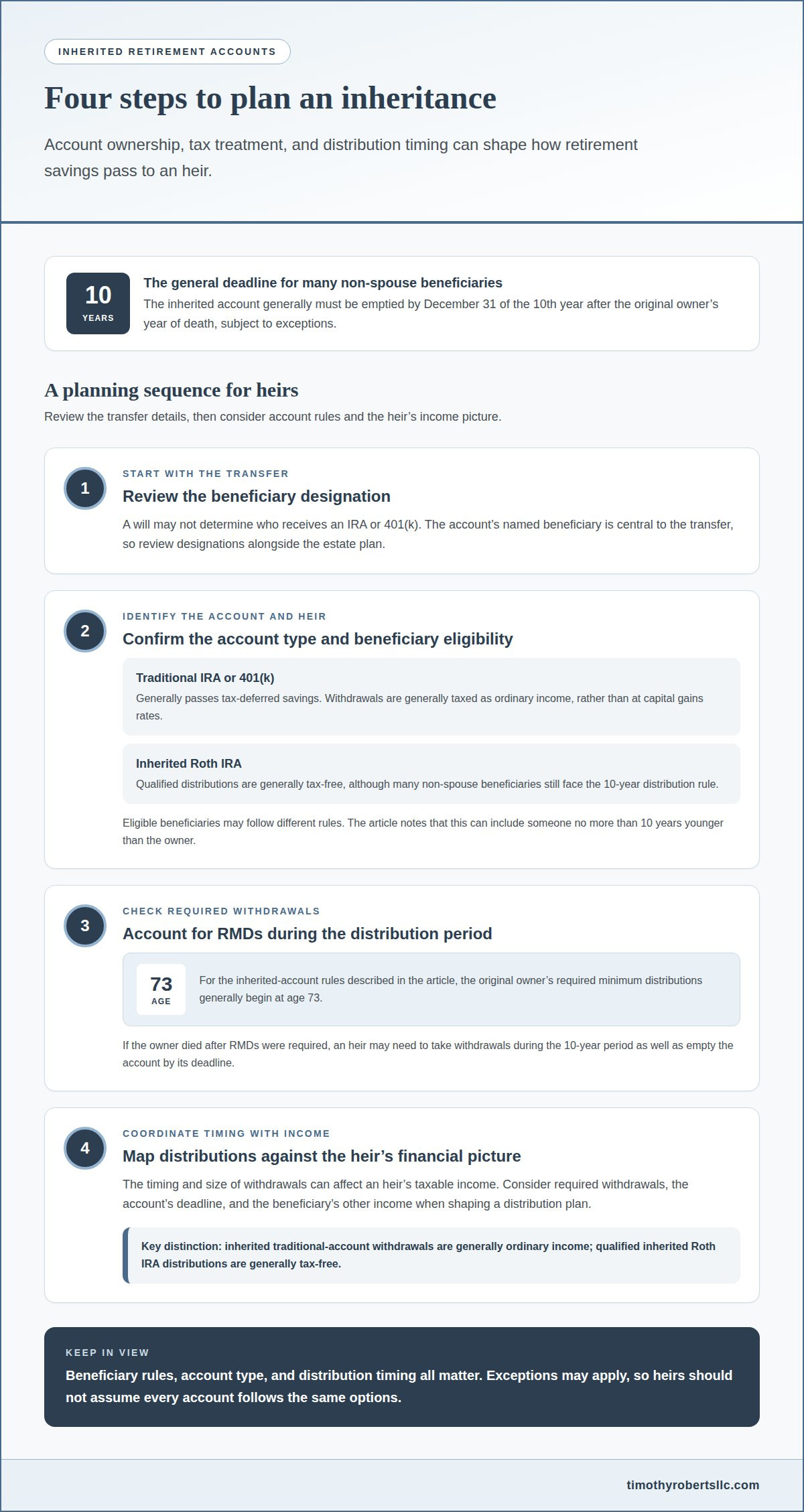
An inherited retirement account can provide a child or grandchild with valuable assets, but its distribution schedule affects when that money becomes income. In the United States, a non-spouse beneficiary generally must empty an inherited account by December 31 of the 10th year after the original owner’s year of death, subject to exceptions, according to the Internal Revenue Service. This rule, established under the SECURE Act framework, makes beneficiary eligibility and account type important planning decisions.
Traditional IRAs and 401(k)s generally pass tax-deferred savings, not tax-free cash. Withdrawals are generally taxed as ordinary income rather than at capital gains rates, so the timing and size of distributions can affect an heir’s taxable income. Qualified distributions from inherited Roth IRAs are generally tax-free, although many non-spouse beneficiaries still face the 10-year distribution rule. An advisor can incorporate these differences when shaping retirement income and inheritance plans.
Required minimum distributions also matter. For the inherited-account rules described here, the original owner’s required minimum distributions generally begin at age 73, according to the Internal Revenue Service. If the owner died after RMDs were required, an heir may need withdrawals during the 10-year period, in addition to emptying the account by its deadline. Eligible beneficiaries, including someone no more than 10 years younger than the owner, may follow different rules.
Before an inheritance, review beneficiary designations alongside the estate plan. A will may not determine who receives an IRA or 401(k); the account’s named beneficiary is central to the transfer. Then identify whether the inherited account is traditional or Roth, confirm the beneficiary’s eligibility, and map required withdrawals against other income. These steps help families understand how accounts may support grandchildren without assuming every heir has the same tax position or distribution options.
2. Financial and nonfinancial aspects of a family legacy
A family legacy includes both assets and the principles that guide their use. Wealth can help grandchildren pay qualified college expenses, while shared traditions shape how they approach responsibility, work, and generosity. Start family conversations by explaining the purpose of an inheritance, such as supporting education, encouraging independence, or preserving a family business. Clear intentions give financial decisions meaning beyond an account balance.
Make those values practical. A grandparent helping with college expenses might agree to support tuition while asking a grandchild to contribute through work or savings. Another family might connect a gift to a tradition of community service. Discuss expectations before money changes hands, including whether support is intended for education, a first home, or broader needs. These conversations help relatives distinguish between providing opportunities and directing every choice.
Do state laws affect inheritance and gifts to grandchildren? Yes. State law can affect how inheritance is administered and when a minor gains control of custodial assets; UGMA or UTMA custodians typically manage accounts until the age of majority, often 18 or 21 depending on the state. That distinction can shape when a grandchild controls funds, so account structure belongs in the family’s planning discussion.
How can grandparents set up a trust for grandchildren? Start by defining its purpose, the assets it may hold, who will manage them, and the conditions for distributions. A trust can direct support toward milestones such as education or other needs instead of transferring everything at once. Its terms should reflect family priorities and beneficiaries’ circumstances.
Preserve the nonfinancial legacy alongside the estate plan. Record family stories, explain the reasoning behind important decisions, and invite grandchildren into age-appropriate conversations about saving and giving. A coordinated approach can connect those intentions with asset management through financial planning for family goals, helping wealth and values move forward together.
3. Does A Grandparent-Owned 529 Plan Affect FAFSA?
For the 2024–25 award year, grandparent-owned 529 plans are no longer reported as student assets or student income under FAFSA rules. This changes how families coordinate education gifts with financial aid, but account ownership and timing still belong in the broader funding plan. A 529 plan offers tax-free investment growth and tax-free withdrawals when funds pay qualified education expenses.
The FAFSA and CSS Profile are separate financial aid applications. Colleges that use the CSS Profile apply their own aid methodology, so FAFSA’s treatment of a grandparent-owned account does not determine how every institution will assess it. Consider the college list, account owner, and timing of withdrawals. These details help clarify how savings fit alongside grants and family contributions.
A 529 is designed for education expenses, while a custodial account offers broader uses. UGMA and UTMA funds can support needs beyond education, but custodians generally manage them until the minor reaches the age of majority, often 18 or 21 depending on state law. A trust follows its written terms, which can direct when and how a beneficiary receives funds. These structures offer different balances of purpose, flexibility, and control.
For example, a grandparent prioritizing college can keep education savings in a 529 and coordinate withdrawals with the student’s expenses. If the named beneficiary doesn’t use the funds for education, families may want to review the plan’s options for using or reallocating the funds. Nonqualified withdrawals may trigger taxes and penalties, including a 10% federal penalty on earnings. That makes the account’s intended use a meaningful part of the decision.
A thoughtful structure considers both aid and family goals across generations. Map expected education costs, account ownership, possible beneficiary changes, and the colleges involved. Then compare a 529 with custodial assets or trust provisions in the estate plan, so each funding choice serves a defined purpose without assuming every option works the same way.
4. Multigenerational estate and financial planning
Creating a financial legacy for your grandchildren starts with connecting assets to the people and purposes they should serve. Parents and grandparents can map retirement needs, education support, and inheritance together rather than making each decision in isolation. For example, a family might assign separate roles to retirement savings, a 529 plan, and income-producing property. This structure helps each member understand the asset’s purpose and who will guide decisions later.
Plan beyond the next five years. Consider how a business, real estate, or another legacy asset could be managed decades from now, especially if several heirs share ownership. Discuss who will maintain records, how decisions will be made, and whether continued revenue could benefit descendants. These questions turn creating a financial legacy for your grandchildren into a practical plan for stewardship, not simply a transfer of wealth.
A trust can set terms for how grandchildren receive support. Its provisions might direct distributions for health, education, maintenance, and support, or connect access to milestones such as graduation. Some trusts distribute funds at ages 35, 45, or 55; others create a shared pool so a trustee can respond to beneficiaries’ different needs. The design should reflect family priorities and establish clear oversight.
Bring beneficiary designations, retirement plans, education funding, and estate documents into one coordinated view. Identify who will manage each asset and how the family will revisit decisions as circumstances change. This is the practical work of coordinating multigenerational financial planning, aligning today’s intentions with tomorrow’s responsibilities. Creating a financial legacy for your grandchildren becomes more meaningful when the financial structure also communicates the values behind it.
Timothy Roberts & Associates: Estate & Legacy Planning
Timothy Roberts & Associates helps families connect inheritance decisions with retirement, education, and long-term priorities through Estate & Legacy Planning. When beneficiary designations, inherited accounts, 529 savings, or family intentions need to work together, this planning can clarify how each piece supports the next generation. Financial Planning and Retirement Income Planning can bring future income needs into the same conversation, while Investment Portfolio Management addresses how investments fit the broader strategy.
This support can be useful when family circumstances change or existing arrangements no longer reflect your intentions. A coordinated plan helps bring wealth transfer decisions into focus alongside practical financial goals. Contact Timothy Roberts & Associates to discuss your estate and legacy planning goals.
Shape a Legacy Your Family Can Carry Forward
Your next step is to turn good intentions into decisions your family can understand and carry forward. Identify what you want your support to make possible, who should guide decisions, and how the plan can evolve as grandchildren become adults. That clarity gives creating a financial legacy for your grandchildren a purpose beyond transferring assets: it connects resources to a future your family recognizes as its own.
Timothy Roberts & Associates, LLC can help align Estate & Legacy Planning with Retirement Income Planning and Investment Portfolio Management, bringing family priorities and financial decisions into the same conversation. A thoughtful discussion can clarify where planning support is most useful and create a shared reference point as goals change. You don’t need every detail settled before beginning; start with what matters to you and the outcomes you hope to support. Start a conversation with Timothy Roberts & Associates, LLC, and take your next step with greater intention.
Frequently Asked Questions
Does A Grandparent-Owned 529 Plan Affect FAFSA?
For the 2024–25 award year, FAFSA no longer reports a grandparent-owned 529 plan as student assets or income. That treatment can help families coordinate education support with aid planning, but ownership remains one part of a broader funding strategy. For example, grandparents and parents can coordinate anticipated tuition payments so the student’s education budget reflects the support each generation plans to provide.
How Can Grandparents Plan For Multiple Generations?
Plan across generations by aligning an intended inheritance with retirement needs, education support, and family decision-making roles. Define the outcomes you want to support, then consider which assets can serve those goals without compromising your financial security. For example, parents can coordinate an education contribution with a grandparent’s retirement-income needs while clarifying who will oversee assets if family circumstances change.
What Happens To Retirement Accounts When You Leave Them To Heirs?
A non-spouse beneficiary generally must distribute an inherited retirement account in full by December 31 of the 10th year after the original owner’s year of death, subject to exceptions, according to the Internal Revenue Service. Traditional account withdrawals are generally taxed as ordinary income, while qualified inherited Roth distributions are generally tax-free. The beneficiary’s eligibility and the owner’s required distribution status can affect the withdrawal schedule.
Can I leave an inheritance in a 529 plan for my grandchildren?
Yes. You can name a grandchild as the beneficiary of a 529 plan and reserve the funds for qualified education expenses. A 529 is not an unrestricted cash inheritance: if the named beneficiary doesn’t use the funds for education, the beneficiary can be changed only to eligible family members for qualified education expenses. Consider the intended education use when deciding how this account fits your estate plan.
What are the best ways to build a financial legacy for grandchildren?
Build a durable legacy by connecting financial support with clear family intentions. Set priorities, such as education, independence, or stewardship of a family asset, and choose a funding approach suited to each goal. Explain the purpose of support to grandchildren in plain language, including any expectations for its use. Revisit decisions as goals and circumstances evolve, rather than treating a gift as a one-time transaction.
How much money should grandparents leave to grandchildren?
There’s no single appropriate inheritance amount. Start with a financial plan that accounts for retirement security, essential expenses, healthcare needs, and existing commitments. Then decide what resources remain available for gifts. A sustainable inheritance fits those priorities without relying on uncertain investment growth or future income. Grandparents can also decide whether support should be divided equally, tied to specific goals, or managed through a structure with defined terms.
