The most expensive mistake a wealthy family can make in 2026 isn’t a poor investment; it’s a passive tax strategy. While Michigan offers a stable 4.25% flat income tax, the true erosion of wealth often occurs at the intersection of federal estate shifts and complex retirement distributions. Implementing sophisticated high net worth tax strategies michigan families rely on requires more than annual filing. It demands a visionary architectural synthesis of your entire portfolio to ensure that your legacy remains intact as it passes to the next generation.
You’ve likely felt the weight of tax drag on your retirement income or feared the complexity of multi-state obligations as your assets grow. We understand that wealth is a journey of upward progression, not just a series of transactions. This guide provides a cohesive roadmap to minimize capital gains and maximize your fiduciary oversight. We’ll explore the permanent 15 million dollar federal estate exemption, the nuances of Michigan’s three-tiered retirement taxation, and the specific frameworks Timothy Roberts & Associates, LLC uses to turn tax liabilities into opportunities for intentional growth.
Key Takeaways
- Understand the 2026 regulatory landscape and how Michigan’s flat tax interacts with federal shifts to protect your portfolio from unnecessary erosion.
- Discover strategic income shielding techniques, including the precise timing of Roth conversions, to minimize long-term tax drag on your retirement income.
- Navigate the permanent 15 million dollar federal estate exemption with a 20-year vision designed to preserve your family’s legacy across generations.
- Leverage sophisticated high net worth tax strategies michigan families use to optimize business succession and charitable giving through Donor-Advised Funds.
- Learn why a fiduciary partner like Timothy Roberts & Associates, LLC is essential for synthesizing creative personal vision with structured wealth management.
The 2026 Tax Landscape for High Net Worth Individuals in Michigan
The year 2026 represents a structural shift for Michigan’s most successful families. It’s no longer sufficient to simply track expenses or maximize annual deductions. True wealth preservation requires an architectural approach that anticipates regulatory transitions before they impact your balance sheet. For those seeking high net worth tax strategies michigan, the focus has shifted from simple compliance to a sophisticated evolution of personal capital. This proactive wealth architecture ensures that your assets aren’t just managed, but are actively shielded from foreseeable erosion.
To better understand how specific vehicles can enhance your tax position, watch this helpful video:
Understanding the 2026 Tax Sunset Provisions
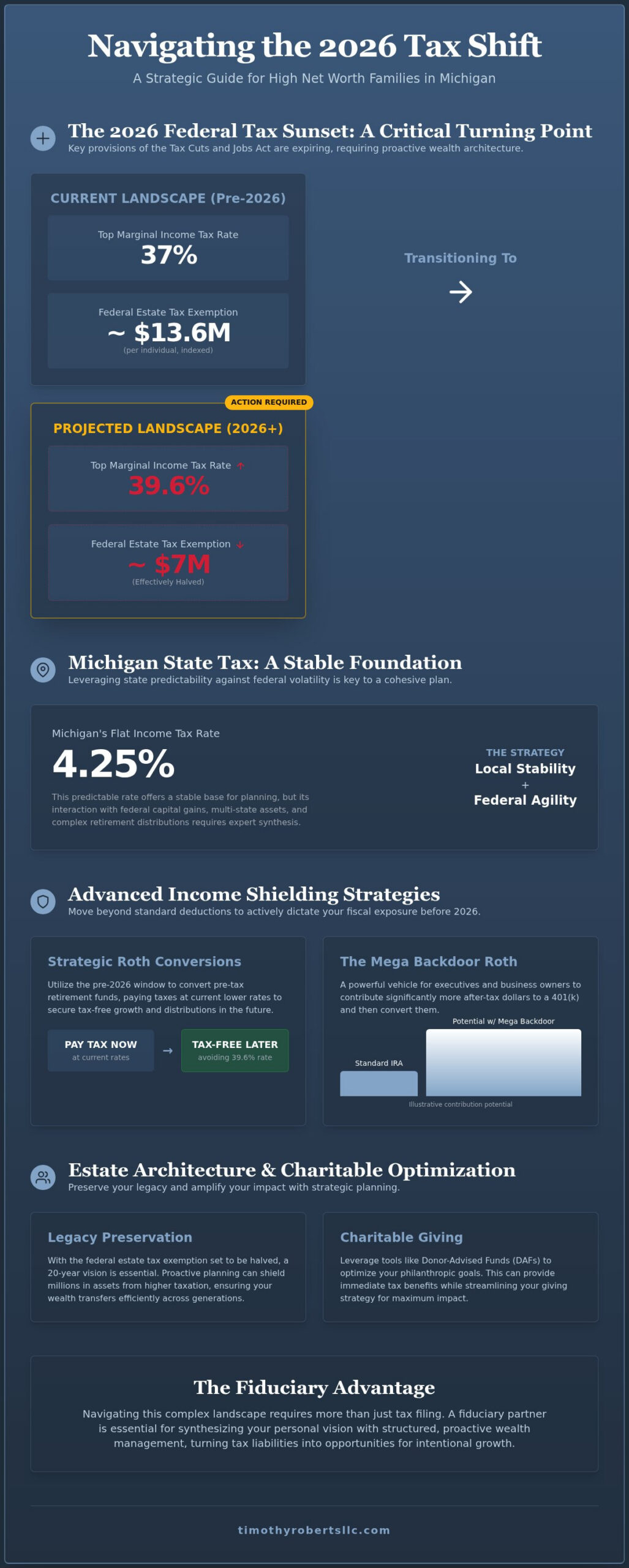
The expiration of the Tax Cuts and Jobs Act marks a return to a 39.6% top marginal rate, a change that will immediately tighten cash flow for top-tier earners. The ‘Tax Sunset’ is the scheduled reversion of federal tax laws to their pre-2018 status, which effectively halves standard deductions and eliminates several key exemptions for 2026. This compression of tax brackets means more of your income will be captured at higher percentages, making the timing of distributions and income recognition critical. Timothy Roberts & Associates, LLC views this not as a hurdle, but as a catalyst for deeper strategic planning. Understanding the broader Federal Estate Tax Landscape is essential, as the exemption limits are also scheduled to reset, potentially exposing millions in assets to higher taxation.
Michigan State Tax Considerations for Wealthy Households
Michigan’s tax environment provides a unique backdrop to these federal shifts. Our state maintains a 4.25% flat income tax rate, providing a level of predictability that contrasts sharply with the graduated federal system. However, this simplicity can be deceptive. High-value investment portfolios must account for how state-level exemptions interact with federal capital gains rates. Wealthy households often manage assets across multiple jurisdictions, making residency and the sourcing of income vital components of a cohesive tax plan. By aligning Michigan’s flat rate with federal shielding techniques, families can create a stable foundation for legacy transfer. This synthesis of local stability and federal agility is the hallmark of a visionary high net worth tax strategies michigan framework.
Advanced Income Shielding: Beyond Standard Tax Deductions
Effective wealth preservation requires moving beyond the basic deductions used by the general public. For families navigating the 2026 landscape, integrating sophisticated tax advising in Ann Arbor with long-term portfolio growth is the only way to counteract rising federal rates. Implementing the kind of high net worth tax strategies michigan residents need requires an architectural approach that treats every dollar as a strategic asset. By utilizing advanced income shielding, you don’t just react to the IRS; you dictate the terms of your fiscal exposure.
Roth Conversion Strategies for the 2026 Bridge
The window of opportunity before the 2026 rate hike is narrowing. Corporate executives and business owners are increasingly looking at the ‘Mega Backdoor Roth’ as a primary vehicle for tax-free growth. This involves contributing after-tax dollars to a 401k and then converting them, allowing for significantly higher contribution limits than a standard Roth IRA. Calculating the break-even point is critical. You’re essentially choosing to pay taxes at current, lower rates to hedge against the 39.6% top marginal rate coming in 2026. These accounts provide a permanent shield against future legislative volatility, ensuring your retirement distributions remain your own.
Synthesizing Investment Management and Tax Efficiency
Investment decisions shouldn’t be made in a tax vacuum. Strategic investment portfolio management in Detroit focuses on optimizing asset location to minimize the impact of tax drag on long-term capital growth. This means placing high-yield bonds and actively managed funds in tax-deferred accounts, while keeping tax-efficient index funds in taxable accounts. We also focus on managing the ‘Phantom Tax’ on mutual fund distributions, which can trigger liabilities even if you didn’t sell any shares. In volatile markets, we employ tax-loss harvesting to offset capital gains, turning market downturns into a strategic advantage for your balance sheet.
To further refine your year-end position, consider Charitable Optimization Strategies that align your philanthropic goals with immediate liability reduction. Maximizing Health Savings Accounts (HSAs) and deferred compensation plans adds another layer of protection. These tools aren’t just about saving money; they’re about the organizational evolution of your wealth. If you’re ready to move beyond generic advice, our team at Timothy Roberts & Associates, LLC can help you craft a tailored intervention that reflects your personal vision.
Estate Architecture and Legacy Preservation Strategies
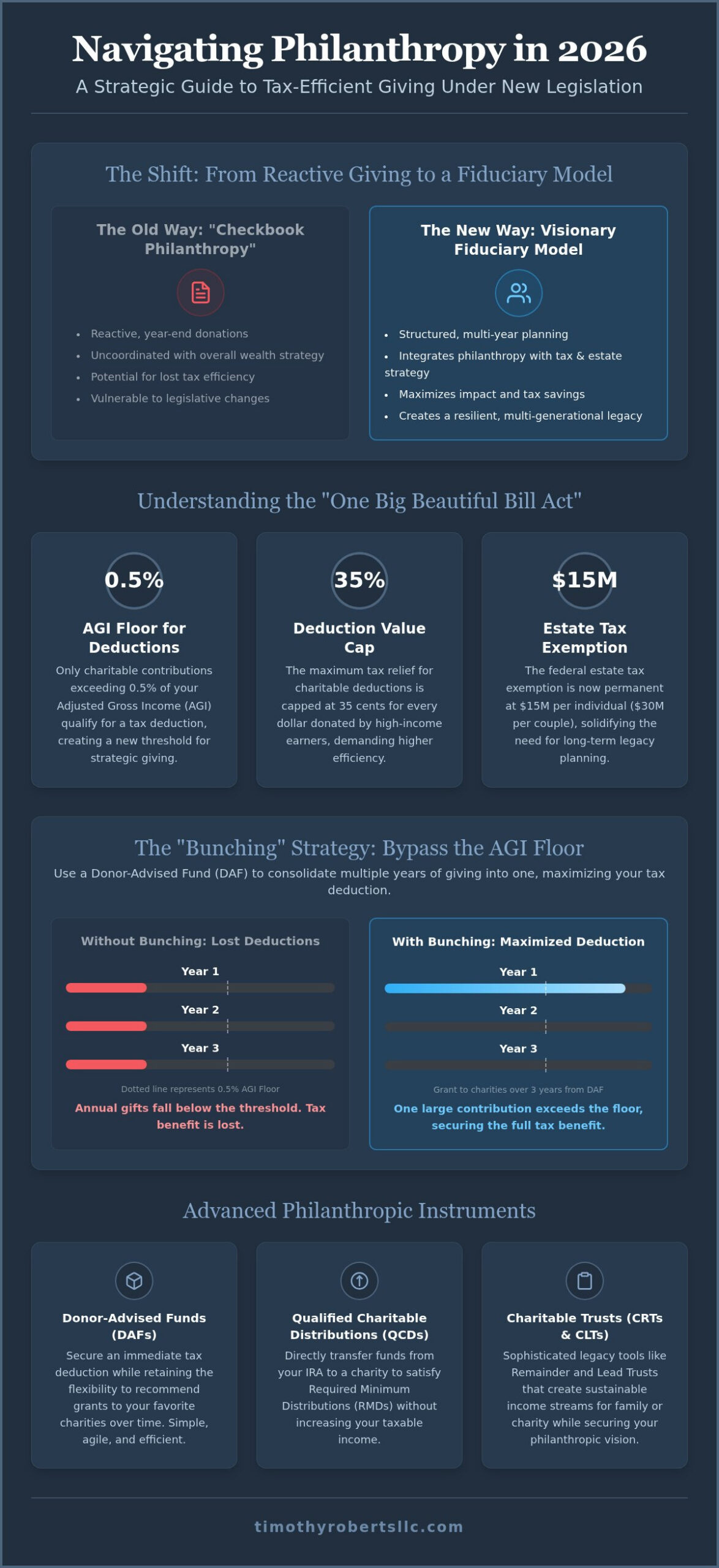
Legacy isn’t a static destination; it’s an evolving narrative of your family’s success. For those navigating high net worth tax strategies michigan, the focus often shifts from immediate income to the long-term architectural integrity of the estate. While Michigan remains a refuge from state-level estate and inheritance taxes, the federal environment demands a sophisticated defense. The passage of the One Big Beautiful Bill Act in 2025 solidified the federal exemption at $15 million per individual, yet estates exceeding this threshold still face a 40% tax rate. Coordinating your legal documents with your financial reality is where the fiduciary standard proves its worth, ensuring that your intent is mirrored in your execution.
Effective estate planning in Farmington Hills requires a 20-year vision that transcends simple document drafting. It involves protecting the step-up in basis for inherited assets, which remains one of the most powerful tools for eliminating capital gains for your heirs. At Timothy Roberts & Associates, LLC, we view legacy preservation as a journey of upward progression, requiring a synthesis of personal vision and corporate-level structured capabilities. This proactive stance ensures that wealth erosion is minimized during the critical transfer between generations.
Trust Frameworks for High-Value Michigan Estates
Irrevocable Life Insurance Trusts (ILITs) serve as a vital liquidity tool, providing the necessary funds to cover federal liabilities without forcing the liquidation of family businesses or real estate. To transfer appreciation out of your taxable estate, Grantor Retained Annuity Trusts (GRATs) allow you to pass high-growth assets to heirs with minimal gift tax impact. Michigan-specific trust structures also offer robust asset protection, shielding your family from external claims while maintaining the privacy that high-net-worth families value. These interventions are not off-the-shelf solutions but carefully crafted instruments designed for specific family dynamics.
Probate Avoidance and Multi-Generational Transfer
Bypassing the public and often costly Michigan probate process is a priority for families who value discretion and efficiency. A comprehensive legacy plan must include regular beneficiary audits to ensure that asset titling aligns with your current trust framework. For those looking beyond their children, Dynasty Trusts provide a structure for multiple future generations to benefit from your success while minimizing future estate tax exposure. This multi-generational transfer ensures that the wealth you’ve built continues to fund education, philanthropy, and family growth for decades to come. It’s about creating a stable foundation that survives market cycles and regulatory shifts.
Business Succession and Charitable Optimization
Business ownership is often the cornerstone of a Michigan family’s balance sheet. Transitioning that value into liquid retirement capital requires a synthesis of corporate exit strategies and personal retirement income planning in Ann Arbor. For those exploring high net worth tax strategies michigan, the intersection of business valuation and charitable intent provides a unique opportunity to reduce liabilities while cementing a legacy. This isn’t just about selling a company; it’s about the organizational evolution of your life’s work into a sustainable source of future income.
Strategic Business Transition Planning
Successful transitions don’t happen overnight. A 24-month lead time is essential for pre-sale tax structuring to ensure all exemptions are fully leveraged. Utilizing Section 1202 Qualified Small Business Stock (QSBS) exemptions can potentially exclude up to 10 million dollars or 10 times the adjusted basis from federal capital gains taxation. If your entity qualifies, this represents one of the most powerful wealth preservation tools available. We also look at installment sales to spread capital gains liability over several tax years. This prevents a massive income spike in a single filing period and keeps more capital working for you. This deliberate pacing ensures that the value you built over decades isn’t disproportionately captured by the IRS during the exit.
Philanthropy as a Tax-Efficiency Tool
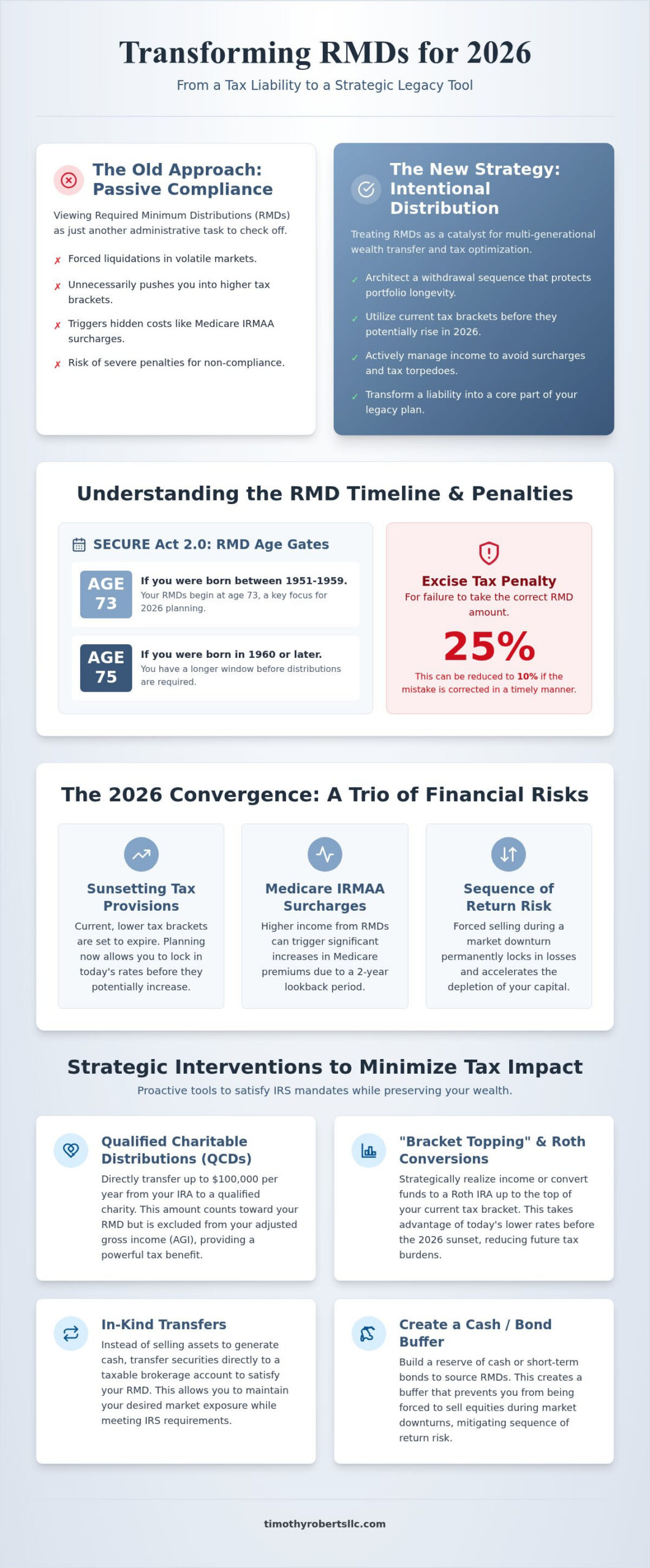
Philanthropy serves as a powerful lever for tax optimization when structured with a visionary mindset. As the standard deduction is set to decrease in 2026, bunching multiple years of charitable contributions into a single Donor-Advised Fund (DAF) can help you exceed the deduction threshold for a significant tax break. Gifting appreciated securities instead of cash is even more effective. This strategy allows you to avoid the 4.25% Michigan flat tax on capital gains while receiving a deduction for the full market value. For retirees over age 70.5, Qualified Charitable Distributions (QCDs) from an IRA satisfy required minimum distributions without adding a single dollar to your taxable income.
Choosing between a private family foundation and a DAF depends on your desired level of control and administrative burden. At Timothy Roberts & Associates, LLC, we treat these choices as part of your broader wealth journey, matching your creative passion with business-minded rigor. We help you navigate the complexities of charitable giving to ensure your generosity also serves your long-term preservation goals. If you’re ready to align your business exit with a tax-efficient legacy, learn how our wealth management services can secure your family’s financial future.
The Fiduciary Advantage in Strategic Tax Management
Managing significant wealth requires more than technical accuracy; it demands a partner who views tax efficiency as a foundational element of your organizational evolution. A fiduciary advisor represents the logical choice for navigating the complex high net worth tax strategies michigan families need as the 2026 regulatory shift approaches. Unlike transactional tax preparers, a fiduciary is legally and ethically bound to prioritize your interests above all else. This standard of care provides a level of professional stability and trust that’s essential when coordinating multi-generational transfers and high-stakes retirement distributions.
At Timothy Roberts & Associates, LLC, we bring over 25 years of fiduciary experience to the table. We don’t just file forms; we craft carefully crafted interventions that align your creative personal vision with structured corporate capabilities. This synthesis of creative passion and business-minded rigor ensures that every decision serves a dual purpose: immediate tax reduction and long-term legacy protection. By moving away from aggressive sales tactics toward a narrative of partnership, we help you treat your wealth as a living architecture that grows and adapts alongside your life.
The Intersection of Aesthetics and Functionality in Wealth
Financial development is a journey, not a transaction. This perspective allows us to focus on the rhythmic experience of wealth growth, pairing punchy, immediate tactical wins with longer, more descriptive strategic goals. The value of a specialized firm lies in its ability to offer deep personal attention that larger entities often overlook. We believe that your wealth architecture should possess both aesthetic elegance in its simplicity and robust functionality in its execution. This balance is what distinguishes a visionary strategist from a mere accountant, turning your balance sheet into a testament to your life’s work.
Next Steps for Your 2026 Tax Architecture
The transition into the new tax environment of 2026 requires a deliberate and steady pace. Securing your future begins with a comprehensive gap analysis of your current financial position to identify where the upcoming federal shifts might expose your assets. We encourage you to schedule a fiduciary review of your investment portfolio and estate planning documents to ensure they’re synchronized for maximum efficiency. High net worth tax strategies michigan residents utilize are most effective when implemented well in advance of deadlines. By taking action now, you move from a position of reaction to one of calm confidence, ensuring your upward progression remains uninterrupted for decades to come.
Architecting Your Financial Future for 2026 and Beyond
The transition into 2026 marks a pivotal moment for your wealth’s organizational evolution. We’ve explored how proactive income shielding and multi-generational trust frameworks are essential for preserving capital against the sunset of federal tax provisions. Implementing the high net worth tax strategies michigan families rely on allows you to transform potential liabilities into a stable foundation for growth. This journey requires a blend of creative vision and meticulous business rigor to ensure your legacy isn’t just maintained, but actively thrives.
Success in this new landscape depends on the professional stability of a partner who understands the nuances of Michigan’s tax environment. With over 25 years of fiduciary expertise, Timothy Roberts & Associates, LLC provides the specialized, high-level intervention your portfolio deserves. Our fiduciary standard of care ensures that every strategic recommendation is crafted with your unique aspirations in mind. Schedule a Strategic Consultation with Timothy Roberts & Associates, LLC to begin refining your 2026 wealth preservation roadmap. Your path to upward progression starts with a single, intentional step toward clarity.
Frequently Asked Questions
What is the federal estate tax exemption for 2026?
The federal estate tax exemption is set at $15 million per individual for 2026. This allows married couples to combine their exemptions for a total of $30 million. For estates exceeding these thresholds, the top federal estate tax rate remains 40%. Understanding these limits is a core component of high net worth tax strategies michigan families use to ensure their legacy is preserved without unnecessary erosion from federal liabilities.
How do Michigan state taxes impact high-net-worth retirees?
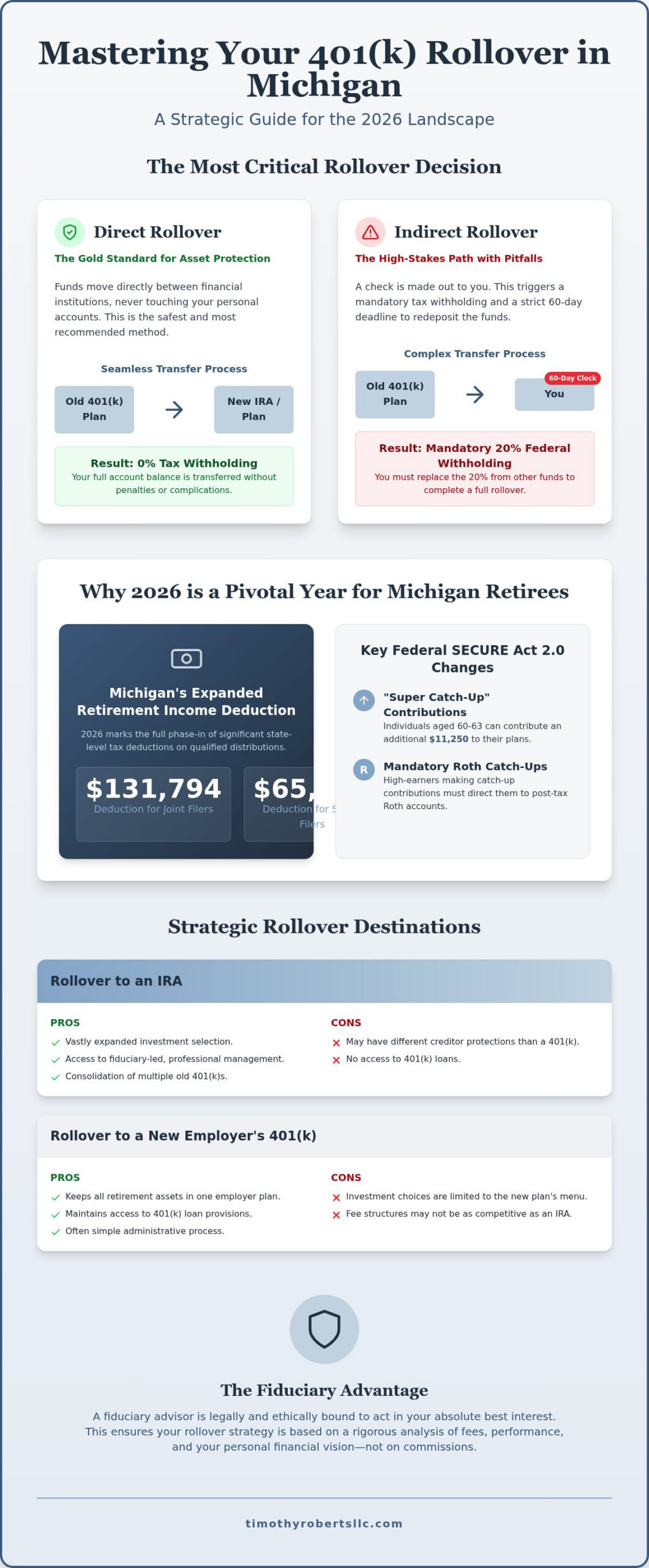
High-net-worth retirees in Michigan benefit from a flat 4.25% income tax rate and the absence of state-level estate, inheritance, or gift taxes. However, the state utilizes a three-tiered system for taxing retirement income based on the recipient’s birth year. This structure requires precise planning to align state exemptions with federal shielding techniques, ensuring that your total tax burden is minimized as your portfolio evolves into a sustainable income source.
Is a Roth conversion always beneficial for high earners in 2026?
A Roth conversion isn’t a universal solution, but it’s particularly compelling before the 2026 rate increases take effect. High earners often benefit from paying taxes at current rates to avoid the 39.6% top marginal rate scheduled for 2026. This strategy effectively hedges against future legislative shifts. Timothy Roberts & Associates, LLC analyzes your specific cash flow and break-even points to determine if the upfront tax cost justifies the long-term tax-free growth.
What is the difference between tax preparation and strategic tax planning?
Tax preparation is a backward-looking, transactional process focused on compliance and annual filing. Strategic tax planning is a forward-looking architectural approach that integrates your investment portfolio, retirement goals, and legacy intent. While preparation records what happened, planning dictates what will happen by restructuring assets to minimize future liabilities. This distinction is vital for those seeking high net worth tax strategies michigan to protect their capital from predictable regulatory shifts.
How can I avoid Michigan probate for my high-value estate?
Avoiding the public and costly Michigan probate process typically involves the use of revocable living trusts and meticulously updated beneficiary designations. By titling assets in the name of a trust, you ensure a private and efficient transfer to your heirs without court intervention. Regular beneficiary audits are essential to confirm that all investment accounts and insurance policies align with your broader estate architecture, providing professional stability for your family’s multi-generational transfer.
What are the tax benefits of a Donor-Advised Fund in 2026?
Donor-Advised Funds allow you to bunch multiple years of charitable contributions into a single tax year, which is especially effective as the standard deduction decreases in 2026. Gifting appreciated securities to a fund allows you to receive a deduction for the full market value while avoiding the 4.25% Michigan flat tax on capital gains. This creates an immediate tax break while providing a flexible vehicle for long-term philanthropic goals and family legacy building.
Can a financial advisor help with my business succession tax strategy?
A fiduciary advisor is essential for synthesizing your corporate exit with your personal retirement income planning. Strategies such as Section 1202 Qualified Small Business Stock exemptions or installment sales require significant lead time to implement correctly. Timothy Roberts & Associates, LLC provides the business-minded rigor needed to structure these transitions, ensuring that the value you’ve built over decades is transferred with maximum tax efficiency and minimal disruption to your long-term stability.
Why is the 2026 ‘Tax Sunset’ important for Michigan investors?
The 2026 ‘Tax Sunset’ marks the expiration of the Tax Cuts and Jobs Act, resulting in higher marginal tax rates and reduced standard deductions. For investors, this shift impacts everything from income recognition to estate tax exposure. It represents a mandatory transition from the current environment to a more aggressive tax landscape. Proactive planning allows you to restructure your portfolio now, ensuring that your upward progression remains uninterrupted despite these significant federal regulatory changes.