

Jun
529 College Savings Plan Rules: A Strategic Guide for 2026
A 529 plan is no longer just a college fund; it’s a sophisticated vehicle for multi-generational wealth transfer and a strategic bridge to retirement. For the visionary investor, mastering the 2026 529 college savings plan rules is the difference between a static account and a dynamic legacy tool. You likely recognize that the rising cost of private education demands more than just a simple savings account, yet the fear of overfunding and the sting of a 10% penalty often cause unnecessary hesitation. It’s a common concern that can stall even the most robust financial strategies.
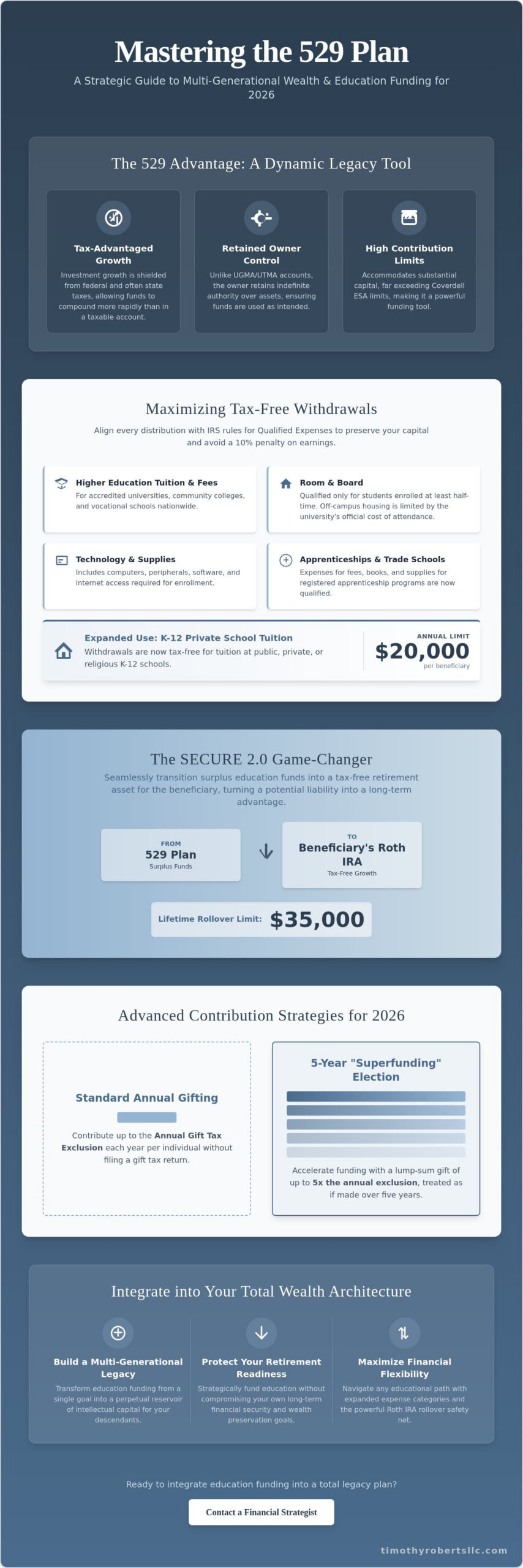
This guide will empower you to navigate the complex regulatory landscape with calm confidence, turning potential tax liabilities into a flexible financial advantage. We’ll show you how to optimize your contributions and maintain control over your capital, regardless of your beneficiary’s path. We’ll explore the 2026 gift tax exclusions, the expanded $20,000 annual K-12 withdrawal limit, and the precise mechanics of the $35,000 lifetime Roth IRA rollover. By the end, you’ll have a clear roadmap to integrate education funding into a total legacy plan that scales with your family’s aspirations.
Key Takeaways
- Transform 529 accounts from simple savings into strategic investment vehicles that leverage tax-deferred growth for long-term wealth preservation.
- Navigate the evolving 529 college savings plan rules to precisely identify qualified expenses, ensuring you maximize tax-free distributions while avoiding costly penalties.
- Discover the tactical advantages of the SECURE Act 2.0, which allows for the seamless transition of surplus funds into a beneficiary’s Roth IRA.
- Implement high-level contribution strategies, such as the five-year superfunding election, to optimize your annual gift tax exclusions for 2026.
- Integrate education funding into your comprehensive wealth architecture to protect your retirement readiness while securing a multi-generational legacy.
The Strategic Landscape of 529 College Savings Plans
View the 529 plan as a specialized asset class rather than a simple savings account. It’s a fiduciary-grade instrument designed for the long-term stewardship of family capital. A foundational 529 plan overview reveals its structural advantages; specifically, its ability to shield investment growth from federal and often state taxes. This tax-deferred environment allows your contributions to compound without the friction of annual capital gains or dividend taxes, maximizing the terminal value of the fund.
While traditional accounts like UGMA or UTMA transfer control to the minor at adulthood, the 529 allows the account owner to retain authority indefinitely. This control is vital for maintaining a cohesive wealth strategy. Unlike Coverdell ESAs, which have restrictive contribution limits, the 529 plan accommodates substantial capital inflows. This makes it the gold standard for families seeking to fund significant educational milestones without sacrificing their broader financial autonomy.
To better understand how these plans function as a strategic asset, watch this helpful breakdown:
The Fiduciary Value of Tax-Advantaged Savings
Tax-free compounding is a powerful engine for capital appreciation. Over an eighteen year horizon, the absence of an annual tax drag allows education funds to grow with significantly more momentum than taxable brokerage accounts. Many states enhance this value by offering tax deductions or credits on contributions. This effectively provides an immediate return on investment. A 529 plan is a vehicle defined by Section 529 of the Internal Revenue Code, specifically engineered to incentivize educational investment through these unique fiscal benefits.
Beyond Tuition: The Evolution of Education Funding
The 529 college savings plan rules have evolved to reflect the non-linear nature of modern education. These accounts now support a broad spectrum of “lifelong learning” opportunities. This includes trade schools, registered apprenticeships, and even K-12 tuition. This flexibility transforms the plan from a narrow college fund into a multi-generational legacy tool. It’s no longer just about the next four years. It’s about building a perpetual reservoir of intellectual capital for your descendants. By treating education funding as an extension of estate planning, you ensure that your family’s upward progression remains uninterrupted by the rising costs of private education.
Navigating Qualified Higher Education Expenses (QHEE)
Precision is paramount. While tuition remains the most visible pillar of education funding, the broader spectrum of qualified higher education expenses requires careful navigation to maintain your account’s tax-advantaged status. If you miscalculate what qualifies, the IRS imposes a 10% penalty on the earnings portion of your withdrawal. To preserve your capital, you must align every distribution with the IRS rules for 529 plans, which define the boundaries of tax-free growth.
Room and board is perhaps the most nuanced category within the 529 college savings plan rules. It isn’t a universal entitlement for every student. To qualify, the beneficiary must be enrolled at least half-time in a degree or certificate program. If a student drops below this threshold, housing costs immediately become non-qualified expenses. Furthermore, the amount you withdraw for off-campus housing cannot exceed the “cost of attendance” figures published by the university’s financial aid office. Modern educational journeys also require technological integration. Computers, software, and internet access now qualify as essential expenses, provided the beneficiary is the primary user during their years of enrollment.
Higher Education and Vocational Training
The definition of an eligible institution is broader than many realize. It encompasses accredited universities, community colleges, and vocational schools nationwide. Under recent legislative evolutions, registered apprenticeship programs are now fully qualified. This ensures that students pursuing specialized trades receive the same tax advantages as those in traditional four-year programs. If your beneficiary’s path leads them abroad, 529 funds remain viable at international institutions that participate in federal student aid programs. Crafting a sophisticated education funding strategy requires this level of granular detail to ensure every dollar serves your family’s long-term vision.
K-12 Tuition and Student Loan Repayment
The utility of a 529 plan now extends far beyond the campus gates. As of January 1, 2026, the annual withdrawal limit for K-12 tuition expenses has increased to $20,000 per student. This expansion allows families to fund private elementary and secondary education with the same tax efficiency once reserved for higher education. Beyond tuition, the 2025 Budget Reconciliation Bill expanded qualified K-12 costs to include curriculum materials, tutoring, and standardized test fees.
For those managing existing debt, the rules offer a strategic exit. You can use 529 funds to repay qualified student loans, subject to a $10,000 lifetime limit per beneficiary. This provision includes a valuable “sibling pivot” feature. If one child’s education is fully funded and surplus capital remains, you can change the beneficiary to a sibling and apply another $10,000 toward their student debt. This flexibility ensures that your education capital remains productive, moving from one family member to the next without triggering unnecessary tax liabilities.
The SECURE 2.0 Evolution: 529-to-Roth IRA Rollovers
For many high-net-worth families, the primary deterrent to aggressive funding hasn’t been a lack of capital, but rather the fear of trapped assets. If a child secures a significant scholarship or chooses a more modest educational path, the prospect of a 10% penalty on surplus earnings feels like a strategic oversight. The SECURE Act 2.0 fundamentally altered this calculation. It transformed the 529 plan into a versatile, “no-lose” vehicle by providing a direct pipeline to a Roth IRA. Understanding these specific 529 college savings plan rules allows you to view overfunding not as a risk, but as a proactive step toward a child’s eventual retirement success.
This mechanism creates a bridge between education and long-term wealth preservation. By allowing surplus funds to roll into a tax-free retirement account, the government has effectively removed the ceiling on the utility of these plans. It’s a sophisticated evolution that aligns with a total legacy plan, ensuring that every dollar contributed remains productive. To maximize this benefit, you must be well-versed in the 529 plan withdrawal rules that govern these transitions, as the IRS maintains strict oversight on the timing and volume of these rollovers.
Eligibility Requirements and Lifetime Limits
Longevity is the cornerstone of this strategy. To be eligible for a rollover, the 529 account must have been open for at least 15 years, and any funds being moved must have resided in the account for at least 5 years. The lifetime rollover limit is capped at $35,000 per beneficiary. It’s also vital to remember that the beneficiary must have earned income equal to the rollover amount. Rollover amounts are subject to annual Roth IRA contribution limits, which are $7,500 in 2026. This means the transition of a full $35,000 balance is a multi-year process, requiring a patient and disciplined execution.
Mitigating the Risk of Overfunding
The existence of the Roth rollover pipeline changes your “optimal” funding target. Previously, parents aimed for a conservative figure to avoid penalties. Now, you can fund more aggressively, knowing that a $35,000 “safety valve” exists. If your child graduates with a surplus, you can begin the rollover process immediately, provided the 15-year account age requirement is met. This strategy can be further enhanced by combining rollovers with beneficiary changes. If one child’s Roth IRA is fully funded or they don’t have earned income, you can pivot the account to another family member to utilize their rollover capacity. This level of flexibility ensures your education capital serves as a foundational pillar of your family’s upward progression.
Contribution Rules and Advanced Tax Strategies
The 529 college savings plan rules offer a unique intersection of educational support and sophisticated estate planning. While many view these accounts through a narrow lens of tuition coverage, they are powerful tools for reducing a taxable estate. Contributions are considered completed gifts for tax purposes, yet the account owner maintains absolute control over the assets. This dual benefit is rare in the tax code. It allows you to move significant wealth out of your name while retaining the right to change beneficiaries or even reclaim the funds if necessary. While each state sets its own aggregate limit, these caps often exceed $500,000 per beneficiary, providing ample room for high-net-worth families to build substantial educational reserves.
The Five-Year Gift Tax Election (Super-funding)
Accelerating the growth of education capital requires a front-loaded approach. In 2026, the annual gift tax exclusion is $19,000 per individual. However, the 529 plan allows for a specific five-year election known as super-funding. This strategy permits an individual to contribute up to $95,000 in a single year, or $190,000 for a married couple, per beneficiary. By treating this lump sum as if it were spread over five years, you bypass the gift tax while immediately putting a substantial amount of capital to work. This front-loading maximizes the power of tax-free compounding and provides an immediate reduction in the size of your taxable estate. For grandparents, this is a particularly effective way to transfer wealth across generations without depleting their lifetime gift and estate tax exemption.
Ownership and Control Dynamics
Unlike many custodial accounts, the owner of a 529 plan retains full authority over the distribution of assets. This control ensures that the funds are used according to your original vision, even as a beneficiary’s life path evolves. Ownership also carries significant implications for financial aid. Under current FAFSA regulations, accounts owned by parents are assessed at a maximum rate of 5.64%. Assets held by grandparents have become even more strategic. Recent updates to the FAFSA formula mean that distributions from grandparent-owned 529 plans no longer count as untaxed income for the student. This effectively removes a long-standing barrier to multi-generational support.
To ensure this legacy remains intact, designating a successor owner is a critical step in your estate and legacy planning. This simple designation prevents the account from becoming part of a probate process, allowing for a seamless transition of stewardship. Mastering these 529 college savings plan rules ensures that your family’s upward progression is secured by a cohesive and tax-efficient wealth strategy. It’s about more than just paying for school; it’s about the intentional transfer of opportunity.
Integrating Education Funding into Your Wealth Architecture
Education savings shouldn’t exist in a silo. True financial stewardship requires viewing these accounts as a single component within a broader, meticulously calibrated wealth architecture. While the 529 college savings plan rules provide the technical boundaries, your personal family objectives must provide the direction. For high-net-worth families, the challenge isn’t simply saving; it’s optimizing the flow of capital between competing priorities without compromising long-term stability. This holistic approach ensures that funding a child’s aspirations doesn’t inadvertently undermine your own financial independence. It’s a matter of maintaining architectural integrity across your entire portfolio.
The “Oxygen Mask” principle remains the cornerstone of this philosophy. You must secure your own retirement readiness before fully committing to education funding. Unlike tuition, which can be financed through various specialized vehicles if necessary, there’s no “scholarship” for retirement. Our Education Funding Strategies in Michigan: A Strategic Guide for 2026 provides a detailed framework for maintaining this delicate balance. A fiduciary advisor serves as a vital partner here. They help you interpret shifting regulations and tax codes to ensure your strategy remains resilient in the face of legislative change. It’s about moving from a reactive posture to one of proactive, strategic intent.
Balancing Education and Retirement Readiness
Strategic success depends on analyzing the trade-offs between 529 contributions and maxing out qualified retirement plans. It’s often a question of sequencing. Applying the 529 college savings plan rules strategically allows you to use the 529-to-Roth pipeline as a powerful bridge. This mechanism lets you hedge against overfunding by effectively converting surplus education capital into retirement assets. This integration is a key element of Retirement Income Planning in Ann Arbor: Strategic Guidance for 2026. By aligning these disparate goals, you create a more fluid and efficient capital structure for your family’s future.
The Value of Sophisticated Financial Planning
Off-the-shelf 529 plans often lack the nuance required for a complex estate strategy. A generic age-based portfolio might not align with your specific risk profile or your family’s broader investment philosophy. Customizing these portfolios allows you to treat education savings as a tactical asset class, calibrated to your total market exposure and tax situation. This level of intentionality distinguishes a standard savings plan from a visionary wealth strategy. It’s the difference between a simple transaction and a strategic transformation. To explore how these tools can be tailored to your unique legacy goals, request a consultation for a comprehensive wealth strategy today. Your family’s upward progression deserves a partner who values depth over superficiality and rigor over generic conclusions.
Securing the Intellectual Capital of Your Future Generations
The strategic landscape of education funding has shifted from a utilitarian necessity to a sophisticated pillar of wealth architecture. By mastering the 2026 529 college savings plan rules, you’ve transformed a transactional account into a multi-generational legacy tool and a strategic bridge to retirement. You now possess the framework to optimize contributions through five-year super-funding while maintaining the flexibility to pivot surplus assets into a Roth IRA. These deliberate maneuvers ensure your family’s upward progression remains uninterrupted by shifting tax codes or rising educational costs.
Navigating these complexities requires more than just a plan; it demands a partnership rooted in precision and foresight. We bring over 25 years of strategic wealth management experience to your table, offering fiduciary oversight of investment portfolios alongside integrated tax preparation and compliance services. Elevate your family’s financial legacy with a personalized education strategy. Your family’s future is a journey of intentional growth. We’re here to ensure every step is taken with absolute clarity and calm confidence.
Frequently Asked Questions
What happens to 529 funds if the beneficiary does not go to college?
You retain several strategic options if a beneficiary’s path diverges from traditional higher education. You can change the beneficiary to a qualifying family member or initiate a 529-to-Roth IRA rollover if eligibility requirements are met. If you choose to withdraw funds for non-qualified purposes, only the earnings portion is subject to income tax and a 10% penalty. Your original principal contributions are always returned tax-free, ensuring your capital remains a versatile asset.
Can I use a 529 plan for private high school tuition?
Yes, 529 funds are a legitimate vehicle for private elementary and secondary school tuition. As of January 1, 2026, the annual withdrawal limit for K-12 education expenses has increased to $20,000 per student. This expansion allows families to apply tax-advantaged growth toward a wider range of early educational milestones. It covers not just tuition, but also tutoring, curriculum materials, and specialized educational therapies for students with disabilities.
How much can I contribute to a 529 plan without triggering the gift tax?
In 2026, individuals can contribute up to $19,000 per beneficiary annually without incurring federal gift tax. Married couples can double this amount to $38,000. For those seeking more aggressive estate reduction, the 529 college savings plan rules allow for superfunding. This election lets you contribute a lump sum of $95,000, or $190,000 for couples, by front-loading five years of gift tax exclusions into a single year of funding.
What is the 529-to-Roth IRA rollover rule for 2026?
The SECURE Act 2.0 allows a lifetime maximum of $35,000 to be rolled over from a 529 plan to a Roth IRA for the same beneficiary. In 2026, the annual rollover limit is $7,500, provided the account has been open for 15 years and the specific funds have been held for at least 5 years. This provides a sophisticated exit strategy for surplus capital while jumpstarting the beneficiary’s long-term retirement success.
Are 529 plan contributions tax-deductible on federal taxes?
Contributions to 529 plans aren’t deductible on federal income tax returns. The primary federal advantage lies in the tax-deferred growth of your investments and tax-free withdrawals for qualified expenses. While the federal government doesn’t offer a deduction, many states provide their own tax deductions or credits for residents who contribute to their home state’s plan. This effectively enhances the immediate net return on your investment at the state level.
Can I use 529 funds to pay off my own student loans?
You can use 529 funds to repay your own qualified student loans or those of a sibling, subject to a lifetime limit of $10,000 per individual. This provision treats loan repayment as a qualified expense, allowing you to deploy tax-advantaged capital toward debt reduction. It’s a strategic way to clear liabilities while maintaining the integrity of your broader financial plan and ensuring education capital serves its intended purpose across your family.
How does a 529 plan affect my child’s eligibility for financial aid?
A 529 plan generally has a minimal impact on financial aid eligibility when owned by a parent. These assets are typically assessed at a maximum rate of 5.64% in the FAFSA calculation, whereas student-owned assets are assessed at 20%. Notably, grandparent-owned accounts no longer count as untaxed income for the student under recent FAFSA updates. This shift makes grandparent-owned plans an increasingly attractive tool for multi-generational wealth transfer and support.
What are the penalties for non-qualified 529 withdrawals?
If you withdraw funds for non-qualified expenses, the earnings portion of the distribution is subject to federal income tax and a 10% penalty. This penalty ensures the account remains focused on educational objectives. However, certain exceptions apply, such as when a beneficiary receives a scholarship or attends a U.S. military academy. In these specific scenarios, the 10% penalty may be waived, though income taxes on the earnings will still apply to the withdrawal.
