

Jul
Advanced Wealth Transfer Strategies: Architectural Frameworks for Generational Legacy
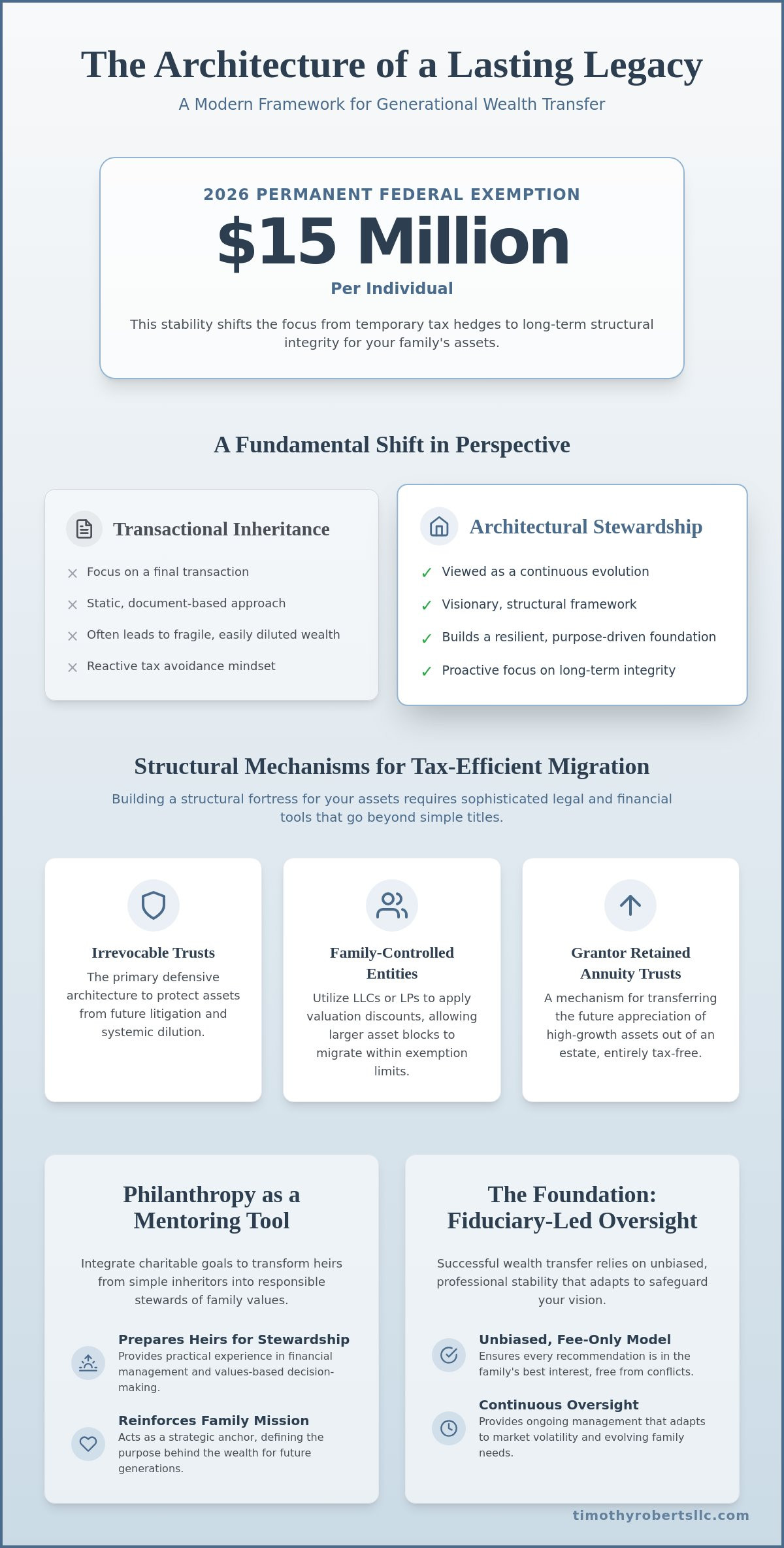
What if the greatest threat to your family legacy isn’t a market downturn, but the structural fragility of the plan itself? For high-net-worth families, the transition of assets is often treated as a final transaction rather than a continuous architectural evolution. In the current landscape of 2026, where federal exemptions have stabilized at a permanent 15 million dollars per individual, the focus has shifted from temporary tax hedges to long-term structural integrity. Implementing sophisticated wealth transfer strategies ann arbor requires more than just filling out forms; it demands a visionary approach that synthesizes tax efficiency with personal values.
You likely recognize that preserving significant wealth across generations involves navigating a labyrinth of generation-skipping transfer taxes and complex trust structures. We understand the weight of this responsibility and the desire to ensure your heirs are prepared for stewardship rather than just inheritance. This article explores the structural mechanisms and tax-efficient frameworks necessary to protect your assets from dilution while maintaining alignment with your philanthropic goals. We’ll examine the shift toward income tax basis planning, the utility of modern dynasty trusts, and the role of fiduciary-led oversight in securing a lasting generational impact.
Key Takeaways
- Learn why shifting from a transactional mindset to an architectural framework of stewardship is essential for preserving the integrity of a generational legacy.
- Discover how to implement advanced wealth transfer strategies ann arbor that utilize irrevocable trust structures to create a fortress for your family’s most significant assets.
- Understand how to navigate the 15 million dollar federal exemption limits and maximize the step-up in basis to minimize tax erosion for your heirs.
- Explore how to integrate philanthropic goals as a practical tool for mentoring the next generation in financial stewardship and values-based management.
- Gain confidence through a centralized fiduciary-led model that provides continuous oversight and adapts to market volatility to safeguard your long-term vision.
The Strategic Architecture of Generational Wealth Evolution
Estate planning is often reduced to a static set of legal documents. True legacy, however, requires a more profound architectural vision. It involves moving away from the simple transfer of titles toward a cohesive narrative of stewardship. In the context of The Great Wealth Transfer, families are realizing that wealth without a guiding philosophy is inherently fragile. It’s the difference between leaving a fortune and building a foundation where aesthetic legacy meets functional asset protection.
As we navigate 2026, the financial landscape has reached a significant inflection point. With the federal estate tax exemption now permanent at 15 million dollars per individual, high-net-worth families have gained a stable horizon for long-term planning. This stability allows for the implementation of sophisticated wealth transfer strategies ann arbor that focus on structural integrity rather than reactive tax avoidance. It’s a time to bridge individual creative vision with rigorous corporate-level capabilities to ensure assets remain a catalyst for growth rather than a source of complexity.
To better understand the nuances of this evolving landscape, watch this helpful video from industry experts:
Defining Stewardship vs. Simple Inheritance
The transition from asset accumulation to legacy distribution is a psychological journey. It requires shifting focus from the balance sheet to the human capital of the next generation. Preparing heirs for the responsibility of significant wealth management ensures that assets are preserved rather than diluted through mismanagement. A family mission statement serves as a strategic anchor in this process. It defines the purpose behind the wealth, providing a clear roadmap for future decision-making. This alignment transforms a simple inheritance into a purposeful mission of stewardship that spans generations.
The Fiduciary Standard in Legacy Coordination
Successful wealth transfer relies on unbiased, fee-only oversight. A fiduciary-led approach ensures that every recommendation is made in the family’s best interest, free from the conflicts of interest inherent in commission-based models. This level of professional stability is vital when balancing aggressive growth objectives with sophisticated risk management. Integrating retirement income planning into the broader estate framework ensures that your personal needs are met while your legacy remains intact. With over 25 years of experience in legacy coordination, we understand that effective wealth transfer strategies ann arbor must be both rhythmic and logical, guiding families from high-level vision to the practicalities of multi-generational execution.
Structural Mechanisms for Tax-Efficient Asset Migration
Constructing a generational legacy requires moving beyond simple asset titles to building a structural fortress. Within the legal framework of estate planning, irrevocable trusts serve as the primary defensive architecture. These vehicles don’t just hold assets; they protect them from future litigation and systemic dilution. By utilizing family-controlled entities, such as limited partnerships or LLCs, families can also apply valuation discounts to transferred interests. This effectively allows for the migration of larger asset blocks while remaining within federal exemption limits.
A Grantor Retained Annuity Trust (GRAT) serves as a sophisticated mechanism for transferring the future appreciation of high-growth assets out of an estate entirely tax-free. This strategy is particularly potent when assets are expected to outperform the IRS-prescribed interest rates. For those refining their wealth transfer strategies ann arbor, the use of leverage within these structures can significantly amplify the volume of capital moved to the next generation without triggering immediate gift tax consequences.
The Grantor Retained Annuity Trust (GRAT) Framework
GRATs are designed to capture “excess” returns. The grantor transfers assets to the trust while retaining an annuity payment for a set term. If the assets grow faster than the July 2026 Applicable Federal Rates, such as the 4.35% mid-term rate, the surplus value passes to heirs at a zero gift tax cost. Implementing a “rolling” or laddered GRAT strategy helps mitigate the risk of market volatility. This rhythmic approach ensures that even if one trust term ends during a downturn, subsequent trusts continue to capture upward market progression.
Spousal Lifetime Access Trusts (SLATs) for Flexibility
Maintaining financial flexibility is a common concern for families considering irrevocable transfers. A SLAT offers a solution by allowing one spouse to create a trust for the benefit of the other. This removes the assets from the taxable estate while providing indirect access to the funds if needed. However, architects of these plans must avoid the “reciprocal trust” trap. If two spouses create identical trusts for each other, the IRS may disregard the structures entirely. Customization is key to ensuring that these Estate & Legacy Planning interventions remain both functional and resilient against regulatory scrutiny.
Mitigating Tax Erosion in Multi-Generational Transfers
Tax erosion is a persistent threat to multi-generational prosperity. While structural vehicles provide the necessary defense, tactical precision in tax management ensures that wealth actually reaches its intended destination. A central pillar of this precision involves the “step-up in basis” rule. This allows heirs to receive assets valued at the time of the benefactor’s death, effectively erasing years of accumulated capital gains. However, this benefit must be weighed against the advantages of lifetime gifting. Integrating professional tax advising into every investment decision ensures that these competing priorities are balanced with surgical care.
The Generation-Skipping Transfer (GST) tax remains a critical consideration for those building long-term legacy trusts. With a flat 40% rate on transfers exceeding the exemption limit, missteps in trust funding can be exceptionally costly. In the current 2026 landscape, the federal GST exemption has reached 15 million dollars per individual, or 30 million dollars for a married couple. Utilizing this limit effectively allows for the creation of dynasty trusts that can support multiple generations without repeated estate tax hits. This level of foresight is a hallmark of the most robust wealth transfer strategies ann arbor, transforming simple asset migration into a resilient financial legacy.
Preparing for the 2026 Tax Landscape Shift
The anticipated sunset of the Tax Cuts and Jobs Act (TCJA) has been superseded by the “One Big Beautiful Bill Act,” which solidified the 15 million dollar individual exemption. This permanence provides a rare window of legislative certainty for high-net-worth families. Beyond the lifetime exemption, the annual gift tax exclusion has risen to 19,000 dollars per recipient in 2026. Families should focus on “use it or lose it” strategies for these annual limits. Accelerated gifting in this high-exemption environment allows for the removal of future appreciation from the taxable estate, locking in current valuations and protecting the family’s upward progression.
The Role of Life Insurance in Liquidity Planning
Liquidity is the lifeblood of a seamless generational transition. For families with significant illiquid holdings, such as private enterprises or sprawling real estate portfolios, estate taxes can create an immediate cash flow crisis. An Irrevocable Life Insurance Trust (ILIT) serves as a tax-efficient reservoir of cash to cover these liabilities. This strategic intervention prevents the forced liquidation of a family business, ensuring the enterprise remains a legacy asset rather than a tax casualty. Customizing death benefit structures allows for specific legacy outcomes, providing the rhythmic stability required to navigate complex financial transitions with confidence.
Harmonizing Philanthropic Goals with Private Family Legacies
Philanthropy is often viewed as a separate endeavor from core financial management. However, for families committed to a multi-generational vision, charitable giving serves as a powerful instrument for teaching stewardship. It provides a controlled environment where the next generation can practice decision-making and asset allocation. Integrating these efforts into your broader wealth transfer strategies ann arbor ensures that personal values aren’t just discussed but are actively embedded into your financial architecture. This synthesis of personal vision and structured corporate giving capabilities creates a legacy that is both impactful and resilient.
Selecting the right vehicle for charitable impact is a strategic choice between control and convenience. While some families prefer the simplicity of immediate tax deductions, others seek the robust grant-making power of a formal entity. The decision often hinges on how much family involvement you wish to foster. By treating philanthropy as a core component of your financial life, you transform wealth into a tool for social progress. This approach doesn’t just benefit the recipients; it strengthens the internal bonds of the family through shared purpose and collaborative management.
Donor-Advised Funds (DAFs) vs. Private Foundations
Donor-Advised Funds (DAFs) offer a streamlined path for families seeking immediate tax benefits without the administrative overhead of a private entity. They are efficient, cost-effective, and provide significant flexibility for annual giving. Conversely, Private Foundations offer the highest level of control. They allow for family members to sit on a formal board, manage investments directly, and run their own charitable programs. Many sophisticated families employ a hybrid approach. They use a DAF for rapid, anonymous grants while maintaining a foundation for long-term mission-driven work and family leadership development.
Charitable Remainder Trusts (CRTs) for Income and Impact
A Charitable Remainder Trust (CRT) represents an elegant intersection of self-interest and altruism. It allows you to convert highly appreciated assets into a lifetime income stream while avoiding immediate capital gains taxes. You receive an upfront charitable deduction, and the remaining assets eventually pass to your chosen cause. This mechanism is particularly effective for those refining their estate planning architecture. It provides rhythmic financial stability today while securing a philanthropic footprint for tomorrow. If you’re ready to align your financial structures with your deepest values, consider a consultation regarding our Wealth Management services to explore these sophisticated interventions.
Orchestrating a Seamless Transition with Fiduciary Oversight
Managing a complex estate requires a centralized command structure. A fragmented approach, where tax planning, investment management, and legacy goals exist in silos, often leads to structural fragility. Adopting a “Family Office” philosophy ensures that every financial move is coordinated through a single, strategic lens. This centralized oversight is the cornerstone of effective wealth transfer strategies ann arbor, allowing for a synthesis of individual creative vision with structured corporate capabilities. It transforms a collection of assets into a unified, resilient legacy.
Steady guidance is essential in a volatile market. Continuous monitoring and rebalancing serve as a safeguard, ensuring that the architecture of your estate remains aligned with your long-term objectives. This isn’t a passive process. It requires a visionary strategist who can anticipate shifts in the economic landscape and adjust the framework accordingly. By maintaining a rhythmic, logical flow from high-level planning to execution, you can protect your family’s upward progression from the erosion of market instability and legislative drift.
The Multi-Generational Review Process
Selecting a Legacy Partner for the Long Term
Success in legacy coordination is measured in decades, not quarters. A partner with over 25 years of experience brings the perspective necessary to navigate multiple economic cycles and evolving tax regimes. This depth of expertise allows for a rare understanding of the intersection between aesthetics and functionality, where the beauty of a personal vision meets the rigor of a fiduciary-led structure. Your legacy deserves a specialized firm where personal attention and high-level expertise go hand in hand. The next step in your journey is a strategic intervention to audit and elevate your current architecture. We invite you to explore how our Estate & Legacy Planning services can secure your family’s future through intentional, strategic design.
Securing the Architecture of Your Generational Legacy
Building a legacy is a journey of intentional design. It requires moving beyond standard documents to create a resilient framework that bridges your personal values with rigorous structural integrity. By navigating the permanent 15 million dollar exemption landscape and utilizing vehicles like dynasty trusts or donor-advised funds, you ensure your wealth remains a catalyst for your family’s upward progression. Implementing these sophisticated wealth transfer strategies ann arbor isn’t just about tax mitigation; it’s about fostering stewardship across generations.
This evolution demands a partner who brings both creative passion and business-minded rigor to the table. With over 25 years of experience in bespoke wealth management, we specialize in the fiduciary-led coordination of estate and tax strategies for high-net-worth families. We invite you to Partner with a visionary strategist for your multi-generational legacy. Your vision deserves a foundation that is as enduring as the values you’ve worked to instill. Together, we can transform your financial success into a lasting, multi-generational masterpiece.
Frequently Asked Questions
What is the difference between wealth transfer and basic estate planning?
Wealth transfer focuses on the strategic evolution of assets across generations, while basic estate planning often centers on the legal documentation for asset distribution. True wealth transfer involves architectural frameworks that align personal values with structural rigor. It treats development as a journey rather than a simple transaction. This approach ensures that assets don’t just move from one person to another but are preserved through intentional stewardship and sophisticated tax-efficient mechanisms.
How will the 2026 tax law changes affect my current wealth transfer strategy?
The 2026 landscape is defined by the permanence of the 15 million dollar individual federal exemption. This provides a stable horizon for high-net-worth families to implement long-term wealth transfer strategies ann arbor without the frantic pressure of a sunsetting provision. While the Tax Cuts and Jobs Act was once expected to revert to lower limits, current legislation has solidified these higher thresholds. This allows for more deliberate planning around asset appreciation and multi-generational trust funding.
What are the most tax-efficient vehicles for transferring wealth to grandchildren?
Dynasty trusts and the strategic use of the Generation-Skipping Transfer (GST) tax exemption are the most effective structural interventions for grandchildren. In 2026, you can allocate up to 15 million dollars per individual to these trusts, allowing assets to grow without being subject to estate taxes at each generational transfer. Using annual exclusion gifts of 19,000 dollars per recipient further accelerates this migration. This creates a fortress for your legacy while maximizing your lifetime exemption.
How can a Grantor Retained Annuity Trust (GRAT) help minimize estate taxes?
A Grantor Retained Annuity Trust (GRAT) minimizes taxes by transferring the future appreciation of an asset to heirs at a zero gift tax cost. When the asset’s growth exceeds the IRS-prescribed interest rate, such as the 4.35% mid-term rate for July 2026, the excess return passes out of the estate tax-free. It’s a highly functional tool for moving high-growth assets into the hands of the next generation while maintaining a steady income stream for the grantor.
Is it possible to transfer a family business without triggering massive tax liabilities?
You can transfer a family business tax-efficiently by utilizing valuation discounts through family-controlled entities like limited partnerships or LLCs. By transferring minority interests, you reduce the taxable value of the gift due to a lack of marketability and control. When combined with an Irrevocable Life Insurance Trust to provide liquidity for any remaining taxes, this prevents the forced liquidation of the enterprise. It ensures the business remains a functional legacy asset rather than a tax casualty.
What role does a fiduciary play in the wealth transfer process?
A fiduciary serves as a visionary strategist who is legally bound to act in your family’s best interest throughout the wealth transfer process. Unlike commission-based advisors, a fiduciary provides unbiased, fee-only oversight that synthesizes tax preparation with investment advisory. This role is essential for maintaining multi-generational alignment and orchestrating complex transitions with calm confidence. They ensure that the structural mechanisms of your plan remain rhythmic and logical as economic conditions and tax laws evolve.
How can I ensure my heirs are prepared for the responsibility of stewardship?
Preparing heirs involves shifting the focus from asset accumulation to the human capital of your family through structured education and philanthropic participation. Facilitating regular family meetings and creating a family mission statement provides a strategic anchor for the next generation. Philanthropy serves as a practical tool for teaching financial stewardship in a controlled environment. This approach ensures that your heirs aren’t just recipients of wealth but are capable managers who share your creative vision.
What is the benefit of a Spousal Lifetime Access Trust (SLAT) in a high-net-worth plan?
A Spousal Lifetime Access Trust (SLAT) allows you to remove assets from your taxable estate while maintaining indirect access to the funds through your spouse. This structural intervention is particularly valuable for high-net-worth families who want to lock in current exemptions but worry about future liquidity needs. It provides a balance between generational transfer goals and spousal security. When implemented as part of comprehensive wealth transfer strategies ann arbor, a SLAT offers both asset protection and long-term financial flexibility.
