
Could your most cherished family assets survive a sudden liquidity crisis? Many Michigan families face the sobering reality that without a strategic buffer, the transition of wealth can trigger forced liquidations or years of probate delays. Integrating life insurance for estate planning michigan isn’t just about a death benefit; it’s a sophisticated financial intervention designed to protect your principal wealth from the friction of taxes and legal costs.
You’ve worked hard to curate a life of significance, and it’s natural to worry about whether your children will receive an equitable inheritance or if the state’s legal timeline will stall your vision. This 2026 guide reveals how to transform life insurance into a strategic asset that provides immediate liquidity and ensures a seamless multi-generational transfer. We’ll explore the impact of the $15 million federal exemption, the advantages of Michigan’s lack of state estate tax, and the practical execution of tools like Irrevocable Life Insurance Trusts to safeguard your legacy. By aligning your insurance analysis with your broader financial goals, you can move from uncertainty toward a future of intentional growth and lasting impact.
Key Takeaways
- Understand why life insurance functions as a vital liquidity tool that bypasses the Michigan probate process to provide immediate, accessible funds for heirs.
- Discover how to select the optimal insurance architecture, balancing permanent and term solutions to address unique estate liabilities and long-term legacy goals.
- Learn how strategically utilizing life insurance for estate planning michigan prevents the forced liquidation of family businesses and cherished real estate assets.
- Explore the mechanism of the Irrevocable Life Insurance Trust (ILIT) as a sophisticated shield to remove death benefits from your gross taxable estate.
- Recognize the value of a fiduciary-led approach that integrates insurance analysis with comprehensive tax advising to ensure a seamless multi-generational wealth transfer.
The Strategic Intersection: Why Life Insurance is Essential for Michigan Estate Planning
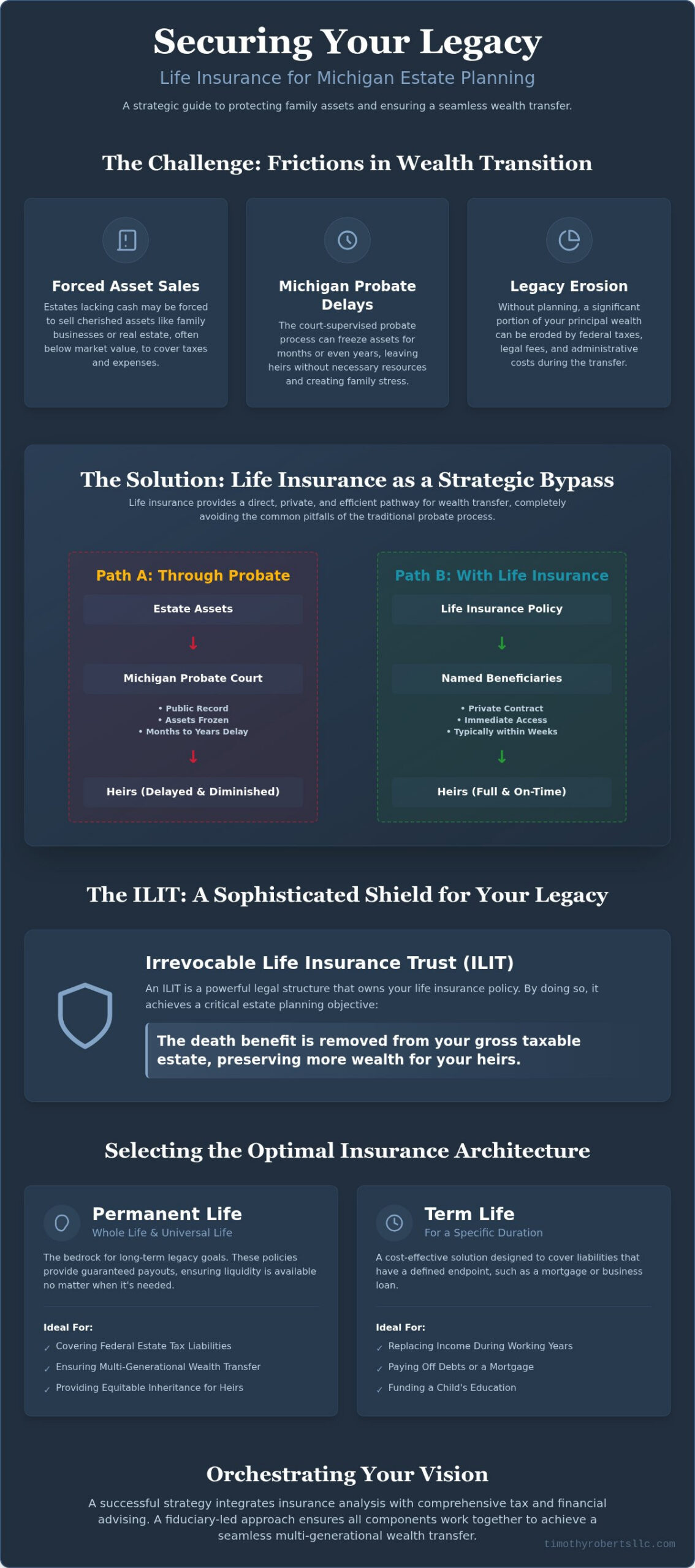
While Michigan residents benefit from the absence of a state-level estate or inheritance tax, the complexities of federal law and the inherent friction of asset transfer remain significant hurdles. High-net-worth individuals often find themselves in a position where their wealth is tied up in illiquid holdings like real estate, closely held businesses, or complex investment portfolios. In this context, life insurance for estate planning michigan functions as a vital liquidity tool. It provides a tax-free cash infusion that allows an estate to settle obligations without the forced liquidation of cherished family assets.
Think of life insurance not as a simple death benefit, but as a wealth replacement vehicle. It replenishes the value of the estate used to pay final expenses, taxes, or administrative costs. This strategic intervention ensures that the principal wealth you’ve curated remains intact for the next generation, rather than being eroded by the costs of transition.
Defining Insurance in a Sophisticated Estate Context
Many individuals approach insurance from a “needs-based” perspective, focusing on debt payoff or temporary income replacement. However, sophisticated planning requires a pivot toward a “legacy-based” mindset. In this tier of wealth management, insurance acts as a stabilizer for high-net-worth portfolios, hedging against market volatility that might occur during the estate settlement period. Life insurance is a strategic fiduciary tool that delivers immediate liquidity exactly when a legacy requires it most.
By treating insurance as a dedicated asset class, you can orchestrate a more balanced distribution of wealth. This is particularly useful for families with multiple children where only one child intends to take over a family business. The insurance proceeds can provide an equitable inheritance for the other siblings, preventing resentment and maintaining family harmony.
The Advantage of Bypassing Michigan Probate
The Michigan probate process is often characterized by meticulous court oversight that, while intended to protect, frequently leads to significant delays. Assets caught in probate can be frozen for months or even years, leaving heirs without the resources they need for daily life or to maintain estate properties. Life insurance bypasses this administrative bottleneck entirely. Because proceeds are paid directly to named beneficiaries, or structured within an Irrevocable Life Insurance Trust (ILIT), the capital is typically available within weeks of a claim.
Beyond speed, there is the critical element of privacy. Probate is a public matter; anyone can access court records to view an inventory of your assets and the details of your distributions. Life insurance payouts are private contracts. They allow you to transfer significant wealth with a level of discretion that public court proceedings simply cannot offer. This combination of speed, liquidity, and confidentiality makes it an indispensable component of a modern Michigan estate plan.
Evaluating Insurance Architectures: Selecting the Optimal Vehicle for Wealth Preservation
The design of an estate plan is only as robust as the financial vehicles chosen to support it. Selecting the right insurance architecture requires a deep understanding of how different policy types interact with tax laws and liquidity needs. While some view insurance as a static product, a strategic approach treats it as a dynamic asset class that evolves alongside your net worth. Architecture matters. Matching the duration of your liabilities with the duration of your coverage is the first step in sophisticated wealth preservation.
Permanent Structures for Multi-Generational Transfer
Permanent solutions, such as Whole Life or Universal Life, provide the bedrock for long-term legacy goals. Unlike term policies that expire, these structures offer guaranteed payouts, ensuring that the necessary liquidity is available regardless of when the transition occurs. This is vital for covering federal estate tax liabilities, which for 2026 apply to estates exceeding $15 million per individual or $30 million for married couples. These policies ensure that the cash is there precisely when the tax bill arrives.
Beyond the death benefit, the cash value component serves as a non-correlated asset class. It offers a strategic reserve that remains insulated from market volatility, providing a source of tax-efficient withdrawals or loans if needed during your lifetime. By utilizing “paid-up” additions, you can effectively increase the death benefit over time, compounding the value of the transfer. For those exploring advanced gifting strategies, the University of Michigan Estate Planning Library provides excellent context on how these assets can be leveraged to elevate a legacy plan.
Tactical Term Insurance for Contingent Liabilities
Term insurance isn’t a legacy tool in the traditional sense, but it’s a powerful tactical instrument for managing time-bound risks. If your estate carries outstanding business loans, mortgages, or specific education funding goals, term insurance provides high-limit coverage at a lower immediate cost. It acts as a temporary bridge, protecting your principal assets from being raided to pay off creditors during the early stages of wealth accumulation.
The true value of a sophisticated term policy lies in its “convertible” feature. This allows you to pivot from a temporary shield to a permanent legacy structure without undergoing a new medical evaluation. It’s a common strategy for individuals whose wealth is on an upward trajectory and who anticipate future tax exposure. A tailored Risk Management & Insurance Analysis can illuminate which structure aligns with your specific legacy vision.
For married couples, Survivorship or “Second-to-Die” policies often present the most cost-effective solution for estate tax exposure. These policies only pay out upon the passing of the second spouse, which is exactly when the federal tax bill typically becomes due. By aligning the payout with the tax event, you minimize premium costs while maximizing the capital available for your heirs. Using life insurance for estate planning michigan in this way transforms a potential tax burden into a managed, predictable financial outcome.
Solving the Liquidity Challenge: Protecting Real Estate and Business Interests
Estates built on significant non-liquid holdings face a specific, often overlooked vulnerability. When a legacy is centered on tangible assets, the eventual transition frequently reveals a stark lack of ready capital. This “Asset Rich, Cash Poor” scenario is a primary driver for utilizing life insurance for estate planning michigan. It transforms a potential liquidity crisis into a managed, orderly transition. Without this strategic cash infusion, the very assets you spent decades acquiring could be dismantled or sold at a steep discount to meet immediate administrative or tax obligations.
Preventing the Forced Liquidation of Tangible Assets
A common threat to high-net-worth legacies is the “Fire Sale” risk. When heirs encounter immediate tax bills or outstanding debts, they may find themselves forced to sell real estate or business interests under extreme duress. This leads to discounted valuations and the permanent loss of long-term growth potential. Life insurance proceeds act as a sophisticated financial buffer. They provide the necessary “holding power,” allowing your family to wait for favorable market conditions rather than accepting the first available offer. This protection is vital for complex real estate portfolios or cherished vacation properties that carry deep sentimental value alongside their market price.
Equalizing Inheritances for Blended or Complex Families
Legacy orchestration often involves balancing the needs of diverse heirs with precision. In many Michigan families, one child may be deeply involved in the operations of a family business while others have pursued entirely different careers. Bequeathing equal shares of a business to all children can lead to operational paralysis and inevitable family disputes. A more strategic approach involves bequeathing the operating entity to the active participant while using life insurance proceeds to provide an equivalent value to the other siblings.
This framework addresses the vital fiduciary distinction between “fair” and “equal.” By providing a cash inheritance through insurance, you ensure every child feels valued without compromising the operational integrity of the business. Additionally, for corporate structures, insurance-funded Buy-Sell agreements provide a clear, pre-funded exit strategy for partners. This ensures a surviving owner can buy out a deceased partner’s shares at a fair price, providing immediate cash to the heirs while maintaining business continuity. This synthesis of creative vision and structured capability is what defines a truly elevated estate strategy.
The Irrevocable Life Insurance Trust (ILIT): A Sophisticated Shield for Legacy Assets
Personally owning a life insurance policy is a common oversight that can inadvertently inflate your taxable estate. While the death benefit is generally income tax-free, it’s not necessarily estate tax-free. When you maintain “incidents of ownership,” the full value of the policy is included in your gross estate. Integrating life insurance for estate planning michigan within an ILIT creates a specialized legal entity that owns the policy on your behalf. This effectively removes the proceeds from your taxable estate while still directing how those funds are utilized.
Tax Mitigation through Irrevocable Structures
The primary advantage of an ILIT is its ability to provide immediate liquidity to your estate without adding to the tax burden. For 2026, the federal estate tax exemption is $15 million per individual and $30 million for married couples; any value above these thresholds faces a 40% tax rate, making the ILIT a vital tool for wealth preservation. By housing your life insurance for estate planning michigan within an irrevocable trust, you ensure that the liquidity meant to pay those taxes isn’t itself being taxed.
If you already own a policy and wish to transfer it into an ILIT, you must be aware of the “Three-Year Rule.” If the grantor passes away within three years of the transfer, the IRS will pull the proceeds back into the taxable estate. For this reason, many sophisticated planners prefer to have the trust apply for a new policy directly. To fund premium payments, grantors typically utilize the annual gift tax exclusion, which is $19,000 per recipient in 2026. To ensure these gifts qualify for the exclusion, the Trustee must issue “Crummey Notices” to beneficiaries, granting them a brief window to withdraw the funds.
Fiduciary Oversight and Distribution Control
Beyond tax efficiency, an ILIT offers a level of control that personal ownership cannot match. It acts as a protective wrapper, shielding the proceeds from the creditors or divorcing spouses of your beneficiaries. This is particularly vital when planning for minor children or heirs who may lack the financial maturity to manage a large windfall. The Trustee follows your specific instructions for distribution, ensuring the capital supports your long-term vision.
Managing these complex structures requires a blend of legal precision and financial acumen. Coordinating your ILIT distributions with your broader estate and legacy planning ensures that every component of your wealth works in harmony. Professional trust administration is essential for maintaining compliance and avoiding the pitfalls of improper gifting or record-keeping. If you’re ready to elevate your strategy, consider a comprehensive Risk Management & Insurance Analysis to determine if an ILIT is the right catalyst for your legacy.
Orchestrating Your Vision: The Fiduciary Path to an Elevated Legacy Strategy
A legacy is rarely defined by a single document or a solitary financial product. It’s the result of a meticulously curated strategy where every asset, including life insurance for estate planning michigan, is aligned with a broader vision of upward progression. True wealth preservation requires moving beyond the transactional nature of policy acquisition toward a narrative of partnership and shared success. It’s about ensuring that your creative vision for the future is supported by the rigorous corporate capabilities of a dedicated advisory team.
The Fiduciary Standard in Insurance Analysis
Most insurance policies are sold; few are truly planned. A fiduciary-led review differs fundamentally from a commission-based sales pitch because it prioritizes the integrity of your estate over the transaction itself. This high-level analysis evaluates internal policy costs, carrier stability, and the actual performance of the death benefit against your evolving net worth. We frequently identify orphaned policies; coverage that was appropriate a decade ago but now lingers as a disconnected relic that no longer serves your current estate vision.
Our approach involves a steady, logical examination of your existing portfolio to ensure maximum efficiency. We focus on these critical areas:
- Carrier Solvency: Verifying the long-term stability of the institutions backing your legacy.
- Cost Optimization: Identifying hidden fees that may be eroding the cash value within permanent structures.
- Strategic Alignment: Ensuring that beneficiary designations and ownership structures match the latest updates in your legal documents.
Synthesizing the Personal and the Professional
At Timothy Roberts & Associates, LLC, we view legacy planning as a journey rather than a simple exchange of services. With over 25 years of experience, our firm acts as a visionary strategist, bridging the gap between your individual values and structured financial execution. This requires the seamless integration of insurance with strategic tax advising to ensure that every dollar of liquidity is deployed with maximum tax efficiency. When these pillars are coordinated, the result is a polished, intentional plan that inspires trust and confidence in your heirs.
The path to an elevated legacy begins with a comprehensive Risk Management & Insurance Analysis. This specialized intervention allows us to solve complex problems with personal attention and high-level expertise. We invite you to move away from fragmented planning and embrace a steady, results-driven identity for your wealth. By aligning your life insurance for estate planning michigan with your total financial landscape, you ensure a future of aspirational growth and multi-generational stability.
Securing Your Legacy with Intentional Precision
The transition of significant wealth is a complex evolution that requires more than just legal documents; it demands a synthesis of creative vision and rigorous financial coordination. By strategically integrating life insurance for estate planning michigan, you ensure your heirs have the immediate liquidity needed to maintain family assets without the friction of probate or forced liquidations. From the protective shield of an ILIT to the tactical use of survivorship policies, these interventions transform potential liabilities into managed, predictable outcomes.
True wealth preservation isn’t a single transaction but a journey of upward progression. Timothy Roberts & Associates, LLC brings over 25 years of strategic financial experience to this journey, offering fiduciary-led wealth management that bridges the gap between individual goals and structured corporate capabilities. Our team specializes in comprehensive tax and estate coordination, ensuring every pillar of your plan remains in perfect alignment.
Take the next step in elevating your legacy strategy. Request a Strategic Estate and Insurance Consultation to begin crafting a future defined by clarity and confidence. Your legacy deserves the attention of a visionary strategist who understands that depth always outweighs superficiality.
Frequently Asked Questions
Is life insurance death benefit taxable to the beneficiary in Michigan?
Life insurance death benefits are generally received by beneficiaries free of both federal and Michigan state income tax. Since Michigan does not impose a state-level inheritance tax for deaths occurring after September 30, 1993, your heirs won’t face a state tax bill on these proceeds. However, the value of the policy might still be included in your gross taxable estate for federal purposes if you maintain incidents of ownership.
How does an Irrevocable Life Insurance Trust (ILIT) work in an estate plan?
An ILIT functions as a specialized legal entity that owns and manages your life insurance policy, effectively removing the proceeds from your taxable estate. By appointing a trustee to oversee the distribution, you gain precise control over how and when heirs receive funds. This structure is a cornerstone of life insurance for estate planning michigan because it provides the liquidity needed to settle federal obligations without increasing the estate’s overall valuation.
Can life insurance proceeds be used to pay Michigan estate or inheritance taxes?
While Michigan does not currently have a state-level estate or inheritance tax, life insurance is frequently used to settle federal estate tax liabilities. For 2026, the federal exemption is $15 million per individual. If your estate exceeds this threshold, insurance proceeds provide the immediate cash necessary to pay the IRS. This prevents the forced sale of illiquid assets, such as family businesses or real estate, to cover those federal tax bills.
What is the difference between owning a policy personally vs. in a trust?
Personal ownership grants you direct control but includes the full death benefit in your taxable estate, potentially triggering a 40% federal tax on those proceeds. In contrast, trust ownership removes the policy from your estate entirely. While you relinquish the right to change beneficiaries or borrow against the cash value personally, the trust ensures the full benefit reaches your heirs and remains shielded from their creditors or potential legal disputes.
How often should I review my life insurance for estate planning purposes?
You should conduct a fiduciary-led review of your insurance portfolio every two to three years or whenever a significant life event occurs. Changes in federal tax laws, such as the 2026 exemption adjustments, or shifts in your family’s net worth can make existing policies obsolete. A regular audit ensures that carrier stability remains high, internal costs stay competitive, and your coverage continues to align with your long-term legacy vision.
Can I use life insurance to equalize inheritances among my children?
Life insurance is an exceptional tool for ensuring equitable distribution when your estate includes indivisible assets like a family business or a vacation property. You can bequeath the tangible asset to one child while designating insurance proceeds of equivalent value to the others. This strategy addresses the vital distinction between fair and equal, preventing family resentment and providing every heir with a meaningful, liquid inheritance that doesn’t require selling assets.
What happens if I transfer my existing life insurance policy to a trust?
Transferring an existing policy to an irrevocable trust triggers the IRS Three-Year Rule, which states the proceeds are pulled back into your taxable estate if you pass away within three years of the transfer. To avoid this risk, many sophisticated planners have the trust purchase a new policy directly. If a transfer is necessary, it must be executed with meticulous attention to gifting rules and the $19,000 annual exclusion limit for 2026.
Is term insurance or whole life insurance better for estate planning in 2026?
The optimal choice depends on whether your liability is permanent or temporary. Whole life and other permanent structures are generally superior for life insurance for estate planning michigan because they provide a guaranteed payout for final taxes and legacy goals. Term insurance serves as a tactical tool to cover time-bound debts, such as a mortgage or business loan, but it lacks the long-term certainty and cash-value growth essential for multi-generational wealth transfer.