

Aug
Legacy Planning in Ann Arbor: A Strategic Framework for Wealth Transfer
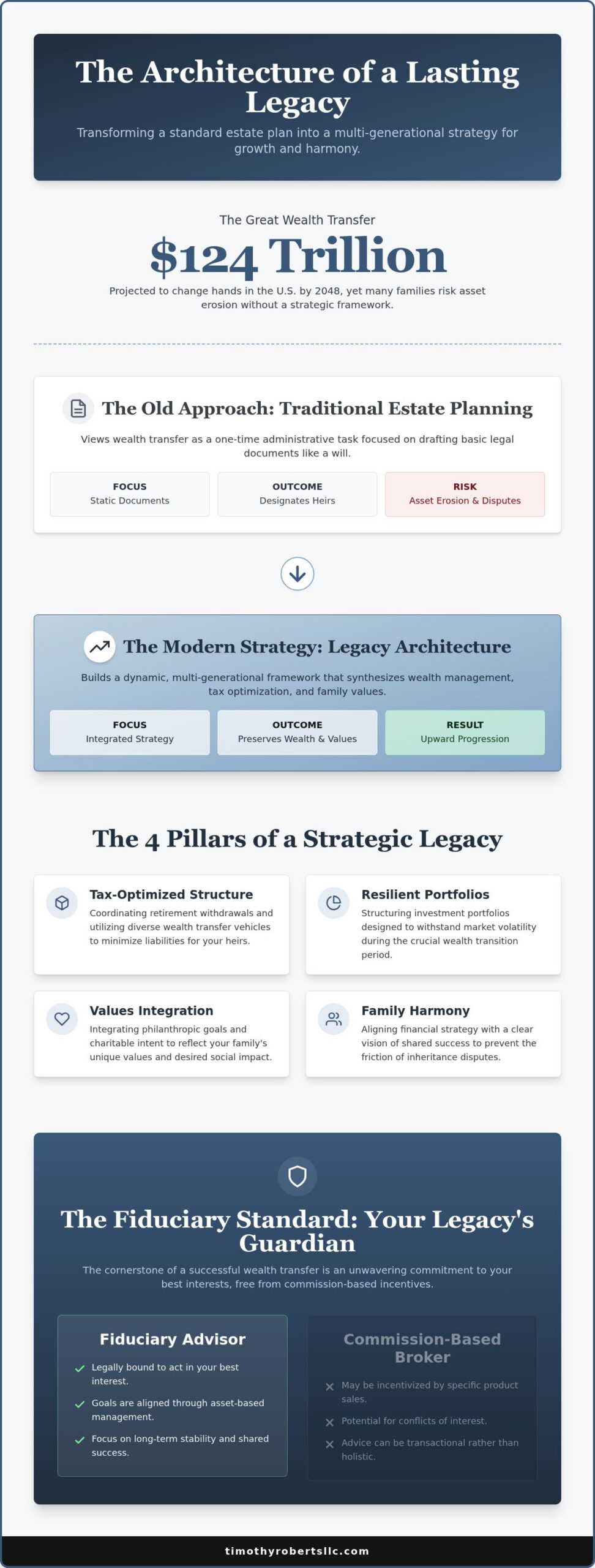
Nearly $124 trillion is projected to change hands across the United States by 2048, yet many families remain unprepared for the complexities of this transition. It’s a staggering figure that underscores a vital truth: wealth isn’t just about what you’ve built, but how it evolves. For those seeking legacy planning ann arbor, the challenge isn’t merely signing a set of documents; it’s about crafting a deliberate architecture for the future. You’ve worked hard to curate a life of significance, and ensuring that your success translates into a lasting impact requires more than just a standard will.
You likely feel a deep responsibility to protect your family from the friction of inheritance disputes and the erosion of assets through excessive taxation. It’s common to feel a sense of confusion when trying to distinguish between basic legal filings and a truly integrated financial strategy. This article provides a sophisticated framework to bridge that gap. We’ll explore how to transform a traditional estate plan into a comprehensive legacy strategy that preserves both your capital and your values. From navigating the $15 million federal exemption to implementing “giving while living” initiatives, you’ll discover a roadmap that secures your family’s harmony and financial trajectory for generations to come.
Key Takeaways
- Learn how to elevate a standard estate plan into a sophisticated architecture that preserves both tangible wealth and intangible family values.
- Discover why legacy planning ann arbor requires a strategic, tax-optimized approach rather than a series of disconnected legal transactions.
- Identify the structural advantages of the fiduciary standard in coordinating complex wealth transfers without the interference of commission-based incentives.
- Explore integrated tax strategies designed to minimize multi-generational liabilities and protect your portfolio’s growth during the transfer process.
- Gain a clear roadmap for fostering family harmony by aligning your financial strategy with a vision of shared success and upward progression.
Beyond the Will: Understanding the Architecture of Legacy Planning
Legacy planning is often mistaken for a simple administrative task. Many believe that drafting a basic will is sufficient to protect their life’s work. However, a will is merely a set of instructions for a single point in time. True legacy planning ann arbor involves building a dynamic architecture that synthesizes wealth management, tax optimization, and personal values. It’s about ensuring your capital continues to support an upward progression for your heirs long after the initial transfer. This process requires a specialized focus on how assets interact with tax laws and market fluctuations over decades.
Relying solely on legal documents creates a strategic gap. While documents designate beneficiaries, they don’t manage the underlying investment portfolio or address the tax implications of specific asset types. Strategic wealth preservation requires a deliberate alignment between your current holdings and your multi-generational goals. If your portfolio isn’t structured for tax-efficient growth and eventual distribution, a significant portion of your legacy could be lost to avoidable liabilities. We view this not as a transaction, but as a journey of organizational and personal evolution. Legacy planning ann arbor ensures that your wealth remains a tool for growth rather than a source of family friction.
The Components of a Strategic Legacy
A robust strategy moves beyond basic probate avoidance. It looks at the mechanics of how wealth moves through different vehicles. Understanding Estate Planning as a broader financial discipline allows you to integrate philanthropic goals into your roadmap without compromising your family’s security. Key elements of this framework include:
- Coordinating tax-efficient retirement withdrawals to minimize the tax burden on your heirs.
- Utilizing diverse wealth transfer mechanisms that provide asset protection and long-term stability.
- Structuring investment portfolios to withstand market volatility during the transition period.
- Integrating charitable intent to reflect your family’s unique values and social impact.
Why Timing Matters in Wealth Elevation
Waiting to plan is a risk in itself. Volatile economic cycles can erode the value of an estate if the transfer strategy isn’t already in place. Early intervention allows for the implementation of advanced tax strategies that require time to mature. By acting now, you maximize the impact of every dollar transferred. Legacy planning is the intersection of financial rigor and personal vision. It’s the difference between leaving behind a collection of assets and leaving a meaningful, structured future for the next generation.
The Fiduciary Standard in Multi-Generational Wealth Management
Legacy planning is a high-stakes endeavor that requires more than technical skill. It demands an unwavering commitment to the client’s best interests, a principle known as the fiduciary standard. This legal and ethical obligation is the cornerstone of a successful wealth transfer strategy. Unlike commission-based brokers who may be incentivized by specific product sales, a fiduciary advisor is bound to put your needs first in every recommendation. This distinction is vital when you’re coordinating the intricate details of a multi-generational estate.
The architecture of a lasting legacy shouldn’t be built on transactional advice. When engaging in legacy planning ann arbor, the structural integrity of your guidance matters as much as the assets themselves. A fiduciary approach utilizes asset-based investment management, which creates a natural alignment between the advisor and the family. As your portfolio grows and evolves, the partnership thrives. This model provides the transparency needed to move away from aggressive sales tactics toward a narrative of shared success and aspirational growth. The Fiduciary Standard ensures that every strategic intervention is scrutinized for its impact on your family’s long-term stability.
Protecting the Integrity of the Estate
Managing inherited IRAs, 401k plans, and private business interests involves navigating complex regulatory environments. A single oversight can lead to “legacy leakage,” where wealth is eroded by unnecessary fees, inefficiencies, or tax penalties. Fiduciary oversight provides the rigorous analysis required to mitigate these risks. By maintaining a focus on personalized strategies rather than off-the-shelf solutions, an advisor can protect the estate’s core value during the transition between generations. This level of professional stability is essential for preserving the tangible impact of your work.
Building Trust Across Generations
For those navigating the complexities of legacy planning ann arbor, the objective guidance of a fiduciary is indispensable for maintaining family harmony. The advisor acts as a visionary strategist and a reliable partner for both the current wealth owner and the future heirs. This role often involves facilitating difficult conversations about financial stewardship and family values. Because a fiduciary provides a steady, logical rhythm to the planning process, they help bridge the gap between individual creative vision and structured corporate capabilities.
The firm’s 25 years of experience in fiduciary wealth management offers the intellectual curiosity and business-minded rigor needed to solve complex problems. We believe that true partnership is built on transparency and a commitment to your family’s upward progression. If you’re ready to explore a more sophisticated approach to your future, consider how estate coordination can bring clarity to your long-term goals. Ensuring your financial roadmap remains relevant as tax laws and market conditions evolve is not just a service; it’s a journey we take together.
Strategic Wealth Transfer vs. Traditional Estate Planning
Traditional estate planning is frequently viewed as a transactional necessity. It’s often a reactive process, focused on drafting documents to manage assets at the end of life. In contrast, strategic legacy planning is a proactive evolution that begins long before a transfer occurs. This approach treats wealth as a living entity that requires intentional stewardship. When pursuing legacy planning ann arbor, the goal shifts from simple probate avoidance to the creation of a sophisticated framework that supports your family’s upward progression. It’s the difference between leaving a set of instructions and leaving a functional, thriving financial ecosystem.
A strategic framework addresses asset protection during your lifetime, ensuring that your wealth remains secure against market volatility and unforeseen liabilities. This involves a transition from the phase of asset accumulation to a period of intentional wealth distribution. Implementing legacy planning ann arbor requires a steady and logical rhythm that guides you from a high-level vision down to the practicalities of execution. By integrating education funding strategies early, you provide heirs with the tools for their own success while witnessing the impact of your generosity. This synthesis of personal vision and financial rigor ensures that the transfer of wealth isn’t just an event, but a continuous journey of shared success.
Framework for Evaluating Your Current Strategy
Many existing plans are static, failing to account for the dynamic nature of global markets and shifting tax regulations. To determine if your current approach is truly strategic, consider these essential elements of a high-end roadmap:
- Year-round tax planning strategies: Does your plan actively seek to minimize liabilities through continuous intervention rather than once-a-year compliance?
- Portfolio optimization: Are your investment portfolios specifically structured for the eventual transfer of assets, or are they managed in isolation?
- Risk management: Does your strategy include a thorough insurance analysis to protect the estate’s core value from catastrophic loss?
The Impact of Professional Intervention
Moving away from off-the-shelf legal forms is the first step toward a bespoke legacy. Genuine wealth preservation requires carefully crafted interventions that pair investment advisory with rigorous tax compliance. This level of customization ensures that every decision aligns with your overarching goals. For those seeking to refine their approach, exploring Estate Planning in Farmington Hills can provide additional insights into how a strategic legacy is elevated for the modern era. By choosing a partner who values depth over superficiality, you secure a reliable business advisor dedicated to your family’s long-term stability.
Tax-Efficient Strategies for Preserving Your Family’s Future
Tax efficiency isn’t a seasonal event. It’s a foundational pillar of sophisticated wealth transfer. For high-net-worth clients, legacy planning ann arbor must integrate rigorous tax advising to minimize liabilities that can otherwise fracture a family’s financial future. Seasonal filing is reactive. Year-round planning is strategic. This proactive approach allows for the identification of opportunities that a standard tax preparer might miss, ensuring that your capital remains a tool for growth rather than a source of tax friction.
Capital gains and income taxes can significantly erode inherited assets if they aren’t managed with a long-term vision. Roth IRAs offer a unique advantage in this architecture, providing a tax-free vehicle for growth and eventual distribution to heirs. Strategic withdrawals from traditional retirement accounts can also be timed to manage the tax bracket of the estate. When you prioritize tax-efficient preservation, the “Great Wealth Transfer” becomes a journey of upward progression. Legacy planning ann arbor ensures that your success is protected from the complexities of the federal tax code.
Minimizing the Tax Burden on Heirs
Inheritance often triggers unexpected “windfall” tax events for beneficiaries who may be unprepared for the sudden tax liability. These risks can be mitigated by coordinating tax preparation with investment management. When these two disciplines are synthesized, the result is a more resilient estate that protects heirs from avoidable financial stress. Discover how Tax Advising in Ann Arbor creates a strategic approach to wealth elevation by addressing these issues before they arise. This integration is essential for maintaining family harmony and financial stability.
Charitable Giving as a Strategic Tax Tool
Philanthropy serves a dual purpose. It reflects your family’s values while acting as a powerful tax tool to reduce the taxable estate. Charitable strategies can remove highly appreciated assets from the core portfolio, fulfilling personal values while lowering the overall tax burden. Utilizing specific retirement plan structures for tax-deductible giving further optimizes the outcome for both the donor and the recipient. A meticulously integrated tax strategy can potentially preserve up to 40% of the estate’s value for high-net-worth families who would otherwise face the top federal tax bracket.
If you’re ready to secure your family’s financial trajectory through a custom legacy framework, contact Timothy Roberts & Associates to begin your strategic evolution. We specialize in the intersection of wealth management and tax planning to ensure your legacy remains intact for generations.
Partnering with Timothy Roberts & Associates for Long-Term Stability
Timothy Roberts & Associates, LLC brings over 25 years of experience to the intricate process of estate coordination. We don’t view wealth transfer as a static event. Instead, we see it as a journey of upward progression that requires both a visionary strategist and a reliable business advisor. Our firm’s history is rooted in fiduciary excellence, ensuring that every recommendation aligns with your family’s long-term stability. By specializing in the synthesis of wealth management and tax advising, we provide a level of depth that larger, more anonymous entities often overlook. This specialized focus on retirement income and legacy coordination allows us to solve complex problems with intellectual curiosity and business-minded rigor.
Choosing a partner for legacy planning ann arbor means selecting a firm that values personal attention and high-level expertise. We take the time to understand your unique goals, moving away from generic conclusions toward carefully crafted interventions. This deliberate pacing reinforces the idea that your legacy is an evolving narrative of shared success. It’s about more than just numbers; it’s about the tangible impact of your life’s work on future generations. We position ourselves as a high-end partner for your family’s evolution, providing the calm confidence needed to face a volatile economic landscape.
The Value of Personalized Financial Strategies
One-size-fits-all solutions invariably fail when applied to complex legacy scenarios. Wealth is personal, and its transfer should reflect the individual creative vision of the owner. We pride ourselves on the synthesis of aesthetics and functionality. The aesthetics represent your personal vision and values. The functionality represents the financial rigor and tax planning strategies required to execute that vision. This intersection ensures that your roadmap is both inspiring and practical. For those nearing the transition phase, our Retirement Income Planning in Ann Arbor provides the strategic guidance needed to maintain your lifestyle while preparing for the future.
Taking the Next Step in Your Legacy Journey
The transition of wealth is one of the most significant milestones in a family’s journey. It’s a process that demands more than simple legal filings; it requires a synthesis of financial rigor and personal values. By elevating your approach to legacy planning ann arbor, you ensure that your life’s work becomes a foundation for future success rather than a source of administrative burden. We’ve explored how the fiduciary standard protects the integrity of your estate and how integrated tax strategies can preserve a significant portion of your family’s capital.
A lasting legacy is built on intentionality and professional stability. With over 25 years of fiduciary expertise, Timothy Roberts & Associates provides the specialized insight needed to navigate complex multi-generational transfers. Our commitment to integrated wealth management and tax strategy ensures your roadmap is optimized for every economic cycle. We believe in crafting personalized strategies that reflect your unique vision and support your family’s upward progression.
Secure your family’s future with a strategic legacy consultation.
Your journey toward a more meaningful and structured future starts with a single, deliberate step. We’re ready to partner with you in making that vision a reality.
Frequently Asked Questions
What is the primary difference between estate planning and legacy planning?
Estate planning focuses on the legal transfer of assets at death, while legacy planning encompasses a broader strategy for wealth, values, and tax optimization. It’s the difference between a transactional document and a visionary roadmap. Engaging in legacy planning ann arbor ensures that your capital continues to support an upward progression for your heirs, integrating your personal philosophy with structured financial rigor to create a lasting impact.
Why do I need a financial advisor for my legacy if I already have an attorney?
An attorney specializes in the legal drafting of documents, whereas a financial advisor provides the strategic framework for the assets within those documents. While a lawyer ensures your will is valid, an advisor manages the investment portfolios and tax strategies that give the documents value. To see how these legal frameworks are priced and structured, visit Law Offices of Robert P. Bergman for an expert perspective on trust creation. This partnership ensures that your financial roadmap remains functional and resilient, bridging the gap between individual creative vision and the practicalities of wealth management.
Fiduciary status ensures that every recommendation is made with your best interests as the sole priority. This legal obligation eliminates the conflicts of interest often found with commission-based brokers. In the context of legacy coordination, a fiduciary advisor acts as a reliable business advisor, providing the calm confidence needed to handle complex multi-generational transfers. It’s the cornerstone of a relationship built on transparency and shared success.
Can legacy planning help reduce the taxes my children will pay on their inheritance?
Yes, legacy planning ann arbor utilizes advanced strategies like Roth IRA conversions and step-up in basis optimization to minimize the tax burden on beneficiaries. Without proactive tax advising, heirs may face significant income and capital gains liabilities upon inheritance. By implementing a year-round tax planning strategy, you can protect the estate’s value from the top 40% federal tax bracket, ensuring that more of your life’s work remains within the family.
What role does retirement income planning play in my overall legacy?
Retirement income planning serves as the engine that powers your legacy by determining how and when assets are distributed. It’s not just about funding your lifestyle; it’s about the sequence of returns and withdrawal timing. Tax-efficient withdrawals from 401k or IRA accounts prevent unnecessary erosion of the estate. This ensures that you maintain your own security while maximizing the residual wealth available for your strategic legacy transfer.
How often should a strategic legacy plan be reviewed and updated?
A strategic legacy plan should be reviewed at least every two to three years or whenever a significant life event occurs. Market conditions, tax regulations, and family dynamics are constantly evolving. Regular interventions ensure that your financial architecture remains relevant and effective. This steady and logical rhythm of review allows for the adjustment of investment portfolios to align with your current vision and the evolving needs of your heirs.
Is legacy planning only necessary for those with a high net worth?
While high-net-worth individuals face more complex tax challenges, legacy planning is valuable for anyone who wishes to pass on their values and assets intentionally. It’s about providing a clear roadmap for family harmony and financial stewardship regardless of the portfolio size. Every family benefits from a strategy that minimizes conflict and legal friction. Professional guidance helps transform a standard plan into a personalized journey of shared success for any household.
What are the risks of ignoring tax-efficient withdrawal strategies?
Ignoring tax-efficient withdrawal strategies can lead to “legacy leakage,” where a substantial portion of the estate is lost to avoidable taxes. This often happens when heirs are forced into higher tax brackets by large, uncoordinated distributions. Failing to account for the tax status of different accounts can significantly reduce the total wealth transferred to the next generation. A meticulous approach to withdrawals is essential for preserving the tangible impact of your work.
