

Aug
Strategic College Savings Plans: Elevating Education Funding into Wealth Management
What if your child’s education fund was actually one of your most powerful tools for estate optimization and tax-efficient wealth transfer? For many families, the search for a college savings plan ann arbor begins with the simple goal of covering tuition, yet it often ends in a maze of concerns regarding overfunding penalties and the potential erosion of retirement security. You’ve likely felt the tension between wanting to provide every advantage for the next generation while ensuring your own long-term financial independence remains untouched.
We believe education funding is not an isolated transaction but a strategic pillar of your broader financial legacy. This guide provides a clear roadmap to master these complexities through a fiduciary lens, ensuring your contributions work in harmony with your estate goals. You’ll discover how to minimize tax liabilities and protect your retirement income while transforming a standard savings vehicle into a sophisticated instrument for upward progression. We’ll explore how modern provisions allow for greater flexibility, turning once-rigid accounts into versatile components of a comprehensive wealth management strategy.
Key Takeaways
- Transform education funding from a transactional expense into a sophisticated multi-generational wealth transfer strategy that enhances your financial legacy.
- Optimize your college savings plan ann arbor by selecting the most efficient tax-advantaged vehicles to maximize your family’s long-term capital growth.
- Utilize strategic gift tax exclusions and fiduciary oversight to minimize tax liabilities while accelerating your family’s upward progression.
- Implement a deliberate five-step framework that protects your retirement income while securing high-quality educational opportunities for your heirs.
- Shift from generic savings tools to personalized wealth interventions that offer the depth and rigor required for managing complex financial trajectories.
The Strategic Significance of Education Funding in Wealth Management
For the affluent family, education funding transcends the simple act of setting aside tuition dollars. It’s a deliberate exercise in capital allocation. While a basic college savings plan ann arbor might focus on modest monthly contributions, a strategic approach views these assets as a vital component of a multi-generational legacy. This shift in perspective transforms education from a recurring expense into a powerful hedge against future estate tax liabilities. It’s a sophisticated movement toward long-term preservation that requires a blend of creative passion and business-minded rigor.
Integrating a 529 plan into your broader financial roadmap allows for the accelerated transfer of wealth while maintaining a level of control that other gift strategies lack. It’s a sophisticated method for reducing your taxable estate without sacrificing the flexibility needed to adapt to changing family needs. By moving capital into these tax-advantaged environments, you’re effectively shielding growth from the friction of annual taxation. This process isn’t merely functional; it’s an aesthetic alignment of your values with your financial structure. We treat these interventions as carefully crafted solutions rather than off-the-shelf products.
The Fiduciary Standard in Education Planning
Selecting the right vehicle requires more than a generic online calculator. It demands a fiduciary standard of care where your interests remain the sole priority. We prioritize your long-term stability over the convenience of off-the-shelf products that often carry hidden costs and misaligned investment choices. With over 25 years of experience, we understand that education planning is inseparable from tax preparation and wealth management. Professional oversight ensures that every contribution serves your total financial roadmap, preventing the fragmentation that occurs when savings goals are managed in isolation. We move away from aggressive sales tactics toward a narrative of partnership and shared success.
Education as a Pillar of Upward Progression
We view development as a journey rather than a simple transaction. Education is the ultimate engine for upward progression, providing the intellectual capital that sustains a family’s influence and success across generations. Education funding is a strategic intervention in wealth transfer that bridges individual creative vision with structured corporate capabilities. It’s about more than degrees. It’s about the intentional evolution of your family’s organizational strength. By funding these goals through a strategic lens, you’re not just paying for a classroom; you’re investing in the future leadership of your family legacy. This deliberate pacing reinforces the idea that we take the time to solve complex problems rather than rushing to generic conclusions.
Evaluating Tax-Advantaged Vehicles: 529 Plans vs. Alternative Strategies
While a 529 plan is often the cornerstone of a college savings plan ann arbor, it shouldn’t be the only tool in your arsenal. A sophisticated strategy requires a blend of tax-advantaged growth and operational flexibility. We analyze how different structures interact with your broader portfolio to ensure your capital remains productive across decades. This approach moves beyond simple savings, treating education funding as a core component of your investment portfolio management.
The 529 Plan: Mechanics and Strategic Advantages
The primary appeal of the 529 lies in its tax-deferred growth and the ability to withdraw funds tax-free for qualified education expenses. As we look toward the 2026 fiscal environment, staying informed on evolving 529 plan policy is essential for maximizing contribution limits. One powerful tactic involves front-loading these accounts to capture years of additional market participation. The super-funding rule allows contributors to treat a single large contribution as if it were spread over five years for gift tax purposes. This accelerated funding jumpstarts the compounding process while efficiently reducing the size of a taxable estate. Additionally, provisions under the SECURE Act 2.0 now allow for the potential rollover of unused funds into a Roth IRA, significantly mitigating the risk of overfunding.
Alternative Vehicles for Education Capital
When control and flexibility are paramount, alternative structures like UTMA or UGMA accounts offer distinct advantages. These custodial accounts allow for a broader range of investment types, including individual stocks or private equity, though the assets eventually transfer to the beneficiary at the age of majority. This transfer of ownership is a critical consideration; while it provides the child with a significant head start, it also counts more heavily against financial aid eligibility than assets held in a 529 plan. For families who value maximum liquidity, a taxable brokerage account provides a secondary layer of protection. It doesn’t offer the same tax breaks, but it lacks the usage restrictions found in dedicated education accounts, allowing for a pivot if a child’s educational path changes.
Strategic planners often weigh the following variables when selecting a vehicle:
- Ownership and Control: 529 plans allow the owner to change beneficiaries, whereas UTMAs belong strictly to the child once they reach adulthood.
- Tax Treatment: Different accounts offer varying levels of tax-deferred growth or tax-free distributions for specific costs.
- Financial Aid Impact: Assets held in a parent’s name generally have a lower impact on aid calculations than those owned by the student.
Some strategists also look to Roth IRAs as a dual-purpose reserve. These accounts provide a safety net for retirement while allowing for penalty-free withdrawals of contributions for education costs. Balancing these variables requires a comprehensive financial roadmap that aligns every dollar with your ultimate legacy goals. We help you navigate these trade-offs to ensure your education funding doesn’t compromise your long-term retirement income.
Advanced Tax Efficiency and Wealth Transfer Considerations
Strategic education funding is a vital lever for estate compression. While many look for a college savings plan ann arbor to simply cover costs, high-net-worth families use these accounts to systematically reduce their taxable estate. By shifting large sums of capital into tax-advantaged structures, you effectively remove future appreciation from your balance sheet. This isn’t just about tuition. It’s a calculated intervention in your family’s financial evolution. Each dollar moved into a 529 plan represents a dollar that grows outside the reach of the federal estate tax, creating a protective barrier around your long-term legacy.
Maximizing Federal Gift Tax Exclusions
Utilizing the annual gift tax exclusion provides a steady, rhythmic way to transfer wealth without tapping into your lifetime exemption. For those seeking more immediate impact, five-year gift bunching, often called super-funding, allows a single contributor to front-load a 529 plan with up to five times the annual limit. This technique accelerates the power of compounding and provides a significant hedge against future tax volatility. It’s a sophisticated method for deploying capital today to solve problems decades in the future. Coordinating these moves with your broader legacy planning strategies ensures that education funding enhances your total wealth trajectory rather than existing as an isolated transaction. We treat these contributions as part of a polished, intentional roadmap for family growth.
Tax-Efficient Distributions and Timing
The landscape of education funding was fundamentally altered by the SECURE Act 2.0. This legislation introduced the ability to roll over up to $35,000 of unused 529 assets into a Roth IRA for the beneficiary, provided the account has been open for at least 15 years. This provision eliminates the common fear of overfunding and provides a seamless transition from education savings to the start of a child’s retirement security. It reflects a shift toward more flexible, human-led wealth management. Navigating the strict definition of qualified expenses is essential to avoid the 10% penalty on non-qualified withdrawals. Our integrated tax advising services help you time distributions and coordinate with other income sources to maximize the net benefit for your family. By aligning tuition payments with tax-loss harvesting or other portfolio adjustments, we ensure your college savings plan ann arbor remains a high-functioning component of your wealth management strategy.
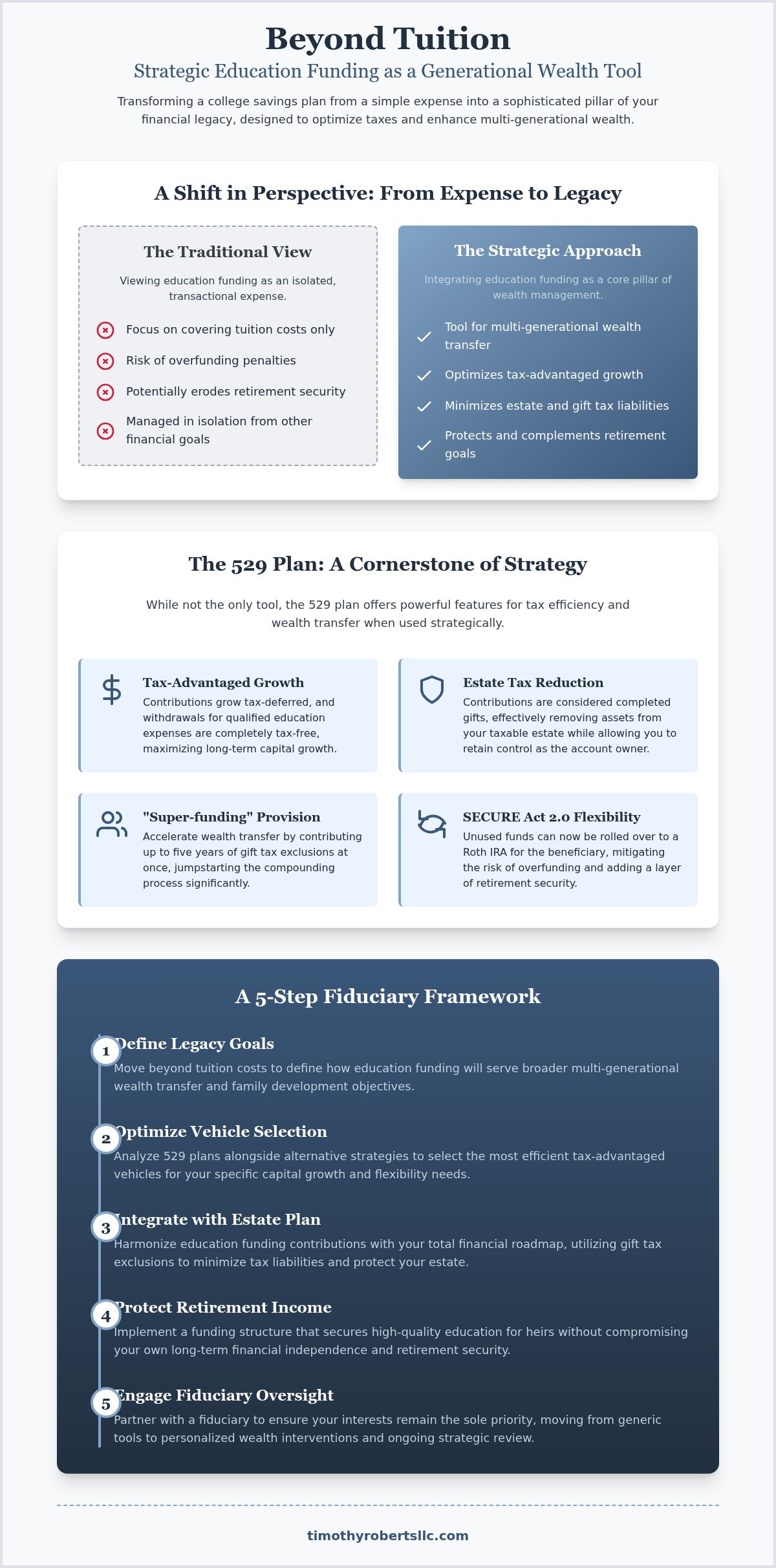
A Five-Step Framework for Integrating Education into Your Financial Roadmap
Effective wealth management requires a transition from reactive saving to proactive architectural planning. While generic platforms suggest a college savings plan ann arbor can be established in minutes, a truly strategic intervention involves a more rigorous methodology. We utilize a five-step framework designed to align your educational aspirations with your broader financial trajectory. This process ensures that every contribution serves as a deliberate building block for your family’s upward progression.
- Step 1: Define the Scope. Determine the level of support you intend to provide, accounting for projected tuition inflation and the specific costs of elite institutions.
- Step 2: Assess Trajectory. Analyze how these funding goals interact with your current assets and long-term liquidity needs.
- Step 3: Select the Vehicle Mix. Deploy a customized blend of 529 plans, UTMAs, and taxable accounts based on your specific tax profile.
- Step 4: Implement Management. Establish a disciplined investment strategy that balances growth with capital preservation as enrollment nears.
- Step 5: Monitor and Pivot. Review the plan annually to adjust for market performance and significant legislative shifts like the SECURE Act 2.0.
Balancing Tuition and Retirement Income
The most critical component of this framework is the preservation of your own long-term independence. We adhere to the fundamental rule of prioritizing your own financial security before committing to expansive education goals. Funding a child’s degree should never come at the expense of your retirement income planning. By modeling the long-term impact of tuition payments on your future cash flow, we identify the optimal funding level that supports your heirs without eroding your capital base. This balanced approach provides the calm confidence needed to navigate high-cost years without compromising your lifestyle.
Disciplined Investment Management for Education
As the matriculation date approaches, the focus of a college savings plan ann arbor must shift from aggressive accumulation to strategic preservation. We move beyond simple age-based defaults, opting instead for a more nuanced approach to risk. This involves integrating education assets into your comprehensive portfolio management to ensure proper diversification across all account types. Managing volatility becomes an art form in the final five years before enrollment, requiring a steady hand and a logical rhythm to protect the principal. Our goal is to ensure that market fluctuations do not dictate your child’s educational opportunities. To begin crafting a personalized strategy for your family, we invite you to connect with our advisory team for a detailed consultation.
The Fiduciary Advantage: Partnering for Long-Term Financial Stability
Generic online calculators and automated platforms often fail to account for the intricate interplay between tax liabilities, estate preservation, and long-term liquidity. While these tools might provide a basic starting point for a college savings plan ann arbor, they lack the strategic depth required for high-net-worth wealth management. We provide a sophisticated alternative that treats education funding as a deliberate intervention in your family’s financial trajectory. This is where personal attention meets high-level expertise, ensuring your strategy isn’t just functional but truly progressive. Our firm positions itself as a high-end partner for your family’s evolution, moving away from simple savings to a narrative of partnership and shared success.
Tailored Strategies for Unique Family Goals
We move away from generic, off-the-shelf solutions toward bespoke financial roadmaps that reflect your specific values and aspirations. With over 25 years of experience, Timothy Roberts & Associates, LLC understands that your goals are as unique as your legacy. We bridge individual creative vision with structured corporate-level rigor to ensure your education strategy is both ambitious and grounded. This synthesis of the personal and the professional serves as our signature trait, distinguishing our approach from larger, more anonymous entities. Ongoing monitoring and fiduciary oversight are essential components of this process, as market conditions and legislative frameworks are constantly in flux. We take the time to solve complex problems, ensuring your college savings plan ann arbor remains a high-performing asset within your total wealth management strategy.
Your Journey Toward Upward Progression
Viewing your financial advisor as a partner in organizational evolution creates a foundation of trust and aspirational growth. It’s a journey of upward progression where development is treated as a continuous path rather than a simple transaction. This polished, intentional strategy provides the calm confidence necessary to manage multi-generational wealth without the stress of uncertainty. You deserve a specialized firm where personal attention and business-minded rigor go hand in hand to protect your long-term retirement income. Our steady and logical rhythm guides you from a high-level vision down to the practicalities of execution, avoiding the cluttered feel of traditional brokerage models. It’s time to elevate your approach to education funding and secure the intellectual capital of the next generation. We invite you to schedule a consultation to refine your education funding plan and transform your family’s vision into a structured, sustainable reality.
Securing Your Legacy Through Strategic Education Funding
Mastering the complexities of education funding requires a shift from passive saving to intentional wealth management. Throughout this guide, we’ve demonstrated how a sophisticated college savings plan ann arbor serves as a high-functioning vehicle for estate compression and tax-efficient wealth transfer. By integrating these strategies into your broader financial roadmap, you ensure that your contributions support the next generation without compromising your long-term retirement security.
Success in these complex interventions demands more than a generic calculator; it requires a partner committed to your family’s upward progression. With 25+ years of wealth management expertise and a steadfast fiduciary standard of care, we provide the specialized oversight necessary to navigate evolving legislative landscapes. Our approach combines creative vision with strategic tax-integrated planning to protect and grow your family’s capital. Elevate your education funding strategy with our fiduciary experts today. The journey toward a lasting financial legacy is a marathon, and we’re here to guide every step with calm confidence.
Frequently Asked Questions
What is the best college savings plan for high-income earners in 2026?
High-income earners often find that a 529 plan remains the most effective tool because it allows for significant capital migration without income restrictions. In 2026, the ability to front-load these accounts provides a unique opportunity to maximize tax-free growth. When evaluating a college savings plan ann arbor, it’s essential to look beyond basic state tax deductions. You should focus on how the plan’s investment options align with your broader portfolio management and estate compression goals.
Are 529 plans still worth it if my child receives a scholarship?
Scholarships don’t render these accounts obsolete. You can withdraw funds equal to the scholarship amount without the 10% penalty, though the earnings portion will be subject to income tax. Alternatively, the assets can remain in the account to fund graduate school or be rolled over into a Roth IRA under current legislative provisions. This flexibility ensures your strategic capital allocation remains productive even when external funding sources reduce the immediate need for tuition dollars.
How does a 529 plan affect my child’s eligibility for financial aid?
Assets held in a 529 plan are typically treated as parental assets on the FAFSA, which has a much smaller impact on aid eligibility than assets owned directly by the student. Specifically, parental assets are assessed at a maximum rate of 5.64%, while student assets are assessed at 20%. This distinction is a vital component of a sophisticated college savings plan ann arbor, as it protects your child’s access to institutional aid while preserving family wealth.
Can I use 529 plan funds for private K-12 tuition?
You can use up to $10,000 annually per beneficiary for tuition at private, public, or religious K-12 schools. This provision allows for a more rhythmic distribution of tax-advantaged growth earlier in your child’s educational journey. It’s a strategic intervention that bridges the gap between early childhood savings and higher education costs. Utilizing these funds for secondary education can be a polished way to manage your family’s overall tax liability across multiple decades.
What happens to the money in a 529 plan if the child does not go to college?
If a beneficiary chooses a different path, you retain several high-level options for the capital. You can change the beneficiary to a qualifying family member or use the funds for registered apprenticeship programs and trade schools. The SECURE Act 2.0 also permits rolling over up to $35,000 into a Roth IRA for the original beneficiary. These interventions ensure that your education funding strategy remains a versatile component of your family’s upward progression and long-term stability.
Can I transfer a college savings plan to another family member?
Transferring assets to another family member is a straightforward process that supports a multi-generational legacy. You can change the beneficiary to siblings, first cousins, or even yourself without triggering federal income tax or penalties. This flexibility allows you to redirect capital where it’s most needed as your family’s organizational needs evolve. It’s a strategic way to maintain control over wealth while ensuring it continues to serve as an engine for personal and professional growth.
How do 529 plans integrate with my estate planning strategy?
These plans serve as a sophisticated tool for estate compression by allowing you to remove assets from your taxable estate while maintaining ownership. Contributions are considered completed gifts, yet you retain the power to change beneficiaries or control the timing of distributions. This unique combination of control and estate reduction is rare in wealth management. Integrating these accounts into your legacy planning ensures that your wealth transfer is both tax-efficient and aligned with your family values.
Is there a limit to how much I can contribute to a college savings plan annually?
While there’s no strict federal annual contribution limit, you must be mindful of gift tax thresholds. In 2026, you can contribute up to the annual exclusion amount per beneficiary without impacting your lifetime gift tax exemption. Couples can double this amount through gift splitting. For those seeking accelerated estate reduction, the five-year election allows you to front-load a large sum immediately. This strategic move jumpstarts compounding while protecting your broader financial roadmap from unnecessary tax friction.
