

Aug
Investment Portfolio Management in Farmington Hills: Architecting a Sophisticated RMD Framework for 2026
What if the mandatory distributions you’ve been dreading were actually the most powerful tool in your legacy planning arsenal? For individuals prioritizing sophisticated investment portfolio management, the arrival of 2026 brings a unique convergence of shifting tax laws and market complexity. You’ve likely felt the weight of sunsetting tax brackets and the looming threat of Medicare IRMAA surcharges that can quietly erode your hard-earned wealth. It’s frustrating to watch a lifetime of disciplined saving be subjected to forced liquidations during periods of market volatility, especially when those distributions feel like a tax penalty rather than a benefit.
We understand that your financial journey is about more than just compliance; it’s about the intentional evolution of your estate. This article promises to show you how to transform required minimum distributions from a simple tax liability into a strategic component of your long-term wealth and legacy architecture. We’ll explore a sophisticated framework for 2026 that prioritizes tax-efficient withdrawals and wealth preservation. By architecting a proactive plan today, you’ll discover how to navigate the 25% penalty risks and rising Medicare costs while ensuring your portfolio remains a robust engine for your family’s future.
Key Takeaways
- Shift from passive compliance to intentional distribution, treating mandatory withdrawals as a strategic catalyst for multi-generational wealth transfer.
- Master the nuanced mechanics of 2026 requirements, including the age 73 milestone, to effectively eliminate the risk of high excise tax penalties.
- Deploy strategic interventions like Qualified Charitable Distributions and in-kind transfers to satisfy IRS mandates while maintaining your desired market exposure.
- Proactively address the 2026 sunsetting of tax provisions by utilizing “bracket topping” to secure current rates before they potentially increase.
- Optimize your legacy through integrated investment portfolio management in Farmington Hills that aligns tax-efficient withdrawals with your broader wealth management objectives.
Navigating the RMD Landscape: Why Strategy Surpasses Compliance
The transition from wealth accumulation to intentional distribution represents more than a change in account activity; it’s a fundamental psychological shift. For decades, your focus has been on growth and preservation. Now, the mandate shifts toward the strategic release of capital. Viewing Required Minimum Distribution (RMD) rules as a mere administrative hurdle is a mistake that high-net-worth families often make. This passive stance transforms what should be a controlled release into a ticking tax bomb that threatens to disrupt the very legacy you’ve meticulously built.
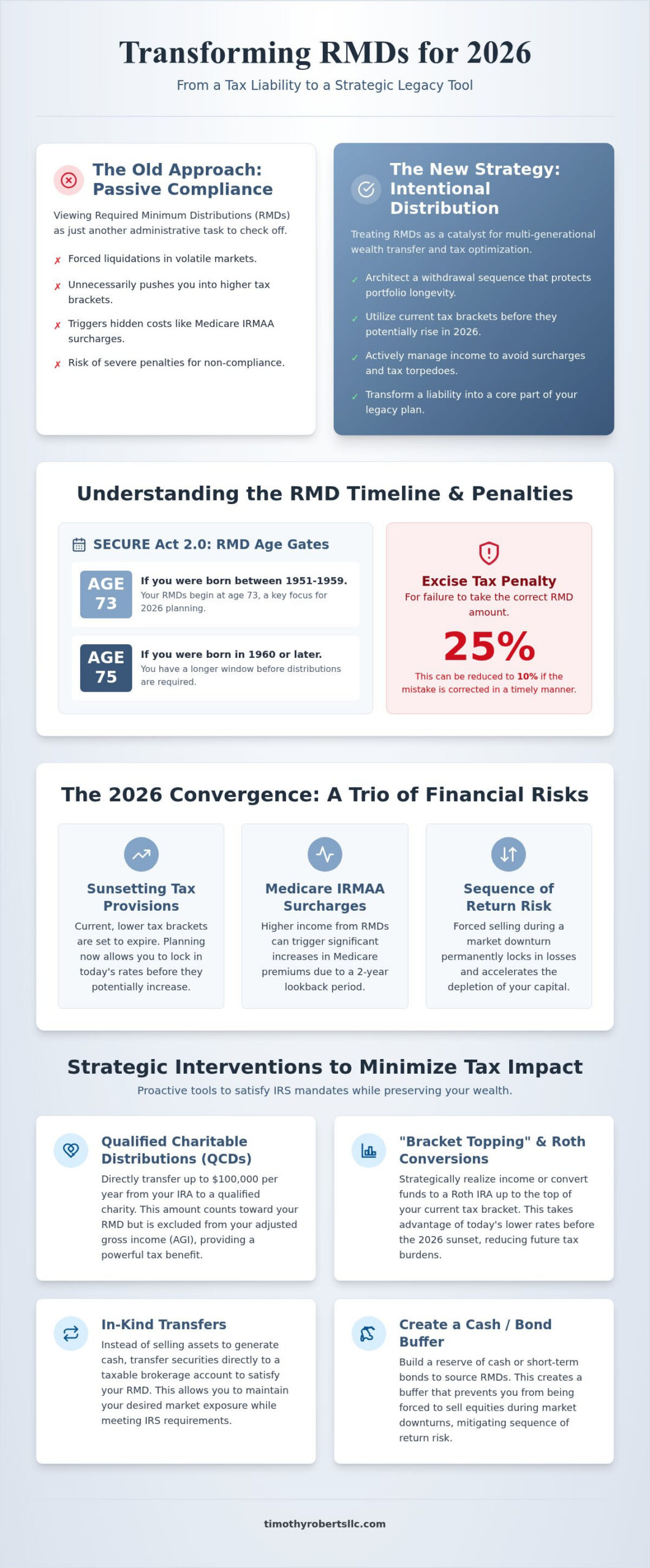
Effective investment portfolio management in Farmington Hills requires acknowledging the intersection of the SECURE Act 2.0 and your long-term financial roadmap. With the RMD age reaching 73 in 2026 for those born between 1951 and 1959, the window for proactive planning is narrowing. A “set it and forget it” mentality ignores how these forced withdrawals interact with sunsetting tax brackets and shifting market cycles. Without a bespoke strategy, you risk liquidating assets during downturns or pushing yourself into a higher tax tier unnecessarily.
The Fiduciary Perspective on Forced Distributions
Passive compliance often leads to unnecessary wealth erosion because it fails to account for the sequence of returns or the specific tax character of different assets. A fiduciary advisor doesn’t just calculate a number; they architect a withdrawal sequence that protects portfolio longevity. An RMD strategy is a proactive intervention designed to transform mandatory withdrawals into a tax-efficient framework for legacy building. By coordinating these distributions with your broader estate goals, we move away from reactive liquidation toward purposeful growth that respects the rhythm of the markets.
Beyond the IRS: IRMAA and Social Security Implications
The impact of RMDs extends far beyond the immediate tax bill. Increased Adjusted Gross Income (AGI) can trigger what is often called the Social Security tax torpedo, where a larger portion of your benefits becomes subject to federal income tax. Additionally, the two-year lookback for Medicare Part B and D means that a distribution taken in 2026 could result in significant IRMAA surcharges in 2028. Managing these income thresholds is vital for maintaining fiscal efficiency. Sophisticated investment portfolio management in Farmington Hills balances the desire for aspirational growth with the need to avoid these avoidable surcharges, ensuring your distributions serve your long-term interests.
The Mechanics of Distribution: Timing, Ages, and Penalties
The architecture of a successful retirement depends on precise timing and a deep understanding of evolving mandates. Under the SECURE Act 2.0, the age at which you must begin taking distributions has shifted, creating a tiered timeline for retirees. If you were born between 1951 and 1959, your RMD age is 73. Those born in 1960 or later will wait until age 75. This distinction is critical for your 2026 planning. Failing to meet these deadlines carries a severe 25% excise tax on the amount that should’ve been distributed. While this penalty can be reduced to 10% if corrected promptly, the friction it creates in a high-net-worth portfolio is significant.
Calculation methods also require careful selection. Most retirees utilize the IRS Uniform Lifetime Table, yet those with a spouse more than ten years younger may benefit from the Joint Life Expectancy option. This choice can lower the mandatory withdrawal amount, preserving more capital for long-term growth. You also face a strategic choice during your first RMD year. You can delay the initial withdrawal until April 1st of the following year. However, this often creates a tax cliff. You’ll be required to take two distributions in a single calendar year, potentially spiking your tax bracket and increasing your exposure to surcharges.
Sequence of Return Risk in the Distribution Phase
Taking RMDs during a market downturn is a permanent “sell low” event that can’t be undone. When your portfolio value drops, the percentage of your remaining assets that the RMD represents actually increases. This accelerates the depletion of your capital. Sophisticated investment portfolio management in Farmington Hills creates a cash or short-term bond buffer to satisfy these distributions without forced liquidation of equities during volatility. Protecting your 30-year retirement horizon requires this level of defensive architecture to ensure that early-distribution volatility doesn’t derail your long-term success.
Roth IRA and 401(k) Exceptions
Roth IRAs remain the ultimate tool for maintaining control because they aren’t subject to RMDs for the original owner. This allows for tax-free growth to continue indefinitely. Recent changes under the SECURE Act 2.0 have extended this benefit, exempting Roth 401(k) and 403(b) accounts from RMD requirements starting in 2024. Utilizing these exceptions provides the flexibility to choose when and how you access your wealth. If you’re looking to refine your approach, a bespoke retirement income planning strategy can help align these mechanics with your legacy goals and broader investment portfolio management in Farmington Hills.
Strategic Interventions: Minimizing the Tax Impact of Withdrawals
While understanding timelines and penalties is foundational, true portfolio mastery involves active intervention. For those seeking sophisticated investment portfolio management in Farmington Hills, the goal is to satisfy the IRS without compromising the portfolio’s structural integrity or legacy potential. Strategic interventions allow you to reclaim control over your cash flow, ensuring that mandatory distributions serve your long-term vision rather than just meeting a legal requirement.
The Power of the Qualified Charitable Distribution
QCDs are arguably the most efficient tool for retirees who don’t require their full RMD for living expenses. In 2026, the annual limit for these distributions is $111,000 per individual, providing a significant ceiling for tax-free giving. Unlike standard charitable deductions, which only benefit those who itemize, a QCD reduces your Adjusted Gross Income (AGI) directly at the source. This is a vital distinction. It prevents the distribution from ever appearing on your tax return, which helps mitigate the IRMAA surcharges and Social Security taxation risks that often accompany high-income years. A QCD serves as a surgical tool that bypasses standard deduction limitations for retirees by providing a dollar-for-dollar reduction in taxable income.
In-Kind Transfers: Preserving Market Position
One of the most overlooked strategies involves in-kind distributions. Rather than liquidating shares during a market dip, you can transfer stocks or mutual fund shares directly from your IRA to a taxable brokerage account. This satisfies the RMD requirement based on the fair market value at the time of transfer. You keep your investment thesis intact. You don’t realize a permanent loss. This maneuver is particularly effective during periods of market stress, as it allows you to maintain your exposure to high-conviction assets while resetting the cost basis for future capital gains planning.
When combined with tax-loss harvesting in your taxable accounts, in-kind transfers become a cornerstone of high-level investment portfolio management in Farmington Hills. Coordinating across multiple accounts offers a final layer of efficiency. You aren’t required to take a proportional RMD from every IRA you own. Instead, you can aggregate the total required amount and withdraw it from the account that makes the most sense for your current tax and investment strategy. This flexibility ensures that your legacy accounts continue to grow under optimal conditions while your income needs are met through the most fiscally responsible channels.
Architecting a Multi-Year Framework for 2026 and Beyond
Sustainable wealth is rarely the result of a single decision; it’s the outcome of a meticulously architected framework. As we approach 2026, the sunsetting of the Tax Cuts and Jobs Act (TCJA) provisions introduces a new layer of complexity to investment portfolio management in Farmington Hills. Preparing for this shift requires a four-step evolution from reactive compliance to proactive fiscal leadership. First, we must analyze your current tax liability against the projected return to higher historical brackets. This isn’t just a spreadsheet exercise. It’s a strategic assessment of how your income will be treated once the 2026 rates take effect.
The second step involves “bracket topping.” By taking proactive distributions or converting assets today, you can capture current lower rates before they disappear. This reduces the future RMD burden and minimizes the risk of being pushed into a 37% or higher tier later. Third, we integrate these distributions into a multi-generational estate plan. The goal is to minimize the total tax bill across your entire family tree, not just your personal return. Finally, we review the 10-year liquidation rule for non-spouse beneficiaries. Under the SECURE Act, most heirs must fully deplete inherited IRAs within a decade, often during their own peak earning years. This creates a massive tax liability for your children that can be avoided with better architecture today.
Pre-RMD Roth Conversions: A Vital Intervention
The gap years between retirement and age 73 represent a unique window of opportunity. During this period, your income may be lower, allowing for strategic Roth conversions that won’t trigger excessive tax. These conversions reduce the overall size of your tax-deferred accounts, thereby lowering your future “RMD shock” and Medicare IRMAA exposure. Integrating this into your Retirement Income Planning ensures that every dollar moved is done so with surgical precision.
Legacy Architecture and the 10-Year Rule
The SECURE Act 2.0 fundamentally changed the math for inherited accounts. Because non-spouse beneficiaries generally cannot stretch distributions over their lifetimes, we must rethink how we pass on wealth. Using RMD proceeds to fund life insurance or irrevocable trusts can provide a tax-free inheritance that bypasses the 10-year liquidation mandate. This level of Estate Planning Strategies transforms a forced withdrawal into a permanent family asset. If you’re ready to secure your family’s financial future, consider a bespoke tax planning strategy that aligns your portfolio with the 2026 landscape.
Partnering for Organizational and Personal Evolution
Navigating the transition from asset accumulation to strategic distribution requires a partner who views your wealth as a living architecture rather than a static balance sheet. For families prioritizing investment portfolio management in Farmington Hills, the complexity of 2026 mandates a shift toward bespoke, fiduciary-led interventions. A generic approach often fails to account for the intricate interplay between mandatory withdrawals and long-term legacy goals. By synthesizing high-level tax preparation with disciplined investment management, we ensure that every fiscal move is intentional, progressive, and protective of your net worth.
Timothy Roberts & Associates, LLC specializes in crafting these personalized roadmaps. We move beyond the standard transactional relationship, positioning ourselves as visionary strategists who understand the intersection of personal ambition and corporate-level rigor. This specialized focus allows us to transform what many perceive as financial anxiety into a narrative of aspirational growth. When your RMD framework is designed with craftsman-level precision, forced distributions cease to be a burden and instead become a vital tool for family wealth elevation.
Our Strategic Approach to Wealth Elevation
With a 25-year history of guiding families through shifting fiscal landscapes, we’ve refined an integrated approach that balances immediate income needs with multi-generational preservation. We don’t view tax planning and portfolio oversight as separate silos. Instead, we treat them as a single, unified discipline. Our Tax Advising Services are woven directly into the fabric of your investment strategy, ensuring that RMDs are executed with maximum fiscal efficiency. This synergy is what distinguishes a specialized firm from larger, more anonymous entities, providing the personal attention your estate deserves.
Securing Your Legacy Today
The time for intentional design is now. Waiting until the 2026 tax shifts are in full effect limits your ability to utilize the “gap year” strategies and bracket-topping techniques discussed in previous sections. Securing your legacy requires immediate, decisive action to insulate your portfolio from unnecessary surcharges and wealth erosion. We invite you to a comprehensive retirement income plan review and portfolio analysis. This is the first step toward a partnership built on trust, intellectual curiosity, and shared success. Let’s begin the journey of architecting your investment portfolio management in Farmington Hills to meet the challenges of the coming decade with calm confidence.
Architecting Your Legacy Through Intentional Design
The transition into the RMD phase represents a pivotal moment in your financial evolution. As we’ve explored, success in 2026 requires moving beyond simple compliance toward a framework that treats mandatory distributions as a catalyst for wealth preservation. By mastering the nuances of timing, utilizing interventions like in-kind transfers, and preparing for the sunsetting tax provisions, you ensure your portfolio remains a robust engine for your family’s future. This level of sophistication defines investment portfolio management farmington hills.
Securing your wealth against rising surcharges and shifting brackets requires an expert craftsman’s touch. With over 25 years of specialized retirement experience and a steadfast fiduciary commitment to your best interests, Timothy Roberts & Associates, LLC provides the integrated tax and investment management necessary for complex estates. We don’t offer off-the-shelf solutions; we deliver carefully crafted interventions that align with your unique vision. It’s time to move from reactive management to proactive growth. We invite you to request a strategic consultation with our fiduciary team to begin refining your roadmap. Your legacy is an ongoing journey, and we’re here to ensure it’s one of continued upward progression.
Frequently Asked Questions
What is the RMD age for 2026 under the SECURE Act 2.0?
In 2026, the age for beginning your Required Minimum Distributions is 73 for individuals born between 1951 and 1959. If you turn 73 during the 2026 calendar year, you must initiate your first withdrawal by April 1, 2027. Waiting until that deadline requires taking two distributions in a single year, which can spike your taxable income. For those born in 1960 or later, the age requirement remains 75.
Can a Roth conversion in 2026 reduce my future RMD obligations?
Executing a Roth conversion in 2026 effectively reduces the balance of your tax-deferred accounts, which directly lowers the basis for future mandatory withdrawals. Since Roth IRAs aren’t subject to RMDs for the original owner, this strategy offers long-term control over your taxable income. Sophisticated investment portfolio management in Farmington Hills utilizes these conversions during lower-income years to shield your wealth from the higher tax brackets projected after 2025.
What happens if I miss my RMD deadline in 2026?
Failing to meet your distribution deadline triggers a significant excise tax equal to 25% of the amount that should’ve been withdrawn. This penalty is a direct erosion of your capital and requires immediate attention. If you correct the error within a timely correction window, the IRS may reduce this penalty to 10%. Proactive oversight is essential to avoid these avoidable costs and maintain the structural integrity of your long-term retirement income plan.
Is there a way to satisfy my RMD without selling my stock?
You can satisfy your distribution mandate through in-kind transfers, which involve moving shares directly from your retirement account to a taxable brokerage account. This maneuver allows you to meet IRS requirements based on the fair market value of the assets without triggering a forced sale. It’s an excellent strategy for maintaining your investment thesis during market volatility. This approach preserves your market position while resetting the cost basis for future capital gains planning.
How do RMDs affect my Medicare Part B premiums (IRMAA)?
RMD income increases your Modified Adjusted Gross Income, which can push you into higher brackets for Medicare Part B and D surcharges known as IRMAA. Because Social Security uses a two-year lookback period, your 2026 distributions will determine your 2028 premiums. For high-net-worth families, managing these thresholds is a critical component of investment portfolio management in Farmington Hills, ensuring that aspirational growth doesn’t lead to disproportionate increases in healthcare costs.
Can I donate my RMD directly to a charity to avoid taxes?
A Qualified Charitable Distribution (QCD) allows you to transfer up to $111,000 in 2026 directly from your IRA to a qualified nonprofit. This satisfies all or part of your RMD mandate while keeping the income off your tax return entirely. Unlike standard deductions, a QCD reduces your Adjusted Gross Income at the source. This is a powerful tool for legacy planning that bypasses the limitations of the standard deduction for philanthropic retirees.
Are inherited IRAs subject to the same RMD rules as my own accounts?
Inherited IRAs are governed by distinct rules, primarily the 10-year liquidation mandate introduced by the SECURE Act. Most non-spouse beneficiaries must fully deplete the account within a decade of the original owner’s passing, often during their peak earning years. While they may not have annual RMDs in every scenario, the tax liability is often more concentrated. Spouses generally retain more flexibility, including the option to treat the account as their own.
Should I take my RMD as a lump sum or monthly payments?
The choice between a lump sum and periodic payments depends on your specific cash flow needs and the current market environment. Taking a lump sum early in the year may provide certainty, but monthly distributions allow your assets to remain invested and potentially grow for a longer duration. We often recommend a strategic approach that utilizes cash buffers to satisfy requirements without forced liquidations. This ensures your withdrawal sequence respects the rhythm of your long-term goals.
