

Aug
Michigan 401(k) Rollover Rules: 2026 Guide for Retirees
A 401(k) rollover isn’t just a simple administrative transfer; it’s a meticulously balanced strategic move to unlock sophisticated investment management and state-level tax efficiencies. You’ve spent decades building your nest egg, and the fear of a sudden 20% federal withholding or a misstep with the 401k rollover rules michigan retirees face in 2026 is a heavy burden to carry. It’s natural to feel overwhelmed by the administrative weight of moving assets, especially when the state’s tax landscape is shifting beneath your feet.
We’ll help you master these complexities with a sophisticated look at 2026 regulations and bespoke Michigan-specific tax strategies. This article provides a clear roadmap for a seamless transfer of assets without tax penalties, positioning your rollover as the first step in a broader journey of wealth evolution. You’ll discover how the full phase-in of Michigan’s retirement income deduction, now reaching $131,794 for joint filers, integrates with the latest Roth catch-up mandates to protect your legacy. We’ll guide you from high-level vision down to the practicalities of execution, ensuring your portfolio is optimized for growth and stability.
Key Takeaways
- Understand how 2026 legislative shifts turn a simple asset transfer into a pivotal moment for your portfolio’s organizational evolution.
- Learn the mechanics of direct rollovers to eliminate the risk of a 20% federal tax withholding and ensure a seamless transition of wealth.
- Capitalize on the specific 401k rollover rules michigan offers in 2026, including the fully phased-in state tax deductions for retirement income.
- Determine if an IRA or a new employer plan provides the tailored investment selection and fee structure required for your bespoke financial roadmap.
- Integrate your rollover strategy with a fiduciary-led wealth plan to bridge your personal vision with structured legacy capabilities.
Navigating the 401(k) Rollover Landscape in Michigan for 2026
A 401(k) rollover represents more than a logistical shift of funds; it’s a strategic pivot from a standardized employer plan to a bespoke wealth architecture. By understanding 401(k) plan basics, you can better appreciate how this tax-advantaged movement of assets preserves your capital while expanding your investment horizon. In 2026, the legislative maturity of the SECURE Act 2.0 creates a unique environment where the 401k rollover rules michigan residents follow must be integrated into a broader narrative of organizational evolution. You’re moving away from off-the-shelf solutions toward a carefully crafted intervention that mirrors your individual creative vision and professional stability.
To better understand this concept, watch this helpful video:
Why 2026 is a Critical Year for Michigan Retirees
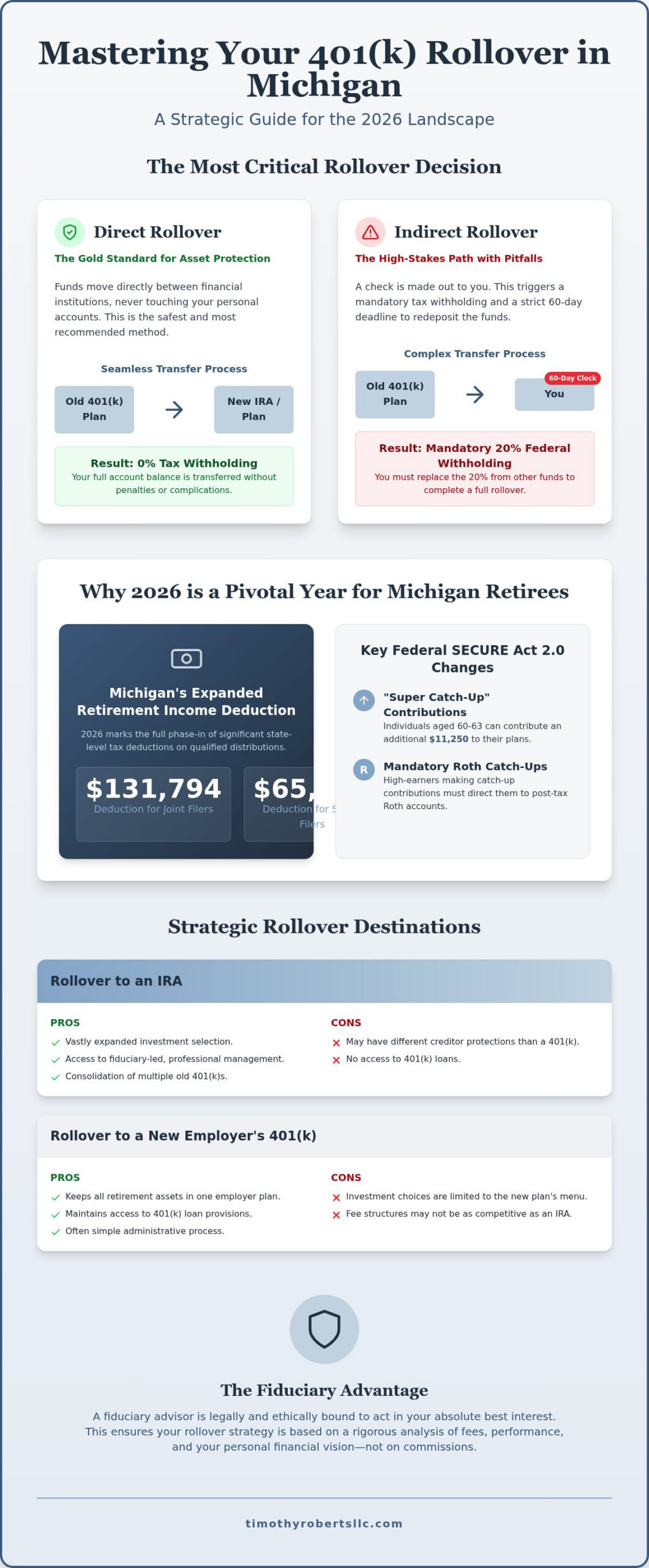
The year 2026 marks a significant milestone for Michigan’s tax environment. It’s the first year the state’s expanded retirement income deduction is fully phased in, allowing single filers to deduct up to $65,987 and married couples up to $131,794 on qualified distributions. This shift creates a fertile ground for retirement income planning that prioritizes tax efficiency. Additionally, the 2026 federal landscape introduces a super catch-up contribution of $11,250 for those aged 60 through 63. High-earners must also navigate new requirements that mandate catch-up dollars be directed to Roth accounts. These variables mean the timing of your rollover can significantly impact your long-term legacy and current liquidity.
The Fiduciary Standard in Asset Movement
Moving assets requires an expert strategist who operates under a fiduciary standard of care. Unlike commission-based models that might favor high-fee products, a fiduciary advisor evaluates whether a rollover is in your absolute best interest. This involves a rigorous analysis of fee structures and investment options. It also ensures compliance with the IRS one-rollover-per-year rule for indirect transfers, which remains a high-stakes administrative hurdle. By adhering to the 401k rollover rules michigan mandates, you ensure that your wealth transition is not just a transaction, but a deliberate step toward upward progression. This partnership focuses on depth over superficiality, treating your financial development as a journey rather than a simple exchange of accounts.
The Mechanics of a Direct vs. Indirect Rollover
Managing the movement of retirement capital requires a high degree of administrative rigor to avoid unintended tax consequences. When evaluating the 401k rollover rules michigan residents must follow, the choice between a direct and indirect transfer is the most critical decision in the execution phase. A direct rollover, often called a trustee-to-trustee transfer, is the gold standard for asset protection. It ensures that funds move seamlessly between institutions without the participant ever taking possession of the capital. In contrast, an indirect rollover involves the distribution of funds directly to you, triggering a high-stakes 60-day window and a mandatory 20% federal tax withholding. This withholding isn’t a fee but a prepayment of taxes that can create a significant liquidity trap if you don’t have the cash on hand to replace it during the rollover process.
Step-by-Step: Executing a Flawless Direct Transfer
To initiate a direct transfer, you’ll first contact your current plan administrator to secure a Letter of Intent or the specific distribution forms required. You must simultaneously establish a destination account, such as a traditional IRA or a new employer plan, with a fiduciary partner who understands your long-term legacy goals. The most vital detail is the check’s ‘Payable To’ line; it should be made out to the receiving institution ‘For the Benefit Of’ (FBO) your name. This specific phrasing prevents you from being taxed on the distribution before it reaches its new home. It’s a meticulous process, but it’s the only way to ensure your wealth evolution remains on a steady, upward trajectory.
Managing the 60-Day Indirect Rollover Risk
Navigating the 401k rollover rules michigan applies to indirect transfers requires careful timing and capital management. The indirect method is fraught with logistical complexity. Because the IRS requires the plan administrator to withhold 20% of the distribution for federal taxes, you’re left with only 80% of your actual balance in the form of a check. To complete a full rollover and avoid taxes on the withheld portion, you must use personal funds to bridge that 20% gap within the 60-day timeframe. While the IRS offers self-certification waivers for missed deadlines due to specific hardships, relying on these exceptions is a precarious strategy. Professional tax advising is indispensable here to ensure these movements are reported accurately on your return. Constructive receipt occurs when funds are made available to you without restriction, which immediately subjects the entire amount to potential taxation and penalties. If you’re feeling overwhelmed by these technical requirements, a comprehensive wealth review can help clarify your next steps.
Strategic Rollover Options: IRAs, New Plans, and the ‘Stay Put’ Analysis
Selecting the ultimate destination for your retirement capital is a defining moment in your financial narrative. While a new employer’s 401(k) might offer institutional pricing or ERISA-based creditor protections, it often lacks the granular control required for a high-net-worth strategy. Under the 401k rollover rules michigan retirees navigate in 2026, the choice of destination dictates your tax exposure and your ability to pivot as markets evolve. It’s about moving from a rigid, employer-defined structure to a flexible environment that supports your specific legacy goals.
Sometimes, the most strategic move is to leave your assets exactly where they are. This ‘Stay Put’ analysis is particularly vital for those considering the Rule of 55. If you separate from service in or after the year you turn 55, you may be able to take penalty-free distributions from that specific employer’s plan before reaching age 59½. Rolling those funds into an IRA would eliminate this flexibility, subjecting early withdrawals to a 10% federal penalty. Sophisticated investment portfolio management serves as the compass for this decision, ensuring your account structure aligns with your liquidity needs and long-term vision.
The IRA Advantage: Sophistication and Control
An Individual Retirement Account (IRA) offers an expansive universe of asset classes that standard mutual fund menus simply cannot match. You gain the ability to implement professional tax-loss harvesting and consolidate disparate old plans into one cohesive strategy. This centralization reduces administrative clutter and allows for a more rhythmic, intentional approach to wealth growth. By moving beyond the standardized options of a corporate plan, you create a bespoke financial roadmap that prioritizes your individual creative vision and professional stability.
The NUA Strategy: A High-Level Tax Intervention
For those holding highly appreciated company stock, the Net Unrealized Appreciation (NUA) strategy offers a high-level tax intervention. Instead of rolling the stock into an IRA where future withdrawals are taxed as ordinary income, you can move the shares directly to a taxable brokerage account. You’ll pay ordinary income tax only on the cost basis, while the appreciation is taxed at more favorable long-term capital gains rates. A single misstep in the 401k rollover rules michigan participants must follow could forfeit this benefit; turning a strategic tax win into a standard tax liability. This maneuver requires the precision of a craftsman to ensure the stock is distributed in-kind and the entire balance of the plan is emptied within a single tax year.
Michigan-Specific Tax Nuances and SECURE Act 2.0 Implications
The sophistication of a wealth strategy lies in its ability to adapt to regional tax codes. In 2026, the 401k rollover rules michigan residents must monitor are inextricably linked to the state’s landmark retirement tax phase-out. This isn’t merely an administrative update; it’s a structural shift that allows for greater retention of your hard-earned capital. By aligning your rollover with the Michigan Department of Treasury’s specific treatment of qualified distributions, you can transform a standard asset transfer into a high-level tax intervention. This period of legislative maturity offers a unique window to refine your portfolio’s organizational evolution.
Michigan’s Retirement Income Tax Landscape in 2026
The year 2026 represents a pivotal moment for Michigan’s tax environment. The expanded retirement income deduction is now fully phased in, allowing single filers to exempt up to $65,987 and joint filers up to $131,794 of qualified retirement income from the state’s 4.05% flat tax. While Michigan previously utilized a complex ‘Tier’ system based on birth years, the 2026 paradigm provides a much broader umbrella for those rolling assets into traditional IRAs or keeping them in qualified plans. Coordinating your state tax filings with professional oversight ensures you don’t overlook these significant deductions during the asset movement process. If you are navigating these changes, a bespoke retirement wealth plan can help ensure your strategy is fully optimized for the current Michigan landscape.
SECURE Act 2.0: 2026 Updates for Rollovers
Federal regulations add another layer of strategic depth to the 2026 landscape. Business owners and families should consider the refined 529-to-Roth-IRA rollover provisions, which allow for a $35,000 lifetime transfer of long-held education funds into retirement accounts, provided the 529 plan has been open for at least 15 years. For individuals who reached age 72 after December 31, 2022, the required minimum distribution age is 73 in 2026, though this will eventually shift to 75 for those born in 1960 or later. This delay in mandatory withdrawals creates an extended window for strategic Roth conversions. By converting traditional assets to Roth during the rollover phase, you can pay taxes at today’s known rates and shield future growth from both federal and Michigan state income taxes, ensuring a more stable upward progression for your legacy.
The Fiduciary Advantage: Integrating Your Rollover into a Comprehensive Wealth Strategy
A rollover serves as a powerful catalyst for upward progression, transforming a static employer-sponsored account into a dynamic engine for personal wealth. While administrative checklists often focus solely on the mechanics of the move, the true value lies in how these assets integrate into your broader financial roadmap. Mastering the 401k rollover rules michigan residents face in 2026 requires more than a simple transfer; it demands a visionary strategist who views your capital through a fiduciary lens. By moving beyond off-the-shelf solutions, you ensure that your assets aren’t just parked but are actively contributing to a narrative of partnership and multi-generational success. This carefully crafted intervention distinguishes a mere transaction from a deliberate step toward organizational evolution, bridging your individual creative vision with structured corporate capabilities.
Bespoke Portfolio Construction Post-Rollover
Many employer plans rely on standardized Target Date Funds that offer a one-size-fits-all approach to risk management. A sophisticated rollover allows you to pivot toward a risk-aligned portfolio that reflects your professional stability and long-term aspirational growth. This transition involves more than just a wider selection of equities; it requires continuous fiduciary monitoring and rhythmic rebalancing to maintain alignment with your specific goals. The intersection of aesthetics and functionality in a polished wealth roadmap ensures that your portfolio is as resilient as it is growth-oriented. By moving away from generic allocations, you gain the ability to implement high-level thinking that targets specific market opportunities while protecting against volatility. This steady, logical approach guides your portfolio from a high-level vision down to the practicalities of daily execution.
Legacy Planning: Beyond the Individual
Your rollover is a foundational element of your estate planning strategy. Adhering to the 401k rollover rules michigan applies to beneficiary designations is crucial, especially regarding the ’10-year rule’ for inherited IRAs under current federal law. This rule generally requires non-spouse beneficiaries to deplete the account within a decade, which can create a significant tax burden for your heirs if not managed with intellectual curiosity and foresight. Strategic distribution planning is essential to ensure that your wealth transfer remains a blessing rather than a liability. Whether you’re using rolled-over assets for charitable giving or funding education for the next generation, a high-end partner like Timothy Roberts & Associates, LLC ensures your legacy remains protected and intentional. We invite you to a strategic consultation to explore how a bespoke rollover can elevate your financial future and secure your family’s journey for years to come.
Designing Your Bespoke Financial Roadmap for 2026
The transition from an employer-sponsored plan to a customized wealth structure is a defining moment in your financial evolution. As we have explored, mastering the 401k rollover rules michigan retirees must navigate in 2026 requires a synthesis of federal legislative maturity and state-level tax optimization. By moving beyond standardized mutual funds and embracing the flexibility of a fiduciary-led strategy, you transform a simple asset transfer into a durable foundation for your multi-generational legacy. This period of legislative clarity offers a rare opportunity to align your personal creative vision with the structural rigor of a high-end financial architecture, ensuring your wealth evolution remains polished and intentional.
At Timothy Roberts & Associates, LLC, we offer the intellectual curiosity and business-minded rigor necessary to solve complex retirement challenges. With over 25 years of experience in the Michigan financial landscape, our team provides the integrated tax and investment advisory required for high-net-worth success. We invite you to Request a Strategic Consultation for Your 2026 Rollover to begin your journey toward upward progression. Let us help you convert the practicalities of today’s regulations into a bespoke roadmap that reflects your lifetime of achievement and secures your future growth.
Frequently Asked Questions
Is a 401(k) rollover to an IRA taxable in Michigan in 2026?
No, a direct rollover is a non-taxable event at both the federal and state levels. The funds maintain their tax-deferred status until you begin taking distributions from the new account. Because 2026 marks the full phase-in of Michigan’s retirement income deduction, future withdrawals will be subject to the expanded exemption limits of $65,987 for single filers or $131,794 for joint filers. This strategic movement ensures your assets grow without immediate tax friction.
What is the 60-day rule for 401(k) rollovers?
The 60-day rule applies to indirect rollovers where you receive a check directly from your plan administrator. You must deposit the full amount, including the 20% withheld for federal taxes, into a new qualified account within 60 calendar days. Failure to meet this deadline results in the distribution being treated as taxable income. Under the 401k rollover rules michigan residents follow, missing this window could also trigger state income tax liabilities and potential early withdrawal penalties.
Can I roll over my 401(k) while I am still working for the same company?
Yes, many plans allow for in-service distributions once you reach age 59½, even if you remain employed. This maneuver allows you to move a portion of your balance to an IRA for more sophisticated investment portfolio management while continuing to contribute to your employer plan. It’s a strategic intervention for those seeking to diversify their holdings or access broader asset classes before full retirement. Check your specific summary plan description for eligibility and any potential restrictions.
How do Michigan’s 2026 retirement tax rules affect my rollover?
Michigan’s 2026 tax landscape is exceptionally favorable, as the state has fully phased in the retirement income deduction for all retirees regardless of birth year. While the rollover itself is tax-neutral, the eventual distributions from your new account can be significantly shielded from the state’s 4.05% flat tax. Aligning your asset movement with these state-level exemptions is a core component of a bespoke financial roadmap, ensuring you retain a larger portion of your legacy and enjoy long-term financial stability.
What is the difference between a direct and indirect rollover?
A direct rollover moves funds directly between financial institutions, which is the gold standard for asset protection. An indirect rollover involves the plan administrator issuing a check to you, minus a mandatory 20% federal withholding. While the direct method is seamless and avoids tax complications, the indirect method requires you to replace that 20% withholding from personal funds within 60 days to complete a full rollover. Most fiduciary advisors recommend the direct approach to eliminate administrative risk and tax exposure.
Should I roll over my 401(k) into a Roth IRA or a Traditional IRA?
The choice depends on your current tax bracket versus your expected bracket in retirement. A Traditional IRA maintains tax-deferred status, while a Roth conversion involves paying taxes now to secure tax-free growth and withdrawals later. Given the 2026 SECURE Act 2.0 provisions requiring high-earners to make catch-up contributions on a Roth basis, many retirees are finding Roth conversions to be a strategic tool for managing long-term tax liabilities and enhancing their multi-generational legacy planning during the rollover process.
What happens to my 401(k) loan if I decide to roll over my account?
If you have an outstanding loan when you initiate a rollover, the remaining balance is typically offset and treated as a distribution. You generally have until the tax filing deadline, including extensions, for the year the offset occurs to roll over the loan balance to an IRA and avoid taxes. This Qualified Plan Loan Offset rule provides a longer window than the standard 60-day rule, but it requires careful coordination with your tax planning strategies to avoid unintended penalties and taxation.
Are there any 401(k) rollover limits I should be aware of in 2026?
There is no limit on the dollar amount you can move through a direct 401(k) rollover. However, you must be mindful of the IRS one-rollover-per-year rule, which restricts you to one indirect IRA-to-IRA rollover every 12 months. This limit does not apply to trustee-to-trustee transfers or 401(k)-to-IRA movements. Following the 401k rollover rules michigan mandates ensures that your organizational evolution remains compliant while maximizing the growth potential of your consolidated retirement assets and protecting your financial future.
