

Oct
Fiduciary Financial Advisor: How to Evaluate Advice, Fees, and Fit
What shows that a financial advisor will put your interests first: the fiduciary label, the way they’re paid, or how they explain their recommendations? If you’re considering a fiduciary financial advisor, the answer is more nuanced than a title alone. It helps to understand what fiduciary responsibility means in practice and how an advisor’s compensation and planning process shape the relationship.
It’s reasonable to want clear answers before making important financial decisions. You should be able to understand what an advisor is responsible for, how their business model works, and why a recommendation fits your circumstances. Comparing those details can make an initial conversation more productive and help you decide whether the relationship aligns with your needs.
This article explains the fiduciary standard in plain language, offers questions to clarify fees and potential conflicts, and outlines what to look for in a coordinated planning relationship. Timothy Roberts & Associates, LLC provides fee-only financial planning and wealth management, guided by the philosophy “Your Interest is Our Only Interest.” The goal is to support thoughtful decisions based on your priorities, not to promise particular investment results.
Key Takeaways
- Understand what fiduciary responsibility means in practice and why an advisor’s obligations matter before you share financial details.
- Look beyond the fiduciary label by considering compensation, potential conflicts, planning scope, communication, and fit.
- Use evaluation questions to assess a fiduciary financial advisor, and distinguish verifiable facts from impressions or performance claims.
- Prepare for an introductory conversation by writing down your priorities, questions, and difficult or time-sensitive financial decisions.
- Learn how Timothy Roberts & Associates, LLC combines independent, fee-only financial planning with fiduciary-focused wealth management and a client-centered philosophy.
What Does Fiduciary Financial Advice Mean for Your Financial Decisions?
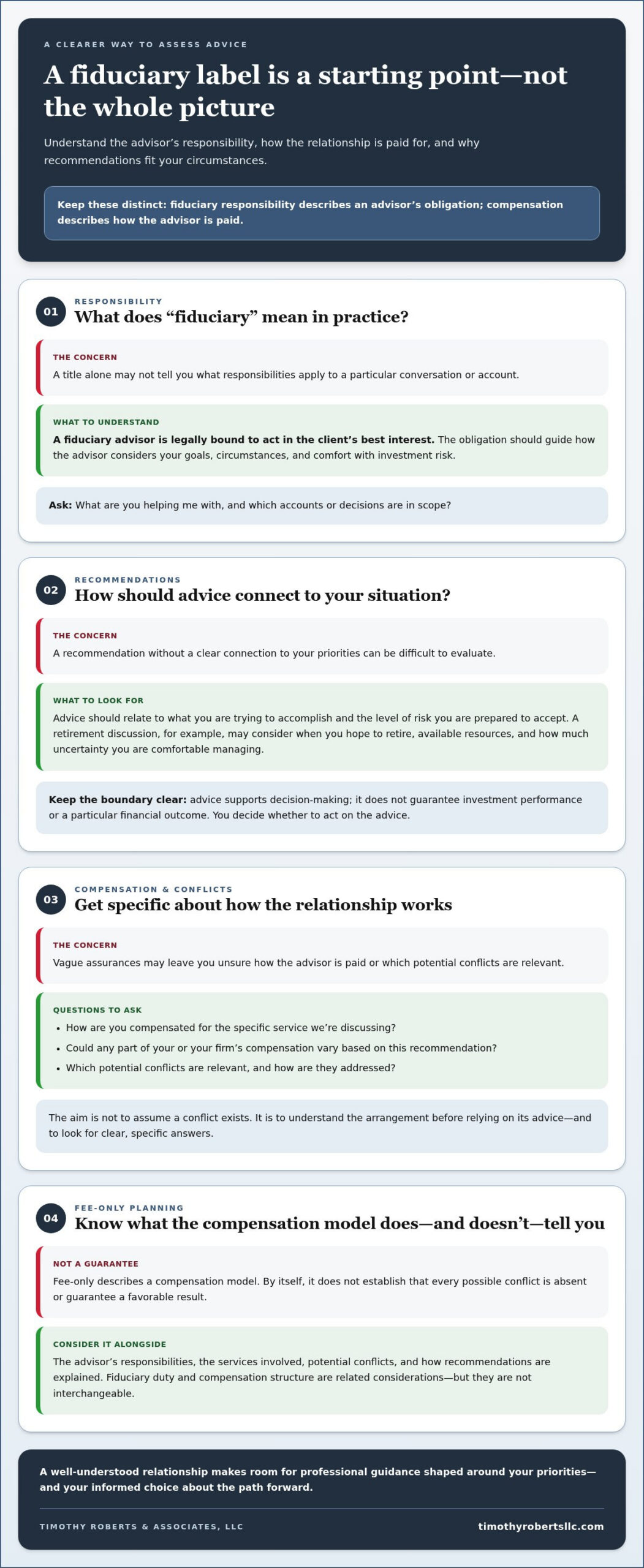
Before sharing details about your savings, income, or family priorities, it’s reasonable to understand an advisor’s responsibilities. “Fiduciary” signals an obligation, not simply an appealing job title or a broad description of financial services. In plain language, a fiduciary advisor is legally bound to act in the client’s best interest. A general overview of the term appears in What is a Fiduciary?
Fiduciary responsibility means placing the client’s interests at the center of advice and recommendations. That obligation guides how an advisor considers your goals, circumstances, and comfort with investment risk. It doesn’t promise that an investment will perform well or that a financial plan will produce a particular outcome. Markets and personal circumstances can change, so advice supports decision-making rather than guaranteeing results.
What does acting in a client’s best interest mean?
Recommendations should connect to what you’re trying to accomplish and the level of risk you’re prepared to accept. For example, a retirement planning discussion may consider when you hope to retire, the resources available, and how much uncertainty you’re comfortable managing. The recommendation is guidance, not a guarantee. You decide whether to act on advice, while the advisor remains responsible for providing advice consistent with the fiduciary obligation.
Why should you clarify an advisor’s role?
Financial relationships can involve different services, accounts, and kinds of recommendations. A title alone may not explain which responsibilities apply to a particular conversation or account. Ask what the advisor is helping with, which accounts or decisions are in scope, and how the relationship works. Clear answers help you understand where the advice applies and where you may need additional information.
Look for a specific explanation of the advisor’s role and the services covered by the relationship, rather than relying on a label alone. Knowing the scope gives you a stronger basis for weighing recommendations and asking informed follow-up questions.
Fiduciary advice can bring structure to complex decisions, but it doesn’t remove uncertainty or transfer your decision-making responsibility. A well-understood relationship makes room for both professional guidance shaped around your priorities and your informed choice about the path forward.
This site is published for residents of the United States only. Not all of the products and services referenced on this site may be available in every state and through every advisor listed.
The information in this material is not intended as tax or legal advice. Please consult legal or tax professionals for specific information regarding your individual situation.
Securities offered through Cetera Financial Specialists LLC (doing insurance business in CA as CFGFS Insurance Agency), member FINRA/SIPC. Advisory services offered through Cetera Investment Advisers LLC. Cetera entities are under separate ownership from any other named entity.
How Fiduciary Responsibility Shapes Recommendations, Conflicts, and Compensation
A best-interest duty should shape how advice is developed, not serve as a promise about what happens next. Recommendations can connect a financial decision to your goals, time horizon, and comfort with risk. Investments involve uncertainty, however, and even carefully considered advice can’t guarantee performance or a particular financial outcome.
Fiduciary responsibility describes an advisor’s obligation; compensation describes how the advisor is paid. Both matter when you assess a relationship, but neither substitutes for understanding the other. A clear conversation about recommendations, compensation, and potential conflicts gives you more useful information than a label alone.
How can you understand compensation and potential conflicts?
Ask how the advisor is compensated for the specific service you’re discussing, and request an explanation in plain language. If the conversation involves an investment recommendation, ask whether any aspect of the advisor’s or firm’s compensation could vary based on that recommendation. You can also ask which potential conflicts are relevant and how they’re addressed. The aim isn’t to assume a conflict exists, but to understand the relationship before relying on its advice.
Pay attention to whether the answers are specific. If you’re discussing investment management, can the advisor explain how compensation relates to that service and identify relevant conflicts? If you’re discussing broader financial planning, is it clear how the planning is paid for? Understanding these details helps you compare advisory arrangements without relying on assumptions or vague assurances.
What does fee-only planning tell you, and what doesn’t it tell you?
Fee-only describes a compensation model. By itself, it doesn’t establish that every possible conflict is absent or guarantee a favorable result. It’s one meaningful detail to consider alongside the advisor’s responsibilities, the services involved, and the way recommendations are explained. Fiduciary duty and compensation structure are related considerations, but they aren’t interchangeable.
Timothy Roberts & Associates provides fee-only financial planning, with no commissions. This clarifies the firm’s compensation model for its planning services, while its fiduciary focus reflects the responsibility guiding advice. Neither detail predicts investment performance. A careful evaluation considers how these elements work together and whether the explanations give you enough information to make informed decisions.
If you’re considering a fiduciary financial advisor Farmington Hills MI, raise questions about compensation and conflicts early. You might ask, “How are you paid for this service?” “What conflicts could relate to the recommendations we discuss?” and “How are those conflicts managed?” Direct questions make for a more transparent discussion and help clarify what the advice covers.
For a closer look at an approach built around fee-only planning and wealth management, explore Timothy Roberts & Associates’ financial planning approach as you consider what matters in an advisory relationship.
How to Compare Fiduciary Financial Advisors Beyond the Label
A fiduciary label is a starting point, not a complete comparison. To understand whether an advisory relationship fits, look at four connected elements: responsibilities, services covered, how compensation is explained, and whether the planning process suits your needs. Clear, specific answers are more useful than broad claims about performance or promises of results.
Use this framework to organize what you learn. Compare verifiable details, such as the stated scope of services and compensation model, with personal-fit considerations, such as whether explanations feel clear and collaborative.
| Area to compare | What to understand | Useful signal |
|---|---|---|
| Fiduciary duty | Which services and accounts the advisory relationship covers | Responsibilities are explained in clear, specific terms |
| Service scope | Whether advice addresses your stated financial priorities | The planning approach connects relevant decisions rather than treating each in isolation |
| Compensation clarity | How the advisor is paid for the services being discussed | The explanation is direct and helps you understand relevant conflicts |
| Planning approach | How recommendations and changing circumstances are handled | Communication feels understandable, collaborative, and suited to your needs |
Which questions clarify an advisor’s responsibilities?
Ask which services and accounts are part of the relationship, then ask how recommendations reflect your goals, circumstances, and comfort with risk. You might also ask how relevant conflicts are explained and addressed. These questions help distinguish a clear description of the relationship from a general assurance. A broader financial advisor selection guide can offer additional criteria for evaluating an advisory relationship.
How can you assess planning fit and communication?
Consider whether the planning conversation reflects the priorities you’ve shared and can account for changes in your circumstances over time. Ask how recommendations will be presented, how you’ll discuss decisions, and how the advisor communicates about reviews. The goal isn’t to find a process that promises certainty, but one you can understand and engage with as your financial life evolves.
Separate facts from impressions as you compare. A firm’s stated compensation model or service scope can be checked against its disclosures. By contrast, “this feels like a good fit” is a personal judgment, not evidence of investment performance. Both kinds of information matter, but they answer different questions. Don’t treat past results, confident language, or a polished presentation as assurance of future outcomes.
If you’re evaluating a fiduciary financial advisor Farmington Hills MI, take notes and compare answers using the same categories. Which responsibilities are clear? What services are included in the discussion? Can you follow the compensation explanation? Do you feel heard, and can you explain the planning approach in your own words? A thoughtful comparison helps identify what you still need to understand before deciding on a next step.
What to Prepare Before Meeting With a Fiduciary Financial Advisor
A little preparation can make an initial financial planning conversation more focused. You don’t need a perfect financial file or a complete plan. The aim is to give the advisor a useful picture of your priorities, current circumstances, and the decisions you want help thinking through.
- Write down your priorities. Note what matters most now, such as evaluating retirement timing, coordinating investments, or planning for education costs. Add longer-term goals too, so the discussion can connect immediate choices with the direction you want your finances to take.
- Sketch a high-level financial inventory. List major sources of income, savings and investment accounts, debts, workplace benefits, and significant ongoing commitments. Include existing retirement or investment plans when relevant. A summary can frame the conversation; you don’t need to assemble every document in advance.
- Identify decisions that feel difficult or time-sensitive. You may be weighing when to retire, how to approach a major expense, or how competing priorities fit available resources. Describe what makes the decision challenging and what information you still need.
- Prepare questions about the relationship. Ask which services and accounts are in scope, how recommendations will reflect your goals and risk tolerance, how compensation works, and how the advisor communicates about recommendations and reviews.
- Share information thoughtfully. Bring relevant information in a way that protects sensitive details. Avoid sending account credentials or unnecessary personal information, and use a secure method when sharing financial documents.
Which financial details help frame the conversation?
A concise inventory is usually more useful than a stack of unsorted paperwork. Group information by income, assets, liabilities, benefits, and major commitments. For instance, you might note workplace retirement savings, an individual investment account, a mortgage, and a planned family expense. Include context that affects your goals, such as a potential career change or an upcoming retirement decision.
How should you define goals and questions in advance?
Separate near-term decisions from longer-range objectives, then mark which topics feel most pressing. If retirement income is central to your plans, the retirement income planning guide can help you think through questions to raise. Keep the list flexible; the conversation may reveal priorities you hadn’t considered.
Before you meet, choose the questions you most want answered and consider what a useful response would sound like: clear, specific to your circumstances, and understandable without specialized financial language. This preparation helps you assess both the recommendations and whether the planning process feels collaborative and relevant to your goals.
To take a next step, explore financial planning with Timothy Roberts & Associates and bring your priorities and questions into the conversation.
How Timothy Roberts & Associates Approaches Fiduciary Financial Planning
Once you understand fiduciary responsibility and how to evaluate an advisory relationship, consider how those principles shape a firm’s planning approach. Timothy Roberts & Associates, LLC provides independent, fee-only financial planning and fiduciary-focused wealth management. Its advisors are legally bound to act in the client’s best interest. The firm’s philosophy, “Your Interest is Our Only Interest,” reflects a client-centered approach to decisions involving goals, circumstances, and risk tolerance.
A client-centered approach to financial planning
Planning is most useful when it reflects the individual, not a generic template. Conversations can bring relevant financial priorities into view and help connect decisions across a person’s financial life. The firm reports more than 30 years of financial-management experience. That experience informs its work, while recommendations remain subject to uncertainty and don’t guarantee investment performance, income, or other financial outcomes.
What to expect from the firm’s planning scope
Timothy Roberts & Associates offers financial planning, retirement planning, and wealth and investment management. Depending on a client’s goals, planning may also address estate and legacy planning, risk management, or education funding. The firm also offers tax services and tax planning strategies. This material is not tax or legal advice. A planning conversation can help clarify which financial priorities are most relevant to the decisions at hand.
For someone considering a fiduciary financial advisor Farmington Hills MI, the firm’s independent, fee-only model is one practical detail to understand alongside its responsibilities and planning scope. Fee-only describes compensation, not a promise of results. A thoughtful discussion can help you understand how the firm’s approach relates to your goals and the questions you’ve prepared.
A useful next step is to bring your priorities and questions into a planning conversation, then consider whether the scope and communication align with what you need. You can explore the firm’s financial planning approach as you decide how to move forward.
This site is published for residents of the United States only. Not all of the products and services referenced on this site may be available in every state and through every advisor listed.
The information in this material is not intended as tax or legal advice. Please consult legal or tax professionals for specific information regarding your individual situation.
Securities offered through Cetera Financial Specialists LLC (doing insurance business in CA as CFGFS Insurance Agency), member FINRA/SIPC. Advisory services offered through Cetera Investment Advisers LLC. Cetera entities are under separate ownership from any other named entity.
Take a Thoughtful Next Step
Financial decisions rarely arrive one at a time. A change in work, family priorities, or retirement timing can shift how different parts of a plan fit together. You don’t need every question resolved before beginning. Start with the decision that would benefit most from a clearer perspective, then use it to shape a focused planning conversation.
As you consider a fiduciary financial advisor Farmington Hills MI, look for a relationship that gives you room to explain what matters, understand the advice being offered, and make decisions at your own pace. A productive conversation should make complex choices easier to consider, not pressure you toward an immediate answer. Your priorities may change, and your planning can adapt as they do.
Explore a fiduciary-focused financial planning approach with Timothy Roberts & Associates. Bring your priorities and questions to a planning conversation to discuss how the firm’s approach may support your next financial decision.
Frequently Asked Questions
Can a fiduciary financial advisor guarantee investment returns?
No. A fiduciary obligation doesn’t remove market uncertainty or make investment performance predictable. Be cautious of anyone presenting returns as certain. Instead, ask how a recommendation relates to your goals, risk tolerance, and time horizon, and what risks could affect it. Money intended for a near-term expense may call for different considerations than funds meant for a distant goal. Planning can guide decisions, but outcomes aren’t guaranteed.
Is every financial advisor a fiduciary for every service they provide?
No. Don’t assume a title alone tells you which responsibilities apply to every service or account. Ask the advisor to explain their role in the specific relationship you’re considering, including what advice is covered and where responsibilities may differ. This is especially useful if you’re discussing both investment recommendations and broader planning. A clear explanation helps you understand the scope before relying on guidance.
How often should I review my financial plan with an advisor?
Review your plan when a meaningful change could affect your priorities or resources, and agree with your advisor on a review rhythm suited to your situation. A new job, inheritance, major purchase, or change in retirement timing may warrant revisiting assumptions sooner. You can also check whether your goals still reflect what matters to you. A review is an opportunity to update the plan, not a guarantee of a particular outcome.
Can a financial advisor coordinate planning with my tax or legal professionals?
Coordination may help keep financial decisions aligned, but each professional’s role should be clear. An advisor can help identify financial planning questions that intersect with tax or legal matters, while tax and legal professionals address advice within their expertise. For example, a planned asset transfer may affect investment and estate considerations. Share relevant information securely and clarify who is responsible for each recommendation. The material here isn’t tax or legal advice.
What should I bring to an initial financial planning conversation?
Bring a concise picture of your finances and the questions you most want answered. A benefits summary, account statements, debt overview, or notes about a major upcoming decision can add useful context. You don’t need to gather every record before speaking. Avoid sending passwords or sensitive details through unsecured channels, and use a secure method to share documents if they’re needed for the discussion.
Does fee-only financial planning mean an advisor has no potential conflicts?
No. Fee-only describes how an advisor is compensated; it doesn’t mean every potential conflict is impossible. Ask how compensation relates to the particular service you’re discussing, whether relevant conflicts could arise, and how they’re explained or managed. Consider the answers alongside the advisor’s responsibilities and the scope of advice. Clear, specific explanations give you a better basis for understanding the relationship than the compensation label alone.
