

Oct
Commission-Free Advisory: What Investors Should Know in 2026
What if “commission-free” describes the investment product, not the advice guiding your decisions? That distinction matters when you’re considering commission-free advisory in 2026. A trade or fund may carry no commission while you still pay an advisor through an asset-based fee, a fixed planning fee, or another arrangement.
It’s reasonable to want clarity. You should know who compensates your advisor, what that compensation covers, and whether product recommendations could create conflicts of interest. The label alone won’t answer those questions, and “commission-free” doesn’t necessarily mean the advice is free.
This article explains the difference between commission-free products and commission-free advisory relationships, outlines common ways advisors are paid, and gives you practical questions for comparing fees, services, and disclosures. It also explains why the scope of planning matters: investment oversight is only one part of a relationship that may include retirement income planning, tax advising, and broader financial planning. The goal is to help you assess the full arrangement and choose support that fits your long-term financial and retirement goals.
Key Takeaways
- Commission-free advisory is a phrase to clarify, not a standardized fee category. Ask how the advisor is compensated and whether product commissions may apply.
- Compare compensation models by what they cover, including planning, investment oversight, and ongoing support, rather than choosing by fee label alone.
- Review written disclosures, fee schedules, and agreements. Use Form ADV and FINRA BrokerCheck where applicable to inform your due diligence.
- Ask how the advisor’s duties and potential incentives relate to recommendations so you can assess the relationship more clearly.
- Match the scope of support to your priorities, such as retirement income, investment management, tax planning, and estate and legacy planning.
What Does Commission-Free Advisory Mean for an Investor?
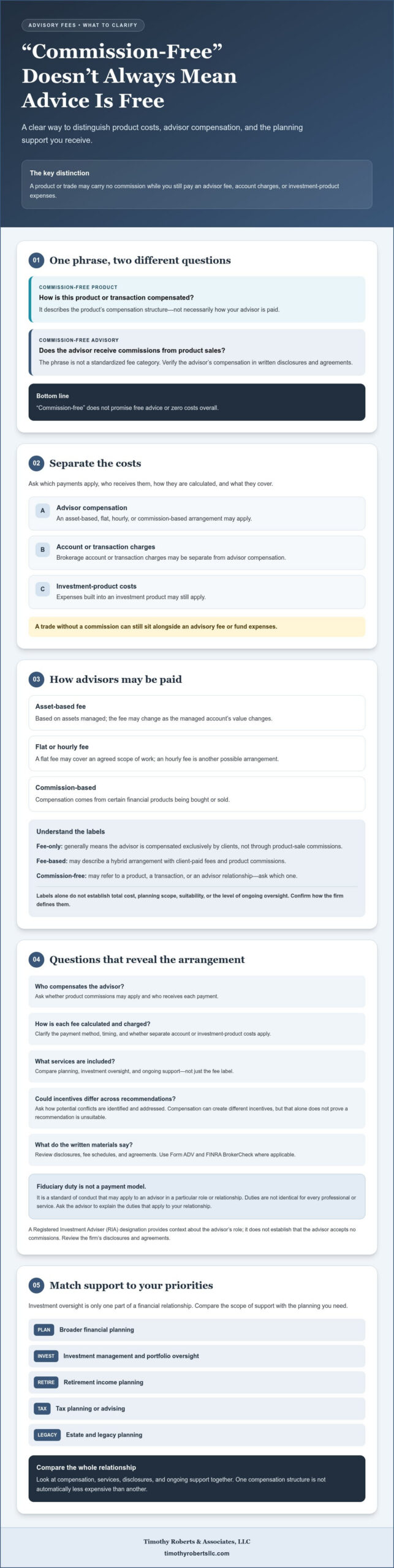
Commission-free advisory generally means an advisor provides advice without receiving commissions from product sales. But the phrase isn’t a precise description of every advisory relationship. Verify how the advisor is paid and what the written disclosures say. It doesn’t promise free advice or zero costs overall.
Keep three types of costs distinct: compensation paid to the advisor, charges connected with a brokerage account or transaction, and costs built into an investment product. A brokerage may offer trades without a commission, for example, while you still pay an advisory fee or fund expenses. A product described as commission-free tells you about that product’s compensation structure, not necessarily how the advisor is paid.
Commission-free products describe how a product is compensated; commission-free advisory describes how an advisor is paid for a relationship, and the latter needs verification. If the advisor is a Registered Investment Adviser (RIA), that designation provides context about the advisor’s role, but it doesn’t establish that the advisor accepts no commissions. Review the firm’s disclosures and agreements to understand the specific arrangement.
Does commission-free advisory mean financial advice is free?
No. Advisory, financial planning, account, or investment management fees may still apply, even if product-sale commissions don’t. Ask who receives each payment, how it’s calculated, what services it covers, and when it’s charged. Check whether separate account or investment-product costs may apply as well. One compensation structure isn’t automatically less expensive than another. Compare the full cost with the services and ongoing support you’ll receive.
How is commission-free advisory different from fee-only advice?
Fee-only generally means the advisor is compensated exclusively by clients, not by commissions from product sales. Confirm the definition against the firm’s disclosures and agreement. Commission-free is less precise: ask whether it refers to a particular product, transaction, or the advisor’s entire compensation. Fee-based is different again. It can describe a hybrid arrangement where the advisor charges client fees and may also receive product commissions.
These labels describe payment, not the full value or suitability of advice. Before deciding, ask how compensation relates to the planning you need, from portfolio oversight to retirement income planning, and which services are included. Clear answers make it easier to assess incentives and compare relationships on their actual terms.
How Financial Advisors Are Paid: Fees, Commissions, and Fiduciary Duties
Compensation tells you how an advisor is paid, not what services you’ll receive or what duties apply. An advisor might charge a fee based on assets managed, a flat fee for an agreed scope of work, or an hourly fee. A commission-based arrangement pays the advisor when certain financial products are bought or sold. Details vary, so look beyond the label to the agreement, payment source, calculation method, and services included.
Each model can create different incentives worth understanding. An asset-based fee may change as the managed account’s value changes, while a commission may depend on a product transaction. Neither fact alone proves that a recommendation is unsuitable or that an advisor has acted improperly. Ask how potential conflicts are identified and addressed, and whether compensation could differ across the options being considered.
What is the difference between fee-only, fee-based, and commission-based advice?
Fee-only generally means the advisor is paid by clients and doesn’t receive product commissions. Fee-based may mean the advisor receives client-paid fees and commissions, depending on the relationship. Commission-based generally means compensation comes from product transactions. Because firms may use these terms differently, verify them in disclosures. A label alone won’t tell you the total cost, planning scope, or level of ongoing portfolio oversight.
What does fiduciary duty tell you about an advisor?
A fiduciary duty is a standard of conduct that may apply to an advisor in a particular role or relationship. It’s not a payment model, and obligations aren’t identical for every professional or service. Ask the advisor to explain the capacity in which they act for each recommendation and what duties apply. Review current SEC Investment Adviser Public Disclosure information and the firm’s Form ADV for details about services, compensation, and conflicts.
For background on checking an investment professional’s history and asking informed questions, consult FINRA’s guide to choosing an investment professional. Consider the advisor’s disclosures alongside your discussions and written agreements.
Compensation disclosure helps you understand an advisor’s incentives; it doesn’t, on its own, predict the quality of the advice. Use that information to ask how recommendations are made and how the work supports your goals. For information about planning and investment support, review the firm’s financial planning and investment management services, then ask directly about applicable compensation and disclosures.
Commission-Free Advisory Compared With Other Advisor Compensation Models
A useful comparison looks beyond the label to the payment source, what triggers a charge, and what work the advisor agrees to provide. “Commission-free advisory” isn’t a standardized fee category. Treat it as a prompt to clarify the arrangement, then compare the written terms.
| Arrangement | Payment source and possible structure | Services to clarify | Questions to ask |
|---|---|---|---|
| Commission-free advisory | Phrase that may indicate no product-sale commissions; other advisory or account fees may apply. | Planning, investment advice, and ongoing oversight may vary. | Does this apply to the full relationship or only certain products? What other charges may apply? |
| Asset-based fee | Client pays a fee calculated by reference to assets managed. | Investment management and any included planning or reviews. | Which assets are included, and what services come with the fee? |
| Flat or hourly fee | Client pays a set fee for defined work or pays for time spent. | Scope, duration, follow-up, and any work outside the agreed engagement. | What is included, and what would involve an additional charge? |
| Commission-based or fee-based | Compensation may come from product transactions, client fees, or both, depending on the relationship. | Advice related to products, planning, and ongoing account support. | Who pays the advisor, when is compensation earned, and can it vary by product? |
Which compensation questions reveal the practical differences?
Ask whether compensation comes from you, a product provider, or more than one source. Find out whether charges vary by account, product, transaction, or service. Request a clear description of the work covered, including whether portfolio monitoring or planning is ongoing. Confirm how often oversight occurs and whether any services fall outside the agreed scope.
Can commission-free advice still involve costs or conflicts?
Yes. No product commission doesn’t necessarily eliminate advisory or account fees, and commission-free products don’t remove every potential conflict. Ask about referral arrangements and other compensation, then check how the firm describes potential conflicts in its disclosures. These are issues to understand, not proof of misconduct.
There can be trade-offs across models. A fee tied to managed assets may align payment with ongoing portfolio oversight, while a flat or hourly arrangement may make the engagement’s scope more explicit. Transaction-based compensation may connect payment to a purchase or sale. None guarantees lower total costs or better results. Compare the full service, its payment terms, and its fit with your needs before drawing conclusions.
How to Evaluate a Commission-Free Advisory Relationship
A careful review turns a broad label into a clearer picture of the relationship. Use these steps to connect your financial priorities with the advisor’s role, compensation, and documented services. The term commission-free advisory alone can’t establish what you’ll pay or what support you’ll receive.
- 1. Define what you need. List your priorities, such as investment management, tax planning, or retirement income. Decide whether you need a one-time plan or ongoing guidance. If retirement income is a central concern, identify the questions you want an advisor to address, including how income needs fit into your broader financial plan.
- 2. Ask how compensation works across the relationship. For each service and account under consideration, ask who pays the advisor, how compensation is calculated, and when it applies. Find out whether product commissions, referral compensation, or other payments may be involved.
- 3. Clarify the advisor’s capacity and duties. Ask which fiduciary duties apply to each service and in what capacity the advisor acts. Request a plain-language explanation of how recommendations are developed and how potential conflicts are addressed.
- 4. Connect the services to your goals. Ask how the proposed plan coordinates investments, taxes, and retirement income. Confirm whether ongoing portfolio oversight is included, how often the plan is reviewed, and what might fall outside the agreed scope.
- 5. Review documents and public records. Read the current Form ADV, applicable fee disclosures, fee schedules, and the written advisory or planning agreement. Check the firm through SEC Investment Adviser Public Disclosure and use FINRA BrokerCheck when relevant to the professional’s registration or background. Confirm that the documents apply to the specific advisor, service, and account you’re considering.
- 6. Reconcile the paperwork with the conversation. Compare written fees, services, and conflict disclosures with what you were told. Ask for clarification if the agreement is silent or the wording differs. Keep the answers and documents together so you can make a considered comparison.
Public records and registration tools are useful research, not a recommendation. They can provide background, but they can’t determine whether an advisor’s services fit your circumstances or predict future outcomes. Fit depends on your goals, the proposed relationship, and the details of the advice.
For a clearer view of how a firm describes its planning and compensation, ask Timothy Roberts & Associates, LLC about its services, fees, and disclosures.
Choosing Advisory Support for Retirement Income and Long-Term Planning
The most useful advisory relationship is one whose services fit your financial priorities and whose compensation is clear. A commission-free label may start the conversation, but it can’t tell you whether the advisor’s work covers the decisions you need to make over time.
When might coordinated retirement planning matter more than a fee label?
Retirement decisions often connect. Investment choices affect the resources available for withdrawals, while the timing and structure of income can have tax implications. Estate and legacy goals may add another layer. Ask whether the advisor can coordinate the services relevant to your situation, and confirm what’s included in writing. Tax advising and wealth planning can help you consider how tax decisions relate to broader financial priorities.
The right scope depends on your goals and circumstances, not on a single fee label. Timothy Roberts & Associates, LLC offers asset-based investment management and fixed-fee financial planning. These describe compensation structures, but they shouldn’t be taken as a claim that the firm is commission-free or fee-only. Ask about current compensation, applicable disclosures, and which services each arrangement includes.
Consider the trade-offs. Clear compensation disclosures can help you understand how an advisor is paid and assess potential incentives. A service scope tailored to your needs can support more coordinated planning. A label without clear terms, however, may leave questions about total costs, ongoing oversight, or work outside the arrangement. No payment model guarantees lower costs, stronger advice, or better outcomes.
What is a sensible next step before choosing an advisor?
Prepare a concise picture of your goals, current accounts, and questions about compensation. Ask how recommendations connect investments, retirement income, and taxes, then compare the written service scope, fee terms, and disclosures before making a commitment. Take time to assess both the relationship and the work it’s designed to support.
If you’d like to explore whether the firm’s financial planning and investment management services fit your priorities, discuss your financial planning needs and ask about current compensation and disclosures.
Choose Advice That Supports Your Next Chapter
The phrase commission-free advisory is only a starting point. To understand the relationship, confirm who pays the advisor, what other charges may apply, and which planning and investment services are included. Compare those written terms with the support you need rather than assuming one compensation model is always less costly or more suitable.
For long-term and retirement goals, consider how investment management, retirement income planning, tax advising, and estate and legacy planning may fit together. Timothy Roberts & Associates describes its advisors as fiduciaries who tailor strategies to clients’ goals and risk tolerance, and the firm reports more than 25 years of experience. Ask about current compensation, disclosures, and the scope of any proposed arrangement to make an informed comparison.
A thoughtful conversation can help clarify your priorities and the guidance you’re seeking. Discuss your financial planning needs and take the next step with greater confidence.
Frequently Asked Questions
What is the difference between fee-only and commission-free advisory?
Fee-only generally means the advisor is compensated by clients and doesn’t receive product-sale commissions. Commission-free is less specific: it might describe a particular product or transaction rather than the advisor’s entire relationship with you. Check the firm’s current disclosures and agreement to confirm the meaning. Neither label alone tells you the complete cost, the planning services included, or the extent of ongoing investment oversight.
Can a fee-based financial advisor receive commissions?
Yes. Fee-based commonly describes an arrangement in which an advisor may receive client-paid fees and product commissions, depending on the services and products involved. Ask whether commissions apply to any recommendation being discussed, who pays them, and whether compensation differs across options. Review the written disclosures and agreements to confirm the advisor’s explanation. The term “fee-based” alone doesn’t establish total costs or determine whether a recommendation fits your needs.
How do I check how a financial advisor is compensated?
Ask the advisor to explain each source of compensation across the services and accounts you’re considering. Compare the explanation with the current Form ADV, written fee disclosures, fee schedule, and advisory or planning agreement. SEC Investment Adviser Public Disclosure can provide information about investment advisers; FINRA BrokerCheck may be relevant for checking a broker’s background. These resources inform your research, but they don’t determine whether an advisor is right for you.
Does commission-free advisory eliminate conflicts of interest?
No. Even without product-sale commissions, an advisory relationship may involve other fees, referral arrangements, or incentives relevant to your decision. Ask what potential conflicts exist, how they’re addressed, and where they’re described in the firm’s disclosures. A possible conflict isn’t proof of misconduct, but it’s worth understanding before you engage an advisor. Consider the disclosures alongside the services offered and how recommendations are made.
Is commission-free advisory a good fit for retirement planning?
It can be, but the label alone can’t show whether an arrangement suits your retirement needs. Consider whether the services address investment management, retirement income, tax planning, and the level of ongoing guidance you want. Ask what’s included, how the advisor is compensated, and whether the written terms match your expectations. Compare the complete service and disclosures with your goals rather than choosing solely on the presence or absence of commissions.
To discuss your financial planning priorities, contact Timothy Roberts & Associates and ask about the services, compensation, and disclosures relevant to your needs.
