

Sep
Managing Financial Anxiety About Market Volatility: A Practical Guide
The most important decision during a volatile market may be the one you choose not to make in the heat of the moment. Managing financial anxiety about market volatility starts with recognizing that headlines can intensify worry without changing your long-term goals or the reasons behind your investment plan.
If you’re weighing whether to sell, hold, or adjust your investments, the uncertainty can feel especially pressing when you may need the money for retirement. It’s understandable to want a clear answer. But reacting to every market swing can pull you away from a strategy built around your goals, time horizon, and comfort with risk.
This guide offers a repeatable way to pause, check the facts, and decide whether a change is warranted. You’ll learn how to set boundaries around market news, identify changes that merit a plan review, and prepare useful questions for a financial advisor. The aim isn’t to predict the market or avoid every loss. It’s to make considered choices that remain connected to your broader financial plan.
Key Takeaways
- Market volatility describes price changes; a decline alone doesn’t determine whether an investment plan still fits your needs.
- Separate verified account information from predictions and fears before deciding whether to make a change.
- Selling and holding aren’t universally right or wrong. Weigh each response against your goals, time horizon, and risk tolerance.
- For managing financial anxiety about market volatility, use a repeatable process: pause, name the concern, review your plan, and assess whether action is warranted.
- If worry keeps raising unanswered questions, an advisor can help review how your investments align with your goals and retirement income needs.
Why Market Volatility Can Trigger Financial Anxiety
Worry during a market downturn doesn’t mean you made a poor financial choice. When account values shift, it’s natural to wonder what that means for your plans, especially if the money represents years of saving or supports a goal that feels close.
Market volatility is the degree to which investment prices rise and fall over time. Volatility describes how prices move, not where they will go next or whether a decline will become permanent. A lower account value may reflect a temporary market change, but investments can also lose value permanently. The distinction depends on the investments and circumstances, not the headline alone.
For another perspective on responding to market shifts across life stages, watch this video from Morningstar, Inc.:
How uncertainty and headlines amplify investment worry
Frequent updates can keep your attention fixed on short-term price movements. A dramatic loss or urgent prediction may feel more immediate than a long-term plan, even when the news doesn’t answer the personal question that matters: does the plan still fit? Behavioral economics explores how people make decisions under uncertainty, including why a potential loss can feel especially powerful. Recognizing that influence can help create space between a headline and a financial decision.
A market update is information, but it isn’t automatically a reason to change your investment strategy. Before acting, identify whether the news changes something about your own goals, cash needs, or circumstances.
Why retirement timelines change the emotional context
Money needed soon can carry a different weight from investments intended to support goals years away. If you expect to draw from savings in the near term, a downturn may raise practical questions: which assets would fund withdrawals, and how does that approach fit your broader plan? Without a considered withdrawal strategy, market changes can feel more consequential because the next step is unclear.
A retirement income plan can connect savings, expected withdrawals, goals, and time horizon. A retirement income planning guide can offer more context on how income needs fit into retirement planning. Managing financial anxiety about market volatility begins with understanding what the movement means for your own timeline, rather than assuming every price change calls for the same response.
How to Separate Market Facts From Fear-Driven Decisions
A falling account balance is an observable fact. “My retirement plan is no longer viable” is an interpretation, and “the market will keep dropping” is a prediction. Separating these statements helps you see what you know, what you fear, and what still needs to be checked before acting.
Volatility describes the extent of price movement, not a reliable forecast of what prices will do next. A decline by itself doesn’t show whether your portfolio is suited to your plan. That assessment also depends on your goals, time horizon, liquidity needs, and comfort with risk. The SEC’s guide to understanding investment risk can help put market risk in the context of investment goals.
Recognize the difference between a feeling and a financial signal
When an update creates urgency, pause and name the concern. Then write down the specific decision it seems to demand, such as selling an investment or changing an allocation. This turns a vague sense of alarm into a question you can examine.
Next, separate account information you can verify from commentary and hypothetical scenarios. Check what changed in your portfolio, then ask whether it reveals a concrete mismatch with your plan. A news update may warrant attention, but it doesn’t have to dictate an immediate decision.
Use your investment plan as the reference point
Review the intended purpose and time horizon of each major account. Consider whether the money supports a near-term need, a longer-range goal, or both. Then ask whether your circumstances have changed. A new income need, a shift in retirement timing, or a different need for accessible savings may matter more than market movement alone.
- Goals: What is this account meant to support?
- Time horizon: When might you need to use the money?
- Liquidity: Are expected withdrawals accounted for?
- Risk tolerance: Does the investment approach still feel appropriate for your circumstances?
If your answers remain consistent with your plan, that’s useful context, though it doesn’t guarantee an outcome or rule out a review. If you can’t explain how your investments serve their intended roles, an investment portfolio management overview may help you understand the role of portfolio oversight. For personalized guidance, you can also explore financial planning support.
This is a practical foundation for managing financial anxiety about market volatility: verify the information, test it against your plan, and consider changes only after reviewing your full circumstances.
Common Responses to Market Volatility & What to Do Instead
Market uncertainty can prompt opposite reactions: selling investments to stop further losses or holding everything because selling feels like giving up. Neither response is automatically right. The better choice depends on why you invested, when you may need the money, and whether your circumstances or plan have changed.
Diversification can spread investments across different holdings, but it can’t eliminate investment risk or ensure gains when markets decline. Risk tolerance can help shape a strategy, but it doesn’t guarantee that market movements will feel comfortable or that a portfolio will meet every future need. Treat these tools as parts of a broader plan, not as assurances.
Selling during a downturn: questions to ask before acting
Before changing investments, ask what is prompting the decision. Has your goal changed? Do you need to spend the money sooner than expected, or has your time horizon shifted? Or is the urge to sell mainly a response to short-term price movement?
A planned withdrawal for a known expense is different from selling because a headline has made a decline feel intolerable. Before acting, consider how a change could affect your portfolio’s role in the plan, future withdrawals, and relevant tax considerations. If the consequences aren’t clear, take time to seek qualified guidance rather than treating urgency as evidence that action is necessary.
Checking accounts too often or avoiding them altogether
Frequent account checks may leave some people more focused on daily fluctuations. Avoiding statements entirely can make it easier to miss changes in balances, withdrawals, or personal needs. Neither pattern offers a complete view. A more useful approach is to set a review cadence that fits your plan and any guidance you receive from an advisor.
If repeated checking tends to increase your worry, consider limiting balance reviews to planned intervals and turning off nonessential market alerts. If you tend to put off reviews, schedule a regular time to look over account statements and confirm that the information still reflects your circumstances.
- If you feel compelled to sell: Identify the changed goal or need the sale would address.
- If you feel you must hold: Check whether that choice still supports your time horizon and planned withdrawals.
- If you keep checking or avoiding accounts: Choose a review rhythm you can sustain, then revisit it if your needs change.
Managing financial anxiety about market volatility isn’t about adopting a permanent rule to sell, hold, or check less. It’s about matching each response to your circumstances and making deliberate adjustments when your plan, not just the market mood, gives you a reason to review.
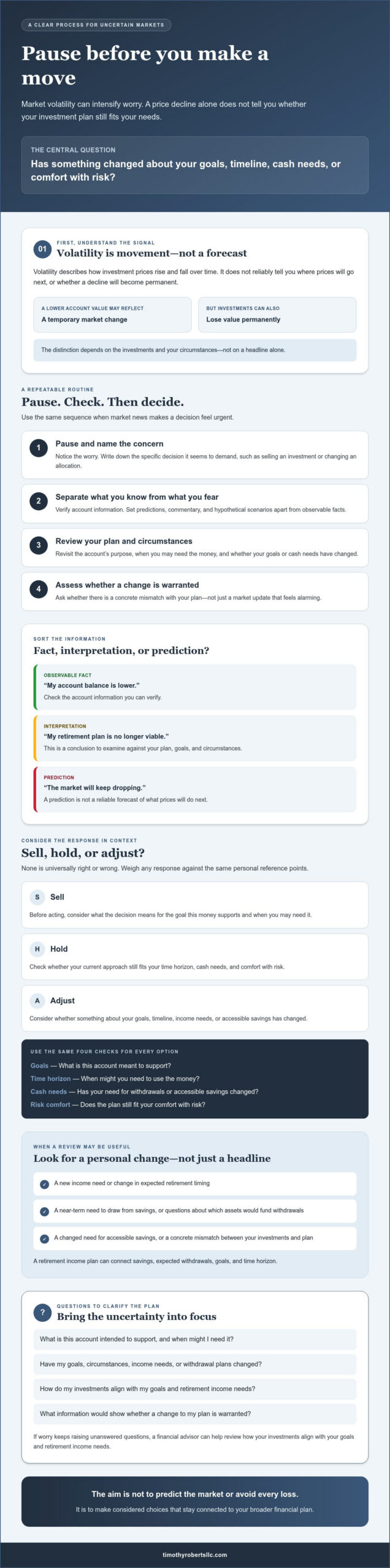
A Practical Routine for Managing Anxiety During Volatile Markets
A repeatable process can create space between a market update and a consequential financial decision. When you feel unsettled, pause, identify the concern, review your plan, and decide whether action is warranted. The purpose isn’t to suppress concern. It’s to give it a clear place in your decision-making.
Create a personal market-volatility checklist
Before changing investments, write down what the money is meant to support and when you expect to need it. Note your cash needs, the investment’s original purpose, and any personal circumstances that have changed. Then distinguish those changes from what remains the same. A market decline may alter account values without changing your goal or timeline.
Use these questions to prepare for a financial review:
- What goal is this money intended to support, and when might I need it?
- Have my income, planned spending, or retirement timeline changed?
- What specific concern is prompting me to consider a portfolio change?
- What do I still need to understand about the potential consequences?
Writing down unanswered questions can help focus a conversation with an advisor. It also lets you consider whether a proposed action addresses a real planning need or mainly responds to a moment of uncertainty.
Set a review rhythm that supports clearer thinking
Choose an account review schedule that suits your needs and aligns with your financial plan or advisor’s guidance. Checking balances every time a headline appears may keep your attention fixed on short-term movement. Avoiding statements altogether can make it harder to notice changes in withdrawals, goals, or other planning details. A planned review gives you a consistent opportunity to check account information without treating every update as a call to act.
Keep forecasts and social media commentary separate from verified information about your own accounts. You might turn off nonessential market alerts, limit news checks, or review statements at a scheduled time. Adjust those boundaries if your circumstances or plan change.
This routine can support more considered decisions, but it can’t remove market risk, predict price movements, or guarantee results. If financial worry is disrupting daily life, consider reaching out to a qualified mental health professional. For questions about how your goals and investments fit together, discuss your financial plan with an advisor.
When a Financial Advisor Can Help Turn Uncertainty Into a Plan
If market worries keep returning, the underlying issue may be an unanswered planning question rather than a need for someone to predict what markets will do. You may be unsure how much of your savings supports near-term spending, whether your investments still fit your risk tolerance, or what would justify changing course. An advisor can help review these questions in the context of your full financial picture.
A personalized review can connect your goals and time horizon with your investment approach and retirement income needs. It can also help clarify whether a change in your circumstances calls for revisiting the plan, rather than treating every market decline as a signal to act. This guidance can support more informed decisions, but it can’t predict market movements or ensure investment results.
Questions to bring to a portfolio or retirement review
Arrive with questions that invite clear explanations, not market forecasts. For example:
- How do my current investments relate to my goals and the time horizon for each account?
- How does the portfolio reflect my willingness and ability to tolerate losses?
- How might planned withdrawals interact with market conditions and my other income sources?
- What changes in my goals, spending, or circumstances would make it appropriate to review the plan sooner?
It’s also reasonable to ask about an advisor’s fiduciary responsibilities, the services they provide, and how they’re compensated. Before engaging anyone, make sure you understand what the relationship includes and what fees may apply. Clear answers help you assess whether the advisor’s approach fits your needs.
Choose guidance that reflects your circumstances
Useful recommendations depend on an advisor understanding your financial situation, goals, time horizon, income needs, and risk tolerance. A strategy suited to one household may not fit another, even when both are reacting to the same market conditions. Share relevant changes and concerns openly so a review can address the questions that matter to you.
Timothy Roberts & Associates, LLC provides retirement income planning, investment portfolio management, and comprehensive financial planning. Its fiduciary advisors develop personalized strategies based on clients’ goals and risk tolerance. An advisor conversation may be worthwhile if uncertainty has exposed gaps in your plan or left you unsure how investments relate to future income needs.
For a measured next step, explore personalized financial planning and consider whether a review could help bring your decisions back into focus.
Make Your Next Financial Decision With Greater Clarity
Market movement can feel urgent, but it doesn’t automatically call for a change in your investments. Managing financial anxiety about market volatility means distinguishing account facts from predictions, then checking whether your goals, time horizon, cash needs, or circumstances have changed. A repeatable review process can help you respond thoughtfully without assuming that selling or holding is always the right choice.
If worry keeps surfacing, it may point to planning questions worth addressing. An advisor can help connect your investments with your goals, risk tolerance, and retirement income needs. Timothy Roberts & Associates, LLC reports more than 25 years of experience, and its fiduciary advisors develop personalized strategies around individual goals and risk tolerance.
If you’re ready to clarify how your financial plan fits your circumstances, explore personalized financial planning. Market uncertainty may remain, but a considered plan can give you a steadier framework for deciding what deserves your attention and what can wait.
Frequently Asked Questions
Is it normal to feel anxious about market volatility?
Yes, feeling uneasy during market swings is a common response to uncertainty, especially when investments support important future goals. Anxiety doesn’t mean you made a poor financial choice or need to act immediately. Identify what’s driving the concern: a change in your plans, a near-term need for cash, or distress from market news. That distinction can help you decide what deserves attention.
Can market volatility affect my retirement plan?
Yes, market changes can affect the value of investments held for retirement and may matter if you’re withdrawing from those accounts. The impact depends on factors such as your investment mix, when you expect to use the money, other income sources, and planned withdrawals. A market decline alone doesn’t show whether your retirement plan still fits. Review the full picture, including whether your goals or timeline have changed.
What should I do when the stock market drops?
Pause before making a major change based on one update. Verify what has changed in your own accounts, then consider whether your goals, time horizon, spending needs, or other circumstances have shifted. A planned withdrawal is different from selling because a decline feels alarming. If you’re unsure how a change could affect your investments or future income, gather your questions and consider discussing them with a financial advisor.
Should I stop checking my investment accounts during volatile markets?
Not necessarily. If frequent account checks heighten your worry, set a review schedule that feels manageable and fits your financial plan. You might turn off nonessential alerts and review statements at planned intervals instead of responding to every market headline. Avoiding accounts entirely can also make it harder to notice relevant changes. The goal is a steady review rhythm that helps you stay informed without making short-term movements the focus.
How can I avoid making emotional investment decisions?
Managing financial anxiety about market volatility can start with a simple pause: name the concern, write down the decision you feel pressured to make, and separate verified account information from predictions or commentary. Then check the decision against your goals, time horizon, cash needs, and risk tolerance. If key facts or possible consequences are unclear, wait to make a consequential change until you’ve reviewed the details or sought appropriate guidance.
When should I talk to a financial advisor about market volatility?
Consider speaking with an advisor when market worry keeps returning, your goals or retirement timeline change, or you’re unsure how investments relate to planned income needs. A review can help clarify how your portfolio aligns with your goals, time horizon, and risk tolerance. Before engaging an advisor, ask about their fiduciary responsibilities, services, and fees so you understand the relationship and can decide whether it suits your needs.
Can diversification eliminate the risk of market losses?
No. Diversification spreads investments across different holdings, but it can’t eliminate investment risk or guarantee against losses. Different assets may respond differently to market conditions, and a diversified portfolio can still decline in value. How diversification fits your situation depends on your goals, time horizon, and tolerance for risk. Treat it as one part of an investment approach, not as a promise of protection or a particular result.
