

Sep
Business Exit Strategy in Michigan: A 2026 Guide for Owners
Your business sale price isn’t your retirement plan. A thoughtful business exit strategy michigan owners can build starts with the life and income they want after the transition. It’s natural to focus first on who might take over, how ownership could change hands, and what a sale might involve. But the right path also depends on timing, tax considerations, and whether the proceeds ultimately available to you can support your next chapter.
Planning ahead gives you time to compare possible paths, identify questions for qualified tax, legal, and business professionals, and make informed decisions about your personal finances. No single exit route suits every owner. The goal is to plan a transition around both the company’s needs and your priorities.
This 2026 guide covers common exit paths and practical preparation steps, along with financial and tax topics to discuss with your advisors at Timothy Roberts & Associates, LLC. It also explains how to connect a business transition with a retirement-income plan, so your personal next chapter is part of the strategy from the start.
Key Takeaways
- Compare a third-party sale, succession, employee transition, and closure based on your priorities for control, continuity, and preparation.
- A business exit strategy michigan owners develop should account for personal goals and business readiness, not just the ownership transfer.
- Ask qualified tax and legal professionals how your entity type, transaction structure, and asset allocation may affect your situation.
- Review household spending needs, existing assets, and retirement timing before relying on potential exit proceeds to fund your next chapter.
- Coordinate advice from the right specialists, then revisit your personal financial plan as transaction details become clearer.
Business exit strategy in Michigan: what owners should plan for
An exit strategy is a plan for transferring ownership, leadership, or business operations in a way that supports both the company’s future and the owner’s next chapter. It’s broader than a sale. It considers what the owner wants, how prepared the business is to operate through a transition, when a change may make sense, and which professionals can assess the related financial, tax, and legal questions. A general business exit strategy overview can introduce common concepts, but an owner’s plan needs to reflect their own circumstances.
For a business exit strategy Michigan owners develop, it’s important to distinguish preparation from a transaction. Preparation means clarifying goals, reducing the company’s reliance on the owner where possible, and understanding potential paths. It doesn’t commit the owner to selling or choosing a particular date. A transaction decision comes later, after the owner has compared options, sought professional advice, and assessed the circumstances at that time.
What does a business exit strategy include?
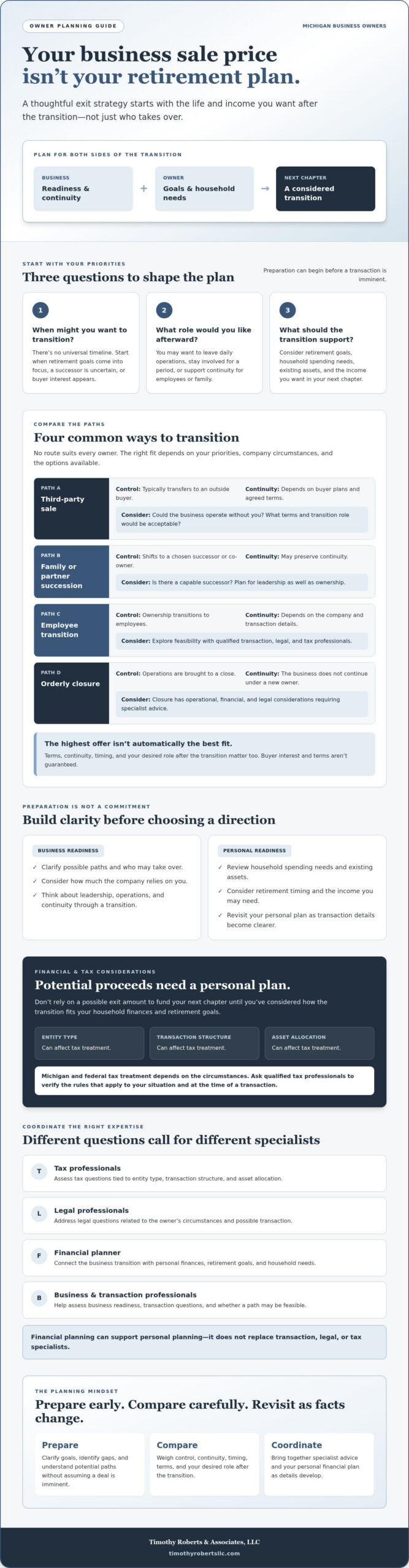
Begin with three questions: When might you want to transition? What role, if any, would you like afterward? What financial goals should the transition support? For example, an owner may want to leave daily operations, stay involved for a period, or preserve continuity for employees or family. Possible paths include a third-party sale, succession to family or a partner, an employee transition, or an orderly closure. Each has different implications, and no route is right for every company.
The plan should change as personal circumstances, business readiness, and available options change. Financial planning can help you consider how a transition may affect retirement goals and household finances. Tax and legal questions require appropriate professional input. A financial planner can help with personal planning, but doesn’t replace transaction, legal, or tax specialists.
When should a Michigan business owner begin planning?
Start before a decision feels urgent. There’s no universal timeline, but several situations can prompt a closer look: uncertainty about who could take over, retirement goals coming into focus, or an unsolicited expression of buyer interest. Early preparation gives you more room to compare paths and identify gaps without assuming a deal is imminent.
Include tax questions in that preparation, but don’t treat a general summary as advice for a specific transaction. Michigan and federal tax treatment can depend on your entity type, transaction structure, and how assets are allocated. Ask qualified tax professionals to verify the rules that apply to your circumstances and at the time of the transaction. A useful plan connects those discussions with business readiness and personal priorities, then adjusts as the facts change.
Compare business exit paths before choosing a direction
Choosing a path means weighing more than whether a buyer is available. A third-party sale, family or partner succession, employee transition, and orderly closure can each affect control, continuity, and your role in different ways. What’s feasible depends on the company’s structure, the interest of potential successors or buyers, and your goals for the transition.
The highest offer isn’t automatically the best fit. Terms, continuity, timing, and your desired role after the transition matter too. Discuss options with qualified legal, tax, and transaction professionals before treating any path as feasible.
How do common business exit options differ?
A third-party sale transfers ownership to an outside buyer, but buyer interest and terms aren’t guaranteed. Family or partner succession may preserve continuity, but it requires a capable successor and thoughtful planning for leadership as well as ownership. An employee transition may be worth exploring, though its feasibility depends on the company and transaction details. An orderly closure is another possibility, with operational, financial, and legal considerations that call for specialist advice.
Use the comparison below as a starting point for questions, not as a prediction of what’s available to your business.
| Path | Control | Continuity | Preparation and questions |
|---|---|---|---|
| Third-party sale | Typically transfers to an outside buyer | Depends on buyer plans and agreed terms | Could the business operate without the owner? What terms and transition role would be acceptable? |
| Family or partner succession | Shifts to a chosen successor or co-owner | May support continuity if leadership is ready | Is a successor willing and capable? How will responsibilities and ownership be addressed? |
| Employee transition | May shift to employees through a suitable structure | Could retain familiarity with the business | Is a transition feasible for the company and employees? Which specialists should assess the structure? |
| Orderly closure | Owner directs the wind-down, subject to applicable obligations | Business operations end | What steps and obligations apply? Seek qualified legal, tax, and financial guidance. |
Which exit path may fit your priorities?
Consider how much control you want to retain, what legacy means to you, when you hope to transition, and whether you want an ongoing role. Then separate preference from feasibility. An option that appeals to you may not fit the company’s structure, a successor’s readiness, or your financial circumstances.
To evaluate a business exit strategy michigan owners can discuss with greater clarity, bring your goals and questions to qualified legal, tax, and transaction professionals. A financial planning conversation can help connect possible transition scenarios with your personal goals. If you’re assessing how a future change could affect retirement, explore retirement income planning as part of that broader review.
Michigan exit planning: prepare for tax, legal, and business questions
A transition can raise questions across several areas of expertise. Your business exit strategy michigan plan should bring those questions together without assuming one professional handles every part. Tax outcomes depend on the transaction and your circumstances. Legal documents, business transfer terms, and personal financial planning also require appropriate expertise.
Before choosing a structure or relying on an estimate of what you may keep, ask a qualified tax professional to model relevant federal and Michigan scenarios. The analysis may differ based on your entity type, transaction structure, and asset allocation. Rules can change, so verify current requirements for the specific transaction instead of relying on a general rate or a prior-year assumption.
What tax questions should owners raise before an exit?
Give your tax professional a clear description of the paths you’re considering. Ask how each structure could affect the business and you personally, which assumptions drive the analysis, and what information is still needed to compare scenarios. A financial advisor can help connect potential proceeds and timing to personal financial goals, but shouldn’t replace transaction-specific tax advice or legal counsel.
What should be organized before a business transition?
Gather records for review before discussions become time-sensitive. A practical starting checklist includes:
- Financial statements and business tax filings
- Ownership records and relevant agreements
- Key customer, supplier, and employee arrangements
- Notes on operational dependencies, including responsibilities or relationships that rely heavily on the owner
Organizing records helps specialists identify questions to resolve; it doesn’t confirm that documents or terms are complete. Ask legal counsel to review agreements and ownership documents and advise on legal requirements. Transaction specialists can address transaction-specific matters within their role. A financial advisor can focus on how different scenarios may affect household assets, retirement timing, and income planning. Timothy Roberts & Associates, LLC offers financial planning, tax advising, and retirement-income planning. It isn’t a law firm, business broker, or transaction-execution provider, and it doesn’t draft legal documents.
Keep the process coordinated. Share relevant information with the professionals involved, clarify who is responsible for each question, and revisit assumptions as the potential structure changes. Clear roles can help you make informed decisions without treating preliminary estimates as guaranteed outcomes.
Connect business exit proceeds with your retirement income plan
A business transition can change your personal finances, but an estimated sale value isn’t the same as retirement income. Before building plans around possible proceeds, review your household picture: expected spending, assets outside the business, desired retirement timing, and the lifestyle you want after the transition. This puts the exit in the context of a broader financial plan instead of treating it as a stand-alone event.
A considered business exit strategy michigan owners can use should account for uncertainty. Until transaction terms and costs are established, proceeds are estimates. Gross business value may differ from the amount available for personal use after taxes, transaction expenses, and other obligations. Keep these figures distinct in your planning, and avoid making irreversible retirement decisions based only on an assumed sale price.
How can owners plan around uncertain sale proceeds?
Build more than one scenario with qualified professionals. For example, consider how your plans might change if a transition is delayed, proceeds differ from expectations, or your post-exit role affects income timing. Ask tax and transaction professionals to review the assumptions behind each scenario. A financial advisor can help assess how different possibilities relate to household assets, spending needs, and retirement goals.
What changes after ownership transfers?
Once transaction details are known, revisit your plan using confirmed information. Review income sources, portfolio risk, liquidity needs, and the timing of withdrawals or other retirement income. Moving from business ownership to personal investments may also change how concentrated your assets are and how much flexibility you need. Consider estate and legacy goals as you update your financial plan.
Tax questions remain part of that review. The implications depend on the transaction and your personal circumstances, so discuss the specifics with a qualified tax professional. If you’re assessing investments and a changed financial picture, you may also want to explore tax planning for investors with your advisor. Keep legal, tax, transaction, and financial-planning roles distinct while coordinating the advice that informs your next steps.
A personalized retirement income planning approach can help connect your post-exit resources with the lifestyle and timing you envision. Consider how retirement income planning may fit into your broader financial plan as transaction details become clearer.
Build a coordinated business exit plan and choose your next steps
A coordinated plan turns broad intentions into manageable decisions. To shape a business exit strategy michigan owners can align with company and personal priorities, work through these steps and revisit them as circumstances change:
- Define your goals. Note your preferred timing, the role you may want after the transition, and what you hope your next chapter will look like.
- Gather information. Assemble available business and personal financial records, ownership details, and questions. These materials support professional review, but don’t establish a sale value.
- Consult specialists. Identify the legal, tax, valuation, transaction, and financial advice your situation may require.
- Compare paths. Assess potential options against your goals and the company’s structure, readiness, and circumstances.
- Review personal finances. Consider how possible timing and proceeds could affect your assets, retirement income, and other financial priorities.
What professionals may belong on an exit-planning team?
Give each professional a clear role. Business counsel can advise on legal matters and documents; tax professionals can assess transaction-specific tax questions; valuation specialists can evaluate business value; and transaction advisors can support transaction-related work. A financial planner can focus on personal assets, investment management, and retirement-income implications. These roles may inform one another, but they aren’t interchangeable.
Before engaging anyone, ask about scope of work, relevant credentials, compensation, and potential conflicts of interest. A financial planner who describes their practice as fiduciary should be able to explain what that means for the services and advice provided. Timothy Roberts & Associates, LLC describes its advisors as fiduciaries; confirm current disclosures and the scope of any services directly with the firm.
How do you take the first practical steps?
Start with a concise personal planning brief: your goals, likely timing, ownership structure, and questions that need specialist input. Gather available financial and business records, and label estimates clearly so preliminary figures aren’t mistaken for confirmed transaction terms. This gives each professional a useful starting point and helps keep advice connected to your priorities.
If a business transition is prompting questions about your personal financial plan, consider discussing a personalized financial plan. A conversation about retirement-income planning, investment management, tax advising, or estate and legacy planning may help clarify personal considerations alongside advice from your legal, tax, valuation, and transaction professionals.
Shape your next chapter with a coordinated plan
A thoughtful business exit strategy michigan owners build should connect the transition they choose with the personal financial life they want afterward. Compare possible paths against your priorities, verify tax and legal questions with qualified specialists, and treat potential proceeds as uncertain until transaction terms and costs are clear.
Revisit your retirement-income plan as your options develop. Household spending, existing assets, timing, investment decisions, and legacy goals all help shape what comes next. A financial planner can focus on these personal considerations while legal, tax, valuation, and transaction professionals address their respective areas.
Timothy Roberts & Associates, LLC reports more than 25 years of experience and describes its advisors as fiduciaries. Its stated services include retirement-income planning, investment management, estate planning, and tax advising. To discuss how a potential transition may relate to your personal financial goals, discuss how a business transition may affect your financial plan.
Clear priorities and advice from the right professionals can help you approach the transition deliberately and give your next chapter the same care you’ve given your business.
Frequently Asked Questions
What is a business exit strategy?
A business exit strategy is a plan for transitioning ownership, leadership, or operations while considering the owner’s goals and the company’s future. It’s broader than a sale. It may involve transferring the business to a buyer, family member, partner, or employees, or closing it in an orderly way. A useful plan considers timing, the owner’s desired role afterward, business readiness, and how the transition connects to personal financial goals.
How do I create a business exit strategy in Michigan?
Start by defining your goals, desired timing, and preferred involvement after the transition. Gather business and personal financial records, then compare possible paths, such as a third-party sale, succession, employee transition, or closure. Consult qualified legal, tax, valuation, and transaction professionals about their respective areas. A business exit strategy michigan owners create should also consider how possible outcomes may affect personal assets and retirement income, without treating estimates as guaranteed proceeds.
When should I start planning to exit my business?
Start when an exit becomes a possibility, rather than waiting until a transaction feels imminent. Succession uncertainty, retirement goals, or unsolicited buyer interest can all prompt planning. Early preparation gives you time to organize records, examine whether the business can operate without your daily involvement, and consider alternatives. There’s no universal timeline; the appropriate pace depends on your goals, business circumstances, and the complexity of a potential transition.
What are the main ways to exit a business?
Common options include selling to a third-party buyer, transferring ownership to family or a business partner, transitioning ownership to employees, or winding down operations. Each route differs in control, continuity, preparation, and feasibility. For example, succession depends on having a willing and capable successor, while employee ownership requires specialist review to determine whether a structure can work for the business. Compare options against your priorities and seek qualified advice before settling on a path.
What taxes apply when I sell a business in Michigan?
Tax treatment depends on factors such as entity type, transaction structure, asset allocation, and your individual circumstances. For 2026, Michigan’s individual income tax rate is 4.25%, including capital gains. Federal long-term capital gains rates are generally 0%, 15%, or 20%, depending on taxable income and filing status; other federal taxes may apply. These rates don’t determine the full tax result. Ask a qualified tax professional to verify current rules and model your transaction.
Can a financial advisor help with a business exit?
Yes. A financial advisor can help assess how potential transition scenarios relate to personal assets, investment management, retirement timing, and future income needs. This role is distinct from legal counsel, valuation specialists, tax professionals, and transaction advisors, who address their own areas of expertise. Timothy Roberts & Associates, LLC provides financial planning, retirement-income planning, investment management, estate and legacy planning, and tax advising. The firm describes its advisors as fiduciaries; confirm current disclosures and service scope.
How should I plan for life after selling my business?
Begin with the life you want to support: expected household spending, retirement timing, other assets, and plans for your time after ownership. Don’t treat an estimated sale price as spendable income. Revisit your plan when transaction terms, taxes, and costs are clearer, then assess income sources, liquidity needs, portfolio risk, and estate or legacy goals. Qualified financial, tax, and legal professionals can help evaluate these pieces within their respective roles.
