

Nov
What a Fiduciary Financial Advisor Does Differently
A suitable recommendation and a fiduciary recommendation are not always the same. Understanding what a fiduciary financial advisor does differently starts with the obligation to put your interests ahead of the advisor’s own and address conflicts that could affect the advice you receive.
It is reasonable to expect financial advice to reflect your goals. The difference is how an advisor must weigh those goals against their own interests, disclose relevant conflicts, and guide decisions about your money.
This article explains what fiduciary means, how the duty compares with standards that apply to other financial advisors, and how federal rules shape these obligations. It also covers compensation and potential conflicts, so you can understand what a fiduciary relationship means for your financial decisions.
Key Takeaways
- A fiduciary’s defining responsibility is to put a client’s interests first and address conflicts that could affect advice.
- Understand how fiduciary obligations differ from standards that may apply to other financial professionals.
- Learn how federal rules shape obligations around recommendations, disclosures, and potential conflicts.
- See how personalized financial planning can connect investment, retirement, and legacy decisions to your broader goals.
What Is a Financial Advisor?
A financial advisor helps people make decisions about money, investments, and long-term goals. In the United States, the Securities and Exchange Act of 1934 is cited by U.S. Congress as a law regulating brokers as issuers or sellers of securities.
Client-First Fiduciary Duties
Fiduciary duty means an advisor must put a client’s interests ahead of their own when providing services in a fiduciary capacity. This obligation matters when recommendations involve potential conflicts: the advisor must address them and disclose material information that could affect your decision.
For example, when weighing two portfolio options, an advisor should consider your goals and circumstances, not simply which option benefits them. Ask whether the advisor acts as a fiduciary for each service and whether that commitment is documented in writing.
Financial Advisor Services
A fiduciary financial advisor may provide planning related to investments, retirement, risk management, insurance, and taxes. The scope depends on the advisor’s role: one professional might develop a financial plan, while another manages a portfolio or handles securities transactions.
These functions may be handled by separate people or combined. Clarify who provides advice, who makes portfolio decisions, and who supports you as a client. A registered investment adviser provides investment advice and registers with the SEC or a state securities regulator, depending on the amount of assets they manage.
Ask how changes in your financial situation will affect recommendations. The answer can show how financial planning and portfolio management connect to your needs.
Checking Fiduciary Status
To understand an advisor’s fiduciary role, ask whether they have a fiduciary duty, which services it covers, and whether they receive commissions on products. Request a written explanation of compensation and conflicts, including who pays the advisor and whether compensation changes based on a recommendation.
You can use FINRA BrokerCheck to review disciplinary actions and complaints, the CFP Board’s tool to check CFP credentials, and the SEC Investment Professional Online Tool to review investment professionals. A title alone is not enough: someone may call themselves a financial planner without holding the CFP designation.
Before hiring an advisor, ask who makes investment decisions for your portfolio, how changes in your circumstances will inform advice, and what fees or commissions the advisor receives. Clear answers help you understand the relationship and what to expect.
SEC Regulation Best Interest and the DOL Fiduciary Rule
Federal rules shape how financial professionals address clients’ interests and conflicts. Their obligations depend on their role and the service they provide.
SEC and DOL Rules
SEC Regulation Best Interest and the DOL Fiduciary Rule have drawn attention to the standards governing financial advice. “Best interest” and fiduciary obligations are not interchangeable labels for every advisor and service.
The SEC’s Regulation Best Interest applies to broker recommendations, while the Department of Labor’s rule addresses fiduciary obligations in the contexts it governs. Because these standards can differ, the title “advisor” alone does not explain which duties apply to a particular recommendation.
Compensation and Commissions
Advisor compensation may include a flat fee, hourly rate, a percentage of managed assets, or commissions. The structure matters because compensation tied to a product or transaction can create a conflict between the advisor’s financial interest and your goals.
Fiduciaries often charge advisory fees and do not earn commissions or kickbacks on recommended products. But that general pattern does not replace a clear explanation of how a particular advisor is paid. The U.S. Department of Labor’s guide recommends asking whether compensation changes based on the products purchased or the size of an investment.
Conflict Disclosures
Conflict disclosure means explaining material interests or payments that could reasonably affect a client’s decision. It helps you understand the relationship behind a recommendation, not just the securities under consideration.
For example, ask whether the advisor receives higher compensation for recommending certain products. The U.S. Department of Labor’s guide recommends requesting a written list of fees and commissions received from you or other sources. Review those details alongside expenses and potential conflicts before deciding whether the advice suits your priorities.
When Fiduciary Duties Apply
A financial advisor is legally required to act as a fiduciary when the role and service carry that duty. Registered investment advisers must uphold the fiduciary standard, while broker recommendations are subject to a different standard, including SEC Regulation Best Interest.
Some professionals perform different roles across services, so the applicable duty can depend on the specific recommendation. Ask whether the advisor has a fiduciary duty for the work involved, whether it applies throughout your relationship, and how conflicts are disclosed. Clear answers help you understand the protections relevant to your decision.
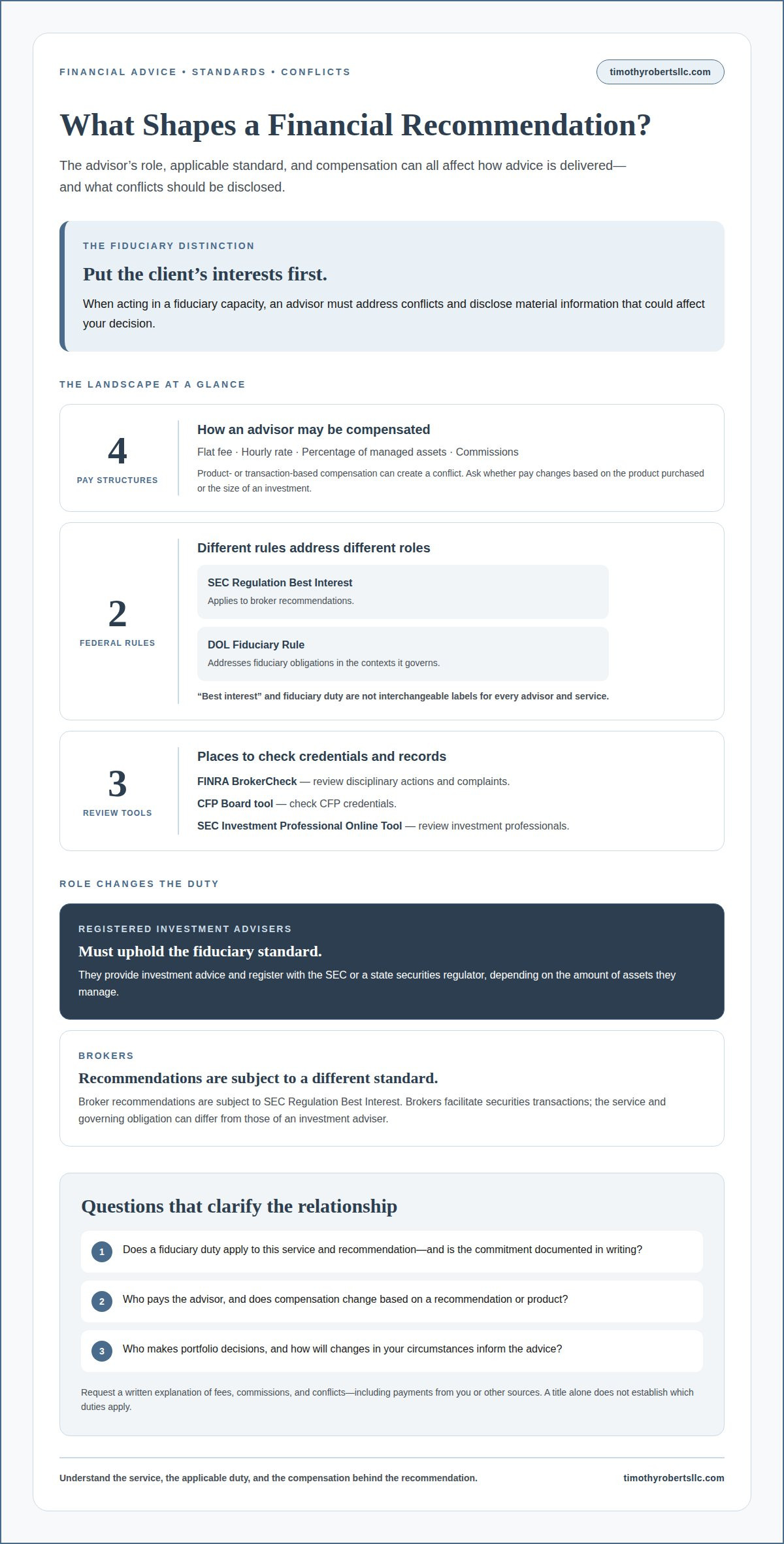
Differences between fiduciaries and financial advisors
“Financial advisor” is a broad title, while fiduciary describes a duty attached to particular services or relationships. That distinction affects how advice about investments, retirement, and accounts is assessed.
Investment Advisers and Brokers
Investment advisers provide investment advice and register with the SEC or a state securities regulator. Brokers facilitate securities transactions, and their recommendations have traditionally been subject to a suitability standard. The roles can differ both in the service provided and in the obligation governing a recommendation.
Licensing also shapes what a broker may sell. A Series 6-licensed representative is limited to mutual funds, variable annuities, and related products. A Series 7 license permits sales of additional securities beyond those permitted under Series 6. These distinctions help explain why “financial advisor” alone doesn’t identify a professional’s role.
Fiduciary Advisors and Brokers
A fiduciary advisor must put the client’s interests first when acting in that capacity, while a broker’s recommendation may be governed by a different standard. This matters when two investments could both suit a client’s stated objectives, but one creates potential conflicts for the person recommending it.
For example, an investment that suits an account’s objectives and risk tolerance is not automatically the client’s best choice. A fiduciary must act with good faith and loyalty, while a broker’s recommendation is assessed under the applicable standard. The professional’s role and the service being performed shape the comparison.
Some distinctions concern how client assets and information are handled. Fiduciaries must keep comprehensive records and separate their personal money and property from clients’ assets. They also have a duty to keep client information confidential. These practices support accountability beyond the investment recommendation itself.
For a retirement portfolio, clarify who provides advice, who makes investment decisions, and who executes securities transactions. This helps distinguish planning from sales and ongoing portfolio management. Ask how the professional’s duties apply to each service and how potential conflicts are handled. The answers reveal whether the relationship involves advice, transactions, or both.
Fiduciaries compared with financial advisors
The key distinction is the obligation behind a recommendation, not simply the professional’s title. “Financial advisor” describes a broad role; fiduciary describes a duty that applies to particular services and relationships. Understanding what a fiduciary financial advisor does differently starts with identifying the duty attached to the work you need.
That difference matters because advice can sound reasonable while reflecting an advisor’s financial interests. A fiduciary must act on the client’s behalf, putting loyalty and the client’s best interests ahead of personal interests. Other recommendations may instead be assessed under a standard focused on suitability for the client’s objectives and risk tolerance.
Consider a client balancing retirement income with preserving assets for family. A fiduciary evaluating recommendations considers the client’s circumstances and potential conflicts, rather than treating a suitable product as automatically the best choice. This obligation encourages advice that connects individual decisions to the client’s overall financial picture.
The categories can overlap. An investment adviser registered with a state or the SEC must uphold the fiduciary standard, while one professional may provide different services in different capacities. So ask not only, “Is this person a fiduciary?” but also, “For which service, and under what duty?” That distinction helps clarify what a fiduciary financial advisor does differently in practice.
Compensation provides context, but it does not settle the comparison by itself. Fee-only advisors are more likely to be fiduciaries; fee-based advisors may not act as fiduciaries for every task. Ask how recommendations are made, what conflicts could affect them, and whether the fiduciary commitment applies throughout the relationship.
For a financial plan involving investments, retirement, and legacy priorities, the standard matters because each recommendation can affect other goals. Explore personalized financial planning to connect those decisions within a broader strategy.
Timothy Roberts & Associates: Financial Planning
Timothy Roberts & Associates offers financial planning that brings decisions into a coordinated plan. Consider this service when you want investment, retirement, and legacy priorities considered together rather than as isolated choices.
For example, retirement income planning can connect portfolio decisions with the income you expect to draw. Investment portfolio management focuses on managing investments, while estate and legacy planning brings future transfer goals into the broader conversation. The right starting point depends on the decisions you are facing and how they relate to your financial goals.
If you’re ready to discuss how these priorities fit together, contact Timothy Roberts & Associates.
Make Your Next Financial Decision With Intention
Choosing an advisor begins a working relationship; it is not the finish line. Before moving forward, consider what you want your financial decisions to support, which trade-offs matter most, and how advice should reflect your changing priorities. Clear expectations can make future conversations more focused and useful.
Understanding what a fiduciary financial advisor does differently gives you a stronger basis for those conversations. Discuss how advice will be delivered, how your circumstances will inform decisions, and how you will revisit priorities as they change. A thoughtful process makes room for careful analysis and your own judgment.
When you’re ready to take the next step, begin a conversation with Timothy Roberts & Associates, LLC. A deliberate start can help you shape a financial path that reflects what matters to you.
Frequently Asked Questions
What Is a Fiduciary?
A fiduciary is a person or firm obligated to act in another party’s interests within a defined relationship or service. In financial advice, this means evaluating recommendations with the client’s interests ahead of the advisor’s own. For example, an advisor managing investments must consider how a proposed portfolio decision fits the client’s objectives, rather than defaulting to the advisor’s preferred option.
How is a fiduciary advisor different from a non-fiduciary financial advisor?
The central difference is the duty governing the advice: a fiduciary must prioritize the client’s interests, while other financial professionals may operate under a different standard for certain recommendations. To distinguish the roles, consider a specific task, such as portfolio management or a securities transaction. The advisor’s title alone does not establish which duty applies.
What fiduciary standards apply to investment advisers and broker-dealers in the United States?
Registered investment advisers must uphold a fiduciary standard, while broker-dealer recommendations are subject to SEC Regulation Best Interest. These are distinct standards, so a professional’s obligations can depend on the service and capacity involved. If an advisor handles ongoing investment advice and securities transactions, clarify which role applies to each recommendation and what standard governs it.
How do fiduciary financial advisors get paid, and what fees do they charge?
Financial advisors may be compensated through a flat fee, hourly rate, a percentage of managed assets, or commissions. The amount and structure depend on the arrangement, so request a written breakdown of charges and other compensation. For example, ask whether payment changes with the investments selected or the amount invested. This can reveal incentives that might shape advice without assuming a particular fee model.
Do fiduciary advisors have conflicts of interest, and how must they disclose them?
Yes, fiduciary advisors can have conflicts, and material information that could reasonably affect your decisions should be disclosed. A conflict might involve compensation that varies by product or recommendation. Ask for details about direct payments, commissions, and compensation from other sources, then consider how each could influence the advice. Disclosure helps you assess the relationship, but it does not make every recommendation right for you.
What risks or limitations should I consider when choosing a fiduciary advisor?
Fiduciary status does not guarantee investment gains or eliminate the possibility of poor outcomes. The duty may apply to particular services, so understand which work it covers and how recommendations are made. Also consider the advisor’s compensation, potential conflicts, and whether the advice addresses your needs. A portfolio recommendation alone, for instance, may not resolve broader retirement or estate-planning decisions.
