

Nov
Retirement Planning When You and Your Spouse Disagree on Money
A shared retirement date isn’t essential. One spouse can retire while the other keeps working, depending on the couple’s income needs, healthcare coverage, and benefits. A practical approach to retirement planning when you and your spouse disagree is to compare workable paths, rather than treating different preferences as a choice between one person winning and the other giving in.
It’s understandable to worry that different retirement timelines or attitudes toward investment risk could make planning difficult. The goal is to turn those differences into choices you can compare. This guide to retirement planning when you and your spouse disagree covers how to discuss timing and lifestyle, account for health coverage, contributions, taxes, and withdrawals, and find common ground on investing. It also offers questions to clarify each person’s priorities, shape a flexible transition, and decide when financial planning support could help.
Key Takeaways
- Separate retirement hopes from practical constraints to make disagreements easier to discuss and identify potential compromises.
- Map how work and retirement changes could affect income, health coverage, contributions, taxes, and withdrawals.
- Use focused conversation prompts to uncover the priorities behind each spouse’s preferred retirement plan.
- Align investment decisions around shared goals, individual comfort with risk, and a plan to review as circumstances change.
1. What Should You Do If You and Your Spouse Disagree About Retirement Timing?
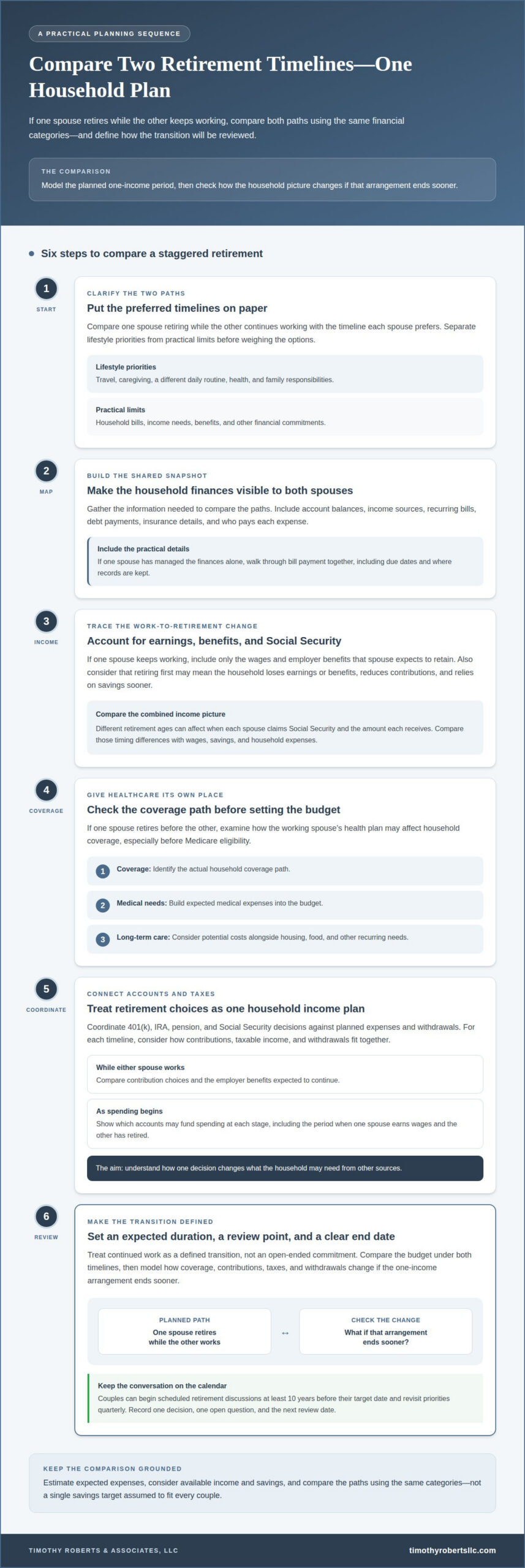
Start by discussing the reasons behind each preferred retirement date. One spouse may value continued earnings, while the other wants time for travel, caregiving, or a different daily routine. Talk about health, family responsibilities, household bills, and what each person hopes retirement will make possible. Separate lifestyle priorities from practical limits, then record both in a shared financial plan.
Make the household’s financial picture visible to both spouses. Gather account balances, income sources, recurring bills, debt payments, insurance details, and information about who pays each expense. If one spouse has managed the finances alone, walk through bill payment together, including due dates and where records are kept. A financial advisor can connect possible retirement dates with income, savings, and spending scenarios. A retirement coach or therapist may help if discussions repeatedly become arguments or one spouse avoids them.
Different retirement ages can affect when each spouse claims Social Security and the amount each receives. Compare those timing differences with wages, savings, and household expenses to see how the combined income picture could change.
There is no single savings target that suits every couple based only on age or income. Estimate expected retirement expenses, consider available income and savings, then identify a reserve or spending range that would help each spouse feel comfortable. Tracking current expenses can make that estimate more realistic.
Consent requirements depend on the asset, account terms, and applicable state or plan rules, so there is no single answer for every U.S. retirement decision. Review ownership and account documents before acting on decisions involving shared assets. If one spouse retires first, the household may lose earnings or benefits, reduce contributions, and rely on savings sooner. Set a review point and a clear end date for a planned transition to one income.
2. Health coverage, retirement contributions, taxes, and withdrawals
Compare both retirement paths using the same categories: employment income, health coverage, retirement contributions, portfolio withdrawals, taxes, and available reserves. If one spouse keeps working, include only the earnings and employer benefits that spouse expects to retain. Treat continued work as a defined transition, not an open-ended commitment, with an expected duration and a review point.
Give health coverage its own place in the comparison. If one spouse retires before the other, examine how the working spouse’s plan may affect household coverage, especially before Medicare eligibility. Build the budget around the actual coverage path and expected medical expenses. Include potential long-term care costs alongside housing, food, and other recurring needs.
Coordinate 401(k), IRA, pension, and Social Security decisions as parts of one household income plan. Compare contribution choices while either spouse works, expected pension income, and the timing of each Social Security claim against planned expenses and withdrawals. The aim is to understand how one decision changes the amount the household may need from other sources.
Tax-advantaged accounts such as 401(k)s and Roth IRAs can be part of retirement saving. For each scenario, consider how contributions, taxable income, and withdrawals fit together. A withdrawal plan should show which accounts may fund spending at each stage, including a period when one spouse earns wages and the other has retired.
Finally, compare the budget under both timelines, not just the preferred one. For example, model one spouse retiring while the other works, then identify how coverage, contributions, taxes, and withdrawals change if that arrangement ends sooner. A coordinated retirement income plan can bring those moving parts into one view.
3. Questions couples can use to discuss retirement
Set a recurring conversation, rather than waiting for a disagreement to resurface. Couples can begin scheduled retirement discussions at least 10 years before their target date and revisit priorities quarterly. Choose a calm time, set an agenda, and give each spouse space to describe preferences before comparing options.
Begin with lifestyle and logistics, then connect the answers to financial choices. Ask what each person wants an ordinary week to include, which activities matter most, and what responsibilities may continue. A spouse picturing travel may have different priorities from one expecting to support family or maintain a familiar routine. Name those differences without treating either preference as the only reasonable choice.
- Which experiences do we most want to fund, such as travel, hobbies, or time with family?
- Which household expenses are essential, and which could change with our retirement lifestyle?
- What health needs, caregiving roles, or family commitments could affect our plans?
- Would we prefer to retire together near the earlier date, near the later date, or in stages?
- If we stagger our exits, how long should the one-income period last, and what change prompts a review?
Turn those answers into planning assumptions. Include desired activities and experiences when estimating savings needs, alongside housing, food, transportation, healthcare, and other regular costs. Tracking expenses can show which spending patterns may continue and which could change after work ends. Discuss a comfortable spending range instead of relying on a single unsupported estimate.
End each discussion by recording one decision, one open question, and the next review date. For example, agree to compare a phased transition with two shared retirement dates, then revisit the scenarios at your next quarterly meeting. Regular conversations give both spouses a chance to share changing priorities and adjust the plan as circumstances evolve.
4. Agreeing on investment strategy and risk tolerance
Investment disagreements often reflect different concerns rather than different goals. One spouse may fear market losses; the other may worry that cautious investing will not support retirement plans. Start by identifying each concern, then distinguish risk tolerance, or emotional comfort with losses, from risk capacity, or the portfolio’s ability to absorb losses while meeting planned needs. Both perspectives matter.
Connect the discussion to the household’s purpose for investing. List expected income needs, planned withdrawals, and money intended for later years. If one spouse wants stability for near-term spending while the other values growth for longer-term goals, discuss whether those needs belong in separate parts of an overall strategy. Avoid treating either person’s preferred investment as the default.
- Which goals does each account need to support?
- How would a market decline affect our willingness to stay invested?
- What money may be needed soon, and what can remain invested longer?
Agree on decision rules before emotions run high. Set a process for reviewing the portfolio, deciding who participates, and discussing proposed changes. A written rationale can capture shared goals, acceptable fluctuations, and reasons to revisit the approach, such as a change in retirement timing or spending needs. Review whether the strategy still fits instead of reacting to every market movement.
If views remain far apart, an investment professional can model how different approaches relate to shared goals and withdrawal needs. A coordinated investment portfolio management discussion can help translate personal risk concerns into a strategy both spouses understand. The aim isn’t identical comfort with every investment; it’s a clear framework both can explain and follow.
Timothy Roberts & Associates
Timothy Roberts & Associates helps couples bring retirement timing, income needs, and investment priorities into one coordinated financial picture. Consider the firm’s retirement planning and financial planning services when different retirement dates or risk preferences make it difficult to settle on a shared plan, or when you want an integrated view of income, investments, insurance considerations, and legacy priorities.
Through retirement income planning, investment portfolio management, estate and legacy planning, and risk management and insurance analysis, the firm can help connect individual concerns to household decisions. The aim is a practical framework both spouses can understand and revisit as goals or circumstances change.
Contact Timothy Roberts & Associates to discuss your retirement planning questions.
Build a Retirement Plan You Can Revisit Together
Agreement does not require identical views on every financial decision. It requires a shared process for making choices, recording what matters to each spouse, and revisiting the plan as life changes. That process can turn retirement planning when you and your spouse disagree into a practical way to make decisions together, even when preferences remain different.
Timothy Roberts & Associates, LLC can help coordinate retirement income, investment decisions, and legacy priorities within a financial plan. Retirement Planning, Wealth & Investment Management, and Estate & Trust Planning each support a different part of that picture. You can begin a conversation before resolving every disagreement. Bring your priorities and questions to the firm to discuss a coordinated plan.
Contact Timothy Roberts & Associates, LLC to discuss your retirement planning needs. A thoughtful plan can give both spouses a clearer way forward.
Frequently Asked Questions
Can one spouse retire while the other keeps working?
Yes. One spouse can retire while the other remains employed if the household can manage the transition. Consider how work schedules affect shared time, household responsibilities, and each person’s sense of purpose. Agree on how long the arrangement is expected to last and what might prompt a change, such as a shift in health, work satisfaction, or family responsibilities. A defined plan helps prevent a temporary arrangement from becoming an unspoken permanent expectation.
Is it normal for one spouse to want to retire years before the other?
Different preferred retirement dates are not inherently a sign of a problem. Spouses can feel differently about work, energy, identity, or what they want their next chapter to look like. Ask what each date represents: relief from demanding work, continued professional purpose, or more time for shared activities. Understanding the reason behind a preference gives you something specific to discuss instead of treating the dates as opposing positions.
What Happens When You and Your Spouse Don’t Agree on When to Retire?
The disagreement may persist until you have a way to compare choices. Set out three paths: retiring together near the earlier date, retiring together near the later date, or leaving work in stages. Discuss what each path would mean for daily routines and responsibilities, then identify which parts are reversible. A flexible retirement window gives you room to review the decision as priorities change.
What Should You Do If You and Your Spouse Disagree About Retirement Timing?
When retirement planning disagreements arise, begin by discussing the need each preferred date is meant to meet. One person may want freedom from work demands; the other may value structure or professional identity. Write down each concern, then identify a condition that could make a compromise workable. For example, agree to revisit a phased transition after a defined change in work or family circumstances.
How can couples resolve disagreements about retirement timing and lifestyle?
Discuss lifestyle choices before debating a date. Each spouse can describe an ideal weekday, desired activities, travel priorities, and family commitments. Compare those visions and identify experiences you both value, alongside preferences that can remain individual. Then discuss how a shared plan could make room for both. A partner who wants a quieter routine and one who wants frequent travel might plan for both kinds of time.
When should couples consult a financial planner or couples counselor about retirement disagreements?
Bring in support when the same retirement argument keeps returning, conversations regularly become fights, or either spouse avoids the subject. A financial planner can help assess the household’s financial picture and model possible paths, even before you agree on a date. A couples counselor can help address communication patterns that block discussion. You don’t need to resolve the disagreement before asking for professional support.
