

Nov
Feeling confident in your retirement plan during a recession
Confidence in a retirement plan during a recession comes from understanding how it responds to market losses, income needs, and changes in timing. Feeling confident in your retirement plan during a recession starts with reviewing whether your investments, expected Social Security income, spending plan, and retirement date still work together.
Market declines can make uncertainty feel immediate, especially as retirement approaches or once it has begun. That concern is understandable, but reacting to headlines alone may not show whether your long-term plan needs to change. This article explains how investment risk and retirement spending affect your outlook, how Social Security claiming and work timing can shape income, and how a structured review can show where your plan is resilient and where adjustments may help. The goal is not to predict the next downturn, but to make decisions with a clearer view of the trade-offs.
Key Takeaways
- Assess investment risk against when you’ll need the money, rather than reacting to a downturn alone.
- Map expected income against retirement spending to identify where your plan may need flexibility.
- Consider how working longer or delaying Social Security could change your income and withdrawals.
- Use a structured plan review to clarify which adjustments could strengthen your confidence through market uncertainty.
1. Retirement investment and market risk
Feeling confident in your retirement plan during a recession starts with knowing when you’ll need different portions of your savings. A stock market decline can shrink account balances, but selling investments immediately may lock in losses and disrupt a long-term strategy. Before making changes, review your withdrawal schedule and investment mix. Money needed soon serves a different purpose from money intended for later years.
Staying invested can preserve the opportunity to participate in a recovery, although it doesn’t remove risk. One approach is to reserve suitable resources for near-term spending while retaining growth-oriented investments for later goals. Higher-risk stocks may have a place when gains won’t be accessed for at least 10 years. That time horizon can support recovery from downturns, but it doesn’t make losses impossible.
Investment returns fluctuate. A 5% annual return is a simplifying assumption, not a dependable forecast; actual results can be higher or lower. Interest from fixed-income investments may help balance a portfolio, but its purchasing power can weaken when inflation is rising. Review how inflation could affect essential spending, and consider whether your investments provide an appropriate balance of income and long-term growth.
Fees also influence what remains invested: ongoing investment costs reduce returns available to compound over time. Include them when assessing your portfolio rather than judging performance by market gains alone. Reassess risk when your retirement date, income needs, health, or tolerance for losses changes. People become eligible for Medicare at age 65, according to the Centers for Medicare & Medicaid Services, so healthcare timing can also shape retirement cash-flow planning.
When should retirees consult a fiduciary financial planner about recession risks? Consider a review when market losses could affect planned withdrawals, your allocation no longer matches your time horizon, or you’re weighing a major change. A fiduciary planner can connect market exposure with spending needs and retirement timing, helping you distinguish a necessary adjustment from a reaction to short-term volatility.
2. Social Security income and retirement spending needs
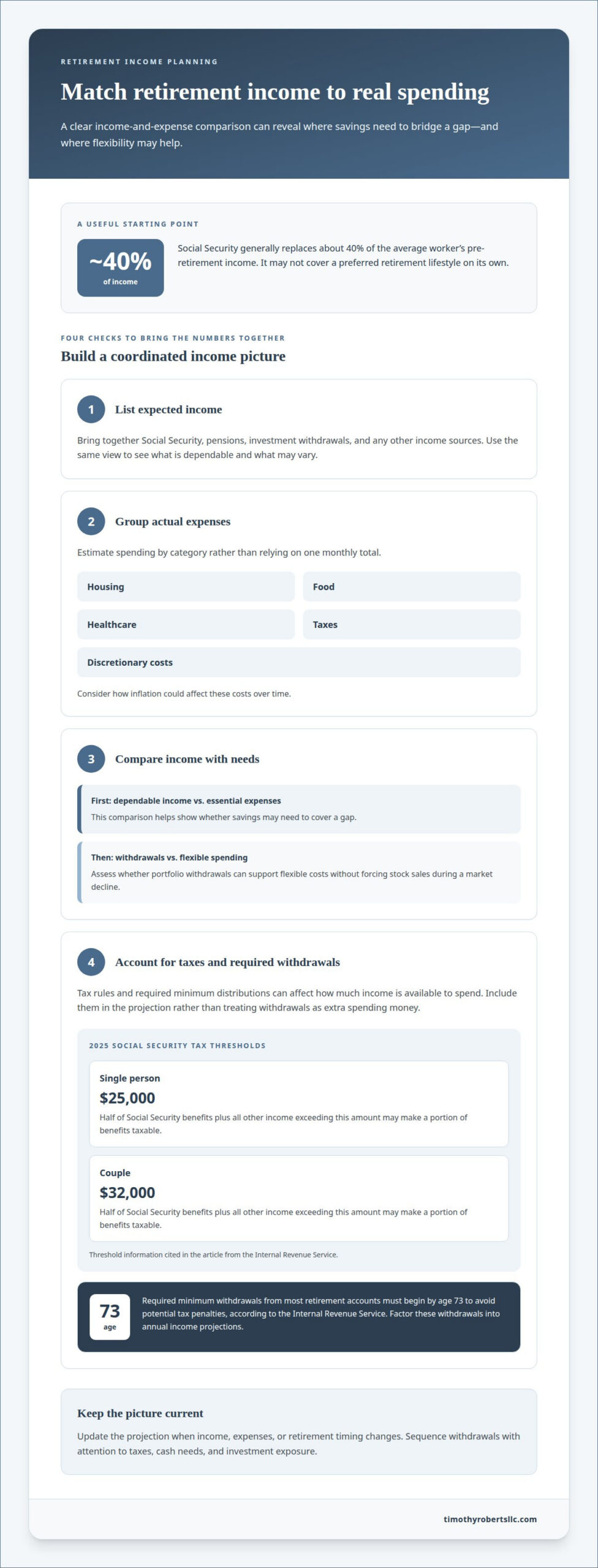
Confidence grows when expected income is compared with realistic expenses. Start by listing Social Security, pensions, investment withdrawals, and other income sources, then set them beside essential and flexible spending. Social Security generally replaces about 40% of the average worker’s pre-retirement income, so it may not cover a preferred retirement lifestyle on its own. A clear comparison helps reveal whether savings must bridge a gap.
Build your estimate from actual spending categories rather than one monthly total. Include housing, food, healthcare, taxes, and discretionary costs, then consider how inflation could affect them over time. First compare dependable income with essential expenses. Then assess whether portfolio withdrawals can support flexible spending without forcing stock sales during a market decline. Update the projection when income, expenses, or retirement timing changes.
Taxes can affect the income available to spend. For 2025, half of a single person’s Social Security benefits plus all other income exceeding $25,000 may make a portion of those benefits taxable, according to the Internal Revenue Service. For 2025, half of a couple’s Social Security benefits plus all other income exceeding $32,000 may make a portion of those benefits taxable, according to the Internal Revenue Service. Include these thresholds in tax-aware income projections.
Withdrawal strategy matters too. Sequence withdrawals across accounts with attention to taxes, cash needs, and investment exposure. People must begin taking required minimum withdrawals from most retirement accounts by age 73 to avoid potential tax penalties, according to the Internal Revenue Service. Integrate those withdrawals into the annual income figure rather than treating them as extra spending money. A well-structured retirement income plan can bring Social Security, account withdrawals, and expenses into one coordinated view.
3. Working longer and delaying Social Security
Retirement timing can shape both income and portfolio pressure during a recession. Continuing to work for pay may cover some expenses, reduce withdrawals from retirement accounts, and leave more invested for a market recovery. In the EBRI confidence survey, 80% of workers expected to continue working for pay after retirement. That expectation can inform a plan, but it helps to distinguish deliberate part-time work from income a household depends on. A later retirement date may also allow additional time to save and adjust the transition around the economy.
Work through the decision in sequence: estimate essential expenses, identify the income gap, then compare potential work income with the withdrawals otherwise needed. If part-time earnings cover flexible spending, you may need to sell fewer assets during a downturn. The trade-off is personal: health, job demands, caregiving, and suitable work all affect whether delaying retirement is practical. A revised timeline should account for these realities and the retirement income you need.
Social Security retirement benefits can begin at age 62 in the United States. Delaying a claim can increase the monthly benefit, and benefits increase by approximately 8% per year when claiming is delayed between ages 62 and 70. The publication also states that delaying beyond full retirement age can earn retirement credits that increase benefits until age 70. For people born after 1959, full Social Security benefits are available at age 67.
Compare Social Security claiming options with investment withdrawals, rather than considering them in isolation. Claiming earlier can provide income sooner, while waiting may mean relying more on work or savings in the meantime. For example, if you plan to retire before claiming benefits, model how you would cover expenses during that gap. Then compare a later claim with the increased benefit and its effect on account withdrawals. This makes a broad timing choice easier to assess in terms of income, savings, and flexibility.
4. Building confidence through retirement planning
Confidence comes from clear assumptions, not a promise that markets will behave predictably. Start with a written baseline: expected retirement date, income sources, essential expenses, and the role of retirement savings. Then test a recession scenario, such as lower portfolio values alongside rising costs. The goal is to identify which decisions remain manageable and which need attention. Pension, Social Security, and investment income can each respond differently to economic conditions.
Use a 30-year retirement projection to examine how income and expenses may change over time. Include inflation, healthcare, housing, taxes, and discretionary spending. Then compare the baseline with a more difficult situation, such as an extended period of weaker investment performance. Identify adjustments in advance, including which flexible expenses could be reduced and which income sources should fund essentials. A prepared plan gives each adjustment a defined purpose instead of relying on rushed decisions during market stress.
Make the review actionable. Record the assumptions behind the projection, the income sources it includes, and the conditions that would prompt a new review. For example, a change in retirement timing, household income, or spending priorities can alter the outlook. Revisit the plan after a meaningful change, and use the same assumptions when comparing options. In a 2024 survey, 89% of people who tried to figure out their financial futures said they were confident in their financial security. Planning makes uncertainty easier to assess, even though it cannot remove market risk.
Keep the process focused on decisions within reach: align spending with dependable income, account for inflation, and revisit investment risk when circumstances shift. That combination can make confidence more grounded than a market forecast. Strengthen your retirement plan with a coordinated review of income, savings, and long-term priorities.
Timothy Roberts & Associates: Retirement Plans 401k, 403b, Roth IRA, IRA, SEP IRA
Timothy Roberts & Associates, LLC helps coordinate retirement accounts, investment decisions, and income needs. When a recession raises questions about withdrawals, portfolio risk, or retirement timing, a focused review can clarify how your current strategy aligns with your goals. Retirement Income Planning and Investment Portfolio Management can connect savings decisions with the income you expect to use.
The firm also works with Retirement Plans 401k, 403b, Roth IRA, IRA, SEP IRA, and Estate & Legacy Planning. These planning areas can be considered together as your circumstances and priorities evolve. Contact Timothy Roberts & Associates, LLC to discuss your retirement planning needs.
Give your plan room to evolve
Feeling confident in your retirement plan during a recession does not mean predicting every market turn. It means having a thoughtful framework to revisit as your priorities and circumstances change. The next step is to move from general concerns to a clear view of the decisions that matter most, including how income, investments, and long-term intentions fit together.
Timothy Roberts & Associates, LLC offers Retirement Income Planning and Investment Portfolio Management to support coordinated financial decisions, along with Estate & Legacy Planning for broader future considerations. A conversation can clarify which planning questions deserve attention now and how they connect to your goals.
Contact Timothy Roberts & Associates, LLC to discuss a planning approach that reflects your circumstances and priorities. A considered next step can help you move forward with greater clarity.
Frequently Asked Questions
How does a recession affect retirement savings and investment portfolios?
A recession can coincide with falling stock prices, reducing the value of retirement accounts invested in stocks. Bond values can fluctuate too, depending on interest rates and credit conditions. The effect on your portfolio depends on its investment mix, your withdrawals, and when you need the money. Review account statements alongside spending needs rather than judging your plan by a single market indicator.
What is a reasonable stock and bond allocation for retirees during a recession?
There is no single stock-and-bond mix that suits every retiree. An appropriate allocation depends on income needs, other resources, investment horizon, and tolerance for fluctuations. For example, someone relying on portfolio withdrawals for essential expenses may need a different balance from someone whose pension covers those costs. Assess your full financial picture and each investment’s role before changing allocations.
How many years of cash should retirees keep for expenses during a market downturn?
The right cash reserve depends on essential expenses, dependable income, and how much you withdraw from investments. First separate recurring necessities from discretionary spending, then compare those needs with pension or Social Security income. The remaining gap can help you determine how much accessible cash may be useful. Revisit the reserve when income, spending, or withdrawal plans change, rather than choosing a fixed period without considering your situation.
Should retirees change their retirement investment plan during a recession?
Change your plan when circumstances or its assumptions have shifted, not simply because markets are down. A new retirement date, a change in household income, or higher essential expenses may justify reviewing your strategy. Compare your current portfolio and withdrawal approach with your written goals. This helps distinguish a practical adjustment from a reaction that could disrupt your long-term investment approach.
How can retirees avoid selling investments at a loss during a recession?
Plan withdrawals before you need the money. Identify which income sources and accessible assets can cover near-term expenses, then decide how investment sales fit into your broader strategy. If a downturn reduces stock values, adjusting discretionary spending or using other income sources may ease pressure to sell immediately. Choices depend on account types, tax considerations, and cash needs, so assess them together.
What withdrawal rate is sustainable during a recession?
No single withdrawal rate suits every retiree or every recession. Sustainability depends on portfolio size, investment performance, spending, other income, and how long withdrawals may continue. Compare withdrawals with essential costs and available income, then model how a market decline could affect future balances. If expenses are flexible, planned adjustments may reduce pressure on investments without assuming markets will recover on a particular schedule.
