

Nov
Is my 401k alone enough to retire? Assess your needs
A 401(k) alone can support retirement only if its withdrawals, alongside any other income you’ll receive, can cover your costs for as long as you need them. Whether my 401(k) alone is enough to retire depends less on the balance in isolation than on spending, retirement timing, and the income you’ll need. As a simple illustration, withdrawing 4% from a $1 million portfolio provides $40,000 a year, but that figure alone doesn’t show whether it will meet your needs.
It’s natural to focus on your account balance, but retirement readiness is about how well your savings can fund the life you intend to lead. Housing, healthcare, taxes, and the timing of withdrawals can all shape how much income your 401(k) can provide.
This article explains how to assess your expenses and goals, understand key withdrawal rules, and consider how delaying retirement could change the picture. You’ll come away with a clearer framework for judging whether your 401(k) can stand on its own or needs to be part of a broader retirement income strategy.
Key Takeaways
- Assess whether your 401(k) can support retirement by weighing expected expenses, lifestyle goals, and other income sources together.
- In the United States, 401(k) withdrawals generally avoid the 10 percent early-withdrawal penalty when taken at age 59½ or later, according to the Internal Revenue Service.
- Social Security benefits can reduce how much income you need to draw from savings, so include their timing and estimated amount in your retirement picture.
- Delaying retirement may give savings more time to grow while shortening the period they need to fund; a professional can connect that timing to an income plan tailored to your goals.
Delaying retirement and average 401(k) balances
Retirement timing affects how long your savings can grow and how long withdrawals must last. Balance projections should reflect your planned retirement date, contributions, investment mix, and expected income needs.
Retirement Timing and Savings
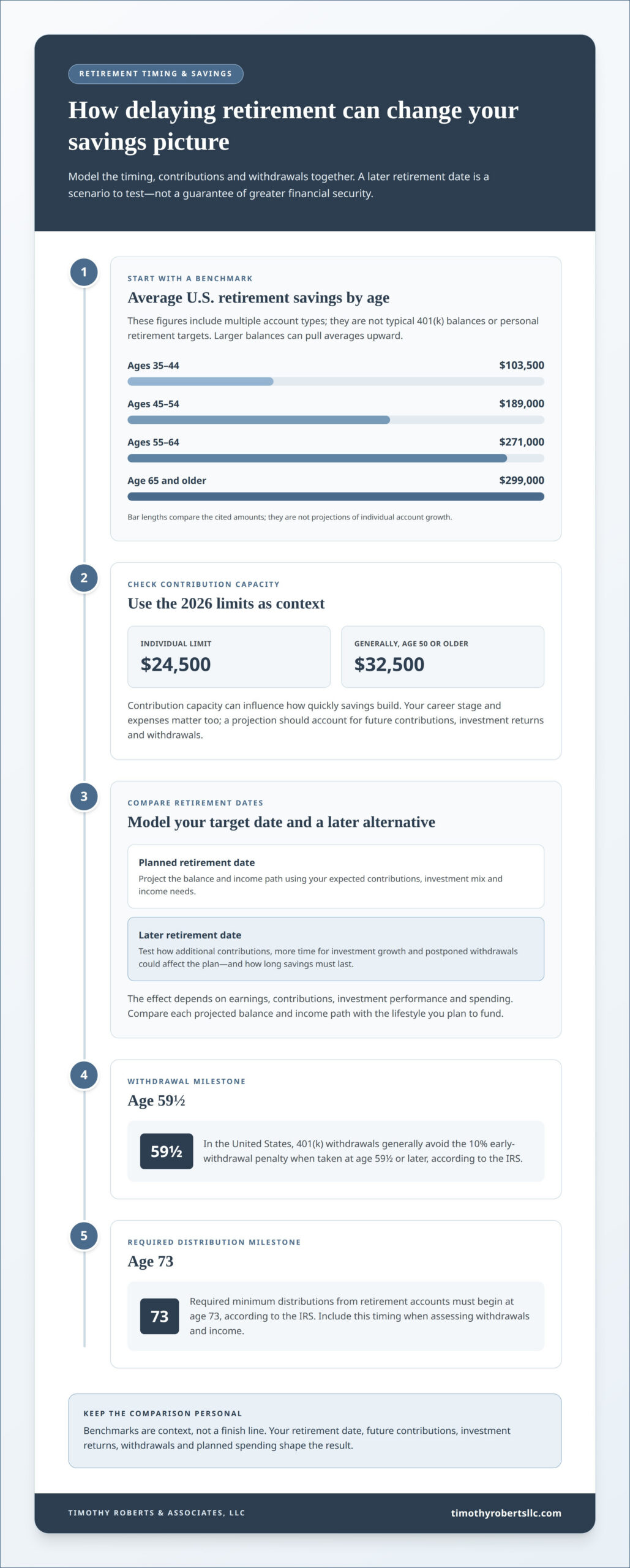
Delaying retirement means working beyond your original target date, which may extend your saving period. You could make additional contributions and allow more time for investment growth while postponing withdrawals. It may also shorten the period your savings must support you. The effect depends on your earnings, contributions, investment performance, and spending. Treat a later retirement date as a scenario to model, not a guarantee of greater financial security.
Access rules also shape the timing decision. In the United States, 401(k) withdrawals generally avoid the 10 percent early-withdrawal penalty when taken at age 59½ or later, according to the Internal Revenue Service. Required minimum distributions from retirement accounts must begin at age 73, according to the Internal Revenue Service. These milestones can affect when money is accessible and when withdrawals must start.
Average 401(k) Balances
Average retirement savings offer context, but they are not a personal retirement target. U.S. retirement savings, including 401(k) accounts, average around $103,500 for people ages 35-44. The average is around $189,000 for ages 45-54, $271,000 for ages 55-64, and $299,000 for people age 65 and older. These figures combine account types, so they don’t describe a typical 401(k) balance alone. Averages can also be pulled upward by larger balances.
Compare a benchmark with your own projected income, not just someone else’s balance. In 2026, the U.S. individual 401(k) contribution limit is $24,500, or generally $32,500 for people age 50 or older, according to the Internal Revenue Service. Contribution capacity can influence how quickly savings build, but your career stage and expenses matter too. A projection should account for future contributions, investment returns, and withdrawals rather than treating today’s balance as the final result.
For a useful estimate, model both your intended retirement date and a later alternative. Compare the resulting balances and income paths, then consider how each supports your planned spending. This makes the trade-off concrete: working longer may create more time to save and less time drawing down assets, while your desired lifestyle determines how much income the portfolio must provide.
How a professional estimates retirement needs based on expenses and goals
A retirement income plan connects your expected expenses and goals with income from your savings and other sources.
Expenses and Retirement Goals
Retirement needs are an estimate of the income required to fund your planned lifestyle. A professional reviews household expenses, distinguishes essential costs from discretionary spending, and considers goals such as travel, housing changes, or family support. A common rule of thumb is to budget about 80 to 85 percent of pre-retirement income. It’s a starting point, not a substitute for examining your actual spending and priorities.
That information helps build a projection of savings and withdrawals. A financial professional can factor in your contribution level, account balance, investment mix, and retirement date, then compare projected income with anticipated expenses. If there is a gap, you can consider changing your timeline, savings approach, or spending goals.
Social Security and Income Needs
Social Security benefits can reduce the amount your retirement portfolio needs to provide. A professional includes expected benefits alongside 401(k) withdrawals and other income, then estimates the remaining gap between resources and spending. The timing of benefits matters because it affects when income begins and how much savings may need to cover beforehand.
For example, a plan can compare expected monthly expenses with income available at different retirement stages. This shows whether the portfolio must carry more of the cost early on, or whether other income sources help later. A precise estimate depends on the individual’s earnings record, benefit timing, and household plans.
Healthcare Costs and Savings Needs
Healthcare costs can increase the savings needed beyond a general spending estimate. Medicare eligibility begins at age 65 for most Americans, but retirement healthcare planning also needs to account for expenses outside the coverage assumptions.
Separating healthcare costs from other expenses can make their effect on retirement withdrawals easier to see. Include them as a distinct part of the projection rather than burying medical spending in a broad annual budget.
Americans surveyed in Northwestern Mutual’s 2026 Planning & Progress study expected to need an average of $1.46 million to retire. That figure offers context, not a personal target: expenses, benefits, healthcare, and goals determine the estimate that fits each household. A professional retirement income planning review can bring those assumptions into one coherent projection.
Why a 401(k) alone may not be enough for retirement
A 401(k) alone may fall short when its withdrawals cannot cover planned expenses throughout retirement. Pensions, IRAs, and other savings can supplement it by adding income sources and spreading retirement resources across accounts.
Limits of 401(k) Savings
A 401(k) is one part of a retirement income plan, not a measure of every resource available. Its balance must support withdrawals over time, while investment performance, inflation, taxes, and spending affect how much income it can provide. Traditional 401(k) withdrawals are taxed as regular income in the United States, so the spendable amount may be lower than the withdrawal.
The income goal matters. A financial planner’s example gives someone earning $500,000 annually as a case where a 401(k) alone may not be enough. That contrast shows why balance benchmarks cannot settle the question: the same account amount can support different lifestyles and expenses. A plan member’s expected costs, retirement timing, and other income all shape the shortfall.
Supplementing a 401(k)
A supplemental source is another asset or benefit that can contribute income during retirement. A pension may provide income alongside 401(k) withdrawals, while an IRA or other savings account can add another pool of assets. Each source affects how much the 401(k) must provide and when withdrawals may be needed.
A professional assesses the combined picture rather than treating each account in isolation. For example, pension income may cover part of regular expenses, leaving retirement accounts to fund other priorities. IRA savings can also broaden the available pool, while cash savings may help meet expenses without relying on a 401(k) withdrawal for every need. Account types and withdrawal timing influence the overall income plan.
For a fuller assessment, compare projected retirement income with the expenses it must cover. A sustainable withdrawal rate is often estimated at 4% to 5% annually, with inflation adjustments, for a typical 30-year retirement. That estimate is a planning reference, not a personal conclusion. The practical takeaway is to evaluate the total income picture, including benefits and other savings, before deciding whether one account can carry the plan.
How do Social Security benefits affect retirement income needs?
Social Security benefits can reduce the amount of retirement income your savings must provide. A professional includes expected benefits beside projected expenses, then calculates the remaining income gap. That gap helps clarify whether 401(k) withdrawals and other resources can support your plans. The answer depends on benefit amounts, when income begins, and how your spending changes throughout retirement.
Consider a two-stage projection. First, compare household expenses with available income before Social Security benefits begin. Then include the expected benefit and reassess how much income must come from savings. This shows whether the portfolio needs to fund a larger share of expenses during one period and a smaller share later. It also makes the benefit’s role visible without treating it as a replacement for a full retirement income plan.
Consider the estimated Social Security benefit alongside your household’s retirement goals, not on its own. A financial professional can model different benefit-starting dates and compare their effects on withdrawals and income timing. If the benefit covers only part of your planned spending, savings must fund the rest. Changes in expenses can change that income gap.
Social Security can also inform decisions about when to retire. Compare an earlier retirement scenario with a later one, accounting for benefit timing, employment income, and withdrawals from retirement accounts. The results can reveal which assumptions have the greatest effect on your plan and where changes to timing, spending, or savings may help align resources with your goals.
Include Social Security in a coordinated income projection rather than judging a 401(k) balance alone. Request retirement income planning to assess how benefits and savings may work together in your retirement plan.
Timothy Roberts & Associates: Retirement Plans 401k, 403b, Roth IRA, IRA, SEP IRA
Timothy Roberts & Associates, LLC can help connect your retirement accounts with an income strategy tailored to your goals. If your projections show that a 401(k) may not cover planned expenses on its own, Retirement Income Planning can help assess how savings and other income sources fit together.
The firm works with 401k, 403b, Roth IRA, IRA, and SEP IRA plans. Investment Portfolio Management can support decisions about how a portfolio aligns with your retirement timeline, while Estate & Legacy Planning addresses how your plans connect with the legacy you intend to leave. The focus is a coordinated view, not an isolated account balance.
If you’re ready to discuss how your retirement savings may support your goals, contact Timothy Roberts & Associates, LLC.
Shape your next retirement decision
The question of whether your 401(k) alone is enough to retire becomes more useful when it leads to a decision: what do you want your savings to make possible, and what adjustments would bring that future into clearer reach? A retirement plan is not only a balance or a target date. It’s a way to align income, priorities, and choices as circumstances change.
Timothy Roberts & Associates, LLC can help you develop a considered strategy through Retirement Income Planning, Investment Portfolio Management, and Estate & Legacy Planning. Start with a conversation about your goals, expected income, and the role you want each resource to play. A fiduciary advisor is legally bound to act in your best interest and can help organize these decisions into a coherent plan.
Contact Timothy Roberts & Associates, LLC to discuss your retirement income strategy. A clearer plan can help you move forward with greater confidence and purpose.
Frequently Asked Questions
Can I retire on my 401(k) alone?
It can be enough if projected after-tax withdrawals cover your expenses throughout retirement. Whether my 401(k) alone is enough to retire depends on the balance, spending needs, and other income. For example, someone with modest housing costs may need less portfolio income than someone supporting dependents or carrying substantial debt. Include taxes on traditional 401(k) withdrawals and the timing of other income before judging the account’s role.
Can delaying retirement help me build a better 401(k) balance?
Continuing to earn and contribute while delaying retirement may increase your savings and reduce the time your accounts need to fund expenses. It may also give you more flexibility about when to begin withdrawals. Weigh these possibilities against your career plans, health, and desired lifestyle. Compare a later date with your original target, including any changes in spending or contributions.
How much of my monthly income should I save for retirement?
A suitable monthly contribution depends on your income, current expenses, retirement timeline, and savings progress. It should fit your household budget while helping you work toward your retirement income goal. For example, substantial debt payments may limit how much you can save compared with a budget that has more room in monthly cash flow. Employer contributions may also affect how much you need to set aside yourself.
How much retirement savings do you actually need?
Your target depends on the income needed to cover planned expenses, how long savings must support you, and other expected resources. Americans surveyed in Northwestern Mutual’s 2026 Planning & Progress study said they expected to need an average of $1.46 million to retire. That survey figure is context, not a personal target. A household’s housing, healthcare, goals, and income sources shape its own estimate.
How much should I have in my 401(k) by age 40?
A common benchmark is savings equal to about twice your annual salary by age 40. This is a broad retirement-savings guideline, not a specific 401(k) requirement, and it doesn’t account for every household’s pension, IRA, or other assets. For example, if your savings are below that benchmark, your contribution history, planned retirement date, and future income needs help determine what adjustments may be appropriate.
How much should I have in my 401(k) by age 50?
A common benchmark is about four times your annual salary saved by age 50. Treat it as a reference point for total retirement savings, rather than a required 401(k) balance. Other accounts and expected income affect how much your workplace plan needs to provide. A professional can compare your current resources with your goals and show how contribution levels and retirement timing affect the projection.
