

Nov
Financial Checklist for Helping Elderly Parents Plan Together
A financial checklist for helping your elderly parents should start with their priorities, not just their paperwork. Keeping a parent involved in decisions helps clarify what matters to them and shape a plan around their wishes, finances, and care needs.
It’s natural to focus on care costs when planning for the future. A clear picture of income, regular expenses, insurance, savings, and possible care arrangements helps your family consider how those costs fit your parent’s financial situation.
This checklist guides you through gathering essential financial records, discussing preferences, reviewing day-to-day money management, and preparing for changing care needs. It also helps you organize next steps together, keeping your parent part of the conversation wherever possible. The goal is a practical foundation for shared decisions that can adapt as circumstances change.
Key Takeaways
- Map potential care arrangements against your parent’s income and regular expenses to make future choices more grounded.
- Start financial conversations with your parent’s priorities, then organize the records and professional contacts that support planning.
- Understand how financial authorization differs from healthcare decision-making, and why planning ahead can preserve options.
- Keep your parent involved in decisions and revisit the plan as their preferences, finances, or support needs change.
How does this checklist relate to long-term care costs?
A financial checklist for helping your elderly parents connects care preferences with the resources available to fund them. Start by discussing whether your parent wants to remain at home, move closer to family, or consider assisted living or nursing care. Then compare those preferences with income, savings, insurance, and regular expenses. This makes housing transitions part of financial planning, rather than a decision made only after care needs change.
In the United States, the Consumer Financial Protection Bureau identifies Social Security, Medicare, Medicaid, housing assistance, and SNAP among government benefits for seniors. These programs may support income, healthcare, housing, and food needs, depending on eligibility. Track utility bills separately in the household budget, alongside rent or mortgage payments.
Build a monthly budget with clear categories for housing, healthcare, daily expenses, and community services. Record insurance premiums, prescriptions, groceries, transportation, utilities, and recurring care costs. Review long-term care insurance and veterans benefits too, since coverage depends on policy or program terms, and consider working with specialists like Safe Harbor Financial Resources when exploring tailored insurance and retirement solutions.
Gather Medicare, Medicaid, and long-term care insurance documents, along with bank statements, investment records, pension details, and recent tax returns. Keep paper records in a secure, accessible place and digital copies in secure online storage. Add contact details for professionals already involved so family members can find key information when plans need attention.
Plan bill-paying with your parent’s agreement and proper authorization. Automatic payments may help prevent missed due dates, while a written list of bills, payment methods, and account institutions clarifies what needs attention. Review the budget as housing, health, or daily support needs change. A future care plan can also record preferences and expectations, giving caregivers a practical reference as arrangements evolve.
What should be on a financial checklist for an aging parent?
Begin with your parent’s wishes, not an account balance. Ask what independence means to them, where they hope to live, and what concerns them about aging. Discussing these priorities first keeps the conversation focused on their choices rather than making it feel like an evaluation of past decisions. Offer to create your own checklist alongside theirs.
Introduce financial preparation with a practical first step: locating important documents. Then organize information together, including bank and credit union accounts, savings, investments, retirement income, insurance, debts, recurring bills, and payment methods. Add recent tax returns, Social Security statements, pension records, property deeds, vehicle titles, and contact details for existing financial or legal professionals. Knowing where records are kept makes later conversations about support more specific.
Discuss possible financial support directly but respectfully. Ask which expenses your parent wants help managing, whether they want family involved, and how they’d prefer updates or decisions to be handled. For example, agree on a shared list of recurring bills while leaving account access and payment decisions with your parent unless they authorize otherwise. Record preferences about housing, social activities, and daily assistance alongside financial notes.
- Record account institutions, recurring payments, insurance policies, and professional contacts so key details stay organized.
- Note your parent’s wishes about living arrangements, independence, and family involvement to guide future discussions.
To help guard against scams, agree to pause and discuss unexpected requests for money or account information before responding. The Consumer Financial Protection Bureau says regularly reviewing credit reports can help identify unauthorized accounts. Include that review in the family’s planning routine.
Keep the checklist accessible to your parent and the family members they choose. A shared, organized record can support your next financial planning steps as needs and preferences evolve.
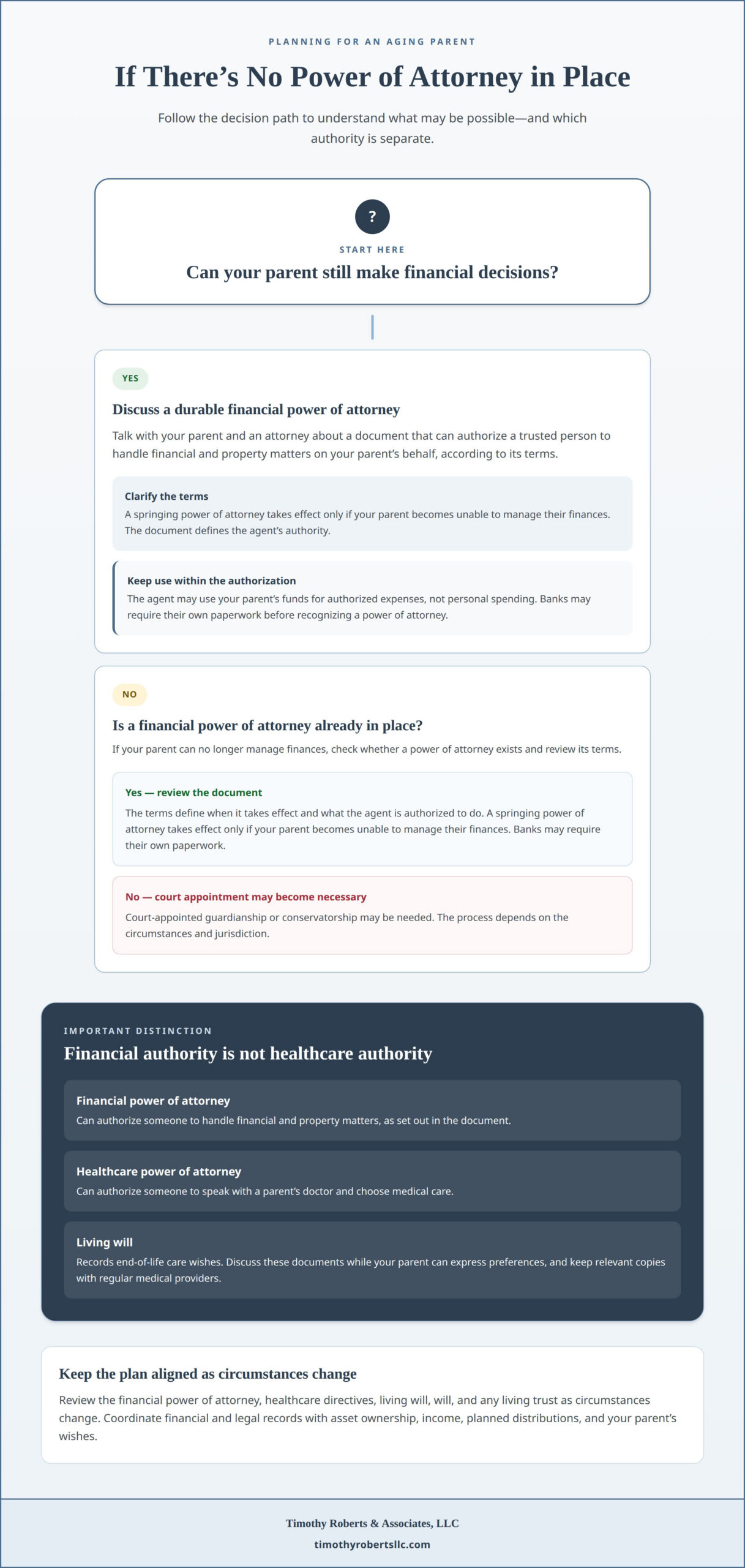
What If There’s No Power of Attorney in Place?
In the United States, being a parent’s child doesn’t automatically grant access to financial accounts or authority over money decisions. If your parent can still make decisions, discuss a durable financial power of attorney with them and an attorney. This document can authorize a trusted person to handle financial and property matters on the parent’s behalf, according to its terms.
When a durable power of attorney takes effect can depend on its terms. A springing power of attorney takes effect only if the parent becomes unable to manage their finances. The document’s terms define the agent’s authority, and the agent may use the parent’s funds for authorized expenses, not personal spending. Banks may require their own paperwork before recognizing a power of attorney.
Financial and healthcare authority are separate. A healthcare power of attorney can authorize someone to speak with a parent’s doctor and choose medical care. A living will records end-of-life care wishes. Discuss both while your parent can express preferences, and keep relevant copies with regular medical providers.
If a parent can no longer manage finances and has no power of attorney, court-appointed guardianship or conservatorship may become necessary. The process depends on the circumstances and jurisdiction. Preparing documents ahead of time helps families understand who may act and which decisions the parent wants respected.
Review the financial power of attorney, healthcare directives, living will, will, and any living trust as circumstances change. A will or living trust can direct property distribution after death. Estate and tax planning should account for asset ownership, income, planned distributions, and the parent’s wishes. Coordinate those details across financial and legal records.
Compare financial advisors, fiduciaries, and elder-law attorneys by the work each handles: financial strategy and investments, oversight of financial interests, or legal planning and documents. Consider relevant experience, scope, compensation, and coordination needs.
Financial planning can address income, investments, and care-related decisions; an elder-law attorney handles legal documents. Keeping those roles distinct helps families organize tax records, estate intentions, and decision-making authority without confusing financial support with legal authorization.
Keeping a parent involved in financial decisions
Involvement should reflect your parent’s abilities and preferences, not assumptions based on age. Ask which decisions they want to lead, where they welcome guidance, and what information helps them feel prepared. For example, they may want to choose housing independently but review monthly expenses with a family member.
Make conversations collaborative. Discuss one decision at a time, explain the choices in plain language, and invite your parent to weigh the trade-offs. When discussing transportation, medication, or social activities, connect each practical need to their goals and budget. This keeps financial decisions tied to everyday life.
- Agree on roles. Name who gathers information, who supports discussions, and which decisions remain your parent’s.
- Use a shared agenda. List current concerns, such as bill management or future housing, so the conversation stays focused.
- Offer clear choices. Compare options using relevant details, such as cost categories, convenience, and your parent’s preferences.
- Record decisions. Note the choice, the parent’s reasoning, and any follow-up, so family members understand the plan.
Revisit the arrangement as circumstances change. A parent who manages routine bills comfortably may want help reviewing investments or future care options. If managing medication, self-care, social connection, or transportation becomes harder, discuss what support feels acceptable. Keep your parent involved in adapting the plan rather than assuming someone else should take over every decision.
Respectful guidance means allowing time for questions and avoiding pressure to decide in one conversation. If family members disagree, return to your parent’s stated priorities and clarify which choice best reflects them. This keeps the process centered on the person whose finances and future are being planned.
Develop a financial plan that keeps your parent’s priorities central.
Timothy Roberts & Associates: Financial Planning
Timothy Roberts & Associates offers fiduciary financial planning to help families bring their discussions into a coordinated plan. When care preferences, retirement income, investments, and estate goals need to be considered together, planning can clarify how those pieces relate. Retirement Income Planning can help structure income decisions, while Wealth & Investment Management addresses investment strategy. Estate & Trust Planning can help organize how a parent’s wishes and financial priorities connect over time. “Your Interest is Our Only Interest.”
This support can be useful when your family has gathered key information and wants to shape it into a considered financial plan. Your parent can remain part of the process, sharing priorities and decisions as the financial picture is organized around their goals.
Contact Timothy Roberts & Associates to discuss financial planning for your family’s next steps.
Make the Next Conversation Count
A plan becomes more useful when it reflects the older adult’s priorities, not only the family’s concerns. Use the financial checklist for helping your elderly parents as a starting point for an ongoing conversation, then let your parent shape what happens next. Their preferences may change, and family roles may need to adjust with them.
Choose one practical next step together. You might set a time to discuss an unresolved decision, clarify who will organize information, or identify planning questions that need professional guidance. Keeping the process collaborative helps preserve your parent’s voice while giving family members a clearer way forward.
Timothy Roberts & Associates, LLC can help families bring financial priorities into a considered plan. Discuss your family’s planning priorities with Timothy Roberts & Associates, LLC, and take the next step with care and clarity.
Frequently Asked Questions
How Does This Connect to the Cost of Care?
A care plan helps families compare preferred support and housing with available resources. Weigh possible arrangements, such as remaining at home with assistance or moving to a care setting, against income, savings, insurance, and regular expenses. List transition costs separately from ongoing bills. Revisit the comparison as needs or preferences change so the plan continues to reflect your parent’s circumstances.
What Should Be on the Checklist?
Include your parent’s priorities, financial records, recurring obligations, and the people involved in planning. Note who is responsible for each follow-up and when the plan was last reviewed. This helps family members identify unanswered questions without taking decisions away from the parent. Review the life plan, financial plan, and legal documents at least once a year, and after a major change.
What financial documents should adult children help elderly parents organize?
Gather records showing what your parent owns, receives, owes, and pays. Useful examples include recent account statements, retirement and pension income details, insurance policies, tax returns, property and vehicle records, debt information, and recurring bills. Add professional contact details and safe-deposit box information. Keep an index showing where original documents are stored so family members can locate the right record without searching unrelated files.
How can parents legally authorize someone to manage finances, including durable power of attorney?
A parent can use a financial power of attorney to authorize someone to make money and property decisions, subject to the document’s terms. A durable version takes effect when signed; a springing version takes effect if the parent becomes unable to manage finances. Parents should discuss the document with an attorney while they can make decisions. Financial institutions may require their own paperwork before recognizing it.
How can you review an older parent’s income, expenses, debts, and budget?
Build a simple cash-flow view by listing income sources, regular bills, debts, and irregular expenses in separate categories. Compare income timing with payment due dates, then identify variable expenses, such as medical appointments or home upkeep. Record family contributions separately from the parent’s funds. Reviewing the same categories consistently makes changes easier to spot and supports clearer conversations about future priorities.
How do Medicare, Medicaid, and long-term care insurance cover elder care costs?
Include Medicare and Medicaid coverage, as well as any long-term care insurance that may help pay eligible expenses under its policy. Coverage and eligibility depend on program rules or insurance terms, so organize the relevant documents and note what each addresses. Veterans benefits may also be a resource, depending on program eligibility and the expenses involved.
