

Aug
Charitable Remainder Trusts in Michigan: A 2026 Strategic Estate Guide
Selling a high-value Michigan business or a legacy property shouldn’t feel like a forced choice between personal wealth and philanthropic impact. For many high-net-worth individuals, the prospect of a massive tax bill often overshadows the satisfaction of a successful exit. You’ve worked hard to build your portfolio, and it’s natural to feel anxious about how market volatility might erode your retirement income. Utilizing charitable remainder trusts michigan offers a sophisticated way to resolve this tension, turning taxable liabilities into a strategic engine for growth.
We understand that your goals are as much about financial precision as they are about personal values. By implementing a Charitable Remainder Trust, you can secure a predictable, lifetime income stream while significantly reducing your immediate tax burden under 2026 regulations. This guide provides a strategic roadmap for your estate evolution. We’ll examine the nuances of Michigan trust registration, the impact of the new 0.5 percent AGI floor on your deductions, and how to synthesize your private wealth with a lasting public legacy.
Key Takeaways
- Discover how to convert highly appreciated assets into a sophisticated income stream while deferring significant capital gains liabilities.
- Learn the critical differences between CRAT and CRUT structures to determine which model best aligns with your long-term inflation and risk objectives.
- Navigate the specific registration requirements for charitable remainder trusts michigan to maintain seamless compliance with the Attorney General’s Charitable Trust Section.
- Identify the strategic steps necessary to optimize your 2026 income tax deductions based on the present value of your future philanthropic gifts.
- Synthesize your personal charitable vision with professional fiduciary management to ensure your wealth evolution leaves a lasting, purposeful impact.
The Strategic Role of Charitable Remainder Trusts in Michigan Wealth Management
A Charitable Remainder Trust is defined as a tax-exempt “split-interest” entity under IRS Section 664. This sophisticated financial structure allows a donor to transfer highly appreciated assets into an irrevocable trust, securing a predictable income stream for a set term while designating the remaining assets for a qualified charity. Within the framework of charitable remainder trusts michigan residents often utilize these vehicles to transform illiquid assets, such as commercial real estate or privately held business interests, into diversified portfolios. By doing so, you bypass the immediate erosion of capital gains taxes that typically accompanies a direct sale. It’s a method of capturing the full market value of your hard work to fuel your future.
Strategic legacy planning is rarely about a single transaction; it’s about the synthesis of personal financial security and communal impact. By using this vehicle, you aren’t simply making a donation. You’re executing a calculated intervention that preserves the integrity of your wealth while advancing a mission you value. To gain a broader perspective on these structures, you can review a Charitable Trust Overview to understand how they differ from other gifting models.
To better understand this concept, watch this helpful video:
The Problem of Appreciated Assets and Tax Exposure
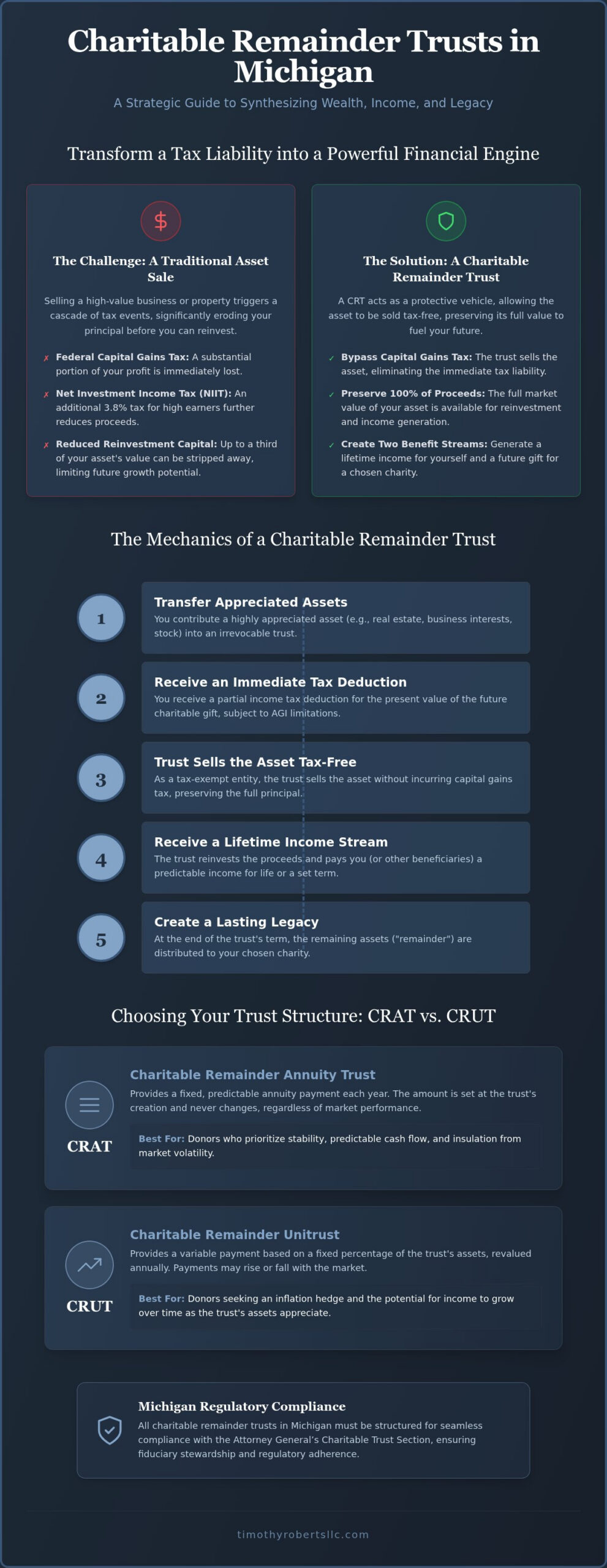
Selling a significant asset in Michigan, whether it’s a family-owned manufacturing firm or prime acreage in Oakland County, often triggers a cascade of tax events. Beyond the standard federal capital gains rate, high earners frequently face the 3.8% Net Investment Income Tax (NIIT). When these liabilities converge, traditional sales methods can easily strip away nearly a third of the asset’s total value before a single dollar is reinvested. This immediate tax exposure limits the principal available for your retirement income, effectively dampening your long-term growth potential. A CRT acts as a protective shell, allowing the asset to be sold tax-free within the trust, preserving 100% of the proceeds for your benefit.
Synthesizing Philanthropy with Retirement Income
A CRT offers a compelling “win-win” scenario that aligns your charitable intent with rigorous financial planning. Instead of a lump-sum tax payment to the IRS, the full value of the sold asset remains within the trust to produce a lifetime income stream. This creates a powerful synergy where your support for Michigan-based universities or local community foundations directly facilitates your own financial independence. Engaging in professional estate planning ensures that your charitable remainder trusts michigan strategy is tailored to your specific liquidity needs and legacy aspirations. It’s a purposeful evolution of wealth that turns a potential tax burden into a structured, impactful gift that serves both your family and your community for decades.
CRAT vs. CRUT: Navigating the Mechanics of Legacy Structures
Choosing between a Charitable Remainder Annuity Trust (CRAT) and a Charitable Remainder Unitrust (CRUT) is a pivotal strategic decision that dictates the rhythm of your future cash flow. While both vehicles serve the same ultimate purpose, their internal mechanics offer vastly different experiences regarding risk and market exposure. When establishing charitable remainder trusts michigan investors must weigh their immediate need for stability against their long-term desire for growth. This isn’t merely a technical choice; it’s a reflection of your personal philosophy on wealth preservation and legacy. Both structures provide a significant federal income tax deduction in the year of funding, but the ongoing management requires a sophisticated understanding of IRS compliance.
The Charitable Remainder Annuity Trust (CRAT)
The CRAT is designed for the donor who values predictability above all else. It provides fixed annual payments that remain constant regardless of market performance or the trust’s internal valuation. This consistency often appeals to conservative Michigan retirees who want a guaranteed “paycheck” to anchor their lifestyle. However, this structure comes with a rigorous “5% probability test.” The IRS mandates that the probability of the trust being exhausted before the charity receives the remainder must be less than 5%. Because the payout is a fixed dollar amount, a CRAT is typically preferred when funding the trust with cash or stable fixed-income assets. It offers a shield against market volatility, ensuring your income remains untouched even during economic downturns.
The Charitable Remainder Unitrust (CRUT)
For those focused on maintaining purchasing power, the CRUT is often the superior strategic choice. Unlike the fixed payments of an annuity trust, a CRUT pays out a fixed percentage of the trust’s fair market value, which is re-evaluated every year. This means that as the trust’s assets grow, your income grows with them, providing a built-in hedge against inflation. This flexibility is further enhanced by “Flip CRUTs,” which are particularly effective for illiquid Michigan assets like commercial real estate or closely held business stock. A Flip CRUT begins as a net-income trust and “flips” to a standard unitrust once the underlying asset is sold. This allows you to defer income until the asset becomes liquid, aligning your cash flow with the reality of your portfolio’s evolution.
Maintaining the integrity of these structures requires diligent fiduciary oversight to ensure the trust remains compliant with the 10% remainder rule. This rule states that the present value of the charitable interest must be at least 10% of the initial fair market value of the assets contributed. You can find more detail on these specific requirements by reviewing the IRS on Charitable Remainder Trusts. Aligning these technical requirements with your broader Estate & Legacy Planning goals ensures that your wealth serves your needs today while honoring your philanthropic vision for tomorrow.
Michigan Regulatory Compliance and Fiduciary Stewardship
The technical architecture of a CRT requires a dual track approach to compliance. You must satisfy rigorous federal IRS codes while simultaneously navigating the specific oversight of the Michigan Attorney General’s Charitable Trust Section. Establishing charitable remainder trusts michigan is not a “set and forget” transaction; it’s a commitment to ongoing regulatory precision. This state level scrutiny ensures that the charitable intent of the trust is protected, requiring a level of administrative rigor that often exceeds the capacity of individual trustees. Professional stewardship isn’t just a convenience. It’s a structural necessity to maintain the trust’s tax exempt status and ensure your legacy remains untarnished by avoidable penalties.
Registration with the Michigan Attorney General
In Michigan, the law mandates that any trust with a charitable remainder must register with the Department of Attorney General. This begins with the mandatory filing of Form CT-1, the Initial Registration form, which must be submitted shortly after the trust is funded. Beyond the initial setup, your fiduciary must manage annual reporting requirements, including state level disclosures and federal filings like Form 990-T if the trust generates unrelated business taxable income. Failing to adhere to these deadlines can lead to the loss of tax exemptions or personal liability for the trustee. This administrative burden is why many high net worth families in Michigan transition away from self management toward structured Wealth Management partnerships that prioritize compliance as a core pillar of the strategy.
The Importance of Independent Fiduciary Oversight
Choosing an independent fiduciary over a family member is a strategic move that protects the integrity of the trust. A professional advisor brings a detached, business minded perspective to the complex “self dealing” rules that can trigger severe IRS excise taxes. For example, on July 8, 2026, the IRS issued final regulations identifying specific CRAT arrangements as “listed transactions,” signaling an era of increased scrutiny that demands expert navigation. Your fiduciary must delicately balance the immediate income needs of the beneficiary with the long term growth required to satisfy the 5% minimum payout rule. This synthesis of personal attention and technical expertise ensures the trust’s investment strategy remains aggressive enough to combat inflation yet conservative enough to guarantee the charitable remainder. It’s a journey of upward progression that requires a partner who understands the intersection of aesthetics and functionality in estate design.
Optimizing Tax Efficiency: Deductions, Capital Gains, and Income
The primary financial driver for establishing a CRT is the immediate and surgical mitigation of capital gains tax. When you transfer an appreciated asset into the trust, you’re essentially moving it into a tax-exempt environment where it can be sold at its full market value without the immediate drag of federal or state levies. This allows the entire principal to be reinvested, fueling a more robust income stream than would be possible after a taxable sale. Engaging in strategic tax advising is necessary to ensure these benefits are maximized against your adjusted gross income (AGI), particularly as 2026 regulations introduce new complexities. The IRS “four-tier” system dictates the taxation of trust distributions by prioritizing ordinary income first, followed by capital gains, tax-exempt income, and finally, a tax-free return of corpus.
Calculating Your Charitable Deduction
Upon funding charitable remainder trusts michigan donors receive an immediate income tax deduction. This value isn’t arbitrary; it’s calculated based on the age of the beneficiaries, the selected payout rate, and the current IRS 7520 interest rate. In 2026, taxpayers in the top 37% marginal bracket should be aware that charitable deductions will only offset taxes at a 35% rate. For contributions of appreciated property, the deduction is generally limited to 30% of your AGI. If your deduction exceeds this ceiling in a single year, the IRS allows for a five-year carryforward, providing a long-term shield for your income. This multi-year planning approach ensures that your philanthropic vision also serves as a disciplined tool for wealth preservation.
Eliminating Capital Gains on Asset Sales
For Michigan business owners and real estate investors, the CRT offers a level of flexibility that traditional methods, such as a 1031 exchange, cannot match. While a 1031 exchange is restricted to “like-kind” real estate, a CRT allows you to sell a business or a property and diversify the proceeds into a broad portfolio of securities. This is especially valuable for those holding closely held stock or commercial assets with a low cost basis. To ensure your heirs aren’t disadvantaged by the eventual charitable gift, many families employ a “Wealth Replacement” strategy. This involves using a portion of the trust’s income to fund a life insurance policy held within an irrevocable life insurance trust. The result is a synthesized legacy: you receive a lifetime income, the charity receives the remainder, and your heirs receive a tax-free death benefit.
Maximizing the impact of these sophisticated vehicles requires a partner who can bridge the gap between creative vision and technical execution. If you’re ready to explore how these strategies can elevate your portfolio, we invite you to learn more about our Tax Planning Strategies to secure your financial future.
Designing a Purposeful Legacy with Timothy Roberts & Associates, LLC
Beyond the technicalities of tax codes and trust structures lies the deeper objective of defining your impact. Successful estate evolution requires a visionary partner who can translate your personal values into a structured financial reality. At Timothy Roberts & Associates, LLC, we facilitate this transition by acting as a strategic bridge between your current portfolio and your long-term philanthropic aspirations. Implementing charitable remainder trusts michigan is a specialized process that demands a synthesis of creative passion and business-minded rigor to ensure every asset serves its highest purpose.
The Fiduciary Difference in Estate Stewardship
Our team brings over 25 years of wealth management experience to the table, operating under a strict fiduciary standard of care. This commitment ensures that the management of your trust is handled with the highest level of professional stability and intellectual curiosity. Unlike standard off-the-shelf solutions, our interventions are carefully crafted to reflect the specific aesthetic and functional needs of your family’s wealth. We provide continuous monitoring and strategic rebalancing, ensuring that the trust assets remain a reliable engine for both your income and your eventual gift.
Next Steps: Your Evolution Toward a Strategic Legacy
The journey toward a more impactful estate begins with a deliberate assessment of your highly appreciated assets and liquidity needs. We work in close coordination with your existing legal advisors to ensure that every registration and filing is handled with meticulous precision. This collaborative approach at Timothy Roberts & Associates, LLC ensures a spacious and logical flow from the initial vision to the practicalities of execution. To determine how these vehicles align with your broader goals, we recommend a comprehensive review of your retirement income planning. Through this personalized stewardship, your charitable remainder trusts michigan strategy becomes a cornerstone of a legacy that is as enduring as it is intentional.
Advancing Your Wealth Toward a Purposeful Future
Establishing a sophisticated estate plan is a journey of upward progression. By now, it’s clear that charitable remainder trusts michigan offer a powerful synthesis of personal financial security and communal impact. You’ve seen how these structures can surgically mitigate capital gains liabilities on your most valued assets while creating a predictable income stream that stands resilient against market volatility. Navigating the 2026 regulatory landscape requires more than just technical knowledge; it demands a partner who views your wealth as a carefully crafted intervention rather than a series of transactions.
At Timothy Roberts & Associates, LLC, we bring over 25 years of wealth management experience to every high-level estate design. Our fiduciary advisors specialize in tax-efficient retirement income and personalized stewardship, ensuring your legacy is both functional and inspired. We don’t believe in off-the-shelf solutions. We believe in visionary strategies that reflect your unique values and long-term goals. Elevate your legacy with a strategic estate consultation. We look forward to helping you transform your success into a lasting, structured impact that benefits your family and your community for generations.
Frequently Asked Questions
How does a Charitable Remainder Trust work in Michigan?
A CRT works by transferring appreciated assets into an irrevocable vehicle that provides you with an income stream for life or a set term. Once funded, the trust can sell the assets tax-free to reinvest the full proceeds into a diversified portfolio. In Michigan, these entities must be registered with the Attorney General’s Charitable Trust Section to ensure state-level compliance and transparency throughout the life of the trust.
What are the specific tax benefits of a CRT for Michigan residents?
Michigan residents benefit from the immediate elimination of capital gains tax upon the sale of assets within the trust. You also receive a federal income tax deduction in the year of funding, which can be carried forward for up to five years if it exceeds your annual AGI limits. While Michigan doesn’t have a state estate tax, the CRT effectively reduces your federal taxable estate, preserving more wealth for your intended legacy.
Can I change the charitable beneficiary of my trust later?
You can typically retain the right to change the charitable beneficiary if the trust document is structured with that specific flexibility. This allows your philanthropic legacy to evolve alongside your personal values or the changing needs of the community. It’s a vital feature for those who want their charitable remainder trusts michigan to remain relevant and impactful over several decades of changing circumstances.
What is the minimum amount required to start a Charitable Remainder Trust?
There is no statutory minimum for a CRT, though the administrative and legal costs usually make it most efficient for assets valued at $250,000 or more. The trust must also satisfy the 10% remainder rule, meaning the charity is projected to receive at least 10% of the initial fair market value. This calculation ensures the trust serves a genuine charitable purpose while providing you with substantial financial benefits.
Who should serve as the trustee of a CRT in Michigan?
While you may technically serve as your own trustee, appointing a professional fiduciary is often the more strategic choice for complex assets. Independent oversight helps you avoid “self-dealing” traps and ensures the trust meets the rigorous reporting requirements of the Michigan Attorney General. A professional advisor brings the business-minded rigor necessary to balance your immediate income needs with the trust’s long-term stability.
How are the income payments from a CRT taxed?
Income payments follow a specific “four-tier” hierarchy mandated by the IRS. Distributions are taxed first as ordinary income, then as capital gains, followed by tax-exempt income, and finally as a tax-free return of the trust principal. This structure requires meticulous accounting by your advisor to ensure that your distributions are reported accurately and that you’re maximizing the tax-efficient nature of the trust’s internal growth.
What happens to the remaining assets in the trust after the term ends?
Once the income term concludes or the last beneficiary passes away, the remaining assets are distributed to the designated charitable organizations. This final transfer completes your legacy, providing a significant, lump-sum contribution to the causes you’ve chosen to support. It marks the culmination of a strategic journey that provided for your retirement needs while securing a meaningful future for a Michigan-based institution or foundation.
Can I fund a Charitable Remainder Trust with Michigan real estate?
You can absolutely fund charitable remainder trusts michigan with real estate, which is a common strategy for owners of highly appreciated commercial or residential property. Using a “Flip CRUT” structure allows you to hold the property until a sale is finalized without the pressure of immediate payout requirements. This ensures the trust doesn’t face liquidity issues before the asset is converted into a liquid, income-producing investment portfolio.
