

Jul
Detroit Retirement Income Strategies: 2026 Guide
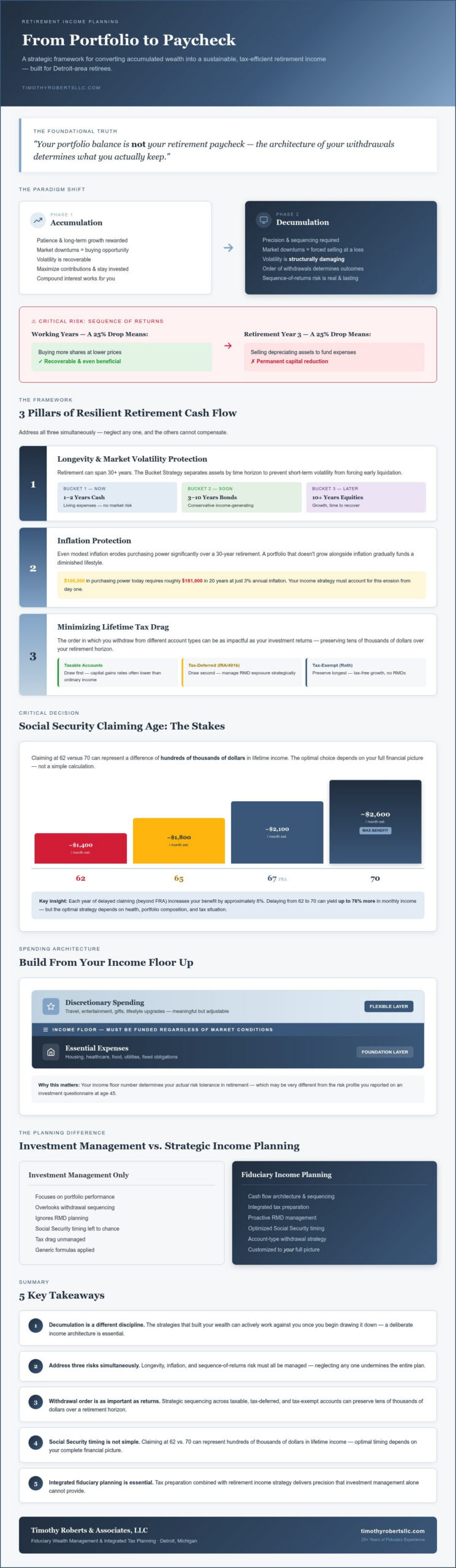
Your portfolio balance is not your retirement paycheck. That distinction, simple as it sounds, is the foundation of every successful retirement income strategy Detroit retirees need to understand before they stop working. A seven-figure account means very little if the architecture of your withdrawals triggers unnecessary taxes, exposes you to sequence-of-returns risk in year one, or leaves Social Security timing to chance.
You already know this transition feels different from anything you’ve planned before. Accumulating wealth follows a relatively forgiving path; converting it into a reliable monthly income stream is a far more precise discipline. One poorly timed decision around required minimum distributions or a market downturn in the first two years of retirement can permanently alter the trajectory of your financial life.
This guide is built to change that. Drawing on over 25 years of fiduciary wealth management and integrated tax planning, what follows is a clear, strategic roadmap covering cash flow sequencing, RMD management, Social Security timing, and tax-efficient withdrawal strategies. By the end, you’ll have a working framework for turning your 401(k), IRA, and investment accounts into a sustainable income that supports the lifestyle you’ve earned.
Key Takeaways
- Decumulation is a fundamentally different discipline from saving — the strategies that built your wealth can actively work against you once you begin drawing it down, making a deliberate income architecture essential.
- The most effective retirement income strategies Detroit retirees can deploy address three interconnected risks simultaneously: longevity, inflation, and sequence-of-returns — not just portfolio performance.
- The order in which you withdraw from taxable, tax-deferred, and tax-exempt accounts can be as impactful as your investment returns, with strategic sequencing capable of preserving tens of thousands of dollars over a retirement horizon.
- Social Security timing is not a simple calculation — claiming at 62 versus 70 can represent a difference of hundreds of thousands of dollars in lifetime income, and the optimal choice depends on your full financial picture.
- Fiduciary planning that integrates tax preparation with retirement income strategy delivers a level of precision that investment management alone cannot — transforming a high-performing portfolio into a genuinely sustainable paycheck.
The Decumulation Paradox: Rethinking Retirement Income Strategies
Decumulation is the architectural reverse of wealth building. Where accumulation rewards patience and growth, decumulation demands precision and sequencing. It’s the strategic process of converting the assets you’ve spent decades building into a reliable, tax-efficient income stream that sustains your lifestyle across a retirement that could span 30 years or more. Understanding this distinction isn’t academic; it’s the difference between a retirement that holds and one that quietly erodes.
The challenge is that most people arrive at retirement with strategies calibrated for a fundamentally different objective. The behaviors and frameworks that served you well during the saving phase — riding out market volatility, maximizing contributions, staying fully invested — can actively work against you the moment distributions begin. This is the decumulation paradox: the very discipline that built your wealth can undermine it if applied unchanged to the spending phase. Reviewing retirement planning fundamentals makes this tension clear; the transition from accumulation to distribution requires a structural rethink, not just a minor adjustment.
Why the Rules Change at Retirement
During your working years, market downturns were recoverable. A 25% portfolio decline in year three of saving meant buying more shares at lower prices. In year three of retirement, that same decline means selling depreciating assets to fund living expenses, permanently reducing the capital available to recover when markets rebound. This is sequence-of-returns risk, and it’s one of the most consequential forces in retirement income planning. A strong long-term average return means little if the early years deliver losses while you’re drawing down principal.
The shift from compounding interest to sustainable withdrawals also reframes how you should think about risk. Volatility isn’t just uncomfortable in retirement; it’s structurally damaging in a way it simply isn’t during accumulation.
Identifying Your Core Retirement Objectives
Before any withdrawal strategy can be designed, two categories of spending need to be clearly separated:
- Essential expenses: Housing, healthcare, food, utilities, and any fixed obligations that must be funded regardless of market conditions.
- Discretionary expenses: Travel, entertainment, gifts, and lifestyle upgrades that are meaningful but adjustable.
Your income floor, the minimum required to cover essential expenses, determines your actual risk tolerance in retirement. That number may be very different from the risk tolerance you reported on an investment questionnaire at 45. Effective retirement income strategies Detroit retirees can rely on are built around this floor first, with discretionary spending layered above it through a customized income architecture rather than a generic withdrawal formula. Off-the-shelf solutions don’t account for your tax situation, your Social Security timing, or the specific composition of your accounts.
The psychological transition matters too. Growth-oriented thinking celebrates upside; stability-oriented thinking protects against downside. Both are rational. But only one of them is appropriate as your primary framework once the paycheck stops.
The Three Pillars of a Resilient Retirement Cash Flow
Every durable retirement income plan is built on the same three structural supports: protecting against outliving your money, preserving purchasing power against inflation, and minimizing the lifetime tax drag on your withdrawals. Address all three, and you have a genuinely resilient framework. Neglect any one of them, and the other two can’t compensate. The retirement income strategies Detroit retirees need aren’t about chasing returns; they’re about engineering a cash flow system that holds across three decades of real-world conditions.
Managing Longevity and Market Volatility
The bucket strategy is one of the most practical tools for managing the tension between short-term income needs and long-term growth requirements. The concept is straightforward: segment your assets into distinct pools based on time horizon, each with a different risk profile and purpose.
- Bucket One (0-2 years): Cash and cash equivalents covering near-term living expenses, completely insulated from market fluctuations. This bucket eliminates the need to sell growth assets during a downturn.
- Bucket Two (2-7 years): Conservative to moderate fixed-income holdings designed to replenish Bucket One as it depletes, with modest growth potential.
- Bucket Three (7+ years): Growth-oriented equities and diversified assets positioned to outpace inflation over the long arc of retirement.
This architecture directly addresses sequence-of-returns risk, the structural threat introduced in the previous section. When markets decline in year two of retirement, you’re drawing from Bucket One, not liquidating equities at a loss. Fiduciary oversight matters here precisely because rebalancing across these buckets requires disciplined, objective judgment, especially during periods of economic uncertainty when emotional decision-making tends to do the most lasting damage to a portfolio.
Inflation: The Silent Threat to Retirement
Inflation doesn’t announce itself. It works quietly, compounding against you year after year. At a sustained 3% annual inflation rate, a fixed income stream loses roughly half its real purchasing power over approximately 24 years, meaning a $6,000 monthly income in 2026 would carry the spending weight of only around $3,000 by 2050 in today’s dollars. For a retiree who is 62 today, that’s well within a realistic planning horizon.
Historical data reinforces the urgency. The U.S. Consumer Price Index has averaged well above 3% during several extended periods since the 1970s, and healthcare costs, a dominant expense category for retirees, have consistently outpaced general inflation. A retirement portfolio that doesn’t include growth-oriented assets isn’t a conservative strategy; it’s a slow erosion strategy.
Incorporating equities, real estate investment trusts, and Social Security claiming age and benefit optimization into your income architecture all serve as inflation hedges in different ways. Social Security benefits include cost-of-living adjustments, which is one of several reasons why delaying your claim can meaningfully strengthen your inflation-adjusted income floor over time.
Tax Efficiency: The Pillar Most Often Underbuilt
Tax efficiency isn’t a year-end consideration. It’s a structural design choice that should be embedded in every withdrawal decision from day one. The sequencing of which accounts you draw from, and in what order, can preserve tens of thousands of dollars across a retirement horizon without changing a single investment holding.
Integrated tax planning, the kind that connects your withdrawal strategy directly to your annual tax preparation, is where this pillar gets built properly. Working with a fiduciary advisor who also manages your tax picture, rather than treating these as separate functions, is what separates a truly optimized retirement income plan from a generic one. If you’re within five years of retirement, exploring personalized retirement income planning now gives you the runway to implement Roth conversions, strategic account drawdowns, and other tax-reduction strategies before RMDs begin to constrain your options.
Investment Management vs. Strategic Income Planning
A well-managed portfolio and a well-designed retirement income plan are not the same thing. This distinction is subtle but consequential. Investment management optimizes for growth and risk-adjusted returns. Strategic income planning optimizes for something different entirely: a reliable, tax-efficient cash flow that sustains your life for decades, regardless of what markets do in any given year. Treating these as interchangeable is one of the most common and costly mistakes retirees make.
The Total Return approach, the dominant framework in traditional wealth management, evaluates success by portfolio performance relative to a benchmark. The Income Floor approach evaluates success by whether your essential expenses are funded with certainty, regardless of market conditions. Both have merit. But only one of them is built around the specific demands of decumulation, and the retirement income strategies Detroit retirees need to sustain a 30-year horizon require that distinction to be made explicitly, not assumed.
Asset location adds another layer of complexity that pure investment management often underserves. Where an asset is held, whether in a tax-deferred IRA, a Roth account, or a taxable brokerage account, directly determines its after-tax yield and its utility in a withdrawal sequence. A high-performing bond fund generating ordinary income inside a taxable account may be significantly less efficient than the same fund held inside a retirement account. Strategic income planning treats asset location as a core design variable, not an afterthought.
The Limitations of Modern Portfolio Theory in Retirement
Modern Portfolio Theory was designed to optimize returns relative to risk across a single time horizon. Retirement doesn’t work that way. You’re simultaneously managing multiple time horizons, near-term income needs, mid-range stability, and long-term growth, each demanding a different risk posture. Standard diversification smooths volatility across a portfolio, but it doesn’t protect cash flow in the specific years when a drawdown would be most damaging. Time segmentation, structuring assets by when they’ll actually be needed, addresses this gap in a way that a single diversified portfolio simply can’t.
Strategic income planning also accounts for liabilities, not just assets. Your future tax obligations, including IRS required minimum distribution rules that will force taxable withdrawals from pre-tax accounts beginning at age 73, represent real financial liabilities that must be built into your income architecture from the start. Ignoring them during the planning phase doesn’t eliminate them; it just makes them more expensive when they arrive.
Choosing the Right Advisory Partner
The fiduciary standard requires an advisor to act in your interest, not their firm’s. That distinction matters enormously in retirement, where product recommendations, fee structures, and withdrawal strategies can all carry conflicts of interest that a non-fiduciary advisor isn’t legally required to disclose. Ask directly: Are you a fiduciary at all times? How are you compensated? Do you receive any third-party compensation for the products you recommend?
The most precise planning comes from a fiduciary who manages both the investment portfolio and the broader income strategy as a unified system. When tax planning, withdrawal sequencing, and portfolio management are handled by the same advisor with full visibility into your financial picture, the decisions compound in your favor. Fragmented advice, even from well-intentioned professionals, leaves gaps that can quietly erode a retirement that looked solid on paper. Explore what integrated investment portfolio management in Detroit looks like when it’s built around income strategy, not just performance metrics.
Optimizing the Sequence: Social Security and Tax-Aware Withdrawals
Withdrawal sequencing is where retirement income strategies Detroit retirees rely on either compound in your favor or quietly erode your net wealth. The order in which you draw from your taxable brokerage accounts, tax-deferred IRAs and 401(k)s, and tax-exempt Roth accounts isn’t incidental. It’s a structural decision with consequences that stretch across decades. Most retirees default to drawing from taxable accounts first, then tax-deferred, then Roth. That conventional sequence is logical, but it’s rarely optimal.
A more precise framework treats your accounts as a coordinated system, not a queue. The goal is to manage your taxable income in each calendar year with the same intentionality you’d apply to any financial decision. This means drawing strategically from multiple account types simultaneously to stay within favorable tax brackets, preserve Roth assets for late-retirement or legacy purposes, and reduce the future RMD burden that begins at age 73. Think of it as engineering your tax bracket rather than simply reporting to it.
Social Security: More Than Just a Monthly Check
For individuals reaching Full Retirement Age in 2026, that age is 67, applying to anyone born in 1959 or later. Claiming at 62 permanently reduces your benefit by as much as 30%, while delaying to age 70 increases it by 8% per year beyond Full Retirement Age through delayed retirement credits. On a $2,500 monthly benefit, that gap between claiming at 62 versus 70 can represent well over $200,000 in cumulative lifetime income, depending on longevity.
Spousal and survivor benefits add another layer of complexity that a standalone Social Security analysis simply can’t resolve. The higher-earning spouse delaying to 70 doesn’t just maximize their own benefit; it permanently elevates the survivor benefit available to a widowed partner. That decision has direct implications for a surviving spouse’s financial security 20 years from now.
There’s also a tax dimension that’s frequently overlooked. Up to 85% of your Social Security benefit can become taxable depending on your provisional income, which is your adjusted gross income plus tax-exempt interest plus half your Social Security benefit. Strategic withdrawals from Roth accounts, which don’t count toward provisional income, can meaningfully reduce the portion of your benefit subject to tax in any given year.
Strategic Tax Coordination
RMDs are the variable most likely to trigger what tax professionals call a “tax torpedo.” When pre-tax account balances grow unchecked through your 60s, the mandatory distributions beginning at 73 can push you into a higher bracket, increase Medicare premium surcharges through IRMAA, and amplify the taxability of your Social Security benefit simultaneously. The solution isn’t reactive; it’s built in the years before RMDs begin.
Roth conversions during low-income years, particularly the window between retirement and age 73, allow you to move pre-tax dollars into a Roth account at a controlled tax cost, reducing future RMD exposure while building a tax-free asset base. The math depends entirely on your current bracket, your projected RMD trajectory, and your estate planning objectives. It’s not a universal prescription; it’s a precision tool that requires year-round visibility into your full tax picture.
Seasonal tax preparation doesn’t provide that visibility. Year-round tax planning does. When your advisor understands your withdrawal plan, your investment income, and your Social Security timing as a unified system, every decision reinforces the others. Explore how tax advising integrated with withdrawal planning can reduce your lifetime tax burden in ways that investment management alone never could.
Coordination is the differentiator. Fragmented advice produces fragmented results. A fiduciary who manages both your portfolio and your tax strategy sees the full picture, and that visibility is precisely where net wealth is preserved or lost. Connect with a fiduciary advisor to build a withdrawal sequence calibrated to your specific accounts, your tax situation, and the retirement timeline you’ve earned.
Partnering for Progression: The Fiduciary Path to Financial Peace
Complexity doesn’t resolve itself. The interlocking decisions around withdrawal sequencing, RMD management, Social Security timing, and tax coordination covered throughout this guide don’t exist in isolation; they interact, and the quality of those interactions determines your financial trajectory for decades. What separates a retirement that holds from one that quietly deteriorates isn’t the size of the portfolio. It’s the caliber of the partnership guiding it.
Retirement income strategies Detroit retirees can genuinely rely on aren’t built from templates. They’re built from a precise understanding of your accounts, your tax picture, your timeline, and your life. That level of specificity requires a fiduciary, someone legally obligated to act in your interest, not a firm’s revenue target.
The Timothy Roberts & Associates Difference
Over 25 years of fiduciary wealth management and integrated tax planning have shaped a methodology that treats retirement not as a product to be sold but as a problem to be solved with intellectual rigor and genuine personal investment. The synthesis of hands-on tax preparation with strategic income planning is the core differentiator. When the same advisory team that designs your withdrawal sequence also prepares your annual return, every decision is informed by the full picture. There are no blind spots created by fragmented advice, and no gaps where tax liability quietly accumulates between conversations.
The firm operates as a professional consultancy for your financial journey, not a transaction processor. Every engagement is shaped by your specific objectives, your account composition, and the retirement timeline you’ve built toward. That’s not a positioning statement; it’s the operational model.
Taking the First Step Toward Clarity
An initial strategic retirement consultation is a working session, not a sales presentation. To make it genuinely productive, come prepared with the following:
- Account statements for all retirement and taxable accounts, including current balances and contribution history
- Recent tax returns from the past two to three years to establish your income baseline and bracket history
- Social Security earnings statement, available through the SSA’s online portal
- A clear picture of your essential and discretionary monthly expenses, including any anticipated healthcare costs
- Any existing estate planning documents, including wills, trusts, or beneficiary designations
That documentation gives your advisor the visibility to move from general principles to specific, actionable recommendations in the first conversation. The goal isn’t to produce a plan that looks comprehensive on paper; it’s to build one that functions precisely in practice.
If you’re within five years of retirement or already in the early stages of drawing down your assets, the time to act is now, before RMDs constrain your options and before another market cycle tests a withdrawal strategy you haven’t yet stress-tested. Explore what a structured, fiduciary-led process looks like through retirement income planning in Ann Arbor and take the first step toward a retirement that doesn’t just look solid on a spreadsheet but holds across the full arc of your life.
Designing the Architecture of Your Retirement
Transitioning from wealth accumulation to strategic distribution is a structural evolution that demands more than just a diversified portfolio. It requires a coordinated architecture where tax-efficient withdrawal sequencing, Social Security optimization, and inflation protection work as a single, unified system. The retirement income strategies Detroit families implement today will define the sustainability and comfort of their lifestyle for the next three decades.
Success in this phase is the result of intentional design rather than market chance. With over 25 years of experience, our fiduciary advisors specialize in the synthesis of integrated tax and investment strategies to build personalized financial roadmaps that evolve with your needs. Schedule your strategic retirement income consultation with our fiduciary team today to ensure your lifetime of savings translates into a lasting, reliable paycheck. You’ve spent decades building your wealth; now it’s time to ensure it provides the enduring peace of mind you’ve earned.
Frequently Asked Questions About Retirement Income Strategies
What is the best retirement income strategy for 2026?
There’s no single best strategy, because the right approach depends on your account composition, tax situation, and timeline. That said, the most effective retirement income strategies Detroit retirees are using in 2026 share a common structure: a coordinated system that addresses longevity, inflation, and tax efficiency simultaneously rather than treating each as a separate problem. Generic withdrawal rules don’t account for your specific bracket, your Social Security timing, or the size of your pre-tax accounts.
What matters most is integration. A strategy that connects your investment portfolio, withdrawal sequencing, and annual tax picture as a unified system consistently outperforms one built from disconnected advice, regardless of what markets do in any given year.
How much income can I safely withdraw from my retirement portfolio?
The traditional 4% rule is a starting point, not a prescription. It assumes a balanced portfolio and a 30-year retirement horizon, but it doesn’t account for your specific tax obligations, Social Security income, or healthcare costs. Withdrawing 4% from a portfolio heavily concentrated in pre-tax accounts could push you into a higher bracket and trigger Medicare premium surcharges, making the effective withdrawal rate considerably less efficient than it appears on paper.
A more precise approach calculates your actual income floor, the minimum required to cover essential expenses, and then designs withdrawals around that number using multiple account types strategically. That calculation is personal, not formulaic.
When is the best time to start taking Social Security benefits?
The optimal claiming age depends on your health, your spouse’s benefit situation, and how your other income sources are structured. Claiming early reduces your benefit permanently; delaying past Full Retirement Age increases it by 8% per year until age 70. For a married couple where the higher earner delays, the decision also permanently shapes the survivor benefit available decades from now, which is a consideration that a standalone Social Security calculator won’t capture.
There’s also a tax dimension worth factoring in. Drawing from Roth accounts in the years before you claim can keep your provisional income low, reducing how much of your eventual Social Security benefit becomes taxable. Timing isn’t just about the monthly check; it’s about how that check interacts with your entire income picture.
What is a fiduciary financial advisor and why does it matter for retirement?
A fiduciary is legally required to act in your interest at all times, not their firm’s. That distinction matters most in retirement, where product recommendations and withdrawal strategies can carry conflicts of interest that a non-fiduciary advisor isn’t required to disclose. The difference between advice optimized for your outcome and advice optimized for a commission can be substantial across a 30-year retirement horizon.
Ask any advisor directly: are you a fiduciary at all times, and how are you compensated? The answer should be clear and unambiguous. A fiduciary who also integrates tax planning with portfolio management adds a second layer of precision, because every withdrawal decision is informed by the full financial picture rather than one piece of it.
How can I reduce taxes on my retirement income?
Tax reduction in retirement is primarily a sequencing and timing discipline. Drawing from taxable, tax-deferred, and Roth accounts in a coordinated way, rather than depleting them one at a time, lets you manage your taxable income in each calendar year and stay within favorable brackets. Roth accounts don’t count toward the provisional income calculation that determines how much of your Social Security benefit is taxed, which makes them a precision tool for managing that specific liability.
Roth conversions during lower-income years, qualified charitable distributions from IRAs after age 70½, and strategic capital gains harvesting in taxable accounts are all techniques that reduce lifetime tax drag. None of them work in isolation; they require year-round visibility into your full income picture, not a single annual tax filing.
Is a Roth conversion right for my retirement plan?
A Roth conversion makes sense when your current tax rate is lower than your projected future rate, particularly if large pre-tax balances are on track to generate significant required minimum distributions beginning at age 73. Converting a portion of those balances now, at a controlled tax cost, reduces future RMD exposure and builds a tax-free asset base that doesn’t affect Medicare premium calculations or Social Security taxability.
It’s not a universal recommendation. If you’re already in a high bracket, or if the conversion would trigger IRMAA surcharges, the math may not support it. The right answer depends on your current balance sheet, your projected income trajectory, and your estate planning objectives. This is a decision that requires a complete picture, not a general rule.
What happens to my retirement income if the stock market crashes?
The answer depends almost entirely on how your income architecture is structured before the downturn. A retiree drawing from a cash reserve designed to cover one to two years of living expenses doesn’t need to sell equities during a decline; the growth assets are left intact to recover. A retiree without that buffer is forced to liquidate depreciated holdings, permanently reducing the capital available to rebound, which is the core mechanism of sequence-of-returns risk.
Structural preparation is the only reliable protection. Guaranteed income sources like Social Security and any pension income provide a floor that doesn’t fluctuate with markets. Building a withdrawal strategy around that floor, with liquid reserves as a buffer, is what separates a portfolio that survives a downturn from one that’s permanently impaired by it.
How do I manage healthcare costs and long-term care in retirement?
Healthcare is one of the few retirement expenses that consistently outpaces general inflation, making it a planning priority rather than an afterthought. Medicare covers a significant portion of medical costs, but it doesn’t cover long-term care, dental, vision, or hearing, and premium costs increase with income through IRMAA surcharges. Keeping your modified adjusted gross income below IRMAA thresholds is one reason why Roth withdrawals and strategic account sequencing carry real dollar value beyond just tax bracket management.
Long-term care planning requires an honest assessment of your family health history, your existing assets, and your risk tolerance. Options range from traditional long-term care insurance to hybrid life insurance policies with long-term care riders to self-insuring through dedicated portfolio reserves. A risk management analysis, integrated with your broader income plan, is the appropriate starting point for making that decision with clarity rather than guesswork.
