

Aug
Fiduciary Wealth Management in Detroit: A Strategic Architecture for Financial Evolution
Wealth management is often mistaken for a collection of disconnected transactions, yet true financial evolution requires a meticulous architectural framework. For those seeking fiduciary wealth management detroit, the goal isn’t merely to accumulate assets; it’s to design a legacy that stands the test of shifting tax codes and market cycles. You’ve likely felt the mounting pressure that comes with a growing portfolio. The complexity can be overwhelming, and the fear that hidden conflicts of interest might be steering your advice is a valid concern for any serious investor.
We understand that the transition from wealth accumulation to a sustainable retirement income often feels like crossing a high-altitude bridge. This article will show you how a dedicated fiduciary partnership transforms that anxiety into a polished, intentional roadmap for long-term stability. We’ll explore the essential coordination between investment management, tax planning, and estate strategy to ensure your financial journey is as deliberate as it is successful. By aligning your personal vision with structured corporate capabilities, you can move toward the future with a sense of calm, strategic confidence.
Key Takeaways
- Understand the legal distinction between the fiduciary standard and the suitability model to ensure your advisor’s interests are strictly aligned with your own.
- Discover how active investment portfolio management moves beyond passive allocation to create a strategic architecture for your growing assets.
- Learn why asset-based fee structures in fiduciary wealth management detroit foster a transparent partnership where success is shared rather than transactional.
- Explore the synthesis of tax planning and retirement income strategies designed to transform wealth accumulation into a sustainable, multi-generational legacy.
- Recognize the value of a visionary strategist who leverages decades of industry experience to provide a polished, conflict-free roadmap for your financial evolution.
Defining the Fiduciary Standard: Why Your Advisor’s Legal Duty Matters
The foundation of any sophisticated financial partnership is the legal framework that governs it. For those exploring fiduciary wealth management detroit, the distinction between a salesperson and a visionary strategist isn’t just a matter of marketing; it’s a matter of law. A fiduciary standard represents the highest legal and ethical obligation in the financial services industry, requiring an advisor to act with undivided loyalty to their clients. This commitment ensures that your financial evolution is guided by expertise rather than hidden agendas.
To better understand how this standard protects your interests and helps you avoid common pitfalls, watch this helpful video:
The Legal Architecture of Trust
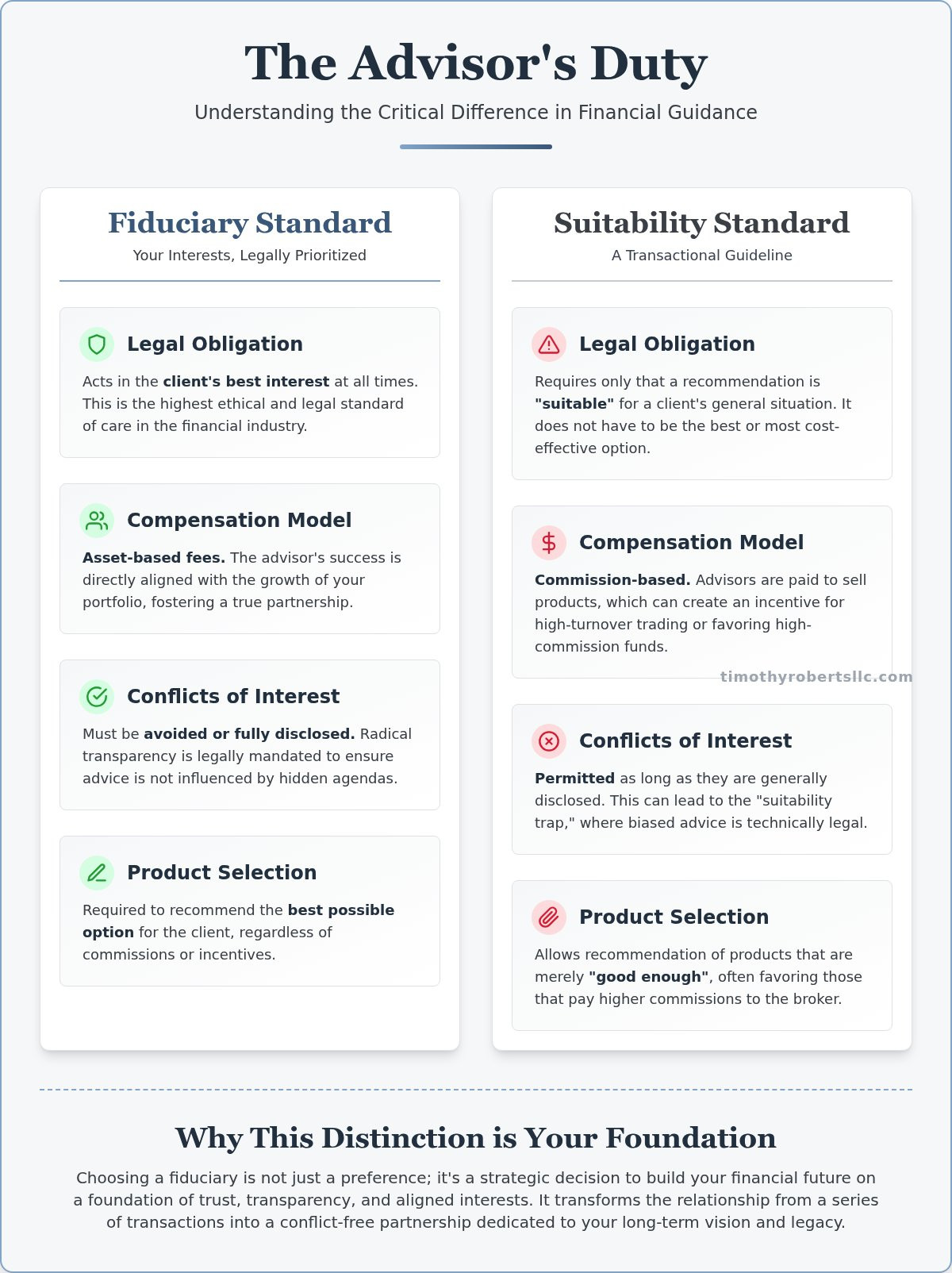
This standard was codified by the Investment Advisers Act of 1940, a piece of legislation that remains the bedrock of modern investment advice. It mandates that advisors provide full and fair disclosure of all material facts, especially those involving potential conflicts of interest. As of August 2026, the SEC continues to prioritize these duties of care and loyalty in its examination protocols. This ensures that every intervention is a carefully crafted solution rather than an off-the-shelf product. Managing conflicts of interest requires more than just a disclosure form; it demands radical transparency and a proactive approach to identifying where a firm’s interests might diverge from the client’s. Fiduciary duty is a legal mandate requiring an advisor to place a client’s best interests above their own at all times.
Fiduciary vs. Broker: A Conflict of Standards
Distinguishing between a fiduciary and a broker is essential for long-term financial stability. Brokers typically operate under a “suitability” standard, which only requires that a recommendation is appropriate for a client’s general situation. It doesn’t require it to be the best option or the most cost-effective. This often leads to the “suitability trap,” where high-commission products are favored over superior, lower-cost alternatives. In contrast, fiduciary wealth management detroit utilizes an asset-based fee structure that aligns the firm’s success directly with the growth of your portfolio. By removing the incentive for high-turnover transactions, the advisor can focus on the rhythmic, logical progression of your wealth. Transparency serves as the hallmark of strategic integrity. When an advisor operates as a fiduciary, every fee and cost is laid bare. Following the vacating of the 2024 Retirement Security Rule in early 2026, the industry has returned to the 1975 five-part test to determine fiduciary status for retirement advice. This shift underscores the importance of choosing an independent partner who voluntarily adheres to the highest standard regardless of shifting regulatory winds. This approach prioritizes building a partnership based on shared success rather than a series of one-off sales.
The Strategic Evolution of Investment Portfolio Management
Investment management isn’t a static achievement. It’s a continuous, rhythmic process of refinement. Many investors are accustomed to passive asset allocation, where a portfolio is built once and left to the mercy of market currents. However, sophisticated fiduciary wealth management detroit demands a more active, strategic oversight. This approach treats your portfolio as a living architecture, balancing the aesthetic of your long-term vision with the rigorous functionality of modern financial science. We don’t just manage assets; we curate them to ensure they align with your specific trajectory.
Customized Interventions in Asset Allocation
Off-the-shelf investment bundles often lack the nuance required for high-net-worth individuals. They don’t account for your specific tax bracket or the unique risk profile of your professional life. A visionary strategist approaches asset allocation with intellectual curiosity, searching for niche growth opportunities that align with your personal goals. By synthesizing your creative vision with structured corporate capabilities, we create a portfolio that feels exclusive and intentional. This level of customization ensures that every asset serves a distinct purpose in your upward progression. It’s about moving away from generic models toward carefully crafted interventions that reflect your individual risk tolerance and emotional state.
Managing Volatility with Calm Confidence
Market shifts are inevitable. What matters is the communication rhythm you maintain during those periods of uncertainty. A professional consultancy provides a steady, logical flow of information, replacing anxiety with calm confidence. Because fiduciary wealth management detroit relies on asset-based fees, the advisor’s success is tied directly to yours. There’s no incentive for unnecessary trading or high-commission products. Instead, the focus remains on long-term stability and growth. This alignment of interests is the cornerstone of a conflict-free strategy.
For deeper insights into this process, explore our approach to Investment Portfolio Management in Detroit. Continuous monitoring and rebalancing aren’t just administrative tasks; they’re the professional stable that keeps your strategy aligned with your evolving life. When you’re ready to move beyond generic solutions, partnering with a reliable business advisor can provide the strategic clarity you need to thrive.
Fiduciary Wealth Management vs. Traditional Brokerage Models
Choosing a partner for your financial evolution requires a clear understanding of the structural differences between service models. In the landscape of fiduciary wealth management detroit, the transition from a commission-based broker to an independent strategist is often the catalyst for significant upward progression. Traditional brokerage models frequently rely on transaction-based compensation. This creates a fragmented experience where the advisor’s primary incentive is the sale of a product rather than the long-term performance of the plan. By contrast, a fiduciary firm operates with an asset-based fee structure, aligning the firm’s success directly with the growth of your portfolio.
High-net-worth individuals favor this model because it prioritizes transparency and deliberate strategy over superficial sales tactics. The impact of this alignment on long-term wealth accumulation is substantial. When an advisor is no longer incentivized to generate trades for commissions, they can focus on the rhythmic coordination of tax planning, investment management, and estate strategy. This holistic approach addresses the common objection regarding the cost of professional management. The value isn’t found in a single transaction; it’s found in the architectural integrity of a conflict-free roadmap that protects your legacy from unnecessary erosion.
The Value of Fee-Based Financial Planning
Strategic financial planning often involves complex projects that require more than just investment advice. For those navigating intricate real estate investments, you might visit LoansByJB (The Nuhome Team) to learn more about how specialized lending strategies can support your broader financial goals. Fiduciary firms may utilize fixed-fee models for comprehensive roadmaps or specific interventions, such as tax-efficient withdrawal analysis or multi-generational estate coordination. These structures eliminate the “product-pushing” narrative entirely. You gain the psychological benefit of knowing your advisor is a dedicated partner and a reliable business advisor, not a salesperson. This clarity allows for an intellectually curious exploration of your goals, ensuring that every recommendation is a carefully crafted intervention designed for your unique circumstances.
There’s a distinct difference between the services of a large-scale anonymous entity and the bespoke attention of a boutique firm. A visionary strategist values depth over superficiality, taking the time to understand the personal creative vision that drives your wealth. This specialized approach ensures that personal attention and high-level expertise go hand in hand, creating an environment where complex problems are solved with rigor and passion. Fee-only advice preserves the absolute purity of financial strategy by ensuring that every recommendation is motivated solely by your objectives.
Architectural Planning for Retirement Income and Multi-Generational Legacies
Designing a financial legacy requires more than just picking stocks; it demands a comprehensive architectural plan that bridges the gap between your current success and your future security. For those utilizing fiduciary wealth management detroit, this transition is treated as a deliberate journey rather than a simple transaction. It’s about synthesizing your personal creative vision with the technical rigor of tax-efficient withdrawal strategies. By treating retirement as a phase of continued evolution, you ensure that your assets continue to serve your purpose long after you’ve stepped away from active accumulation. A comprehensive approach to fiduciary wealth management detroit involves more than just oversight; it requires the coordination of every financial pillar to ensure your life’s work is preserved.
Retirement Income: The Upward Progression
The shift from accumulating wealth to generating a sustainable income is often the most complex hurdle in a financial lifecycle. Maintaining upward progression during this phase requires a focus on tax advising to minimize liabilities. With the 2026 federal tax brackets ranging from 10% to 37%, and the top rate applying to taxable income over $768,600 for married couples filing jointly, a strategic withdrawal plan is essential. You can find more detail on this in our guide to Retirement Income Planning in Ann Arbor. This coordination ensures you aren’t just spending down assets but managing a dynamic cash flow that accounts for the $32,200 standard deduction for joint filers and Michigan’s 4.05% flat state income tax. It’s a rhythmic, logical process that replaces the anxiety of running out of money with the confidence of a structured plan.
Legacy and Estate Coordination
True wealth is defined by its ability to endure across generations. Estate and legacy planning serve as the structural supports for this longevity, protecting assets from fragmentation and legal complications. Sophisticated trust oversight and multi-generational coordination allow you to pass on not just capital, but the values and vision that built it. Our approach to Estate Planning in Farmington Hills focuses on this high-level synthesis of personal intention and corporate capability. We look at the intersection of aesthetics and functionality, ensuring that your estate plan isn’t just a set of documents but a living strategy for your family’s future. By coordinating with your chosen tax professionals and attorneys, we create a seamless strategic intervention that preserves the purity of your legacy. If you’re ready to design a legacy that reflects your life’s work, consider how a visionary strategist can bring clarity to your most complex financial challenges.
Partnering for Progression: The Timothy Roberts & Associates Methodology
Building a legacy requires more than just a list of assets; it requires a partner who understands the nuances of both personal and professional evolution. Timothy Roberts & Associates, LLC brings over 25 years of industry experience to the table, positioning the firm as a visionary strategist for those seeking fiduciary wealth management detroit. We move away from aggressive sales tactics, focusing instead on a narrative of shared success and aspirational growth. Our methodology is polished and intentional, designed to inspire trust through a blend of creative passion and business-minded rigor. We don’t just manage money; we curate a strategic architecture for your financial future.
Our Strategic Intervention Process
We treat development as a journey rather than a simple transaction. Our strategic intervention process begins with a meticulous assessment, where we map every piece of your financial life to understand the high-level vision. This isn’t a generic audit; it’s a deep dive into the practicalities of your current situation and your future goals. Following this, we move into customization, crafting a roadmap that aligns with your unique risk tolerance and long-term objectives. We don’t offer off-the-shelf solutions. Instead, we provide carefully crafted interventions that synthesize your personal vision with our structured corporate capabilities. The final stage is execution, where our high-level expertise is put into action through continuous monitoring and rhythmic rebalancing. This steady, logical flow guides you from a high-level vision down to the practicalities of daily financial life.
Your Invitation to Wealth Elevation
The right time to engage with a fiduciary is before the complexity of your growing assets becomes overwhelming. Managing a transition from accumulation to distribution requires a steady hand and an intellectual curiosity that values depth over superficiality. We focus on long-term financial stability and legacy, ensuring that your upward progression remains uninterrupted by market volatility or shifting tax laws. By partnering with a firm that treats wealth management as a professional consultancy, you gain a reliable business advisor dedicated to your success. It’s time to move toward a more intentional financial future where your personal attention and high-level expertise go hand in hand. We invite you to schedule a strategic consultation with Timothy Roberts & Associates to begin your journey toward a coordinated wealth management strategy. Let’s design a future that reflects the quality and ambition of your life’s work.
Designing Your Strategic Financial Future
The transition from simple asset accumulation to a sophisticated financial evolution requires a partner who operates with undivided loyalty. By prioritizing the fiduciary standard, you ensure that every intervention is a deliberate step toward long-term stability rather than a series of disconnected transactions. We’ve explored how the coordination of investment management, tax strategy, and estate planning creates a robust architecture for your wealth. This integration is essential for those seeking fiduciary wealth management detroit to protect their legacy from the complexities of shifting market cycles and tax codes.
Timothy Roberts & Associates, LLC offers over 25 years of fiduciary expertise to guide this journey. Our team specializes in sophisticated, personalized wealth strategies that harmonize your personal vision with our structured corporate capabilities. With a focus on comprehensive tax and estate coordination, we provide the calm confidence needed to navigate your financial progression with clarity. It’s time to move beyond generic solutions and embrace a roadmap designed for your unique ambitions.
Begin your strategic journey with Timothy Roberts & Associates. The road to financial evolution is a journey best traveled with a visionary strategist by your side.
Frequently Asked Questions
What exactly is a fiduciary wealth manager and why is it important?
A fiduciary wealth manager is a professional legally mandated to act in your best interests at all times. This standard is vital because it ensures that every intervention is designed for your success rather than the advisor’s gain. By adhering to the duties of care and loyalty, a fiduciary provides a conflict-free environment for your financial evolution. This architecture of trust is essential for those seeking fiduciary wealth management detroit to protect their legacy.
How do fiduciary wealth management fees work compared to traditional brokers?
Fiduciary wealth management fees are typically structured as a percentage of assets under management. This differs from traditional brokers who often earn commissions on specific product sales or transactions. An asset-based model aligns the firm’s success directly with your portfolio’s growth. It creates a transparent partnership where the incentive is long-term stability rather than high-turnover trading. This fee structure ensures your advisor acts as a reliable business advisor focused on your upward progression.
Can a fiduciary advisor help with both investment management and tax planning?
A comprehensive fiduciary firm synthesizes investment management with proactive tax planning strategies. This coordination is crucial for minimizing liabilities and maximizing the efficiency of your wealth transfer. By integrating tax advising into the broader financial roadmap, an advisor ensures that your investment decisions are made with a full understanding of their tax implications. This holistic approach treats your financial life as a single, unified architecture rather than a series of disconnected accounts.
What is the difference between fee-only and fee-based financial advisors?
Fee-only advisors are compensated solely by their clients and never accept commissions from product providers. This preserves the absolute purity of their strategic advice. Fee-based advisors, however, may receive a combination of client fees and commissions from financial products. Choosing a fee-only fiduciary wealth management detroit partner ensures that every recommendation is motivated by your objectives. It eliminates the “product-pushing” narrative and reinforces the firm’s role as a visionary strategist for your financial future.
How does retirement income planning differ from standard investment management?
Retirement income planning focuses on the strategic distribution of assets, while standard investment management often prioritizes accumulation. This shift requires a sophisticated understanding of tax-efficient withdrawal sequences and risk management. Instead of just growing a balance, the goal is to create a sustainable, lifelong cash flow. It involves coordinating Social Security, pension plans, and personal portfolios into a rhythmic, logical income stream. This process transforms your wealth from a static number into a functional legacy.
Is a fiduciary required to disclose all potential conflicts of interest?
Fiduciaries are legally required to provide full and fair disclosure of all material facts, including potential conflicts of interest. This radical transparency is a hallmark of strategic integrity. If a situation arises where an advisor’s interests might diverge from yours, they must inform you clearly and proactively. This mandate ensures that your partnership is built on trust and professional stability. It allows you to move forward with calm confidence, knowing your roadmap is free from hidden agendas.
What should I look for when choosing a wealth management firm for my estate legacy?
Look for a firm with deep experience in multi-generational estate coordination and a commitment to personalized strategies. A visionary strategist should demonstrate the ability to collaborate with your tax professionals and attorneys for a seamless strategic intervention. It’s essential that the firm views estate planning as a tool for long-term stability rather than just a set of documents. Seek a partner who values depth over superficiality and takes the time to understand your personal creative vision.
How often should a fiduciary review and rebalance my investment portfolio?
A fiduciary should provide continuous monitoring and rebalance your portfolio based on a steady, logical rhythm. This isn’t a calendar-based task but a strategic intervention triggered by market shifts or changes in your personal circumstances. Regular reviews ensure your asset allocation remains aligned with your risk tolerance and long-term goals. This proactive oversight is a professional stable that prevents your strategy from drifting. It reinforces the idea that managing your wealth is a journey, not a transaction.
