

Nov
How to Be a Good Steward of an Inheritance and Prepare Heirs
An inheritance is a responsibility before it is a windfall. A steward manages entrusted resources thoughtfully, in keeping with their purpose and the needs of others. Learning how to be a good steward of an inheritance starts with pausing before major decisions and considering how each asset can support your long-term goals and values.
It’s natural to focus first on what you’ve received, but responsible stewardship also means understanding the responsibilities that come with it. Different assets can involve distinct tax considerations, timelines, and management needs, so a thoughtful plan can help you make decisions with greater clarity.
This guide explains how to coordinate with financial, tax, and estate professionals, prepare heirs to handle wealth responsibly, and organize inherited assets. It also covers practical habits for managing an inheritance over time, helping you move from receiving wealth to directing it with care and intention.
Key Takeaways
- Bring financial, tax, and estate professionals into decisions so the inheritance’s tax considerations and long-term purpose are understood together.
- Prepare heirs through open conversations about family values, financial responsibilities, and the intentions behind wealth transfers.
- Inventory inherited assets and assess how each fits an heir’s goals, risk tolerance, and ability to manage it.
- Make deliberate choices about spending, debt, saving, and investing rather than rushing into major purchases or opportunities.
1. Working with financial, tax, and estate professionals
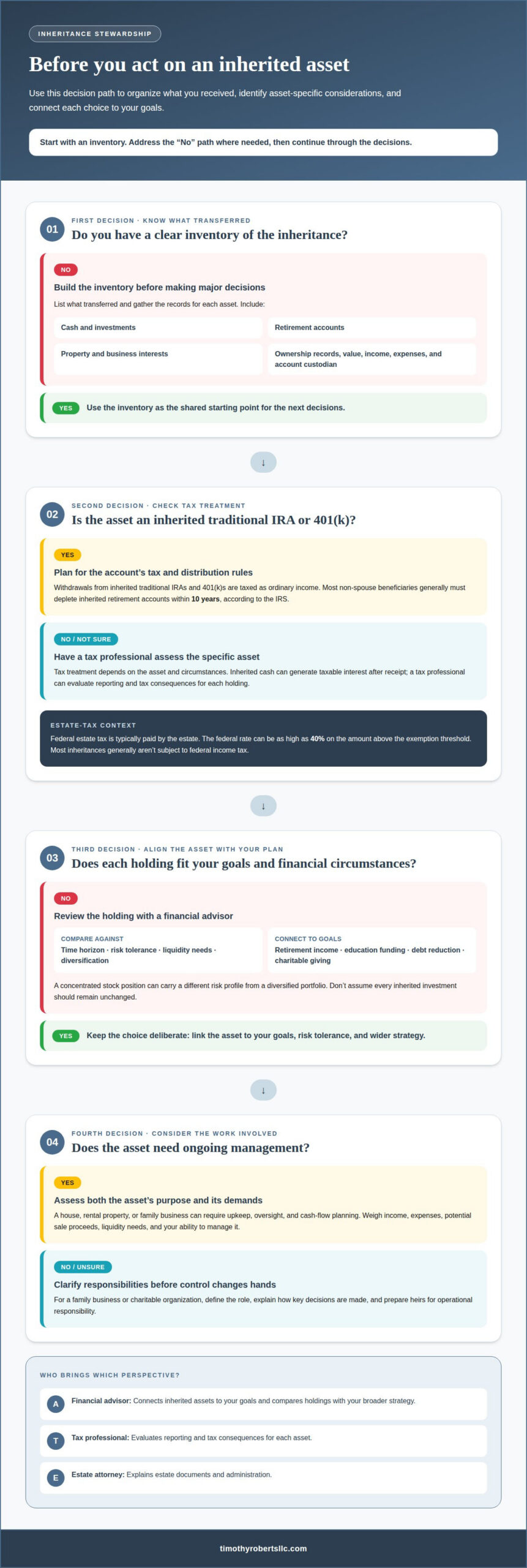
Begin with a coordinated conversation involving a financial advisor, tax professional, and estate attorney. Each offers a different perspective: an advisor connects inherited assets to your goals, a tax professional evaluates reporting and tax consequences, and an attorney explains estate documents and administration. Give them a clear inventory of what transferred, including cash, investments, retirement accounts, property, and business interests. This shared starting point helps identify decisions to address before assets are spent, transferred, or invested.
Tax treatment depends on the asset and the circumstances. According to the Internal Revenue Service, the federal estate tax rate can be as high as 40% on the amount above the exemption threshold. Federal estate tax is typically paid by the estate, while most inheritances generally aren’t subject to federal income tax. However, withdrawals from inherited traditional IRAs and 401(k)s are taxed as ordinary income, and inherited cash can generate taxable interest after receipt. Ask the tax professional to distinguish these rules for each asset.
Next, update your financial strategy rather than simply adding inherited investments to your existing portfolio. An advisor can compare each holding with your time horizon, risk tolerance, liquidity needs, and diversification strategy. For example, a concentrated stock position can carry a different risk profile from a diversified portfolio. Align decisions with specific goals, such as retirement income, education funding, debt reduction, or charitable giving. This makes preserving wealth a deliberate plan, rather than an automatic choice to leave every asset unchanged.
Finally, treat responsibility as a skill that can develop across generations. Beneficiaries can start by learning to review statements and understand spending plans, then take a larger role in investment discussions or family giving decisions. A parent can explain the purpose of a transfer, invite questions, and let heirs practice making smaller financial choices before taking on broader responsibilities. Regular conversations with professionals can help families connect values, practical decisions, and long-term goals.
2. Preparing heirs before transferring wealth
Preparing heirs begins with conversation, not a transfer. Discuss family goals, the responsibilities wealth can bring, and the emotions that may accompany an inheritance. An estate plan can express those intentions through clear instructions for beneficiaries. Invite heirs to ask why assets are being passed on, what values the family hopes to preserve, and how each person can contribute. These discussions build understanding before decisions become urgent.
Build financial skills gradually. A parent might first involve a child in a charitable giving decision, then discuss budgeting, investing, and the purpose of family assets. In the United States, an individual may give up to $19,000 per recipient annually without using any lifetime gift and estate tax exemption, according to the Internal Revenue Service. Families can use planned transfers as opportunities to explain financial choices and expectations. The goal is to prepare heirs to make informed decisions, not simply to receive wealth.
Taxes also belong in the preparation. A deceased person’s state or a beneficiary’s state may levy estate or inheritance taxes that beneficiaries must pay. Make tax considerations part of family discussions, alongside the estate plan and each heir’s future role. For inherited retirement accounts, most non-spouse beneficiaries generally must deplete the accounts within 10 years, according to the Internal Revenue Service. That deadline makes it useful to understand distribution responsibilities before an account is inherited.
Charitable giving can connect family wealth with shared purpose. Discuss which causes matter to the family, how beneficiaries might participate, and whether giving should happen at once or over time. A trust can be considered to fund a charitable organization over time. Families can also talk openly about how donations may affect taxes, including taxes related to new capital gains. An integrated estate plan can help bring transfer intentions and family priorities into a coherent strategy.
3. Preparing heirs to manage inherited businesses and assets
Start with a complete inventory. List each inherited asset, its ownership records, current value, income, expenses, and account custodian. Include investments, real estate, business interests, vehicles, and personal property with material value. Group documents by asset, then note decisions that need attention, such as maintenance, liquidity, or a change in management. This inventory gives heirs a practical picture of what they have received and what each asset requires.
Understand the tax basis before selling appreciated property or investments. Assets that pass as part of an estate receive a step-up in income tax basis. For example, if a parent bought stock for $10,000 and it was worth $100,000 at death, the heir’s basis is $100,000. Selling it immediately would mean no capital gains tax on the $90,000 appreciation in this example. The basis can affect the tax consequences of a later sale, so keep valuation and transfer records with the inventory.
Inherited property may call for active decisions. A house, rental property, or family business can require upkeep, oversight, and cash flow planning. A financial advisor can help assess whether an asset fits your goals, liquidity needs, and ability to manage it. If you are considering converting property into cash, weigh its income, expenses, potential sale proceeds, and role in your wider financial plan. An asset’s purpose matters as much as its value.
Prepare heirs for operational responsibility before handing over control of a family business or charitable organization. Define the role, explain how key decisions are made, and provide relevant education, training, and experience. A successor might first observe financial reviews, then participate in planning, before taking on defined management duties. Discuss how the organization serves its customers, employees, or mission, and how its assets support that purpose. A deliberate transition helps beneficiaries build the skills to preserve value and guide the enterprise for the next generation.
4. Learning to steward an inheritance
Stewardship develops through deliberate choices, not a single investment decision. Start by connecting inherited wealth to your values, financial goals, and the legacy you want to carry forward. Separate immediate needs from long-term plans. For example, account for essential expenses before considering a major purchase. A written plan can organize spending, saving, debt reduction, and giving, helping each choice serve a purpose rather than a passing impulse.
To avoid scams and costly mistakes, pause before moving money or accepting an unsolicited investment offer. Verify who is making the request through a trusted channel, review the terms, and discuss unfamiliar opportunities with a financial professional before committing. Avoid rushed purchases and business deals. Taking time to assess whether an offer fits your plan, while keeping account and personal information private, can help reduce exposure to fraud.
Retirement assets need particular attention. Most non-spouse beneficiaries of inherited retirement accounts generally must deplete the accounts within 10 years, according to the Internal Revenue Service. Withdrawals from inherited traditional IRAs and 401(k)s are taxed as ordinary income, so coordinate distributions with your broader income and tax strategy. Identify account deadlines and required distributions, then decide how proceeds fit your retirement needs, savings, or other priorities.
Honoring the person who left an inheritance doesn’t require repeating every financial choice they made. Instead, reflect on the values behind their decisions, then apply those principles to your circumstances. If generosity mattered to them, for instance, include charitable giving in a sustainable plan alongside your own needs. Encourage heirs to learn through smaller decisions and shared discussions. To shape inherited assets around your goals and legacy, explore a tailored financial plan.
Timothy Roberts & Associates
Timothy Roberts & Associates helps individuals bring inherited assets into a broader financial strategy. Its financial planning, Investment Portfolio Management, and Estate & Legacy Planning can support decisions about aligning investments with goals, coordinating wealth across generations, and preparing for future needs. Turn to the firm when you want to assess how an inheritance fits your existing plans and what role each asset should play.
Stewardship is an ongoing process, shaped by your priorities, responsibilities, and family legacy. A considered plan can help connect immediate decisions with longer-term intentions, while keeping inherited wealth within a coherent financial picture. Contact Timothy Roberts & Associates to discuss your inheritance and financial goals.
Shape the Legacy You Want to Carry Forward
An inheritance can become more than a financial resource. It can create room for intentional choices, support the people and causes that matter to you, and shape what the next generation learns about responsibility. The question of how to be a good steward of an inheritance becomes clearer when you connect each decision to the values you want your wealth to serve.
You don’t need to settle every long-term choice at once. Set a direction, revisit it as your circumstances change, and seek professional guidance for decisions with lasting consequences. A considered plan can help turn uncertainty into purposeful action while leaving room for your goals to evolve.
For support aligning inherited wealth with your financial future, contact Timothy Roberts & Associates, LLC. Thoughtful stewardship starts with the next decision, and each deliberate step can help you build a legacy that reflects what matters most.
Frequently Asked Questions
What Is a Steward?
A steward manages entrusted resources with care and purpose. For an heir, that can mean making choices that respect family intentions while meeting personal needs. For example, someone overseeing a family home might weigh its sentimental value against maintenance responsibilities and other financial goals. Stewardship calls for thoughtful judgment, not simply preserving every asset unchanged.
What is the first thing you should do when you inherit money?
Pause before making major financial commitments, and establish a clear picture of what you received. Confirm how the funds are held, keep related documents together, and identify immediate obligations or deadlines. For instance, money distributed from an account may need different handling from cash already deposited. Avoid sharing account details or responding to unsolicited offers while you organize the basic facts.
What does it mean to be a good steward of an inheritance?
Being a good steward means directing inherited resources with care and aligning decisions with your responsibilities, goals, and values. To understand how to be a good steward of an inheritance, consider not only what wealth can provide today, but also what you want it to make possible over time. A useful test is whether a decision supports a considered priority rather than a momentary impulse.
What steps should you take after receiving an inheritance?
First, clarify how the inheritance was transferred and whether any responsibilities accompany it. Then review your finances, identify decisions that need professional input, and establish priorities before making major changes. A practical starting point is to write down near-term needs, longer-term goals, and questions about unfamiliar assets. Revisit the list as you learn more instead of treating your first plan as permanent.
How much of an inheritance should you save, invest, spend, or give away?
There is no single allocation that suits every heir. The right balance depends on obligations, income needs, goals, and comfort with investment risk. For example, someone approaching retirement may prioritize liquidity and income differently from a beneficiary saving for education. Set priorities first, then consider how much to reserve for near-term needs, invest for future goals, spend, or direct toward charitable giving.
Should you pay off debt or invest an inheritance first?
Compare the debt’s interest cost, repayment terms, and effect on monthly cash flow with the investment’s purpose, time horizon, and risk. Paying down expensive debt may improve flexibility, while investing may support a longer-term goal. For example, someone carrying several balances can assess which obligations are most costly before deciding how much to repay. Consider both choices within the same financial plan.
