

Jul
How to Choose a Trustee in Michigan: A Strategic Wealth Management Perspective (2026)
The person you trust most to carry your legacy might be the least qualified to manage it. While family loyalty is a natural instinct, the technical demands of the Michigan Estates and Protected Individuals Code require more than just good intentions. Understanding how to choose a trustee in Michigan is a high-stakes decision that bridges the gap between your current wealth and the future security of your heirs. It’s natural to feel a sense of trepidation when weighing the risks of family conflict against the need for professional financial oversight.
You deserve a transition of wealth that feels seamless and intentional. This guide provides a sophisticated framework for selecting a trustee who offers the fiduciary precision your estate requires. We will explore the critical intersection of Michigan’s silent trust laws, the financial acumen needed to navigate 2026 market complexities, and strategies to align your legacy with your broader retirement income goals. By moving beyond simple appointments toward a strategic partnership, you ensure your assets remain protected from mismanagement and litigation.
Key Takeaways
- Master the legal obligations of loyalty and impartiality defined by the Michigan Estates and Protected Individuals Code to ensure your legacy remains beyond reproach.
- Evaluate the strategic trade-offs between the personal touch of a family member and the institutional continuity of a corporate professional when determining how to choose a trustee in Michigan.
- Implement a selection framework that prioritizes both financial literacy and emotional intelligence, ensuring your representative can execute complex retirement income goals with confidence.
- Discover how to integrate your trustee selection into a comprehensive estate coordination plan that aligns your professional life’s work with long-term asset protection.
Navigating the Complexity of Selecting a Trustee in Michigan
Your legacy is more than a collection of accounts or a portfolio of real estate. It’s the physical manifestation of your creative and professional life’s work. When you appoint a trustee, you aren’t simply filling a legal requirement; you’re selecting a steward for your vision. This individual or entity becomes the guardian of your values, ensuring that the wealth you’ve built continues to serve its intended purpose with elegance and precision. Selecting this partner requires a move beyond the obvious choice of the eldest child or a close friend toward identifying a visionary who understands the intersection of aesthetics, functionality, and financial duty.
The decision carries profound weight because Michigan law imposes strict standards on those in this role. To appreciate the gravity of this appointment, one must first understand the fundamental legal architecture. A clear answer to the question What is a Trust? reveals a three part relationship where the trustee holds legal title for the benefit of another. In the modern landscape, deciding how to choose a trustee in Michigan is a pivot point that determines whether your estate flourishes through upward progression or becomes entangled in administrative friction.
To better understand this concept, watch this helpful video:
The Weight of Fiduciary Responsibility
The fiduciary standard is the highest duty recognized by the law. It demands absolute loyalty, impartiality, and prudent administration. For a family member, this technical burden can be overwhelming when paired with the emotional weight of a loved one’s passing. Good intentions are insufficient when managing complex assets or navigating the 2026 Michigan small estate thresholds. A trustee must possess the business minded rigor to make objective decisions that protect the trust’s integrity, even when those decisions are unpopular with beneficiaries.
Trustee Roles in a Modern Financial Landscape
The role of a trustee has evolved significantly. While an executor focuses on the immediate settlement of an estate, a trustee manages a journey that may span decades. Modern trust administration involves digital assets, global investment portfolios, and intricate tax planning strategies. For those whose legacies cross borders, you can discover Mohan Yildiz & Associates to see how specialized legal expertise manages complex multijurisdictional needs. It requires organizational stability and a deep understanding of how to choose a trustee in Michigan who can adapt to shifting regulatory environments. This isn’t an off the shelf solution; it’s a carefully crafted intervention that ensures your financial planning remains aligned with your long term legacy goals.
Understanding Fiduciary Duties Under the Michigan Estates and Protected Individuals Code (EPIC)
The Michigan Estates and Protected Individuals Code, commonly known as EPIC, serves as the definitive architecture for trust administration in the Great Lakes State. It’s the anchor of your estate. It establishes the legal boundaries within which every decision must be made, from the distribution of assets to the selection of investment vehicles. Determining how to choose a trustee in Michigan requires a deep dive into this code, as the person you select must be prepared to operate under a mandate of absolute transparency and technical rigor. EPIC doesn’t just suggest best practices; it demands them.
A trustee’s primary function is to serve as a fiduciary, a role that carries significant legal weight. When Evaluating Trustee Candidates, you must look beyond personal affinity to find an individual capable of upholding these stringent standards. This includes meticulous record keeping and the statutory requirement to provide beneficiaries with regular reports, a task that has become more nuanced with the 2024 Michigan “Silent Trust” law. This legislation allows for confidential trust terms for up to 25 years, yet the underlying fiduciary obligation to act in the beneficiaries’ best interests remains unyielding.
The Duty of Loyalty and Impartiality
The duty of loyalty is the most fundamental obligation under EPIC. It requires the trustee to manage the trust solely in the interest of the beneficiaries, strictly avoiding any hint of self dealing or conflict of interest. This becomes particularly complex when an estate includes closely held business interests or family properties where personal and professional lines blur. Under Michigan EPIC, impartiality dictates that a trustee must act with fiduciary neutrality, ensuring that the interests of current income beneficiaries are never sacrificed for the benefit of remainder heirs, or vice versa, unless the trust document explicitly directs otherwise. Achieving this balance requires a level of emotional intelligence and legal literacy that few “obvious” candidates possess.
Asset Management and the Prudent Investor Rule
The process of how to choose a trustee in Michigan is fundamentally a search for a representative who can navigate the Prudent Investor Rule. This rule mandates that a trustee exercise “reasonable care, skill, and caution” when managing assets. It moves away from judging individual investments in isolation, focusing instead on the performance of the entire portfolio. This technical rigor is especially vital when overseeing investment portfolio management in Detroit, where asset rebalancing must align with the trust’s specific risk profile and long term objectives. A trustee must understand the necessity of diversification to mitigate risk, ensuring that the estate’s growth isn’t left to chance. Aligning your trust’s administration with a broader wealth management strategy provides the professional stability necessary to fulfill these EPIC mandates while protecting your legacy from mismanagement.
Evaluating Candidates: Individual Family Members vs. Corporate Trustees
Selecting the right representative is a pivot point for your estate’s upward progression. It requires a clear eyed assessment of whether your legacy is best served by personal affinity or institutional rigor. When determining how to choose a trustee in Michigan, you aren’t just appointing an administrator; you’re designing a succession journey. This journey must bridge the gap between your current wealth and the future security of your heirs. It’s a choice between the intimate understanding of family values and the technical precision of a professional fiduciary.
Pros and Cons of the Individual Trustee
Individual trustees, often family members or close associates, offer a deep cultural fit for your legacy. They understand the nuances of your family dynamics and may operate with lower initial administrative costs. However, good intentions don’t equate to financial acumen. Individual trustees face risks of mortality, health issues, and the potential for intra family friction that can lead to litigation. You must evaluate an individual’s capacity for organizational evolution. Do they have the technical discipline to manage a complex portfolio, or will the emotional weight of the role lead to administrative paralysis?
The Case for Professional Fiduciaries and Corporate Trustees
Corporate trustees provide a level of continuity that individuals simply cannot match. They offer institutional stability across multiple generations, ensuring your trust remains functional long after the original parties have passed. These entities bring a spacious and deliberate flow to trust administration, supported by deep expertise in tax advising in Ann Arbor and complex regulatory compliance. While corporate fees are a consideration, the protection against mismanagement and the technical rigor applied to investment rebalancing often provide a significant net benefit to the estate’s long term health.
The Hybrid Model: Appointing Co-Trustees
The hybrid model serves as a strategic intervention for those who value both heart and head. By appointing a family member and a corporate entity as co trustees, you synthesize personal vision with structured corporate capabilities. This arrangement allows the family member to provide cultural context while the professional fiduciary handles the technical execution and record keeping. To prevent administrative deadlock, these agreements must be meticulously structured. Including a Trust Protector adds another layer of oversight, allowing for the removal or replacement of a trustee if the partnership no longer serves the estate’s objectives. This approach ensures that your decision on how to choose a trustee in Michigan remains a dynamic asset rather than a static liability.
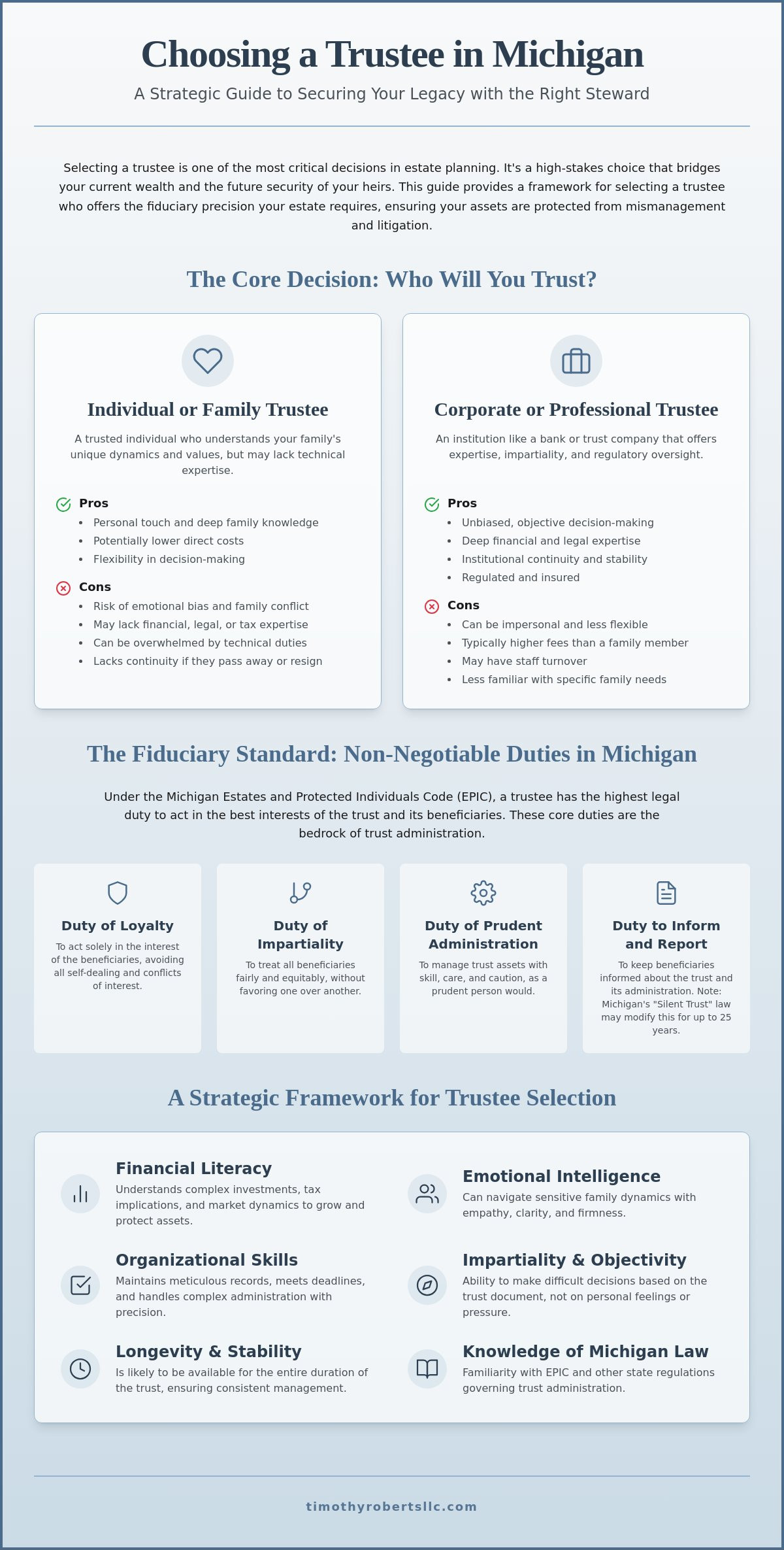
A Strategic Framework for Selecting Your Michigan Trustee
Treating trustee selection as a simple legal checkbox is a mistake that can derail a lifetime of wealth creation. When you consider how to choose a trustee in Michigan, you’re conducting a high level search for a partner who can manage both the capital and the character of your estate. This requires a shift from looking for “someone you trust” to identifying someone with the specific competencies required for organizational evolution. A visionary strategist doesn’t just look for honesty; they look for a proven track record of financial discipline and intellectual curiosity.
The Technical Audit: Investment and Tax Acumen
A trustee’s primary role is the execution of your financial vision. They must possess the technical rigor to implement a sophisticated retirement income plan that balances current distributions with future growth. Every decision carries tax implications that can significantly erode the trust’s value if handled poorly. Fiduciary investment acumen is the ability to synthesize market data with trust directives to ensure long term capital preservation and growth. You should evaluate their professional stability and their history of managing complex assets. If they can’t explain the difference between principal and income accounting, they aren’t ready for the role.
The Cultural Audit: Alignment with Your Vision
Technical skill is useless if it isn’t paired with emotional intelligence. Your trustee must be a calm and confident communicator who can manage beneficiary expectations without creating friction. They need to align with your family’s aspirational growth goals, acting as a bridge between your legacy and the next generation. This requires a polished and intentional communication style, especially during periods of market volatility or family transition. A candidate’s ability to remain composed under pressure is often the deciding factor in preventing intra family litigation.
Longevity and availability are often overlooked. A trust may last for decades, meaning your candidate must have the capacity to serve for the entire lifecycle. Finally, apply the Intellectual Curiosity test. Does the candidate recognize their own limitations? A high end trustee isn’t a solo act; they’re a conductor who knows when to seek expert counsel from tax advisors or legal specialists. To ensure your selection process meets these high standards, you can partner with a fiduciary advisor to build a customized selection framework. This deliberate approach transforms a legal requirement into a strategic advantage for your legacy.
Securing Your Legacy Through Comprehensive Estate Coordination
A trustee isn’t a solitary actor. They’re a vital component of a larger, human led wealth identity that reflects your professional achievements and personal values. When you solve the puzzle of how to choose a trustee in Michigan, you’re essentially selecting the lead architect for your family’s future financial landscape. This decision must be integrated with your broader strategy for estate planning in Farmington Hills to ensure that every legal document and financial account moves in harmony toward your ultimate goals.
Preserving trust principal in 2026 requires more than just reactive management. It demands year round tax planning and a deep understanding of current federal exemptions, which stand at $15 million per individual. Without this proactive coordination, even the most well intentioned trustee can see an estate’s value diminished by avoidable tax liabilities or administrative inefficiencies. Moving from a high level vision to practical execution requires a steady and logical approach that treats legacy management as a continuous journey rather than a one time transaction.
Reviewing and Updating Your Appointments
Your choice of a fiduciary shouldn’t be static. Life is dynamic, and your estate plan must be too. Trigger events such as a change in a candidate’s health, a shift in Michigan’s small estate thresholds (currently $53,000 for 2026), or a significant evolution in your own asset portfolio should prompt a re evaluation of your appointments. Facilitating a transition to a successor trustee works best when it’s handled with calm confidence. This ensures that the momentum of your wealth remains uninterrupted, providing a seamless experience for your beneficiaries during times of transition.
The Role of a Wealth Management Partner
A fiduciary advisor provides the business minded rigor necessary to support a trustee’s technical duties. While the trustee holds the legal authority, a wealth management partner bridges your individual creative vision with structured corporate capabilities. This partnership ensures that your investment portfolio management and retirement income goals remain perfectly aligned with the technical requirements of the Michigan EPIC code. It’s about creating a spacious and deliberate flow for your wealth. To move forward with precision, you should partner with a strategist to refine your legacy roadmap and secure the future you’ve worked so hard to build.
Architecting Your Legacy Succession
Selecting a trustee is the definitive act of stewardship for your life’s work. It requires a move beyond simple familial duty toward a rigorous assessment of financial literacy and fiduciary neutrality. By mastering the nuances of how to choose a trustee in Michigan, you transform a potential point of family friction into a structured journey of upward progression. This strategic choice ensures your wealth remains protected from mismanagement and aligned with your long term retirement income goals through every stage of the transition.
At Timothy Roberts & Associates, LLC, we bring over 25 years of fiduciary wealth management expertise to the table. Our approach focuses on the seamless integration of tax planning and estate management, providing high level strategic interventions that respect your individual vision. We help families move from high level anxiety to a state of calm confidence through personalized coordination and business minded rigor. Elevate your legacy with a strategic estate coordination review. Your legacy is a masterpiece; ensure it’s managed with the precision it deserves.
Frequently Asked Questions
Can a beneficiary serve as a trustee in Michigan?
Yes, a beneficiary can serve as a trustee in Michigan, though this arrangement requires a high level of strategic oversight to avoid conflicts of interest. While it’s a common choice for maintaining family control, the trustee must remain impartial between their own interests and those of other beneficiaries. This dual role can trigger complex tax consequences, making it essential to pair the individual with a professional advisor to ensure fiduciary precision.
What is the difference between a trustee and an executor under Michigan law?
A trustee and an executor serve distinct roles within a legacy roadmap. An executor, often called a personal representative in Michigan, is responsible for the immediate settlement of a probate estate and the distribution of assets according to a will. If you have assets in other regions, you can visit Massingill Attorneys & Counselors at Law to learn more about probate services in Texas. In contrast, a trustee manages assets held within a trust, often overseeing a multi-generational journey that requires long term investment management and ongoing beneficiary reporting to ensure the estate’s stability.
How much does a trustee typically get compensated in Michigan?
Michigan law entitles trustees to “reasonable compensation” unless the trust document specifies a fee. In 2026, corporate trustees typically charge tiered fees, such as 0.65% on the first $1,000,000, while family members often receive between 0% and 1% of trust assets. Understanding these costs is a vital part of the process when deciding how to choose a trustee in Michigan to ensure the estate’s long term viability and professional oversight.
What happens if a trustee is unable to serve and no successor is named?
If a trustee cannot serve and no successor is named, Michigan EPIC provides a steady and logical path for replacement. The qualified beneficiaries may appoint a successor trustee by unanimous agreement. If the beneficiaries cannot reach a consensus, the court will intervene to appoint a representative. This highlights the importance of naming multiple successor trustees to avoid administrative deadlock and ensure the continuous upward progression of your estate coordination.
Can a trustee be removed if the beneficiaries are unhappy with the investment performance?
Removing a trustee solely for poor investment performance is difficult under Michigan law unless it constitutes a breach of fiduciary duty. Beneficiaries must typically demonstrate a persistent failure to administer the trust effectively or a substantial change in circumstances. However, if a trustee fails to follow the Prudent Investor Rule or lacks the technical rigor to manage complex assets, the court may find grounds for a strategic intervention to protect the legacy.
Does a trustee have to live in Michigan to manage a Michigan-based trust?
A trustee isn’t required to reside in Michigan to manage a Michigan based trust. However, an out of state trustee must submit to the jurisdiction of Michigan courts regarding trust matters. While residency isn’t a legal barrier, the trustee must still possess the localized knowledge of Michigan’s EPIC code to ensure compliant administration. This flexibility allows you to prioritize professional stability and expertise over geographic proximity when selecting a partner.
What are the specific reporting requirements for trustees in Michigan?
Trustees in Michigan are generally required to provide an annual report to all qualified beneficiaries. This report must include a statement of trust assets, their market values, and a record of all disbursements and receipts. Under the 2024 “Silent Trust” law, a settlor may choose to keep these terms confidential for up to 25 years. This nuance is a critical factor when evaluating how to choose a trustee in Michigan for a confidential legacy.
How does the Michigan Prudent Investor Rule affect trust investment choices?
The Michigan Prudent Investor Rule shifts the focus from the performance of individual assets to the health of the entire portfolio. It requires trustees to exercise reasonable care and caution by diversifying investments to manage risk effectively. This rule demands a high level of financial literacy, as the trustee must synthesize market data with the trust’s specific objectives to ensure the long term growth and protection of the estate’s capital.
