

Jul
Integrating Philanthropy into Your Estate Plan: A Strategic Guide for Legacy Elevation
What if your most significant tax liability could be transformed into your most enduring contribution to the Ann Arbor community? Many high-net-worth individuals view charitable giving and estate preservation as competing interests, fearing that a legacy of generosity might come at the expense of their heirs’ financial security. When you focus on integrating philanthropy into estate plan ann arbor strategies, you shift from simple donation to sophisticated legacy elevation. It’s a move that replaces uncertainty with a deliberate, high-impact roadmap for your wealth.
You’re about to discover how to transform charitable intent into a rigorous financial strategy that optimizes your legacy while minimizing tax liabilities, such as the flat 40 percent federal estate tax rate on assets exceeding the 2026 exemption. We’ll guide you through the practicalities of Donor-Advised Funds, the strategic use of trusts, and the latest SECURE Act 2.0 implications for inherited retirement accounts. This guide provides the clarity you need to ensure your personal values and your family’s future remain perfectly aligned through every stage of the transfer process.
Key Takeaways
- Align your financial assets with your deepest personal values to transform wealth from a static resource into a dynamic tool for community evolution.
- Identify the most effective financial vehicles for integrating philanthropy into estate plan ann arbor portfolios, comparing the flexibility of Donor-Advised Funds with the structural permanence of charitable trusts.
- Implement the “Asset Matching” framework to shield your heirs from tax-heavy inheritances by directing high-tax assets toward your charitable goals.
- Leverage sophisticated “bunching” strategies to maximize deductions within the 2026 tax landscape, ensuring your estate benefits from the current permanent exemption levels.
- Understand why a fiduciary-first approach is essential for bridging the gap between your creative philanthropic vision and rigorous financial execution.
The Strategic Role of Integrating Philanthropy into Your Estate Plan
Strategic philanthropy is the intentional orchestration of your financial resources to reflect your deepest convictions. It’s a shift from reactive giving to a proactive alignment of capital with a vision for the future. In a community like Ann Arbor, where the local area community foundation manages over $227 million in assets as of May 2026, donors often seek more than just a simple check-off in a document. They require a legacy that’s as intellectually rigorous and structured as their professional lives. Integrating philanthropy into estate plan ann arbor strategies allows for this level of customization, moving beyond the limitations of a standard bequest.
Philanthropic estate integration serves as a dual-purpose instrument for generating measurable social impact while providing a sophisticated mechanism for tax mitigation. To better understand how precision in this process protects your intent, watch this helpful video:
Beyond the Will: The Evolution of Legacy Planning
Traditional wills are often too rigid for the complexities of modern wealth. They act as static instructions rather than dynamic strategies. Today’s donors are moving toward “living” legacies that offer immediate tax benefits while the donor is still active in their community. With the federal estate tax exemption now permanent at $15 million per individual under the One Big Beautiful Bill Act, the focus has shifted toward maximizing the utility of every dollar. Philanthropy acts as a cornerstone for multi-generational wealth transfer, teaching heirs the value of stewardship rather than just consumption.
The Fiduciary Advantage in Charitable Coordination
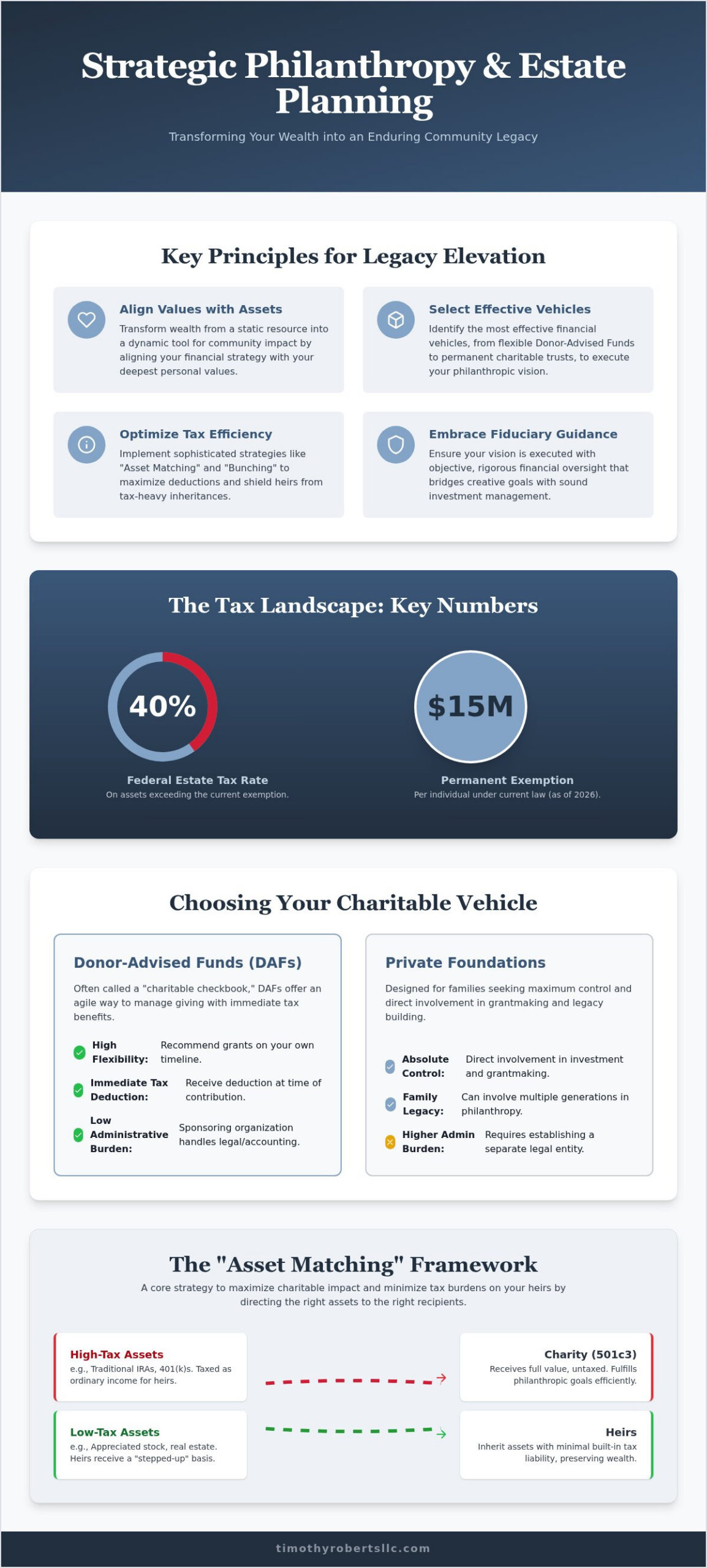
A fiduciary advisor provides an essential layer of protection for your charitable intent. Unlike advisors who may have incentives to favor specific products, a fiduciary ensures that the selection of planned giving vehicles remains entirely objective. This role is where investment management and donor intent intersect. By coordinating your giving with your broader financial plan, we avoid the conflicts of interest that often plague large-scale legacy planning. It’s about matching the right asset to the right cause. For example, directing highly taxed retirement accounts to a 501(c)(3) while leaving stepped-up basis assets to heirs is a sophisticated maneuver that requires professional oversight to execute correctly.
High-Impact Vehicles for Charitable Giving
Executing a philanthropic vision requires more than just good intentions. It demands the right financial architecture. When integrating philanthropy into estate plan ann arbor frameworks, the selection of the vehicle determines the velocity and duration of your impact. You must choose between the immediate gratification of direct grants and the perpetual influence of an endowed fund. This decision isn’t merely administrative; it’s a core component of your broader financial planning. Building on the foundational concepts of estate planning in Farmington Hills, high-impact giving relies on asset-based investment management to ensure your charitable capital grows faster than it’s distributed.
For many families, philanthropy serves as a sophisticated tool for retirement income planning. By selecting specific instruments, you can generate a predictable cash flow while simultaneously securing a future gift for the causes you value most. This dual-purpose approach is where creative vision meets fiduciary rigor.
Donor-Advised Funds (DAFs) vs. Private Foundations
Donor-Advised Funds have become the “charitable checkbook” of choice for those seeking agility. They offer an immediate tax deduction and the ability to recommend grants over time without the administrative burden of a separate legal entity. In contrast, Private Foundations are designed for families who prioritize absolute control and direct involvement in grantmaking. While foundations allow for greater customization, they come with higher costs and public disclosure requirements. DAFs provide a level of privacy and lower overhead that often makes them more efficient for those focusing on localized impact within the Ann Arbor metro area.
Charitable Remainder Trusts (CRTs) and Income Generation
A Charitable Remainder Trust is a powerful intervention for retirees holding highly appreciated assets. By funding a CRT with stock or real estate, you avoid immediate capital gains taxes and secure a lifetime income stream. This is particularly effective in the current tax environment, where the federal estate tax rate sits at a flat 40 percent for estates exceeding the 2026 exemption. The trust provides you with annual payments, and the remaining balance eventually passes to your chosen charity. It’s a strategy that prioritizes your current financial stability while elevating your long-term legacy. If you’re ready to align your income needs with your charitable goals, exploring wealth management solutions tailored to your specific net worth is the logical next step.
Optimizing the Tax Efficiency of Your Charitable Intent
The 2026 tax landscape presents a unique set of opportunities for those focused on legacy elevation. Under the One Big Beautiful Bill Act, the federal estate tax exemption has been solidified at $15 million per individual, providing a stable foundation for long-term planning. However, for estates exceeding this threshold, the flat 40 percent tax rate remains a significant liability. Effectively integrating philanthropy into estate plan ann arbor strategies allows you to reduce the gross value of your taxable estate while ensuring your capital supports the causes you value most. This isn’t merely about giving; it’s about the sophisticated orchestration of assets to minimize the IRS’s share of your life’s work.
High-net-worth donors in Michigan often face a complex hurdle with the 0.5 percent Adjusted Gross Income (AGI) floor for itemized charitable deductions. To counter this, we often employ a “bunching” strategy. By concentrating several years of charitable contributions into a single tax year, perhaps through a Donor-Advised Fund, you can surpass the standard deduction and the AGI floor more effectively. This proactive approach is a core element of tax advising in Ann Arbor, where we treat philanthropy as a strategic asset rather than a simple expense.
Qualified Charitable Distributions (QCDs) from IRAs
For individuals over age 70.5, the Qualified Charitable Distribution remains one of the most efficient tools in the financial toolkit. A QCD allows you to transfer funds directly from your IRA to a qualified 501(c)(3) organization without that distribution counting as taxable income. This is particularly valuable for satisfying Required Minimum Distributions (RMDs). By keeping this income off your tax return, you may also lower the impact on your Medicare premiums and the taxation of Social Security benefits. In the context of SECURE Act 2.0, which forces most non-spouse beneficiaries to deplete inherited IRAs within ten years, using these accounts for lifetime giving protects your heirs from a future tax-heavy inheritance.
Eliminating Capital Gains through Asset Donation
Cash is rarely the most efficient asset to give. Donating appreciated securities that you’ve held for more than a year provides a “double” tax benefit that cash simply cannot match. First, you receive a charitable deduction for the full fair market value of the stock, up to the applicable AGI limits. Second, you completely eliminate the capital gains tax you would have owed had you sold the asset yourself. This strategy allows for the strategic rebalancing of your investment portfolio without the friction of tax leakage. It transforms a potential tax bill into an amplified gift, ensuring that more of your wealth reaches the community rather than the Treasury.
Balancing Heir Inheritance with Philanthropic Goals
A persistent myth suggests that charitable giving is a zero-sum game where every dollar gifted to a nonprofit is a dollar stolen from an heir’s pocket. This perspective ignores the reality of tax friction. In practice, the strategic orchestration of your assets can actually increase the net value received by your family while simultaneously funding your philanthropic vision. When integrating philanthropy into estate plan ann arbor strategies, the goal isn’t to reduce the inheritance but to optimize which assets are delivered to which recipient. By matching the right liability to the right entity, you protect your family from unnecessary tax burdens.
One powerful intervention for maintaining the total value of the estate is the wealth replacement strategy. This involves using a portion of the tax savings generated by a charitable gift to fund a life insurance policy held within an irrevocable trust. This structure effectively “replaces” the asset given to charity, providing your heirs with a tax-free death benefit that often exceeds the value of the original gift. This approach ensures that your legacy supports the community without compromising your family’s long-term financial security.
The ‘Tax-Heavy’ Asset Strategy
Under the SECURE Act 2.0, most non-spouse beneficiaries must withdraw the entirety of an inherited IRA within ten years. For heirs in their peak earning years, this influx of taxable income can be devastating, pushing them into the highest tax brackets. Conversely, a 501(c)(3) organization pays zero tax on that same distribution. Fiduciary estate coordination prioritizes leaving these “tax-heavy” assets to charity while reserving “step-up in basis” assets, such as real estate or highly appreciated brokerage accounts, for your children. This ensures your heirs receive assets they can sell immediately with little to no capital gains tax, creating a more efficient transfer of wealth.
Charitable Lead Trusts (CLTs) for Wealth Transfer
While the Charitable Remainder Trust discussed earlier focuses on donor income, the Charitable Lead Trust is a premier tool for discounted wealth transfer. A CLT provides a stream of income to a charity for a set term of years, after which the remaining assets pass to your heirs. Because the IRS calculates the gift tax value based on the remainder interest, you can often transfer high-growth assets to the next generation at a significantly reduced tax cost. This is an ideal vehicle for assets expected to appreciate aggressively, as all growth above the initial IRS hurdle rate passes to your beneficiaries tax-free. If you’re ready to design a legacy that balances impact with family prosperity, Timothy Roberts & Associates provides the strategic oversight necessary to navigate these complex trade-offs.
Maintaining family harmony throughout this process requires more than just legal documents. It requires transparent communication. By involving your heirs in the philanthropic conversation early, you transform their perception of the estate from a simple inheritance into a shared mission of stewardship. This clarity prevents future resentment and ensures that your personal values remain the guiding force for your family’s future.
The Fiduciary Approach to Legacy and Wealth Management
A legacy isn’t built in a vacuum. It’s the result of meticulous coordination between your creative vision and the technical realities of wealth management. When you focus on integrating philanthropy into estate plan ann arbor strategies, you’re doing more than making a donation. You’re embedding your values into a comprehensive retirement income plan that serves your family and your community simultaneously. At Timothy Roberts & Associates, we serve as the strategic partner for this evolution, coordinating closely with your legal counsel to ensure every trust, fund, and distribution is executed with surgical precision. We don’t draft the documents, but we provide the financial blueprint that makes them effective.
This fiduciary-first approach ensures that your philanthropic goals aren’t sidelined by administrative oversights or shifting tax codes. Year-round tax planning is essential to this process. It’s not enough to review your plan once a decade. We monitor the constant fluctuations of the 2026 tax landscape, including the permanent 15 million dollar federal exemption, to ensure your charitable legacy remains both impactful and efficient. We invite you to a personalized consultation to review your legacy goals and ensure your wealth continues to work for you and the causes you care about most.
Integrating Investment Policy with Charitable Intent
The management of charitable assets shouldn’t be an afterthought. We ensure that the investment policy for your Donor-Advised Fund or foundation is in complete alignment with your personal values. This means applying the same level of business-minded rigor to your giving as you do to your personal portfolio. By integrating risk management into your legacy strategy, we protect the capital intended for long-term support. This continuous monitoring ensures your impact outlives the current market cycle while adapting to the unique requirements of the 2026 tax environment.
Crafting a Multi-Generational Roadmap
A successful legacy requires heirs who are prepared for stewardship. We help you establish family giving traditions using vehicles like DAFs to serve as a training ground for the next generation. This process teaches financial responsibility and the nuances of community impact long before a major transfer occurs. It turns wealth from a potential burden into a shared mission. A dedicated wealth advisor provides the continuity needed for this roadmap, acting as a reliable advisor for your children as they step into their roles as stewards. This partnership ensures that the journey toward your vision is as steady as it is ambitious.
Elevating Your Vision Through Strategic Legacy Coordination
Your wealth is more than a balance sheet; it’s the foundation of your future influence. Successfully integrating philanthropy into estate plan ann arbor frameworks transforms your charitable intent from a mere donation into a sophisticated financial strategy. By matching tax-heavy assets like IRAs with charitable vehicles and prioritizing stepped-up basis assets for your heirs, you protect your family’s prosperity while amplifying your community impact. This level of precision requires a partner who understands the intersection of personal values and financial rigor.
With over 25 years of experience, Timothy Roberts & Associates provides the fiduciary oversight necessary to coordinate your estate and investment goals seamlessly. We specialize in tax-efficient retirement income strategies that ensure your capital continues to grow and serve. It’s time to bridge the gap between your creative vision and rigorous financial execution. Your legacy deserves the attention of a visionary strategist who values depth over superficiality.
Schedule a Strategic Legacy Consultation with Timothy Roberts & Associates to begin crafting a roadmap that reflects your values and secures your family’s future. We look forward to helping you build a legacy that endures.
Frequently Asked Questions
What is the most tax-efficient way to give to charity in 2026?
The most efficient method for integrating philanthropy into estate plan ann arbor portfolios in 2026 is often the donation of appreciated securities or utilizing Qualified Charitable Distributions. By gifting stock held for over a year, you eliminate capital gains tax and receive a deduction for the full market value. For those over age 70.5, a QCD directly reduces taxable income, which is more effective than an itemized deduction under the current 0.5 percent AGI floor.
Can I change my mind about a charitable bequest in my will?
You retain the right to modify or revoke a charitable bequest at any time before your death through a will codicil or a new estate document. This flexibility makes bequests a popular choice for those who want to maintain control over their assets during their lifetime. However, once an irrevocable trust like a CRT is funded, the charitable designation generally cannot be changed, prioritizing tax benefits over future flexibility.
How do Donor-Advised Funds (DAFs) differ from private foundations?
Donor-Advised Funds function as a simplified charitable checkbook that provides immediate tax deductions without the administrative complexity of a private foundation. Foundations offer the highest level of control over grantmaking and family involvement but require public disclosure of grants and higher annual operating costs. DAFs are often the preferred vehicle for Ann Arbor donors seeking a balance of privacy and strategic impact without the burden of separate legal filings.
What are the rules for Qualified Charitable Distributions (QCDs) in 2026?
In 2026, the primary rule for a QCD is that funds must be transferred directly from your IRA custodian to a qualified 501(c)(3) organization. This distribution counts toward your Required Minimum Distribution but isn’t included in your adjusted gross income. This is a critical strategy for retirees who take the standard deduction but still want to achieve maximum tax efficiency with their charitable intent.
How can I support a charity and still receive income for life?
A Charitable Remainder Trust (CRT) allows you to transfer assets into an irrevocable trust that pays you an income stream for life or a set term of years. After the term ends, the remaining balance passes to your chosen charity. You receive an immediate partial tax deduction at the time of funding, making it a powerful tool for retirees who need to balance personal cash flow with a desire for long-term community support.
Is there a limit to how much I can deduct for charitable contributions?
Yes, your deduction is limited by your Adjusted Gross Income (AGI) and the type of asset donated. For 2026, itemized deductions are subject to a 0.5 percent AGI floor, meaning only contributions above that threshold are deductible. Additionally, for those in the 37 percent tax bracket, the value of itemized charitable deductions is capped at 35 percent, requiring careful coordination to ensure you don’t lose the benefit of large gifts.
Should I give cash or stock to my favorite organization?
Giving appreciated stock is almost always more efficient than giving cash. When you donate stock, you avoid the capital gains tax you’d pay if you sold the asset yourself; the charity then sells the stock tax-free. This double benefit amplifies your gift’s impact while preserving your cash for other retirement income needs. It’s a hallmark of a sophisticated approach to integrating philanthropy into estate plan ann arbor strategies.
How do I ensure my heirs aren’t burdened by taxes on their inheritance?
You protect your heirs by directing tax-heavy assets, such as traditional IRAs, to tax-exempt charities while leaving assets with a step-up in basis to your family. Under SECURE Act 2.0, heirs must generally withdraw inherited IRA funds within ten years, creating a massive tax liability. By contrast, assets like real estate or brokerage accounts are reassessed to current market value at death, allowing heirs to sell them with minimal tax friction.
