

Aug
Michigan Gift Tax Rules 2026: A Strategic Guide to Wealth Transfer
What if the greatest threat to your family’s future isn’t a market downturn, but a misunderstanding of how the calendar affects your estate? While many residents search for clarity on the michigan gift tax rules, the reality is that the state itself doesn’t levy a gift tax. This absence of a local tax often creates a false sense of security, yet the federal landscape remains far more complex as we navigate the strategic shifts of 2026.
It’s natural to feel a sense of urgency when facing a potential 40 percent federal tax on your hard-earned assets. You’ve spent a lifetime building a legacy, and the thought of it being eroded by avoidable levies is understandably unsettling. This guide provides the strategic clarity you need to master the 2026 federal exemption levels, which currently stand at 15 million dollars per individual. We’ll explore how to leverage the 19,000 dollar annual exclusion and develop a tax-efficient gifting strategy that preserves your wealth. By the end of this article, you’ll understand how to synthesize Michigan’s favorable tax environment with sophisticated federal planning to secure your family’s upward progression.
Key Takeaways
- Confirm that michigan gift tax rules don’t include a state-level levy, allowing you to focus your strategic efforts on navigating complex federal regulations.
- Master the nuances of the 19,000 dollar annual exclusion to preserve your 15 million dollar lifetime exemption before potential legislative shifts.
- Discover how gift splitting and direct payments for medical or educational expenses can significantly amplify your wealth transfer without incurring tax liabilities.
- Transition from cash transfers to high-appreciation assets to remove future valuation increases from your taxable estate and enhance legacy efficiency.
- Align your gifting strategy with retirement income goals to proactively manage future tax liabilities and required minimum distribution pressures.
The Reality of Michigan Gift Tax Rules in 2026
Michigan remains a favorable jurisdiction for high-net-worth individuals seeking to distribute assets. It is one of the states that does not impose a local gift tax. This absence of a state-level levy simplifies the initial layers of estate planning, yet it often masks the rigorous oversight required by the federal government. While you won’t owe the state of Michigan a percentage of your transfer, high-value gifts still trigger significant reporting duties under Federal Gift Tax Rules. The distinction between state-level silence and federal scrutiny is where many legacy plans falter.
Unlike states that maintain their own inheritance or estate taxes, Michigan allows for a more streamlined transfer of wealth. However, “no state tax” is not a synonym for “tax-free.” The donor remains the primary party responsible for documenting transfers that exceed annual limits. This responsibility persists regardless of your local residency, making the synthesis of state benefits and federal compliance a core pillar of any strategic wealth transfer.
Historical Context: Why Michigan Repealed Its Gift Tax
The current landscape is the result of intentional legislative evolution. Michigan repealed its state gift tax in 2013, a move designed to reduce administrative friction and align the state with a more modern, federal-centric approach to taxation. This shift established a simplified filing environment for residents, placing the focus squarely on IRS Chapter 12 regulations. Today, the michigan gift tax rules are essentially an adherence to federal standards. This alignment ensures that your strategic gifting isn’t burdened by dual-layered reporting, though it demands a meticulous understanding of the federal “bucket” system to avoid the 40 percent marginal tax rate on excess transfers.
The Intersection of State Residency and Federal Liability
Living in a tax-friendly state doesn’t insulate your assets from federal oversight. Federal gift tax liability follows the donor, not the property’s location or the donor’s zip code. Whether you are transferring Michigan-based real estate or liquidating a brokerage account, the IRS views these transactions through a national lens.
There is a common misconception that moving assets between states or holding them in Michigan-based entities avoids federal oversight. It doesn’t. Real estate transfers involving Michigan property must still be appraised and reported if they exceed the 2026 annual exclusion of 19,000 dollars. True wealth preservation requires a synthesis of local benefits and federal strategy. It’s about moving beyond the surface-level advantage of the michigan gift tax rules to address the deeper, more structural challenges of the 2026 sunsetting exemptions.
Navigating the 2026 Federal Gift Tax Landscape
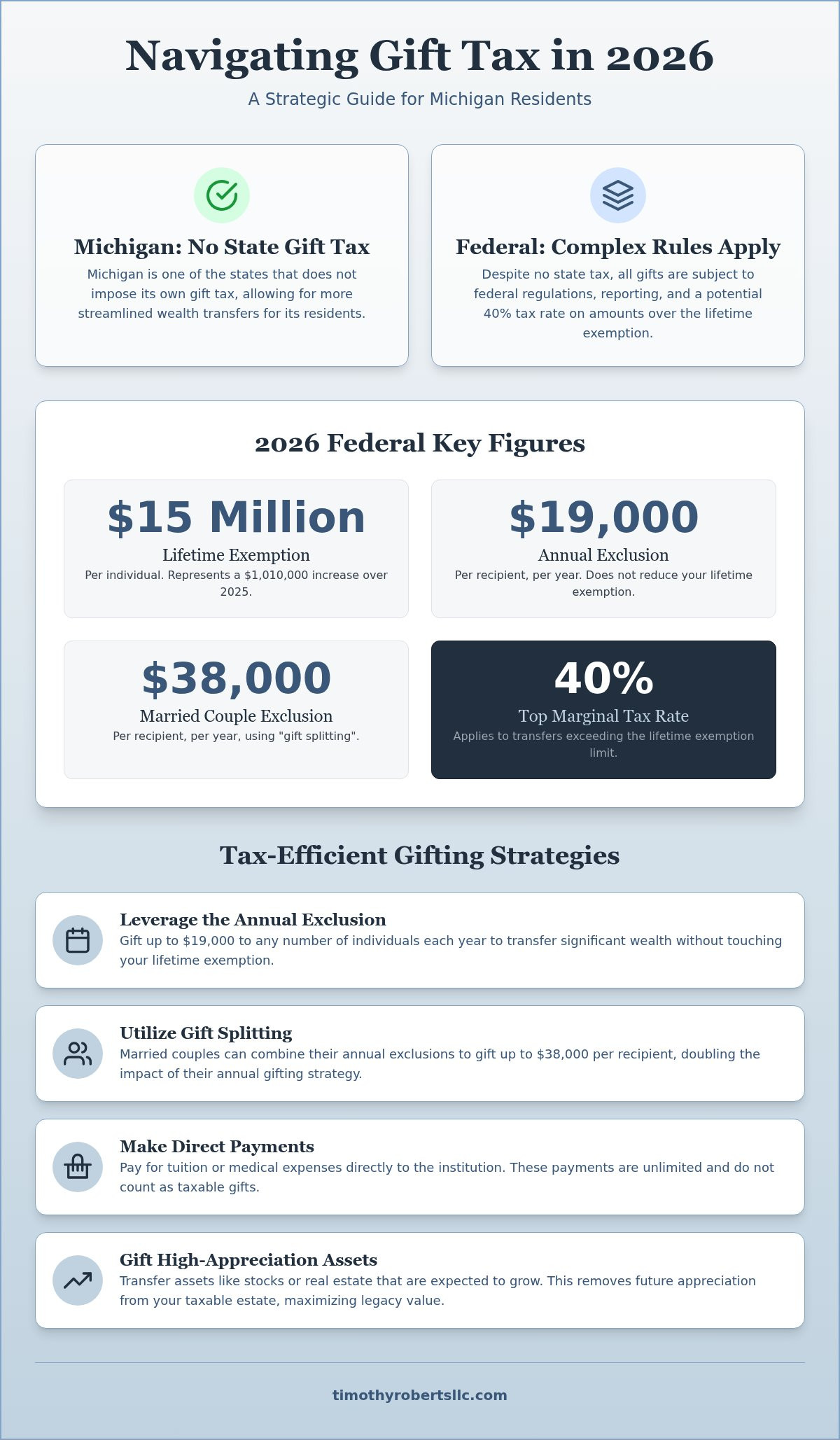
While Michigan residents benefit from the absence of a local levy, the federal environment in 2026 presents a sophisticated array of opportunities and obligations. The federal annual gift tax exclusion for 2026 is officially 19,000 dollars per recipient. This allows you to distribute significant assets to any number of individuals without triggering a gift tax return or exhausting your lifetime credit. For married couples, the impact is doubled to 38,000 dollars through gift splitting. These figures represent a steady upward progression in tax-efficient transfer limits, yet they only tell part of the story for high-net-worth families.
The year 2026 serves as a pivotal moment for legacy coordination. Previously, estate planners braced for a “sunset” of the high exemption levels established years ago. However, the One Big Beautiful Bill Act (OBBBA) prevented that scheduled decline, resulting in a federal lifetime gift and estate tax exemption of 15 million dollars per individual for 2026. This represents an increase of 1,010,000 dollars over 2025 levels. Despite this legislative reprieve, the top marginal tax rate remains 40 percent for transfers exceeding the exemption. This underscores the need for a deliberate approach that synthesizes michigan gift tax rules with federal opportunities.
The TCJA Sunset: What High-Net-Worth Donors Must Know
The legislative landscape has shifted from fear of a cliff to a period of strategic expansion. The prevention of the sunset means that the massive exemption space remains available for those ready to act. Strategic gifting in 2026 isn’t merely about reducing the size of your estate; it’s about moving the future appreciation of assets out of the taxable bucket. By utilizing the 15 million dollar exemption now, you lock in the ability to transfer high-growth investments while they are valued lower. The IRS has maintained “clawback” protection, ensuring that gifts made under these high limits remain protected even if future administrations seek to lower the thresholds. This creates a secure environment for ambitious wealth transfer.
Calculating Your Remaining Lifetime Credit
Precision is the hallmark of a successful estate plan. Your Unified Transfer Tax Credit is a finite resource that tracks every taxable gift you’ve made throughout your life. Every dollar reported on Form 709 in previous years has already begun to erode your 15 million dollar limit. Because the michigan gift tax rules don’t require state-level reporting, it’s easy to lose track of your cumulative federal standing. A professional audit of your historical filings is essential to determine exactly how much “bucket” space remains. Engaging in comprehensive tax planning strategies can help you reconcile past transfers with your 2026 objectives, ensuring your path toward aspirational growth remains unhindered by unexpected tax liabilities.
Strategic Gifting: Annual Exclusion vs. Lifetime Exemption
Effective wealth transfer requires a nuanced understanding of the two primary federal mechanisms available to donors. While the michigan gift tax rules remain silent at the state level, the federal government provides both an annual exclusion and a lifetime exemption. Think of the annual exclusion as a recurring opportunity to distribute wealth without impacting your long-term credits. For 2026, this amount is 19,000 dollars per recipient. Conversely, the lifetime exemption is a finite reservoir, currently at 15 million dollars, that covers transfers exceeding the annual limit. Balancing these two requires a blend of foresight and tactical execution.
Strategic timing often dictates the success of these transfers. Gifting on January 1st is frequently superior to year-end distributions because it removes the entire year’s appreciation from your taxable estate immediately. For those focused on legacy, front-loading 529 plans allows you to contribute up to five years of annual exclusions in a single lump sum. This accelerates the compounding growth of those funds while maintaining tax-efficient boundaries. It’s a sophisticated way to utilize education funding strategies to secure the next generation’s progression.
Maximizing the Annual Exclusion for Multi-Generational Wealth
Imagine a married couple with two children and four grandchildren. By utilizing gift splitting, they can distribute 38,000 dollars to each of the six family members annually. This results in 228,000 dollars leaving their estate every year without ever touching their lifetime credit. Over a decade, this removes millions in principal and potential appreciation. Beyond the mathematical advantages, this strategy offers the profound satisfaction of witnessing heirs utilize their inheritance for education, home purchases, or entrepreneurial ventures during your lifetime. It transforms wealth transfer from a posthumous transaction into a living legacy of partnership and shared success.
When to Tap Into Your Lifetime Exemption
There are specific strategic moments when it’s prudent to dip into your 15 million dollar lifetime bucket. Business succession is a primary trigger. When transferring interests in family entities, you can often apply valuation discounts for lack of marketability or minority control. This allows you to gift a larger portion of the business while consuming less of your exemption. However, precision is mandatory. The IRS closely monitors the Step Transaction Doctrine, which scrutinizes a series of integrated steps that appear as a single, taxable event. Ensuring these transfers are distinct and commercially sound is vital. This level of craftsmanship distinguishes a standard transfer from a visionary strategy that respects the nuances of the michigan gift tax rules and federal oversight.
Actionable Gifting Methods Beyond Cash Transfers
A sophisticated wealth transfer strategy moves beyond the simple distribution of cash. While liquid assets are convenient, a visionary strategist evaluates every gift based on its long-term efficiency and its ability to remove future growth from a taxable estate. Within the framework of the michigan gift tax rules, selecting the right asset class is as vital as the timing of the transfer itself. High-appreciation assets, such as growth-oriented equities or interests in private entities, often represent the most potent gifting opportunities. By transferring these assets now, you effectively freeze their value for tax purposes, allowing the subsequent appreciation to accrue to your heirs without further federal oversight.
Conversely, stable-value assets like bonds or cash are less efficient for large-scale transfers. They don’t offer the same leverage against the 40 percent marginal tax rate. For those with complex portfolios, gifting appreciated securities can also serve as a tool for capital gains management. While the recipient receives a carryover basis, this can be advantageous if they are in a lower tax bracket. Integrating these moves requires a blend of creative passion and business-minded rigor to ensure every transfer aligns with your broader objectives in estate & legacy planning.
The Power of Direct Payments
One of the most effective yet underutilized tools in the donor’s arsenal is the direct payment exclusion. You can pay an unlimited amount for someone else’s tuition or medical expenses without those payments counting toward your annual exclusion or your lifetime credit. These transfers are essentially invisible to the IRS, provided they are structured correctly. To maintain this non-taxable status, payments must be made directly to the educational institution or medical provider. Writing a check to a grandchild for their tuition triggers a reporting requirement; paying the university directly does not. Maintaining meticulous records of these invoices ensures your aspirational growth remains protected from unnecessary scrutiny.
Gifting Appreciated Assets: A Double Tax Benefit
Strategic gifting often involves a choice between transferring an asset now or holding it until death to receive a stepped-up basis. Gifting during your lifetime carries the donor’s original cost basis to the recipient. This is often a superior move for assets with high-appreciation potential that would otherwise balloon your taxable estate. However, for assets with significant built-in gains and lower growth prospects, holding for the step-up may be more prudent. Navigating these nuances requires the level of customization found in our strategic tax advising. By synthesizing individual creative vision with structured corporate capabilities, you can determine which assets are better suited for a living gift versus a testamentary transfer. This deliberate pacing ensures that your michigan gift tax rules strategy is both aesthetically sound and functionally superior.
Integrating Gifting into Your 2026 Wealth Strategy
A successful wealth transfer strategy is never a standalone event; it’s a deliberate integration of your charitable vision, family legacy, and long-term financial security. While the michigan gift tax rules offer a favorable starting point by excluding state-level levies, the true artistry lies in “right-sizing” your estate. This means strategically reducing your taxable footprint to mitigate future tax burdens, specifically those associated with Required Minimum Distributions (RMDs) on large retirement accounts. By gifting assets today, you effectively lower the principal that will eventually be subject to high income tax rates, creating a more efficient flow of resources for both you and your heirs.
This transition marks a profound psychological shift. Moving from a mindset of accumulation to one of intentional distribution requires a high degree of confidence. It’s about seeing wealth as a dynamic tool for impact rather than a static balance sheet. A visionary fiduciary advisor serves as the expert craftsman in this process, coordinating the synthesis of tax advising with investment portfolio management. They ensure that every move you make today contributes to a narrative of upward progression and shared success. This rhythmic approach to wealth management transforms a complex financial obligation into a journey of partnership.
Coordinating Gifting with Retirement Income
The primary challenge in aggressive gifting is the risk of compromising your own lifestyle. You shouldn’t “over-gift” to the point of financial vulnerability. Sophisticated tools like Spousal Lifetime Access Trusts (SLATs) allow one spouse to gift assets to a trust that the other spouse can still access if needed. This provides a critical safety net while still removing the assets from the gross estate for federal purposes. Developing a comprehensive retirement income plan ensures your gifting strategy is supported by rigorous data and business-minded rigor, protecting your standard of living while you empower the next generation.
The Importance of Professional Documentation
Precision in execution is what distinguishes a high-end plan from a generic solution. Even when a gift falls within the 19,000 dollar annual exclusion, filing a “protective” Form 709 is often a wise strategic move. It starts the statute of limitations on the IRS’s ability to challenge the valuation of the gift. For non-cash transfers like real estate or private business interests, a qualified appraisal is mandatory to establish value. This documentation serves as a professional shield, validating your adherence to the michigan gift tax rules and federal standards. Your legacy deserves more than a standard intervention; it requires a carefully crafted strategy that balances personal ambition with structural stability. Reach out to a professional advisor to review your 2026 estate and gift strategy to ensure your plan is positioned for aspirational growth.
Securing Your Legacy Through Strategic Evolution
Navigating the nuances of wealth transfer requires a shift from simple compliance to visionary execution. While the michigan gift tax rules provide a favorable landscape, the true value of an estate plan lies in its ability to adapt to shifting federal boundaries and family objectives. We have explored the tactical advantages of direct payments, the protective nature of spousal trusts, and the necessity of professional documentation. These are not merely administrative tasks; they are the architectural components of a legacy designed for upward progression and long-term stability.
With over 25 years of experience in fiduciary advisory, Timothy Roberts & Associates, LLC provides the sophisticated oversight required to manage complex wealth transfer strategies. Our approach synthesizes tax-efficient estate coordination with fiduciary-first investment management, ensuring your plan remains a living, breathing extension of your values. Don’t leave your family’s future to chance or generic interventions. Request a Strategic Wealth Consultation with Timothy Roberts & Associates, LLC to ensure your wealth transfer strategy is as intentional as the legacy you’ve built. Secure your family’s aspirational growth today.
Frequently Asked Questions
Does Michigan have a gift tax for residents in 2026?
No, Michigan does not impose a state-level gift tax. While residents aren’t subject to local levies on transfers, they remain fully governed by federal regulations. Understanding the michigan gift tax rules means recognizing that the state’s silence places the focus entirely on IRS compliance. This lack of a state tax simplifies the initial planning process but necessitates a rigorous approach to federal reporting for high-value transfers.
How much can I gift someone in 2026 without filing a tax return?
You can gift up to 19,000 dollars per recipient in 2026 without filing a federal gift tax return. If you are married, you can utilize gift splitting to increase this amount to 38,000 dollars per person. These annual exclusion gifts don’t consume any of your lifetime exemption. It’s a highly efficient way to distribute wealth incrementally while avoiding the administrative burden of filing IRS Form 709.
What is the lifetime gift tax exemption in 2026 after the sunset?
The federal lifetime gift and estate tax exemption for 2026 is 15 million dollars per individual. This figure reflects an increase of 1,010,000 dollars over the 2025 limit due to inflation adjustments. The anticipated sunset of the high exemption levels was prevented by the One Big Beautiful Bill Act. This provides a secure window for high-net-worth families to execute large-scale transfers without immediate tax liability, provided they don’t exceed this limit.
Do I have to pay tax on a gift I received in Michigan?
Generally, the recipient of a gift does not pay any income or gift tax on the transfer. In the United States, the responsibility for reporting and paying taxes falls on the donor, not the person receiving the assets. However, if you receive a gift of appreciated property and later sell it, you’ll be responsible for capital gains taxes based on the donor’s original cost basis. This is a critical distinction in estate coordination.
Can I pay for my grandchild’s college tuition without it counting as a gift?
Yes, direct payments for tuition or medical expenses are excluded from the gift tax and don’t count toward your annual or lifetime limits. To qualify for this exclusion, you must pay the educational institution or medical provider directly. Writing a check to your grandchild would be considered a taxable gift under the michigan gift tax rules. Direct payment ensures these transfers remain “invisible” to the IRS, preserving your exclusion for other assets.
What happens if I give away more than the lifetime limit?
Once you exhaust your 15 million dollar lifetime exemption, any additional gifts are subject to a marginal federal tax rate of 40 percent. This tax is typically paid by the donor at the time the gift tax return is filed. Because this rate is significant, strategic wealth managers focus on utilizing the exemption early to remove future asset appreciation from the taxable estate. This proactive approach minimizes the long-term impact of these high marginal rates.
Is there a difference between the gift tax and the inheritance tax in Michigan?
Yes, though Michigan currently has neither a state gift tax nor a state inheritance tax. A gift tax applies to transfers made during your lifetime, while an inheritance tax is levied on assets received after someone’s death. While Michigan residents don’t face these at the state level, they must still account for federal estate and gift taxes. The synthesis of these two concepts is essential for a comprehensive and tax-efficient legacy plan.
How do I report a large gift to the IRS?
You must report any gift that exceeds the 19,000 dollar annual exclusion by filing IRS Form 709 with your annual income tax return. This form tracks how much of your 15 million dollar lifetime exemption you have utilized. Even if no tax is currently owed, professional documentation is vital for establishing the value of the transfer. Filing a protective return can also start the statute of limitations, preventing future challenges to the gift’s valuation.
