

Aug
Michigan Small Business Retirement Planning Guide 2026
What if the tax liabilities currently weighing on your balance sheet could be strategically repurposed into your most powerful engine for personal wealth? For the modern entrepreneur, the business is often the primary vehicle for growth, yet many owners find themselves uncertain about how to translate that corporate success into a secure, private legacy. You’ve likely felt the pressure of rising taxes or the complexity of evolving SECURE 2.0 regulations, making it difficult to see the path forward. Effective retirement planning for small business owners Michigan requires more than just a standard account; it demands a sophisticated synthesis of tax strategy and fiduciary oversight.
We understand that you view your company as an evolving organism rather than a static asset. This guide provides a clear roadmap for transforming your business success into a tax-efficient retirement income stream that rewards your hard work. We will examine how to maximize contributions under the 2026 limits, including the new $11,250 super catch-up for specific age groups, and how to utilize the 100% startup cost tax credit to fuel your organizational evolution. By aligning your personal vision with structured corporate capabilities, you can build a plan that secures your future while attracting the high-level talent your company requires to thrive.
Key Takeaways
- Learn how to capture significant tax credits under SECURE 2.0 to offset the administrative costs of establishing and funding your organizational retirement plan.
- Discover how sophisticated retirement planning for small business owners Michigan can transform current tax liabilities into long-term wealth through customized plan selection and strategic contributions.
- Explore the critical intersection of succession planning and retirement security to ensure your business equity translates into a sustainable and predictable personal legacy.
- Understand why a bespoke fiduciary partnership offers the strategic depth required to manage complex portfolios and navigate the evolving regulatory landscape with confidence.
The Entrepreneur’s Retirement Dilemma: Balancing Growth with Future Security
Business owners in Michigan often inhabit a paradox. You are the architect of corporate growth, yet you’re frequently the most underserved employee in your own firm. Every dollar funneled back into operations feels like a brick in your legacy, but this singular focus creates a fragile foundation for your private life. The psychological shift from reinvesting in operations to building personal liquidity is often the most difficult hurdle. It requires recognizing that business valuation is theoretical until it’s realized, whereas personal wealth provides immediate stability.
To better understand the foundational options available to your firm, watch this helpful overview:
Relying on the mantra “the business is my retirement” is a high-risk strategy in a volatile economic climate. Market shifts, technological disruptions, or personal health changes can erode a company’s value long before an exit occurs. True financial independence happens at the intersection of a healthy business valuation and a robust, independent portfolio. By treating retirement as a non-negotiable business expense, you ensure that your future isn’t held hostage by the same risks you manage during the workday.
The Risk of the Single-Asset Retirement
Concentrating all your wealth within the walls of your company creates a dangerous point of failure. While your business equity is a powerful asset, it’s also illiquid and subject to specific industry volatility. Diversifying wealth through various Retirement Plans in the United States allows you to capture market growth while insulating your personal life from corporate downturns. Asset diversification for business owners is the strategic allocation of capital into uncorrelated financial vehicles to protect personal security from the specific risks inherent in their primary business operations.
Fiduciary Oversight in Business Planning
High-level retirement planning for small business owners Michigan demands a partner who operates with total transparency. Many financial products aimed at small firms are off-the-shelf solutions designed for the vendor’s profit rather than the owner’s tax efficiency. A fiduciary advisor acts as a visionary strategist, providing the calm confidence needed to execute a long-term roadmap. This partnership ensures that your plan isn’t just a collection of accounts, but a bespoke intervention designed for organizational evolution and personal peace of mind. You deserve an expert craftsman who prioritizes your fiduciary interests over a simple transaction.
Navigating SECURE 2.0: Tax-Advantaged Retirement Plans for Michigan Enterprises
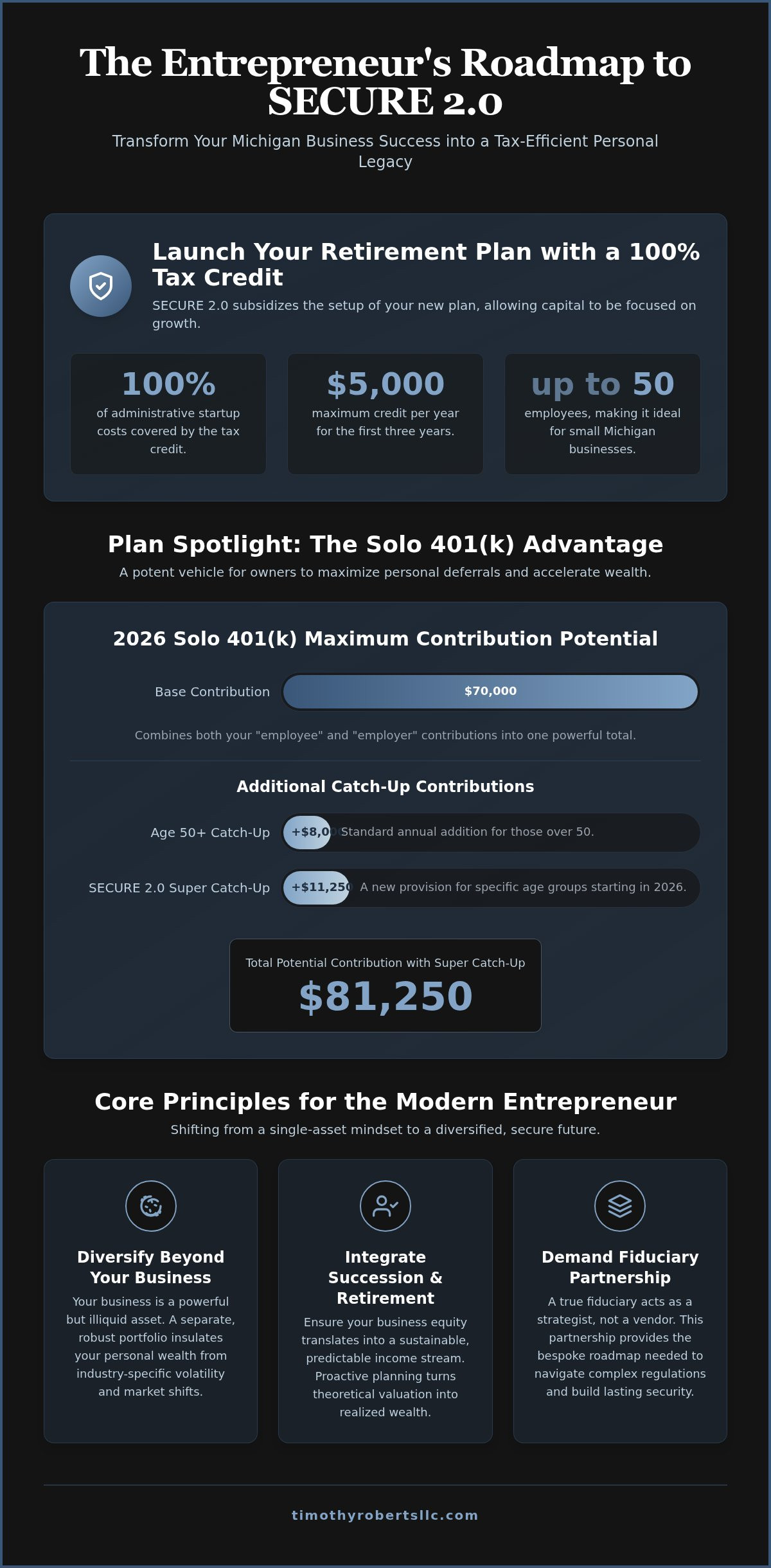
SECURE 2.0 has fundamentally shifted the landscape of retirement planning for small business owners michigan. By 2026, the federal government has effectively lowered the cost of entry for sophisticated retirement vehicles to near zero for many firms. Small businesses with up to 50 employees can now claim a tax credit of 100% of administrative startup costs for the first three years, reaching a maximum of $5,000 per year. This shift allows you to focus capital on growth while the government subsidizes the structural evolution of your firm. It’s a rare opportunity where tax compliance directly funds your organizational development.
SEP IRA vs. Solo 401(k): Which Fits Your Vision?
The choice between these two vehicles is a study in balancing functionality with future flexibility. For 2026, the Solo 401(k) offers a total contribution limit of $70,000, combining both employee and employer inputs. This plan is particularly potent for owners seeking to maximize personal deferrals, especially with the $8,000 catch-up for those over 50. A unique 2026 provision even allows a “super” catch-up of $11,250 for individuals between ages 60 and 63. Conversely, the SEP IRA allows for contributions up to 25% of compensation, also capped at $70,000. While the SEP IRA offers administrative ease, it lacks the robust catch-up options of the 401(k) structure. Reviewing the IRS guide to small business retirement plans highlights the technical nuances, but the true value lies in how these plans align with your broader wealth management goals.
The SIMPLE IRA Advantage for Small Teams
For organizations scaling toward 100 employees, the SIMPLE IRA provides a rhythmic balance between employee benefit and corporate cash flow. In 2026, employees can defer up to $17,000 into these accounts. The SECURE 2.0 Act has added a layer of intentionality here by offering a $500 annual tax credit for the first three years to businesses that implement automatic enrollment. This feature streamlines participation and positions your firm as a forward-thinking employer in a competitive labor market. If you’re looking for a more collaborative approach, Pooled Employer Plans (PEPs) are gaining traction in Michigan. These allow multiple small businesses to band together, reducing the individual administrative burden through shared fiduciary oversight. Understanding these options is the first step toward a personalized financial plan that prioritizes your long-term independence.
Tax Efficiency as a Wealth Accelerator: Beyond Basic Contributions
Selecting the right retirement vehicle is merely the foundation of a sophisticated financial strategy. For the discerning entrepreneur, the true engine of growth lies in the synthesis of tax preparation and wealth management. High-level retirement planning for small business owners michigan moves beyond simple deferrals to treat tax efficiency as a primary asset class. By integrating your business tax liabilities with your personal wealth goals, you transform a mandatory compliance task into a strategic intervention that accelerates your journey toward independence. This approach ensures that your capital works as hard as your operations do. As you refine your corporate strategy, you can discover James O’Brien Core Benefits Group to see how comprehensive benefit structures can support your firm’s long-term objectives.
For high-income owners, the standard contribution limits of a 401(k) may not suffice to meet aggressive retirement goals or offset substantial tax liabilities. Defined Benefit Plans offer a premium alternative, allowing for substantially higher tax-deductible contributions that scale with your income and age. These plans function as powerful tools for organizational evolution, allowing you to shelter significant portions of your income while building a guaranteed future benefit. When paired with active investment portfolio management, such as tax-loss harvesting within your taxable accounts, these plans protect your capital from unnecessary erosion. This level of intellectual curiosity ensures that every dollar on your balance sheet is optimized for its highest and best use.
The Synergy of Tax Planning and Investment Management
Managing an investment portfolio without a deep understanding of tax liability is like building a structure without a blueprint. In Michigan, the flat individual income tax rate of 4.25% for 2026 provides a stable environment, yet the real complexity arises at the federal level where shifting brackets can impact your long-term success. We utilize strategic Roth conversions during lower-income years or business cycles to lock in tax-free growth, ensuring that your future distributions aren’t compromised by shifting tax landscapes. This forward-thinking approach aligns the aesthetics of your desired lifestyle with the functionality of a rigorous tax strategy, creating a seamless transition from business owner to independent retiree.
Year-Round Compliance and Strategy
True organizational evolution requires moving away from the frantic, once-a-year scramble of tax season toward a rhythmic, year-round strategic partnership. Engaging in strategic tax advising creates a sense of professional stability, allowing you to make business decisions with full clarity on their personal financial impact. Tax preparation is the retroactive reporting of financial history to satisfy regulatory requirements, while tax planning is a proactive, visionary strategy designed to optimize future cash flow and minimize long-term liabilities. As you look toward the future, consulting an SBA succession planning guide can help you understand how these tax-efficient structures eventually support a clean and profitable exit from your firm.
Succession Planning: Turning Business Equity into Retirement Income
Succession is a journey of organizational evolution, not a mere transaction at the point of exit. Valuation strategies must move beyond simple industry multiples to reflect the true depth and professional stability you’ve built within your enterprise. This stability extends to the physical integrity of your company’s facilities; for instance, you can find out more about how Thoughtful Roofer Inc. provides inspections that help preserve asset value and prevent costly surprises during a sale. Coordinating with legal experts allows for a seamless synthesis of business divestment and wealth transfer, protecting your capital from unnecessary erosion. This deliberate pacing reinforces the idea that you are an expert craftsman of your own legacy, ensuring that the transition from owner to retiree is as polished and intentional as your business operations.
Legacy Planning and Multi-Generational Wealth
Transitioning a firm while maintaining a stable income stream requires a high-level focus on multi-generational wealth. The use of trusts can be a powerful intervention, shielding business assets for the next generation while providing a structured buffer against creditors and estate taxes. By prioritizing strategic estate planning, you ensure that your family’s future is as intentional and robust as the company you founded. This approach bridges individual vision with the corporate capabilities needed for long-term stability, treating your life’s work as a journey of upward progression rather than a simple transaction.
Preparing for the Exit: A 3-Year Roadmap
A successful exit requires a rhythmic approach to execution over several years. This deliberate timeframe allows for a polished transition that maximizes value for all stakeholders and aligns with your retirement planning for small business owners michigan.
- Balance Sheet Optimization: Aggressively cleaning up non-essential expenses to maximize EBITDA and the final sale price.
- Successor Identification: Deciding whether grooming internal talent or pursuing an external buyer provides the best alignment with your lifestyle goals.
- Tax Structuring: Evaluating the implications of asset versus stock sales to minimize the impact of federal capital gains and state-level liabilities.
Navigating these complexities requires a partner who understands the intersection of aesthetics and functionality. If you’re ready to define your exit and secure your future, explore our wealth management services to begin your transition today.
Partnering with a Fiduciary: Crafting a Bespoke Financial Roadmap
The transition from active entrepreneurship to a legacy-focused retirement requires more than a simple collection of financial products. It demands a bespoke intervention designed by a visionary strategist who understands that your business and personal wealth are inextricably linked. For those pursuing retirement planning for small business owners michigan, the distinction between a salesperson and a fiduciary is the difference between a transaction and a transformation. We believe that sophisticated planning should feel polished and intentional, providing you with the calm confidence to enjoy the growth you’ve built.
Bespoke interventions outperform off-the-shelf products because they account for the intricate nuances of your specific organizational evolution. Our approach at Timothy Roberts & Associates, LLC is built on over 25 years of experience in elevating Michigan wealth through a fiduciary lens. We utilize asset-based investment management to ensure total fee transparency, aligning our success directly with your portfolio’s performance. This rhythmic balance between aesthetics and functionality ensures that your financial plan isn’t just a document, but a living roadmap for upward progression.
The Authority of Experience
Expert craftsmanship matters. A lead advisor who synthesizes corporate and personal finance provides a depth of context that generic firms simply can’t match. We craft personalized strategies tailored to your specific risk tolerance and the unique goals of your Michigan enterprise. This level of intellectual curiosity ensures that strategic retirement income planning serves as a pillar for future stability. By bridging your individual creative vision with structured corporate capabilities, we help you navigate the complexities of long-term wealth elevation with ease.
Next Steps: Your Strategic Consultation
The journey toward a secure retirement begins with a comprehensive portfolio and tax review. This isn’t a surface-level summary; it’s a deep, business-minded analysis of your current trajectory and potential liabilities. We work to reduce the friction of plan implementation through professional guidance, allowing you to focus on leading your firm while we manage the practicalities of execution. If you’re ready to transform your business success into a lasting legacy, Schedule a consultation with our fiduciary team to begin your strategic review.
Elevating Your Future Through Strategic Partnership
The journey from business growth to personal independence requires a shift from operational hustle to visionary strategy. By capturing the 100% administrative tax credits available in 2026 and integrating your business tax preparation with a robust investment portfolio, you transform a standard retirement account into a powerful wealth accelerator. True retirement planning for small business owners michigan demands this level of sophisticated synthesis, ensuring that your company’s success translates into a secure, private legacy that rewards your years of expert craftsmanship.
At Timothy Roberts & Associates, we bring over 25 years of wealth management expertise to our fiduciary-first advisory model. Our integrated tax and investment strategy is designed as a bespoke intervention, moving beyond off-the-shelf products to solve your most complex financial dilemmas. We invite you to Request a Strategic Retirement Review with our Fiduciary Team to begin crafting your personalized roadmap for upward progression. Your vision deserves a partner who values depth as much as you do, and we’re here to help you secure the future you’ve worked so hard to build.
Frequently Asked Questions
What is the best retirement plan for a one-person business in Michigan?
The Solo 401(k) is often the most powerful vehicle for a one-person business because it allows for both employee and employer contributions. In 2026, the total contribution limit reaches $70,000, which provides a significant buffer for tax-efficient growth. This plan offers the flexibility of Roth contributions and loan provisions, making it a cornerstone of retirement planning for small business owners michigan. It’s a sophisticated intervention that scales with your income and long-term vision.
How does the SECURE 2.0 Act provide tax credits for my small business?
SECURE 2.0 provides a 100% tax credit for the administrative startup costs of a new plan, capped at $5,000 annually for the first three years. This applies to firms with up to 50 employees, effectively subsidizing your organizational evolution. Additionally, a credit of up to $1,000 per employee is available for employer contributions during the plan’s initial five years. These incentives reduce the friction of implementation while accelerating your corporate tax strategy.
Can I have both a SEP IRA and a personal Roth IRA?
You can maintain both a SEP IRA and a personal Roth IRA, provided you meet the IRS income eligibility requirements for the Roth account. While the SEP IRA is funded by the business, the Roth IRA is a personal contribution made with after-tax dollars. This dual approach creates a rhythmic balance between immediate tax deductions and future tax-free income. It’s an essential tactic for owners seeking to diversify their tax liability across different retirement buckets.
What is the difference between a fiduciary and a regular financial advisor?
A fiduciary is legally and ethically bound to act solely in your best interest, whereas a regular advisor may only be held to a suitability standard. This distinction is critical for business owners who require objective, conflict-free advice on complex wealth management. Our fiduciary focus ensures that every recommendation is a bespoke intervention designed for your growth rather than a transaction-based sale. It fosters a narrative of partnership and shared success throughout your financial journey.
How do I determine the value of my business for retirement planning?
Determining the true worth of your organizational evolution requires a professional valuation that considers EBITDA multiples, cash flow projections, and intangible assets. We recommend a formal appraisal at least three to five years before your anticipated exit. This timeline allows you to optimize the balance sheet and address any operational inefficiencies that could erode the sale price. Understanding this value is a pillar of retirement planning for small business owners michigan, as it defines your primary liquidity event.
Are employer contributions to a 401(k) tax-deductible for the business?
Employer contributions to a 401(k) are generally fully tax-deductible as a business expense, provided they don’t exceed 25% of the total compensation paid to eligible employees. This functionality allows you to reward your team while simultaneously reducing the company’s taxable income. It’s a strategic tool for wealth elevation that benefits both the firm’s bottom line and the personal retirement security of its leaders. Proper plan design ensures these contributions are optimized for maximum tax efficiency.
What happens to my retirement plan if I sell my business?
When a business is sold, the treatment of the retirement plan depends on the deal structure and the plan type. Typically, a 401(k) is either terminated, allowing participants to roll assets into an IRA, or assumed by the purchasing entity. SEP and SIMPLE IRAs are particularly flexible, as the accounts are already owned by the individuals. Coordinating this transition with a fiduciary ensures that your personal wealth remains protected during the corporate divestment process.
