

Jul
Michigan Small Business Retirement Tax Benefits: 2026 Strategic Guide
The federal government is now effectively subsidizing 100% of retirement plan startup costs for Michigan businesses with 50 or fewer employees through 2026. This marks a rare moment where regulatory shifts create a massive opening for wealth preservation, rather than just another administrative hurdle. Most entrepreneurs feel the persistent drain of high self-employment taxes and the overwhelming complexity of federal mandates. You’ve likely realized that identifying truly tax-efficient investment strategies for Michigan business owners requires more than a standard template; it demands a curated approach that aligns your corporate structure with your long-term legacy goals.
At Timothy Roberts & Associates, LLC, we understand that your focus should remain on strategic organizational evolution, not getting lost in the weeds of plan management. This guide promises to illuminate how you can leverage these federal credits alongside Michigan’s full phase-in of retirement income exemptions to shield your revenue. We will examine the shift toward fiduciary-led oversight and the mechanics of the new “super catch-up” contributions available this year. By the end of this analysis, you’ll possess a clear roadmap to maximize tax deductions while positioning your firm as a sophisticated destination for top-tier talent.
Key Takeaways
- Eliminate the financial barrier to entry by leveraging the 100% federal tax credit for retirement plan startup costs, available to Michigan businesses with 50 or fewer employees.
- Discover how Michigan’s fully implemented 2026 retirement income exemptions create a powerful synergy with federal deductions to significantly lower your total taxable income base.
- Identify the most tax-efficient investment strategies for michigan business owners by comparing the high-contribution limits of Solo 401(k)s against the streamlined administration of SEP and SIMPLE IRAs.
- Utilize the SECURE 2.0 employer contribution credit as a direct federal subsidy to enhance your benefits package and attract elite talent in a competitive labor market.
- Shield your business from administrative risk by implementing a fiduciary-led management strategy that prioritizes professional oversight and long-term legacy preservation.
The Strategic Landscape: Retirement Planning as a Tax Shield in 2026
For the modern entrepreneur, retirement planning has transcended the simple concept of a “safety net.” It’s now a sophisticated mechanism for capital preservation. As we enter 2026, Michigan business owners find themselves at a unique crossroads where state-level tax exemptions fully align with expanded federal incentives. This convergence allows for the implementation of tax-efficient investment strategies for michigan business owners that do more than just save for the future; they actively shield current operational income from excessive taxation while Michigan’s flat income tax rate holds at 4.25%.
The shift from traditional, rigid pension models to owner-optimized defined contribution plans reflects a broader trend toward business agility. By carefully analyzing the U.S. retirement plan landscape, you can effectively lower your Effective Tax Rate (ETR). This isn’t just a ledger adjustment. It’s a deliberate act of organizational evolution that converts potential tax liabilities into private wealth and business equity, ensuring your growth is both sustainable and protected.
To better understand the mechanics of these wealth preservation techniques, watch this helpful analysis:
Tax Deductions vs. Tax Credits: Defining the Value
Employer contributions function as a direct business expense, which reduces your company’s net income before it ever reaches your personal return. This reduction in your Adjusted Gross Income (AGI) can often drop you into a lower tax bracket, amplifying the savings across your entire financial profile. For an S-Corp owner, a tax deduction reduces the amount of income subject to tax, while a tax credit provides a dollar-for-dollar reduction in the actual tax bill you owe the IRS. Utilizing these tax-efficient investment strategies for michigan business owners allows you to optimize the balance between immediate liquidity and future security.
Retirement Planning as Organizational Evolution
Beyond the balance sheet, a robust retirement strategy serves as a powerful instrument for talent acquisition. Data from Manulife John Hancock in early 2026 indicates that 80% of employees are unlikely to join a firm that lacks a retirement plan, making these benefits essential for attracting top-tier talent in Michigan’s competitive market. Transitioning from a transactional mindset to a legacy-focused enterprise requires structured retirement income planning. This transformation ensures that your business doesn’t just provide a living today but builds a lasting legacy that sustains your family and your community for decades to come.
Federal Incentives: Leveraging SECURE 2.0 Credits for Michigan Owners
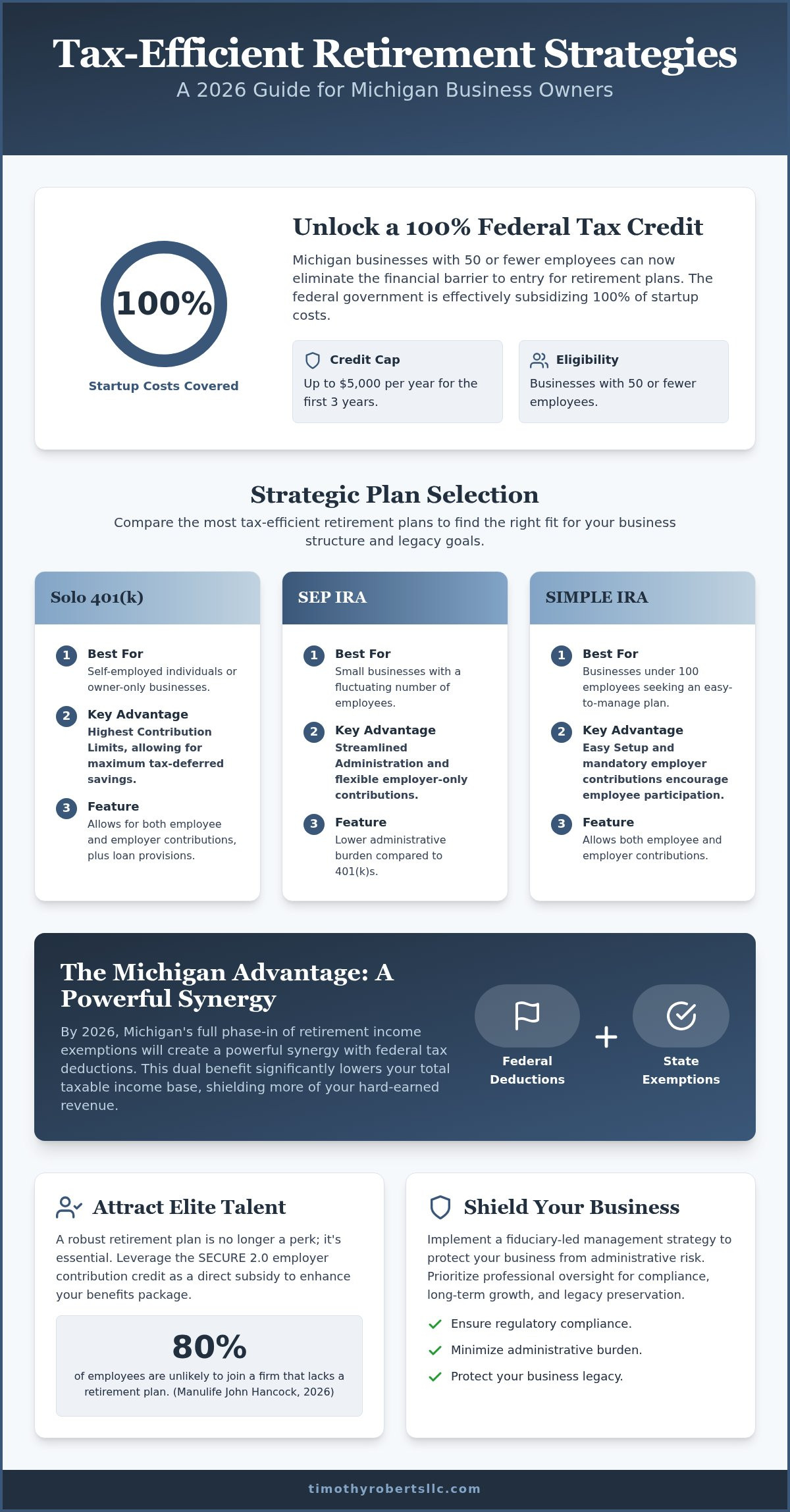
The SECURE 2.0 Act has fundamentally altered the financial equation for establishing a retirement plan. For Michigan businesses with 50 or fewer employees, the federal government has effectively removed the cost of entry by offering a tax credit that covers 100% of eligible startup costs. This credit, capped at $5,000 per year for the first three years, transforms what was once an administrative expense into a strategic tax asset. Implementing tax-efficient investment strategies for michigan business owners now involves leveraging these direct federal subsidies to build a robust benefits framework without impacting operational liquidity.
Beyond the initial setup, the Employer Contribution Credit provides a direct federal subsidy for your employees’ retirement savings. This provision allows small employers to claim a credit for a portion of the contributions made to employee accounts, up to $1,000 per employee per year for the first five years. To ensure your plan remains compliant with the latest federal standards, consulting IRS Publication 560 provides the necessary technical foundation for these small business tax advantages. These incentives, coupled with a $500 annual credit for implementing automatic enrollment, ensure that your firm’s growth is supported by federal policy rather than hindered by it.
SECURE 2.0: The Small Business Game Changer
One of the most significant advancements in the 2026 landscape is the rise of Pooled Employer Plans (PEPs). These structures allow multiple unrelated businesses to join a single plan, significantly reducing the administrative friction and fiduciary burden that often stall small business initiatives. Additionally, owners aged 60 to 63 can now utilize a “super catch-up” contribution of $11,250, a substantial increase from the standard catch-up limits. For those seeking the path of least resistance, “Starter 401(k)” plans offer a streamlined compliance model with minimal administrative overhead, perfectly suited for firms focused on rapid scaling. If you’re looking to refine your approach, exploring a specialized wealth management strategy can help align these federal options with your specific corporate goals.
Calculating the Real Value of Federal Credits
The financial impact of these credits is most visible when viewed through a multi-year lens. The $5,000 startup credit provides a total of $15,000 in potential tax offsets over the first three years of plan operation. While the employer contribution credit begins to phase out after the second year for larger firms, businesses with 50 or fewer employees retain the full benefit for a longer duration. For a Michigan firm with 10 employees, the employer contribution credit could provide up to $10,000 in direct tax offsets annually during the initial years of plan implementation. This creates a powerful incentive to implement tax-efficient investment strategies for michigan business owners that prioritize both employee retention and owner wealth elevation. Provisions for military spouse participation further enhance these benefits, offering additional credits for businesses that include this demographic in their retirement frameworks.
Strategic Plan Selection: Comparing SEP, SIMPLE, and Solo 401(k)
Selecting the appropriate retirement vehicle is a cornerstone of tax-efficient investment strategies for michigan business owners. While federal credits offset the costs of implementation, the structure of the plan itself dictates the ceiling of your annual tax savings. For the self-employed professional seeking high contribution limits with minimal administrative friction, the SEP IRA remains a formidable tool. In 2026, the contribution limit for a SEP IRA is the lesser of 25% of compensation or $72,000, providing a significant avenue for shielding business income through employer-only contributions.
Businesses with a growing headcount often find the SIMPLE IRA to be an effective middle ground. This plan allows for employee contributions of up to $17,000 in 2026, with a higher limit of $18,100 for firms with 25 or fewer employees. To navigate these choices with precision, the U.S. Department of Labor guide on small business retirement plans offers a neutral framework for evaluating which model aligns best with your operational scale. For high-earning professionals experiencing significant income peaks, defined benefit plans offer even more aggressive sheltering, though they require a more rigorous commitment to annual funding and professional actuarial oversight.
Solo 401(k) vs. SEP IRA: The High-Income Debate
The Solo 401(k) often emerges as the superior tax shelter because it allows for both employee and employer contributions. For 2026, the total contribution limit reaches $72,000 for individuals under 50, but it allows you to reach that ceiling at lower net income levels than a SEP IRA. A pivotal shift for the 2026 tax year is the mandatory Roth treatment for catch-up contributions for those earning over $150,000, alongside the new ability to designate SEP and SIMPLE contributions as Roth. This flexibility allows for a more nuanced approach to tax-efficient investment strategies for michigan business owners who want to balance immediate deductions with tax-free growth, especially when utilizing the $11,250 super catch-up for those aged 60 to 63.
Plan Design for Growing Teams
As your organization evolves, plan design becomes a tool for retention and compliance. Implementing vesting schedules can incentivize long-term commitment from top-tier talent, ensuring that your investment in their future mirrors their investment in your firm. Safe Harbor 401(k) provisions are particularly valuable for growing Michigan teams as they allow owners to maximize their own contributions without the burden of complex top-heavy testing. Integrating strategic tax advising into this selection process ensures that your retirement plan isn’t just a benefit, but a meticulously crafted component of your broader wealth management architecture.
The Michigan Advantage: Synergizing State and Federal Tax Benefits
The true power of tax-efficient investment strategies for michigan business owners lies in the seamless integration of federal incentives with the specific nuances of the Michigan tax code. Because the Michigan individual income tax return, Form MI-1040, uses federal Adjusted Gross Income (AGI) as its foundational starting point, every dollar contributed to a pre-tax retirement plan provides a dual benefit. You aren’t just reducing your federal liability; you’re simultaneously shielding that income from Michigan’s flat tax rate. This creates a compounding effect where the state government effectively subsidizes your personal wealth accumulation.
For owners of S-Corps and partnerships, the Michigan Flow-Through Entity (FTE) tax adds another layer of strategic opportunity. By making retirement contributions at the entity level, you reduce the business income subject to the FTE tax, which helps navigate the federal SALT cap limitation. This intersection of corporate structure and personal wealth management ensures that your organizational evolution is supported by a lean, efficient tax profile that prioritizes capital retention over state-level leakage. It’s a sophisticated mechanism for maintaining liquidity while building long-term security.
Michigan State Tax Optimization
The relationship between federal AGI and state filings means that retirement contributions often prove more effective than standard business expense deductions. While a business expense represents a permanent outflow of cash, a retirement contribution is a transfer of wealth from the business entity to your personal balance sheet. For the 2026 tax year, Michigan’s individual income tax rate is a flat 4.25% for small business net income that flows through to the owner’s personal return. This predictability allows for long-term planning where the tax savings are mathematically certain rather than speculative. To refine your approach to these state-level advantages, consult with our advisors to align your tax and investment strategies for maximum impact.
Local Considerations for Michigan Entrepreneurs
Coordinating your business retirement assets requires a deep understanding of Michigan’s unique economic environment, including how wealth accumulation interacts with property tax considerations. As you build significant assets within these plans, it’s vital to consider how they’ll eventually be distributed or passed down. Michigan has completed its phase-in of the retirement income tax exemption for 2026, meaning qualifying distributions from IRAs and 401(k) plans are deductible up to $67,610 for single filers and $135,220 for married couples filing jointly. Integrating these tax-efficient investment strategies for michigan business owners with proactive estate planning within the Michigan legal framework ensures the legacy you build today remains protected for the next generation.
Fiduciary Excellence: Implementing Your Integrated Wealth Strategy
The successful execution of tax-efficient investment strategies for michigan business owners rests upon a single, uncompromising foundation: the fiduciary standard. While the tax credits and plan structures discussed previously provide the framework, professional oversight ensures that these components function as a cohesive engine for wealth preservation. In an environment defined by the complexities of the SECURE 2.0 Act, the role of a fiduciary is not merely advisory. It’s a legal and ethical commitment to act solely in your best interest, ensuring that every investment choice and administrative decision aligns with your long-term legacy.
Many entrepreneurs mistakenly assume that their plan providers share the burden of legal liability. Without a designated fiduciary partner, the business owner often remains personally responsible for investment outcomes and compliance failures. Our approach at Timothy Roberts & Associates, LLC bridges this gap by merging meticulous tax preparation with sophisticated investment portfolio management. This integration allows us to monitor and rebalance your strategy in real time, maintaining organizational stability as market conditions and federal regulations shift through 2026 and beyond.
The Fiduciary Difference for Business Owners
Understanding the distinction between ERISA 3(21) and 3(38) fiduciary roles is essential for reducing your administrative burden. An ERISA 3(21) fiduciary shares the responsibility for investment decisions, while a 3(38) investment manager assumes full discretionary authority, effectively shielding the owner from most investment-related legal risks. This professional management ensures your plan remains compliant with evolving 2026 federal and state laws, allowing you to focus on high-level corporate growth rather than the minutiae of plan testing or regulatory filings. Precision defines the outcome; professional oversight protects it.
Your Path to Financial Clarity
The journey toward a secure retirement begins with a comprehensive assessment of your current tax trajectory and organizational goals. Designing a customized roadmap for wealth elevation requires a deep understanding of how your business revenue intersects with your personal aspirations. We invite you to begin this evolution through a strategic consultation where we analyze your existing structures and identify untapped opportunities for tax mitigation. The next step in securing your legacy involves coordinating with a financial advisor who understands the unique needs of Michigan’s elite business community. By implementing these tax-efficient investment strategies for michigan business owners today, you ensure that your firm remains a vehicle for lasting prosperity.
Securing Your Legacy Through Intentional Wealth Design
The convergence of expanded federal credits and Michigan’s fully implemented retirement exemptions marks 2026 as a definitive year for business owners to reclaim their financial trajectory. By effectively utilizing the SECURE 2.0 startup incentives and aligning your corporate structure with state-specific benefits, you transform potential tax liabilities into fuel for long-term growth. Implementing tax-efficient investment strategies for michigan business owners isn’t a one-time transaction; it’s a continuous process of organizational evolution that demands precision and foresight.
Since 1998, our firm has provided fiduciary-led expertise that bridges the gap between complex tax advising and personalized wealth management. We specialize in creating integrated strategies that protect your high-net-worth status while fostering a lasting legacy for your family and employees. Your journey toward financial clarity deserves a partner who values depth and intellectual rigor over generic solutions. Request a Strategic Consultation for Your Michigan Business to begin designing a future defined by confidence and aspirational growth. We’re ready to help you elevate your wealth to its fullest potential.
Strategic Insights: Frequently Asked Questions
What is the maximum tax credit for starting a small business retirement plan in 2026?
Small employers with 50 or fewer employees can receive a federal tax credit of 100% of eligible startup costs, capped at $5,000 per year for the first three years. This credit effectively eliminates the administrative barrier to entry for many Michigan firms. Additionally, you may qualify for a $500 annual credit for three years by implementing an automatic enrollment feature, further enhancing the fiscal efficiency of your new plan.
How does a SEP IRA differ from a Solo 401(k) for a Michigan business owner?
A SEP IRA is an employer-only contribution plan where you can contribute the lesser of 25% of compensation or $72,000 in 2026. In contrast, a Solo 401(k) allows for both employee deferrals and employer contributions, reaching the same $72,000 total limit but often at much lower net income levels. Identifying the right choice is a core component of tax-efficient investment strategies for michigan business owners who want to maximize their personal wealth elevation.
Can I deduct my own retirement contributions as a business expense in Michigan?
Yes, employer contributions to a qualified retirement plan are generally deductible as a business expense, which reduces your company’s net taxable income. Because Michigan’s individual income tax return uses your federal Adjusted Gross Income (AGI) as a starting point, these deductions directly lower your state-level tax liability. This synergy ensures that your capital remains within your control rather than being redirected to state or federal agencies.
What are the SECURE 2.0 automatic enrollment requirements for small businesses in 2026?
Most new 401(k) or SIMPLE IRA plans established after December 29, 2022, must include an automatic enrollment feature for the 2026 tax year. However, the federal government provides an exemption for small businesses with 10 or fewer employees and for businesses that have been in existence for less than three years. For those required to comply, the $500 annual tax credit helps offset the initial administrative effort of setting up the auto-enrollment mechanism.
Is there a specific Michigan state tax deduction for small business retirement plans?
Michigan doesn’t offer a unique state-level tax credit for plan startup costs, but it provides a significant advantage through the full implementation of its retirement income exemption in 2026. Qualifying distributions from 401(k)s and IRAs are deductible up to $67,610 for single filers and $135,220 for joint filers. By utilizing tax-efficient investment strategies for michigan business owners, you can build a tax-deferred asset that eventually qualifies for these substantial state-level deductions during your distribution years.
What happens to my tax benefits if I have fewer than 10 employees?
Businesses with fewer than 10 employees retain access to the full 100% startup tax credit of up to $5,000 per year while gaining relief from certain federal mandates. Specifically, your firm is exempt from the SECURE 2.0 automatic enrollment requirements that apply to larger organizations. This allows for a more customized approach to benefit design, ensuring your plan remains a tool for organizational evolution without the burden of mandatory administrative features.
How do catch-up contributions work for owners over age 60 in 2026?
Owners aged 60 to 63 can utilize a “super catch-up” contribution of $11,250 for Solo 401(k) plans in 2026, significantly higher than the standard $8,000 catch-up for those aged 50 and over. It’s important to note that for individuals earning over $150,000 in the prior year, federal law now mandates that these catch-up contributions receive Roth treatment. This shift requires a strategic approach to balance your immediate tax deductions with the benefit of future tax-free growth.
Do I need a fiduciary advisor to set up my small business 401(k)?
While you aren’t legally required to use a fiduciary advisor, doing so is a critical step in mitigating your personal liability as a plan sponsor. A fiduciary is legally obligated to act in your best interest, whereas non-fiduciary providers may not have the same level of accountability regarding investment selection or fee structures. Professional fiduciary oversight ensures that your plan remains compliant with 2026 regulations while protecting your personal assets from litigation related to plan management.
