

Jul
Strategic Retirement Plans for Small Business Owners in Michigan: A 2026 Guide
What if your retirement strategy was less about a distant destination and more about a sophisticated intervention for your current tax liability? You understand that building a business in the Great Lakes State requires more than just hard work; it demands a visionary approach to wealth preservation. Finding the right retirement plans for small business owners michigan often feels like a choice between rewarding your team and paying yourself. It’s a common tension that leaves many leaders feeling stuck between high tax burdens and the growing complexity of federal mandates.
We’re here to shift that narrative toward one of partnership and strategic growth. You deserve a plan that works as hard as you do. In this 2026 guide, you’ll discover how to select and optimize a retirement infrastructure that minimizes tax liabilities while securing your personal and professional legacy. We will examine the latest SECURE Act 2.0 requirements, including the new mandatory Roth catch-up rules for high earners and the specific 2026 contribution limits for SEP IRAs and Solo 401(k) plans. This exploration provides a clear roadmap for personal financial independence that aligns perfectly with your corporate evolution and current Michigan regulations.
Key Takeaways
- Learn why treating your business as your sole exit strategy is a risk and how to transition toward a diversified, tax-efficient retirement infrastructure.
- Discover which retirement plans for small business owners michigan offer the highest contribution limits and how to navigate the 2026 SECURE Act 2.0 mandates.
- Identify the strategic advantages of SEP IRAs and SIMPLE IRAs for balancing personal wealth accumulation with competitive employee benefits.
- Gain a clear roadmap for integrating investment portfolio management with proactive tax advising to minimize liabilities and maximize long-term cash flow.
- Understand the importance of the fiduciary standard in protecting your assets and ensuring your retirement plan scales alongside your business growth.
Why Michigan Small Business Owners Must Prioritize Strategic Retirement Planning
Michigan’s economic landscape in 2026 is defined by a delicate balance of industrial legacy and modern innovation. For the entrepreneur, this means operating in a high-stakes environment where business income is often under heavy tax pressure. Many owners fall into the trap of believing their business is their only retirement asset. This “exit strategy” myth assumes a seamless sale at a premium price; however, market fluctuations and shifting industry standards can erode that value overnight. Diversifying your wealth through dedicated retirement plans for small business owners michigan creates a firewall between your personal future and your company’s operational risks. It transforms your business from a singular source of income into a vehicle for long-term wealth generation.
Beyond personal security, a robust retirement infrastructure serves as a powerful instrument for talent acquisition. In a competitive labor market, high-tier professionals seek more than a salary. They look for a partnership that values their future. Offering a Simplified Employee Pension (SEP-IRA) or a 401(k) with matching contributions signals that your firm is an established, forward-thinking entity. It aligns your 5-year growth plan with the financial independence of your entire team, fostering a culture of shared success.
The Shift from Operations to Wealth Preservation
The year 2026 marks a pivotal moment for Michigan entrepreneurs due to the convergence of federal mandates and local tax shifts. Recent adjustments to Michigan’s tax codes regarding retirement income have created unique windows for tax-efficient contributions. A fiduciary roadmap ensures that your retirement strategy isn’t just an off-the-shelf product but a carefully crafted intervention. This approach moves you away from the daily grind of operations toward the high-level synthesis of wealth management and legacy planning. It’s about evolving from a business operator into a visionary strategist.
Leveraging SECURE Act 2.0 Benefits
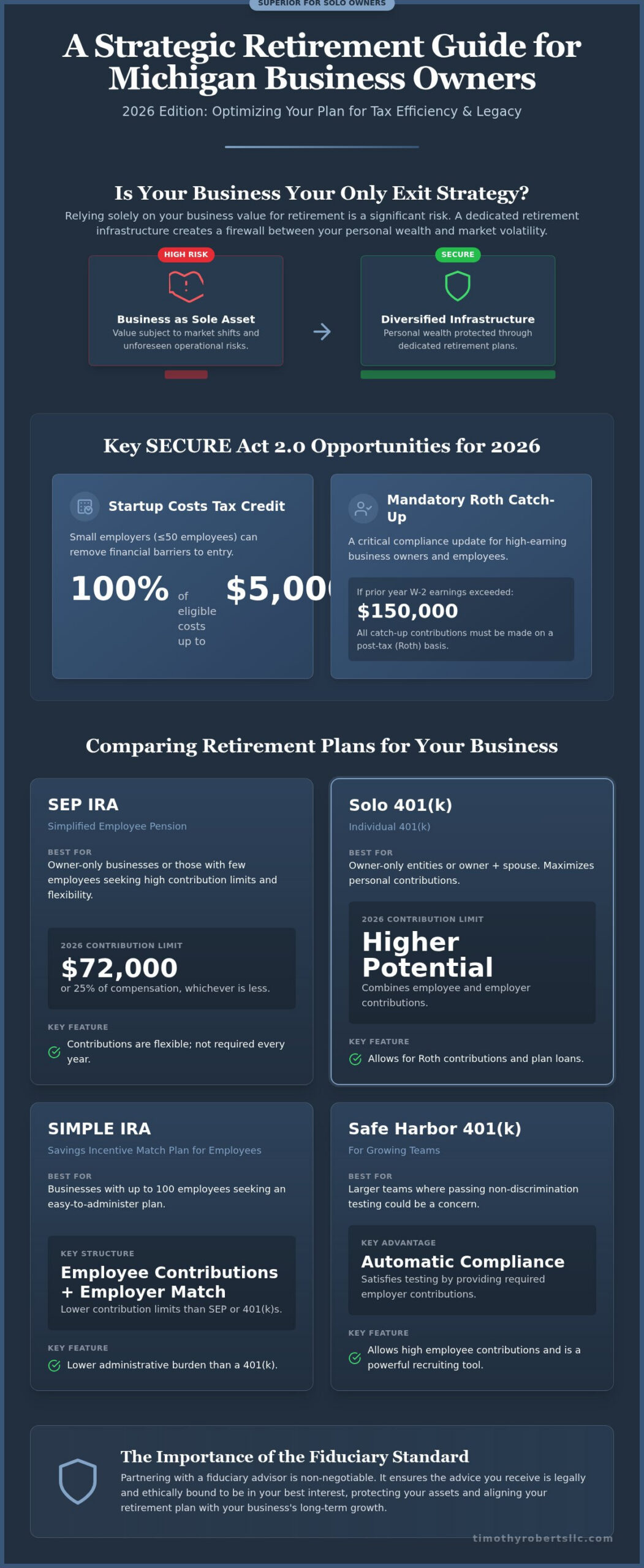
Federal regulations now provide significant incentives for those who act decisively. Small employers with 50 or fewer employees can claim a startup costs tax credit of 100% for eligible expenses, up to $5,000 for three years. This effectively removes the financial barrier to establishing a sophisticated retirement architecture. Additionally, understanding the 2026 implementation of mandatory Roth catch-up contributions for high earners is essential. If your previous year’s earnings exceeded $150,000, these contributions must be handled on an after-tax basis. Strategic timing in 2026 allows you to maximize these deductions while ensuring full compliance with evolving federal and state-level requirements.
Comparing Retirement Plan Options for Michigan Business Entities
Selecting from the available retirement plans for small business owners michigan is not merely an administrative task; it’s a strategic intervention in your firm’s financial trajectory. The ideal architecture depends on your headcount, your cash flow volatility, and your personal income goals. For many, the choice begins with a fundamental analysis of the Department of Labor’s guide to small business retirement solutions, which outlines the structural differences between employer-sponsored vehicles. Whether you are a solo practitioner in Grand Rapids or managing a growing consultancy in Ann Arbor, your plan must balance immediate tax relief with long-term wealth accumulation.
The SEP IRA remains a cornerstone for those seeking simplicity and high contribution ceilings. In 2026, the contribution limit is the lesser of 25% of compensation or $72,000. This plan offers unparalleled flexibility, as you aren’t required to contribute every year, making it ideal for businesses with fluctuating seasonal revenue. Conversely, the SIMPLE IRA serves as an accessible entry point for businesses with fewer than 100 employees, offering lower administrative hurdles while requiring a modest employer match. For those with larger teams, a Safe Harbor 401(k) provides a streamlined path to compliance by automatically satisfying non-discrimination testing, provided the employer makes specific required contributions.
The SEP IRA vs. Solo 401(k) Debate
For owner-only entities, the Solo 401(k) often emerges as the superior choice due to its dual-contribution nature. In 2026, you can defer up to $24,500 as an employee, plus an employer contribution of up to 25% of compensation. A unique advantage for 2026 is the enhanced catch-up provision for those aged 60 to 63, allowing an additional $11,250 for a total employee deferral of $35,750. However, high earners earning over $150,000 must navigate the new SECURE 2.0 mandate requiring catch-up contributions to be made on a Roth basis. While the SEP IRA offers simplicity, the Solo 401(k) provides the added utility of participant loans and Roth components that can be vital for retirement income planning.
Advanced Structures: Defined Benefit and PEPs
As your enterprise matures, you may require more aggressive tax-sheltering instruments. Defined Benefit plans allow for significantly higher contributions than defined contribution plans, often exceeding six figures for high-income earners near retirement. For those looking to offload the fiduciary burden entirely, Pooled Employer Plans (PEPs) allow multiple unrelated businesses to join a single plan administered by a professional provider. This synthesis of scale and professional oversight reduces individual liability while providing institutional-grade investment options. Combining these structures into a multi-layered strategy ensures your personal financial independence remains insulated from the operational demands of your business.
Navigating Tax Efficiency and Fiduciary Responsibilities
True financial leadership requires more than just selecting a plan; it demands a meticulous synthesis of tax advising and wealth management. For many entrepreneurs, the disconnect between year-end tax preparation and long-term retirement goals leads to missed opportunities. Integrating these two disciplines ensures that every dollar allocated to retirement plans for small business owners michigan serves a dual purpose: reducing current taxable income and fueling future independence. This proactive approach moves beyond simple compliance, treating your retirement infrastructure as a sophisticated tool for capital preservation.
While this guide focuses on the Michigan landscape, the principles of integrated wealth management are universal. For entrepreneurs interested in how these strategies drive business performance on a global scale, you can learn more about KHT Accounting & Wealth.
Navigating the technicalities of these vehicles requires a reliable source of truth. The IRS retirement plans for small businesses resource provides the necessary regulatory framework, yet the strategic execution remains the owner’s responsibility. Michigan business owners must be particularly mindful of how their contributions interact with state-level tax nuances. A fiduciary partner helps mitigate potential tax implications by structuring distributions and contributions in a way that aligns with both federal laws and local jurisdictional shifts. This ensures that your wealth isn’t just accumulated, but protected from unnecessary erosion.
Minimizing Business Tax Liabilities
Employer contributions represent one of the most powerful corporate tax deductions available to a small firm. By shifting business income into qualified accounts, you effectively lower your entity’s tax bracket while building a private reserve. The decision between tax-deferred vehicles and Roth options has become more complex in 2026. While traditional contributions provide immediate relief, the strategic use of Roth accounts allows for tax-free growth that can be invaluable during estate planning. Coordinating these accounts with beneficiary designations ensures your legacy remains intact and your family’s future is secured through intentional, high-level thinking.
Fiduciary Oversight and Risk Management
Adopting a fiduciary standard is not just a professional preference; it’s a critical layer of risk management. For businesses with UK operations or those seeking to extend this level of protection to their commercial insurance needs, click here. Unlike commission-led product sales that may prioritize high-margin offerings, asset-based management aligns the advisor’s success directly with your portfolio’s growth. This distinction is vital for ERISA compliance, as owners are legally responsible for the prudent selection and monitoring of plan investments. A personalized financial roadmap provides the documentation and intellectual rigor needed to protect your personal assets. By choosing a partner who values depth over superficiality, you ensure your retirement plan remains a robust, scalable intervention rather than an administrative burden.
Implementation: Building a Scalable Retirement Infrastructure
Implementing retirement plans for small business owners michigan requires a deliberate shift from immediate operational needs to long-term structural integrity. While some platforms promise a quick setup in minutes, a sophisticated leader knows that speed often sacrifices precision. A truly scalable infrastructure is built on a foundation of intellectual rigor and strategic foresight. This process ensures that your chosen plan doesn’t just exist but actively contributes to your firm’s upward progression. It’s a journey that moves from a high-level vision down to the practicalities of execution.
- Conduct a comprehensive cash flow and tax analysis to determine the optimal contribution levels without compromising your firm’s operational liquidity.
- Select a plan architecture for retirement plans for small business owners michigan that supports your 5-year growth plan, ensuring the structure can accommodate team expansions or revenue shifts.
- Establish a fiduciary investment policy statement (IPS) to codify the standards by which all portfolio decisions will be measured and defended.
- Execute plan documents and coordinate with tax professionals to ensure every deduction is captured and every compliance hurdle is cleared for the 2026 tax year.
- Commit to ongoing monitoring and asset-based portfolio rebalancing to maintain alignment with your evolving risk profile and market conditions.
The Role of Investment Portfolio Management
Michigan’s economic climate is unique, blending heavy industrial roots with a burgeoning technology sector. Your diversification strategy must reflect this reality, protecting your retirement assets from regional volatility while capturing growth in emerging markets. Managing market fluctuations requires a steady hand and a commitment to the fiduciary standard. Fiduciary portfolio management is the disciplined practice of prioritizing the client’s financial outcomes above all else through transparent, objective decision-making. This approach ensures your personal wealth remains insulated from the cyclical nature of the broader economy.
Employee Education and Engagement
A retirement plan is only as effective as the participation it inspires. Communicating the value of these benefits to your team transforms a corporate line item into a powerful retention tool. Simplifying the enrollment process ensures plan health and maximizes the tax advantages for the entire organization. By integrating this with expert tax advising ann arbor, you create a synergy where personal wealth and corporate success grow in tandem. It’s about bridging individual creative vision with structured corporate capabilities.
To begin building your firm’s legacy, schedule a personalized wealth management assessment with our fiduciary team today.
Partnering with a Fiduciary Advisor for Long-Term Wealth Management
Selecting the right retirement plans for small business owners michigan is a significant milestone, yet the plan itself is only one component of a much larger architectural vision. True financial independence requires a partner who views your business through the lens of organizational evolution. At Timothy Roberts & Associates, LLC, we don’t just provide off-the-shelf solutions; we craft strategic interventions that align your corporate capabilities with your personal aspirations. This partnership moves beyond simple administration, focusing instead on a narrative of shared success and meticulous wealth preservation.
Our approach synthesizes creative passion with business-minded rigor. We understand that your firm is an extension of your individual vision, and your retirement strategy should reflect that same level of craftsmanship. By treating development as a journey rather than a transaction, we ensure your wealth management strategy remains responsive to the shifting demands of your industry. It’s about building a human-led, results-driven identity that distinguishes your legacy from more anonymous entities.
The Value of 25+ Years of Michigan Expertise
Stability requires experience. With over 25 years of fiduciary expertise, our firm navigates the specific nuances of the Michigan economic landscape with seasoned precision. We specialize in the intersection of integrated tax preparation and wealth management, ensuring that your retirement income planning ann arbor is optimized for the 2026 tax environment. Navigating local tax changes shouldn’t be a solitary burden for the business owner. By leveraging our deep understanding of Michigan-specific pension tax strategies, you can focus on high-level growth while we manage the technicalities of your portfolio’s tax efficiency.
Securing Your Financial Legacy
Visionary leadership extends beyond the current fiscal year. Crafting a transition plan for the next generation of owners is a vital component of a holistic wealth management strategy. As your business lifecycle evolves, your retirement infrastructure must scale accordingly, protecting the assets you’ve spent decades accumulating. We help you bridge the gap between individual creative vision and structured corporate stability, ensuring your exit is as intentional as your entry. A specialized firm provides the personal attention and high-level expertise needed to navigate these complex transitions with calm confidence. To begin your journey toward a more secure professional and personal future, Consult with a Fiduciary Advisor today.
Secure Your Legacy with Strategic Precision
Evolving from a business operator into a visionary strategist requires a commitment to long-term wealth preservation that transcends daily operations. You’ve explored how the right retirement plans for small business owners michigan can serve as a sophisticated intervention for tax liability while simultaneously attracting high-tier talent. By synthesizing creative passion with business-minded rigor, you ensure that your financial infrastructure is not just compliant, but fundamentally transformative for your personal and professional future. This journey is about more than just savings; it’s about the upward progression of your entire enterprise.
At Timothy Roberts & Associates, LLC, we offer over 25 years of fiduciary excellence to guide your organizational evolution. Our integrated tax and wealth management solutions provide the intellectual depth needed to navigate 2026’s shifting regulations with calm confidence. We specialize in crafting personalized financial roadmaps that protect the interests of high-net-worth owners and their families through every business lifecycle. Your path toward financial independence is a continuous journey, and we’re here to provide the steady, expert hand required for such a significant undertaking.
Take the next step in your wealth elevation. Request a Strategic Retirement Plan Consultation today. We look forward to partnering in your continued success.
Frequently Asked Questions
What is the best retirement plan for a self-employed individual in Michigan?
The ideal plan depends on your income goals and whether you intend to hire employees, but the Solo 401(k) often provides the highest contribution ceiling for owner-only entities. In 2026, it allows for significant employee deferrals plus a 25% employer profit-sharing contribution. For those seeking simplicity without the administrative reporting of a 401(k), the SEP IRA remains a premier choice among retirement plans for small business owners michigan.
How much can a small business owner contribute to a SEP IRA in 2026?
For the 2026 tax year, you can contribute the lesser of 25% of your compensation or $72,000 to a SEP IRA. These contributions are made solely by the employer and are fully tax-deductible for the business. Because the plan can be established and funded as late as your tax filing deadline including extensions, it offers exceptional flexibility for managing annual cash flow volatility and year-end tax liabilities.
Are employer contributions to a 401(k) tax-deductible for the business?
Employer contributions to a 401(k) plan are generally deductible as a business expense, provided they don’t exceed specific IRS limits. This deduction reduces your business’s taxable income, effectively subsidizing the cost of the retirement benefit. For many Michigan owners, this serves as a critical tool for minimizing high tax burdens on corporate income while simultaneously building a private wealth reserve for personal independence.
What is the SECURE Act 2.0 and how does it affect my Michigan business?
The SECURE Act 2.0 is federal legislation that introduced significant changes to retirement plan rules, including new tax credits and mandatory provisions. Starting January 1, 2026, high earners making over $150,000 must make catch-up contributions on a Roth basis. Additionally, most new plans established after late 2022 are now required to include automatic enrollment, which may alter your administrative workflow and plan participation rates significantly.
Can I have both a SEP IRA and a personal Roth IRA?
You can contribute to both a SEP IRA and a personal Roth IRA, provided you meet the income eligibility requirements for the Roth account. While the SEP IRA is an employer-sponsored plan with much higher limits, the personal Roth IRA allows for tax-free growth on after-tax contributions. Balancing these two vehicles requires a coordinated tax strategy to ensure you aren’t exceeding total annual contribution limits across all retirement plans for small business owners michigan.
What is a fiduciary advisor and why does my business need one?
A fiduciary advisor is legally and ethically bound to act solely in your best interest, prioritizing your financial outcomes over their own compensation. For a business owner, this standard is essential for managing the legal risks associated with ERISA compliance and plan oversight. Unlike commission-based brokers, a fiduciary provides objective counsel on investment selection, ensuring your retirement infrastructure remains a robust tool for wealth elevation rather than a source of hidden fees.
How do I minimize taxes when withdrawing from my business retirement plan?
Minimizing taxes during the distribution phase requires a sophisticated synthesis of retirement income planning and tax advising. By strategically balancing withdrawals from tax-deferred accounts with tax-free Roth distributions, you can control your effective tax rate in retirement. We often recommend a multi-layered approach that considers Michigan’s specific pension tax rules to protect your assets from unnecessary erosion during the transition from accumulation to income generation.
What happens to my retirement plan if I sell my Michigan business?
When you sell your business, the fate of the retirement plan depends on the type of sale and the plan’s specific structure. In many cases, you can terminate the plan and roll the assets into an Individual Retirement Account (IRA) to maintain their tax-advantaged status. However, a strategic transition plan should be established well in advance to coordinate the sale with your estate planning goals and ensure your personal financial independence remains fully intact.
