

Jul
Tax Planning Southeast Michigan: Strategic Wealth Preservation for 2026
The difference between a standard tax return and a strategic wealth plan is often the difference between looking backward and moving forward. For many high-net-worth families, April is often viewed as a deadline to survive, yet the most successful treat it as a deliberate milestone in their financial evolution. You’ve likely felt the frustration of a substantial tax bill despite having professional filing in place; it’s a common sign that your investments and tax obligations aren’t working in harmony. This article explores sophisticated tax strategies for high-net-worth individuals, providing insights they can leverage to move beyond simple compliance toward a model of intentional wealth preservation.
We’ll provide clarity on your future liabilities by examining the 2026 federal tax bracket shifts and other potential legislative changes that could impact high earners. You’ll discover how a fiduciary-led approach creates a cohesive strategy that aligns your tax footprint with your long-term retirement goals. Our preview of the upcoming fiscal landscape will give you the confidence to stop reacting to tax laws and start using them as tools for your upward trajectory. We’ll show you how sophisticated planning transcends simple filing to protect your legacy and elevate your financial path.
Key Takeaways
- View tax planning as a proactive intervention rather than a seasonal obligation to ensure your wealth is preserved against shifting fiscal landscapes.
- Explore advanced tax strategies for high-net-worth individuals metro detroit families can employ, including strategic asset location and rhythmic tax-loss harvesting.
- Recognize the value of a fiduciary standard in creating an objective, integrated roadmap that balances tax efficiency with investment performance.
- Learn how to optimize your retirement trajectory through a calculated sequence of withdrawals and the intentional use of Roth conversion ladders.
- Transition from generic filing to bespoke wealth management that aligns your individual vision with rigorous financial execution.
Tax Planning Southeast Michigan: Moving Beyond Compliance to Strategic Mitigation
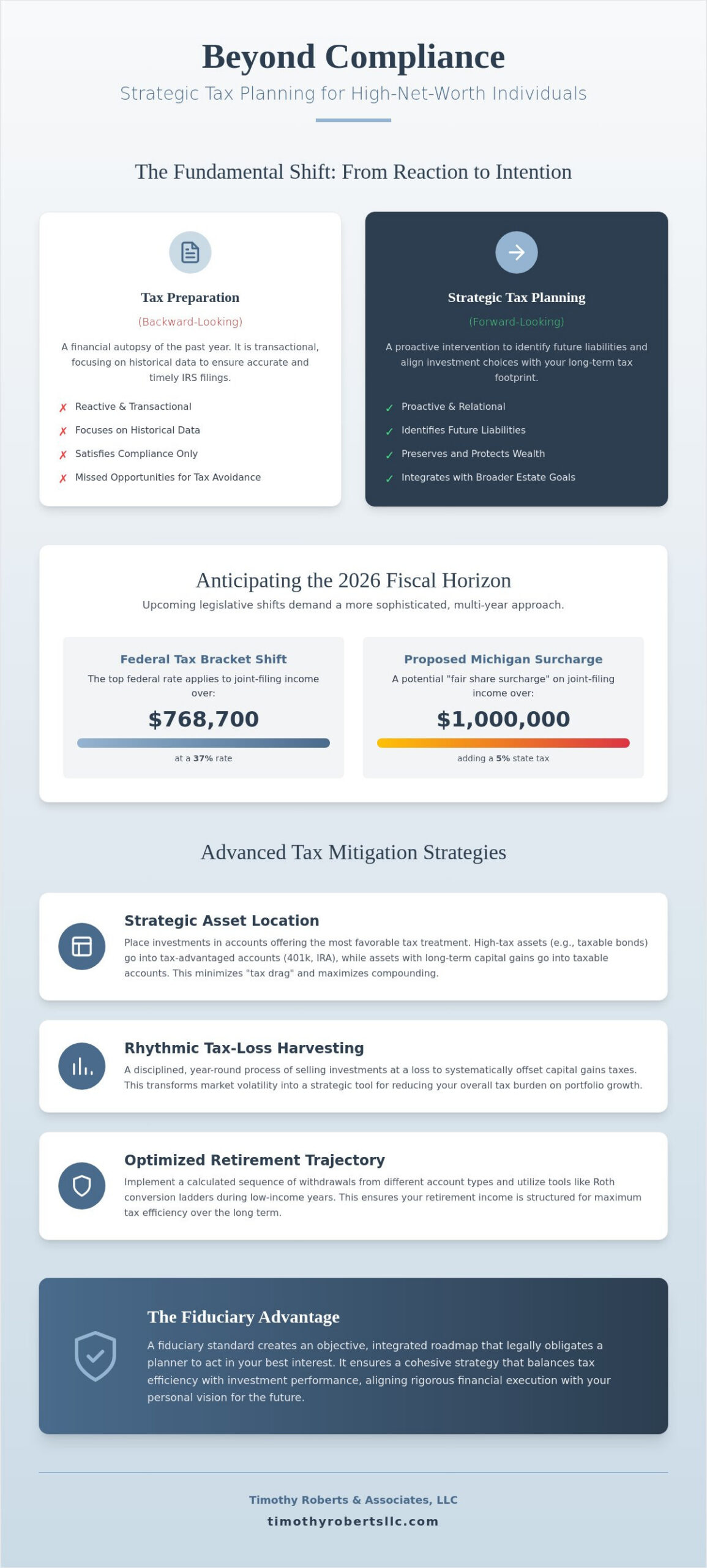
True wealth preservation requires a fundamental shift in perspective. For many high-net-worth families in Metro Detroit, tax management is often synonymous with the annual filing process. This backward-looking approach is mere compliance; it’s a financial autopsy of the previous year’s decisions. While traditional tax preparation satisfies the immediate requirements of the IRS, it rarely addresses the long-term efficiency of your investment portfolio. Strategic tax planning, conversely, functions as a forward-looking intervention. It’s a deliberate process designed to identify future liability triggers before they erode your capital. By treating tax obligations as a manageable variable rather than a fixed cost, you can design a financial trajectory that prioritizes upward progression and stability.
The Distinction Between Preparation and Planning
Tax preparation is transactional. It focuses on historical data to ensure that your filings are accurate and timely. While necessary, relying solely on this annual ritual limits your wealth potential because the opportunity for meaningful tax avoidance strategies has usually passed by the time you meet with a preparer. Planning is an ongoing journey of partnership. It involves crafting bespoke solutions that align your investment choices with your tax footprint. When you move beyond simple compliance, you begin to see how every financial move-from a business exit to a charitable donation-impacts your broader estate. This level of rigor ensures that your assets aren’t just growing, but are also being protected from unnecessary erosion.
Identifying Strategic Opportunities in 2026
The 2026 fiscal landscape necessitates a more sophisticated approach than in years past. We’re entering a period of significant legislative shifts and economic recalibration. For instance, federal tax brackets have adjusted, with the top 37% rate now applying to married couples filing jointly with income over $768,700. Locally, the proposed “fair share surcharge” in Michigan, which aims to add a 5% tax on income over $1 million for joint filers, could fundamentally change the math for the region’s top earners. These variables require more than a cursory glance; they demand multi-year projections and a deep understanding of how state and federal laws intersect. Implementing advanced tax strategies for high-net-worth individuals metro detroit residents rely on means anticipating these shifts rather than reacting to them. Tax planning is a continuous fiduciary oversight process that synthesizes personal vision with structured financial execution. It’s about the intersection of aesthetics and functionality in your financial roadmap, ensuring that your wealth serves your life’s goals without being hindered by predictable liabilities.
Advanced Tax Mitigation Strategies for Sophisticated Portfolios
Sophisticated wealth management requires a rhythmic coordination between portfolio construction and tax outcomes. It isn’t enough to select high-performing assets; you must also consider the specific tax environment in which those assets reside. For those seeking effective tax strategies for high-net-worth individuals metro detroit offers unique challenges and opportunities, particularly as we approach the 2026 fiscal shift. Strategic wealth preservation tax strategies often center on the concept of asset location, which involves a deliberate synthesis of your investment goals with your tax liabilities.
Asset Location and Tax Efficiency
Asset location is the practice of placing specific investments into accounts that offer the most favorable tax treatment for that asset type. High-tax assets, such as taxable bonds or high-turnover active funds, generally belong in tax-advantaged retirement accounts like a 401(k) or IRA. Conversely, assets that generate long-term capital gains or qualified dividends are often better suited for taxable brokerage accounts. This deliberate placement minimizes the annual “tax drag” on your portfolio, allowing more of your capital to remain invested and compounding over time. For investors in high-bracket scenarios, the strategic use of municipal bonds-which offer interest income typically exempt from federal and Michigan’s 4.25% flat tax-can be a powerful tool for enhancing after-tax yield. A fiduciary-led Wealth Management approach ensures these moving parts remain aligned with your broader financial trajectory.
Managing Capital Gains and Distributions
Managing the timing of asset sales is a critical component of portfolio rebalancing. By employing tax-loss harvesting, you can use investment losses to offset realized capital gains, potentially reducing your taxable income by up to $3,000 annually. This isn’t a one-time event but a rhythmic tool used throughout the year to maintain your desired risk profile while minimizing the 3.8% Net Investment Income Tax (NIIT) that often affects high earners. For those with concentrated stock positions, the strategy becomes even more nuanced. Integrating your investment oversight with specialized tax advising in Ann Arbor allows for a more cohesive plan that addresses both personal vision and corporate capabilities. Implementing these tax strategies for high-net-worth individuals metro detroit residents can rely on requires a deep understanding of how capital gains interact with your total income, ensuring that every distribution is a calculated step toward your long-term legacy.
The Fiduciary Advantage in Long-Term Wealth Preservation
Trust is the cornerstone of any sophisticated financial partnership. While many providers offer tax advice, the standard of care varies significantly across the industry. A fiduciary advisor is legally and ethically bound to act in your best interest, a commitment that fundamentally changes the nature of the strategies proposed. This objective framework is essential for high-net-worth families who require more than just technical accuracy. Leading advisory practices, such as samiospartners.com.au, exemplify this commitment to rigorous financial oversight and personalized strategy. When exploring tax strategies for high-net-worth individuals metro detroit residents often find that a fiduciary approach provides the necessary filter to separate generic products from truly bespoke interventions.
Similarly, the high standards of professional excellence found in firms like Bin Hamad Mathew Joseph and Associates Chartered Accountants illustrate how technical auditing and accounting expertise can provide the objective clarity needed for effective wealth preservation on a global scale.
Fiduciary Duty and Tax Strategy
The distinction between a fiduciary and a traditional broker often comes down to the motivation behind the recommendation. A broker may suggest a tax-advantaged product because it meets a suitability standard and generates a commission. A fiduciary, however, evaluates that same tool based on how it serves your long-term trajectory. This level of polished, intentional guidance ensures that your tax roadmap isn’t cluttered with unnecessary complexity. Instead, it focuses on high-impact moves, such as evaluating advanced tax-planning strategies that might include defined benefit plans or structured charitable giving. By aligning tax mitigation with your broader investment oversight, a fiduciary protects the integrity of your legacy while maintaining the upward progression of your capital.
Transparency in Planning Fees
Transparency is a prerequisite for trust. Many firms bury the true cost of their advice in product layers or transaction fees, which can create subtle conflicts of interest. A fixed-fee structure for Financial Planning removes these barriers, ensuring that the advice you receive is purely objective. This model allows for a more spacious and deliberate flow in the planning process, mirroring the experience of a professional consultancy rather than a sales floor. It’s particularly vital when coordinating tax strategies for high-net-worth individuals metro detroit earners must navigate, as the complexity of the 2026 shifts requires an advisor who is focused solely on the math of your success. Partnering with a specialized financial advisor in Bloomfield Hills who adheres to these standards ensures that your wealth strategy is both aesthetically logical and functionally superior. This commitment to clarity allows you to move forward with the calm confidence that your financial roadmap is built on a foundation of professional stability and shared success.
Integrating Retirement Distributions with Year-Round Tax Strategy
The distribution phase of wealth management is often more complex than the accumulation phase. For high-net-worth families, the transition from growing assets to generating a sustainable income stream requires a meticulous, rhythmic approach to tax efficiency. It’s no longer just about portfolio returns; it’s about the net amount that reaches your bank account after federal and state obligations are met. Implementing sophisticated tax strategies for high-net-worth individuals metro detroit residents rely on involves a deliberate sequence of withdrawals designed to preserve the longevity of your capital. By coordinating the timing of distributions from taxable, tax-deferred, and tax-free accounts, you can maintain a lower effective tax rate while allowing your most tax-efficient assets to continue their upward progression.
Optimizing Retirement Account Withdrawals
A strategic withdrawal sequence typically prioritizes taxable brokerage accounts first, followed by tax-deferred accounts like traditional IRAs or 401(k)s, and finally tax-free Roth accounts. This order allows your tax-advantaged assets more time to compound. For high-income earners and business owners, utilizing a SEP IRA can be a powerful tool, as 2026 contribution limits remain a significant factor in reducing current-year taxable income. Additionally, those over age 70.5 can leverage Qualified Charitable Distributions (QCDs). By directing up to $100,000 of your Required Minimum Distribution (RMD) directly to a charity, you satisfy your RMD requirement without increasing your Adjusted Gross Income (AGI). This level of precision is a hallmark of retirement income planning in Ann Arbor where individual creative vision meets structured corporate capabilities.
Roth Conversions and Future Rate Hedge
The 2026 economic landscape presents a unique window for Roth conversion ladders. With the potential sunsetting of current tax provisions, the “Tax Now vs. Tax Later” debate has never been more relevant. Executing conversions during market dips allows you to move assets into a tax-free environment at a lower valuation, maximizing the long-term growth potential of the converted amount. Roth conversions act as a hedge against future legislative changes by locking in current rates before potential tax increases take effect. This proactive intervention ensures that your future self isn’t burdened by a higher tax bracket during your peak retirement years. To ensure your distribution strategy is optimized for the years ahead, you should engage in a comprehensive review of your Retirement Income Planning with a fiduciary partner who understands the intersection of aesthetics and functionality in a financial roadmap.
Managing RMDs before they become liabilities is essential for maintaining the integrity of your estate. Without a forward-looking plan, forced distributions can push you into a higher tax bracket and trigger increased Medicare premiums. By integrating these tax strategies for high-net-worth individuals metro detroit families can transform potential tax bombs into opportunities for legacy building and wealth transfer. This isn’t a one-time transaction but a continuous journey of personal and professional evolution.
Partnering for Progress: The Timothy Roberts & Associates, LLC Approach
Achieving financial excellence is a journey of intentional evolution. At Timothy Roberts & Associates, LLC, we don’t offer off-the-shelf solutions because your wealth isn’t an off-the-shelf story. We treat development as a continuous journey rather than a simple transaction. Our approach to tax strategies for high-net-worth individuals metro detroit residents rely on is characterized by a blend of creative passion and business-minded rigor. We act as a high-end partner for your personal and organizational evolution, ensuring every decision supports your long-term trajectory. This partnership is built on over 25 years of experience, providing a foundation of professional stability that larger, more anonymous entities often struggle to replicate.
Customized Strategic Interventions
We begin by understanding the unique synthesis of your personal vision and corporate capabilities. Our process avoids a frantic or cluttered feel; instead, we opt for a spacious and deliberate flow that allows us to solve complex problems with expert craftsmanship. We analyze your specific risk tolerance and long-term goals to create a roadmap that is both aesthetically logical and functionally superior. By integrating investment portfolio management in Detroit directly into your tax plan, we ensure that your assets are positioned for upward progression. This meticulous oversight allows us to identify strategic interventions that protect your capital from unnecessary erosion while elevating your financial path.
Securing Your Financial Legacy
True wealth preservation requires a steady, logical rhythm that moves from a high-level vision down to the practicalities of execution. We coordinate your estate management with current and future tax liabilities to ensure the integrity of your legacy remains intact. This comprehensive roadmap provides the calm confidence you need to navigate the shifting fiscal landscape of 2026. Whether we’re analyzing state-level flat taxes or preparing for potential legislative surcharges, our focus remains on your success. We bridge the gap between individual creative vision and structured financial capabilities, offering the personal attention that high-net-worth families deserve. This human-led, results-driven identity is what distinguishes our firm as a visionary strategist in the region.
Your wealth deserves a partner that values depth over superficiality. By choosing a fiduciary-led approach, you gain a reliable business advisor dedicated to the intersection of aesthetics and functionality in your financial life. We invite you to take the next step in your financial journey. A strategic consultation with our team allows us to explore how bespoke tax strategies for high-net-worth individuals metro detroit earners can transform your long-term trajectory. Let’s move away from aggressive sales tactics and toward a narrative of partnership and shared success. We’re ready to help you craft a legacy that reflects your ambitions and secures your family’s future for generations to come.
Securing Your Legacy Through Intentional Fiscal Design
Strategic wealth preservation requires a shift from reactive filing to a model of continuous, proactive design. By integrating investment oversight with sophisticated tax planning, you can transform your fiscal obligations into opportunities for upward progression. We’ve explored how a fiduciary-led approach provides the clarity needed to navigate the 2026 legislative landscape, ensuring that your retirement distributions and portfolio rebalancing work in perfect harmony. Implementing the right tax strategies for high-net-worth individuals metro detroit residents rely on is about more than just numbers; it’s about the expert craftsmanship of a legacy that reflects your personal values.
With over 25 years of expertise, Timothy Roberts & Associates, LLC provides the integrated wealth and tax management necessary for complex financial lives. Our bespoke financial roadmaps move beyond off-the-shelf solutions to offer a narrative of partnership and shared success. Elevate your wealth strategy with a strategic tax planning consultation. Taking control of your financial trajectory today ensures that your assets remain protected and your long-term goals stay within reach. Your journey toward a more stable and prosperous future begins with a single, deliberate step.
Frequently Asked Questions
What is the difference between tax planning and tax preparation?
Tax preparation is a backward-looking compliance requirement focused on accurately reporting historical data to the IRS. It ensures you meet legal obligations for the previous year but offers little in the way of future savings. Tax planning is a proactive, forward-looking strategy that identifies opportunities to minimize future liabilities before they occur. It functions as a deliberate roadmap for wealth preservation rather than a financial autopsy.
How often should I review my tax planning strategy?
You should review your strategy at least once a year, though more frequent interventions are necessary during periods of significant legislative change or personal evolution. The shifts occurring in 2026, including the potential sunsetting of current federal tax provisions, make immediate review critical for high-earning families. A rhythmic oversight process ensures your portfolio remains aligned with both your retirement goals and the current fiscal landscape.
Can tax planning help with my retirement income?
Tax planning is essential for maximizing your net spendable income during retirement. By coordinating the sequence of withdrawals from taxable, tax-deferred, and tax-free accounts, you can manage your effective tax rate and preserve the longevity of your capital. This strategic approach ensures that your retirement income planning serves your lifestyle needs without being eroded by unnecessary tax drag.
What are the benefits of a fiduciary tax advisor?
A fiduciary advisor is legally and ethically bound to act in your best interest, providing a level of objective guidance that traditional brokers may not offer. This standard of care ensures that every recommendation is based on your long-term success rather than product commissions. In the context of tax strategies for high-net-worth individuals metro detroit residents value, a fiduciary provides the professional stability and transparency needed for complex wealth management.
How do investment management fees impact my taxes?
The deductibility of investment fees has changed under federal law, but the way these fees are structured still impacts your net performance. Fiduciary advisors often use asset-based fee structures that provide transparency and align their success with your portfolio’s growth. Proper fee management is a component of a broader strategy that prioritizes the intersection of aesthetics and functionality in your financial roadmap.
Are there specific tax strategies for high-net-worth individuals in 2026?
The 2026 fiscal year introduces unique challenges, including adjusted federal brackets and Michigan’s proposed 5% surcharge on income over $1 million for joint filers. Effective tax strategies for high-net-worth individuals metro detroit families use now include Roth conversion ladders to hedge against future rate hikes and managing the 3.8% Net Investment Income Tax. These interventions require a deep understanding of how state and federal laws intersect.
What is tax-loss harvesting and how does it work?
Tax-loss harvesting involves selling investment positions at a loss to offset realized capital gains within your portfolio. This rhythmic tool allows you to rebalance your risk profile while reducing your current year tax obligation. If your losses exceed your gains, you can use up to $3,000 to offset ordinary income, carrying the remainder forward to future years to protect your upward progression.
How does estate planning interact with my current tax strategy?
Estate planning and tax strategy are deeply interconnected, as the timing of asset transfers can significantly impact your lifetime tax footprint and your heirs’ future liabilities. For 2026, the lifetime estate tax exemption is $15 million per individual, making it a critical window for strategic gifting. Coordinating these efforts ensures a step-up in basis where appropriate and protects the integrity of your legacy through integrated wealth management.
